Building software for defense is unlike any other engineering challenge. The stakes are higher, the regulations are stricter, and the environments where your code runs may be disconnected, contested, or hostile. This guide walks developers and architects through the core pillars of defense software: C4ISR systems, Edge AI at the tactical edge, and the regulatory compliance frameworks that govern every design decision from day one.Whether you are working with a prime contractor, a government integrator, or directly supporting U.S. or Canadian armed forces, this article gives you a practical foundation to build systems that are secure, compliant, and operationally effective.
Key Takeaways
- C4ISR integrates command, control, communications, computers, intelligence, surveillance, and reconnaissance into one software driven nervous system that underpins command and control and enhanced situational awareness across land, air, sea, cyber, and space domains.
- Edge AI at the tactical edge reduces latency, enables operations in denied or disconnected environments, and powers real time decision support for modern military operations. Local inference ensures edge AI can function without continuous cloud connection.
- ITAR compliance, along with related regulatory compliance requirements like EAR, NIST SP 800-171, and CMMC 2.0, drives architecture choices including data residency, identity controls, logging, and cloud options like Azure Government. Violating ITAR can result in hefty fines and imprisonment.
- C4ISR systems require modular open architecture frameworks to interoperate, and investment in C4ISR has grown steadily across major militaries because these systems are critical for achieving operational cohesion in complex environments.
- SoftDoes helps U.S. and Canadian defense teams design, build, and maintain secure, mission critical defense systems that stay compliant while using advanced AI tools.
1. C4ISR and Edge AI Fundamentals for Modern Military Operations
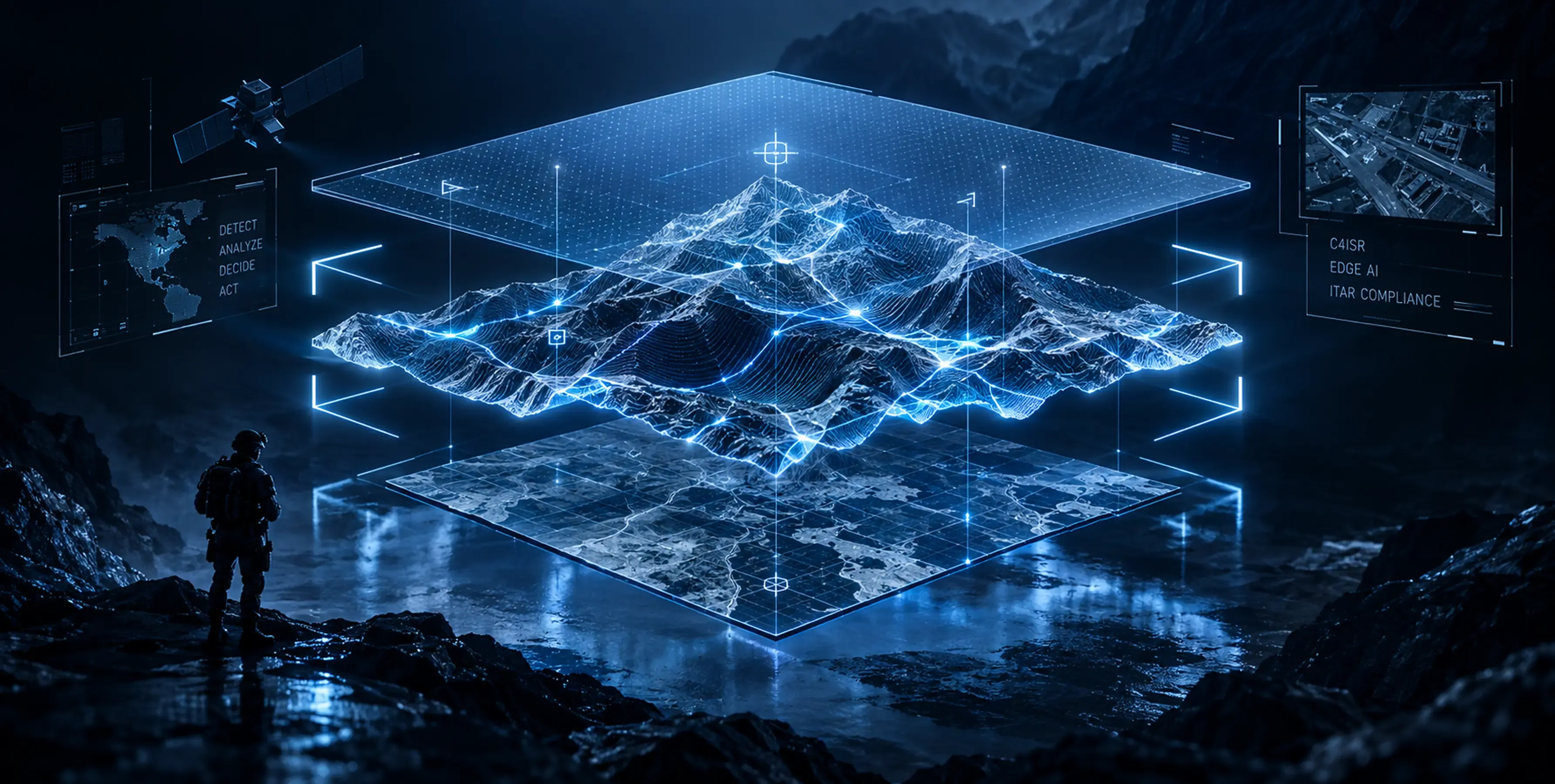
C4ISR stands for Command, Control, Communications, Computers, Intelligence, Surveillance, and Reconnaissance. In practical terms, it is the software and systems backbone that lets armed forces detect threats earlier and respond faster across every operational domain.
Since 2020, the landscape has shifted dramatically. Multi domain operations spanning land, sea, air, space, and cyber have created demand for systems that process vast amounts of data in real time. Adversaries can disrupt communications, jam sensors, and launch cyberattacks against command centers. C4ISR systems enhance decision making and operational effectiveness in military operations by fusing raw data from multiple sources into a shared understanding that commanders can act on immediately.
Modern militaries now treat C4ISR as the nervous system of defense. It connects sensors to shooters, analysts to commanders, and local units to higher headquarters. C4ISR allows militaries to detect threats earlier and respond faster, which is why investment in C4ISR has grown steadily across major militaries in both the United States and Canada.
Edge AI brings artificial intelligence processing close to where data is generated: on vehicles, aircraft, ships, and forward positions. Instead of sending all sensor data back to distant data centers, Edge AI runs inference locally. This reduces latency, eliminates dependence on fragile long haul links, and enables rapid response even when connectivity is lost.
Consider a few scenarios that illustrate the need:
- Border monitoring: Canadian and U.S. forces use ground sensors, cameras, and unmanned systems along remote borders. Edge AI can classify movement patterns and flag anomalies without waiting for a satellite link.
- Naval task group operations: Ships operating in contested waters need real time track correlation from radar, sonar, and electronic warfare sensors. Connectivity to shore data centers cannot be assumed.
- Disaster response: When civil authorities request military support after a hurricane or wildfire, communications infrastructure may be destroyed. Edge enabled C4ISR lets responders coordinate forces and maintain situational awareness without relying on damaged networks.
At SoftDoes, we approach C4ISR software projects through domain discovery, threat modeling, compliance assessment, and iterative delivery. We work with teams to understand the mission, classify data and governance requirements, map regulatory constraints, and build secure, mission critical defense software platforms incrementally so that feedback from operators shapes every release.
1.1 Breaking Down C4ISR Components for Developers
Each element of C4ISR maps to concrete software building blocks:
- Command: Systems supporting commanders' intent, course of action (COA) comparison, and mission planning, including decision support dashboards and AI-enhanced logistics.
- Control: Workflows and asset management tools that keep units aligned with command intent, featuring approval chains and audit trails.
- Communications and Computers: Secure messaging layers, tactical data links, and computing infrastructure from cloud to rugged edge devices.
- Intelligence, Surveillance, Reconnaissance (ISR): Sensor pipelines, integration APIs, data fusion, and geospatial visualization turning raw sensor data into actionable intelligence.
C4ISR is a composable suite of interoperable microservices, APIs, and user experiences. Modular architectures enable seamless integration of new components into legacy systems, essential for long-term defense programs.
AI is integrated into C4ISR to enhance decision making by embedding machine learning models into fusion pipelines and decision support tools.
1.2 Edge AI in the Tactical Environment
The tactical edge is a challenging environment for software due to low bandwidth, intermittent connectivity, strict size, weight, and power (SWaP) limits, contested spectrum, and constant cyber threats. AI models must be optimized for these constraints.
Common defense Edge AI use cases include:
- Automated target recognition from video feeds without cloud reliance.
- Route optimization for convoys considering terrain and threats.
- Anomaly detection in RF spectra for jamming or electronic warfare.
- Predictive maintenance to flag vehicle and weapon system issues early.
Model lifecycles begin with centralized training on secure clusters or cloud environments, followed by compression techniques like quantization and pruning for deployment on constrained hardware. Frameworks such as ONNX Runtime and TensorRT support fast, efficient inference on ARM and x86 architectures. Platforms like EdgeCortix's SAKURA-II have demonstrated low-power, radiation-hardened inference for Air Force missions.
Disconnected operation design patterns include local data caching, store-and-forward for reports, graceful degradation without cloud, and local decision logic with human oversight.
At SoftDoes, we design Edge AI components with deterministic performance, simulate degraded conditions, and build observability for after-action reviews.
2. Architecting Secure C4ISR and Edge AI Systems in Regulated Defense Environments
Security and reliability are as important as AI capability in defense. System failures risk lives and missions. Building defense software requires balancing reliability with innovation, prioritizing compliance and security from the start.
For U.S. and Canadian defense, architectures must follow cybersecurity frameworks like NIST 800-171, CMMC 2.0, and export controls such as ITAR and EAR. Software development must meet NIST SP 800-171’s 110 security requirements.
This section covers practical architectures, design choices, and trade-offs for AI in defense. A defense "data fabric" spans cloud (e.g., Azure Government), regional data centers, and tactical edge nodes linked securely. Early threat modeling is crucial to assess adversarial AI risks, data poisoning, model theft, and denial of service threats before coding.
2.1 Reference Architecture: Cloud, Data Center, and Tactical Edge
Think of the architecture as three tiers connected by secure, redundant links:
|
Cloud / Core | Long term storage, big data analytics, model training, CI/CD pipelines, mission rehearsal | Azure Government, AWS GovCloud, on prem secure cloud |
Operational Layer | Regional command centers, replicated databases, COP servers, integration hubs | Brigade/division HQ, joint operations centers |
Tactical Edge | Ruggedized compute on vehicles, ships, aircraft, FOBs running containerized services and AI inference | Embedded GPU modules, rugged servers, handheld devices |
Event-driven architectures improve resilience in distributed C4ISR systems by decoupling producers (sensors) and consumers (applications) across unreliable networks. Message queues and publish/subscribe patterns let components operate independently, buffering data during connectivity gaps and syncing when links restore.
Cloud-enhanced systems must not rely solely on cloud connectivity. Each tier must operate autonomously for extended periods.
Identity and access management at the edge requires:
- Cached authorization tokens with expiration
- Attribute-based access control offline
- Time-limited offline roles needing reauthentication
SoftDoes helps implement these patterns using defense-ready cloud environments like Azure Government or on-prem equivalents, often paired with data engineering and Databricks consulting to unify analytics and AI workloads.
2.2 Data Management and Enhanced Situational Awareness
Data management is the foundation of reliable situational awareness. Without disciplined data models, schemas, lineage tracking, and governance, a Common Operating Picture (COP) becomes unreliable.
Building a COP involves merging:
- Geospatial layers (terrain, weather, boundaries)
- Tracks from air, maritime, and ground sensors
- Sensor hits and alerts
- Chat, voice, and command messages
Data fusion techniques include track correlation, data quality scoring, confidence levels, and provenance indicators visible in the UI. Operators need to see not just what the system detects but how confident it is and where the data originated.
Critical data management requirements include:
- Time synchronization across nodes for event ordering
- Versioning to compare COP snapshots over time
- Replay capability for analysis, testing, and AI training
- Data labeling that distinguishes Controlled Unclassified Information (CUI) from classified material with clear tagging and segregation
SoftDoes designs data architectures supporting real-time mission execution and offline analytics without duplicating fragile integration logic, treating data as a first-class concern.
2.3 Security by Design for Defense Systems
Zero Trust Architecture ensures secure data handling across various environments. In defense C4ISR and Edge AI applications, the "assume breach" mindset means verifying every request, user, and device regardless of network location.
Core security practices include:
- End-to-end encryption for data in transit and at rest
- Hardware root of trust on edge devices with secure boot
- Code signing for all deployed binaries and models
- Strict role-based and attribute-based access controls
- Intrusion detection systems monitoring networks and applications
Network segmentation between mission, training, and admin systems limits lateral movement if breached.
Secure DevSecOps pipelines require:
- Source control with mandatory code review
- Static and dynamic analysis on every commit
- Container image scanning before deployment
- Software Bill of Materials (SBOM) generation
- Continuous compliance checks against NIST baselines
SoftDoes integrates security, data, and ML engineers into mission teams so security evolves with C4ISR features, not as an afterthought.
3. ITAR Compliance and Regulatory Guardrails for Defense AI and C4ISR Software
ITAR compliance is a key constraint when building software for U.S. defense articles, technical data, or services. The International Traffic in Arms Regulations govern access to defense data and control the export of defense articles and services. ITAR compliance is vital for AI processing defense data because AI workflows can expose controlled information through training pipelines, model weights, and cloud APIs.
This section serves as a practical guide on what to design, what to avoid, and how to use compliant cloud services without export risks. Although focused on U.S. regulations, Canadian contractors working with U.S. defense often follow the same rules under bilateral agreements.
Developers and architects must understand ITAR, not just legal teams. Early architecture decisions can create costly compliance violations later.
3.1 ITAR, EAR, and Related Standards in Practice
ITAR covers defense articles and technical data listed on the U.S. Munitions List (USML). In software and AI, this includes source code, schematics, sensor data tied to defense systems, and AI model weights trained on defense data. ITAR compliance requires keeping controlled data within U.S. jurisdictions.
EAR (Export Administration Regulations) governs dual-use items with commercial and military applications. Together, ITAR and EAR cover most defense-related software.
"Deemed export" means foreign person access to ITAR-controlled data counts as an export, even within the U.S. or Canada. Compliance requires preventing unauthorized exports to foreign nationals. Cloud AI poses risks if data routes outside U.S. locations or if non-U.S. persons administer the infrastructure. Violations can lead to heavy fines and imprisonment, making compliance essential for all team members.
Related frameworks layer additional requirements:
|
NIST 800-171 | Protects CUI in non federal systems | 110 requirements across 14 families; mandatory under DFARS 252.204-7012 |
CMMC 2.0 | Certification for defense contractors | Level 2 maps to NIST 800-171; Level 3 adds 800-172 controls |
DoD Impact Levels (IL4/IL5) | Cloud service authorization | Determines which cloud regions and services are acceptable for ITAR data |
Commercial cloud offerings used for defense workloads, including Azure Government, must be configured to enforce U.S. person access and U.S. only data residency for ITAR workloads. Recent ITAR rulemaking (RIN 1400-AF39) has clarified definitions around "person," Canadian exemptions, and intra company transfer rules, directly impacting cross border teams.
Engineering teams should work with export control officers from project kickoff, not just at deployment, to classify data and define guardrails. A strong data strategy and governance framework is essential for tracking what constitutes ITAR data across your codebase.
3.2 Designing ITAR-Safe AI and Development Workflows
Generative AI tools, code assistants, and cloud APIs can unintentionally leak technical data if not properly controlled. For example, a developer pasting a sensor processing algorithm into a public AI assistant may cause a deemed export to that service's jurisdiction.
ITAR-safe AI development patterns include:
- On-premise or air-gapped AI inference: Local AI processing keeps data and models within controlled boundaries, eliminating export concerns.
- Private AI gateways: These inspect prompts and responses for sensitive content, log interactions, and enforce content filtering to prevent unauthorized exports.
- U.S. only, U.S. person staffed SaaS: Commercial tools used under strict export control review.
The "AI control plane" middleware:
- Inspects all AI interactions for controlled content
- Logs every interaction with immutable audits
- Enforces token limits and content filters
- Routes requests to approved models
Engineering best practices:
- Segregated repositories for ITAR-controlled code and data
- Separate build agents isolated from uncontrolled networks
- Strict access reviews for systems handling controlled data
- Automated risk management adapted from regulated industries
Never paste controlled schematics, source code, or mission data into public AI tools or unvetted cloud services. This includes ChatGPT, GitHub Copilot on public plans, or any SaaS without verified data residency and access controls.
SoftDoes provides dedicated AI environments and secure workflows enabling AI-assisted coding while ensuring ITAR and regulatory compliance.
3.3 Testing, Certification, and Continuous Compliance
Defense buyers expect not just initial compliance but continuous evidence that systems stay within regulatory boundaries over years of operation. Continuous monitoring and documentation are critical for defense software compliance.
Key testing activities include:
- Security assessments and penetration tests on software and ML components
- FIPS validated cryptography checks
- Validation of access controls for U.S. person requirements
- Scenario-based testing of Edge AI under degraded conditions
Logging and audit requirements are extensive, needing immutable logs for:
- Mission actions and operator decisions
- Administrative access and configuration changes
- AI recommendations, confidence scores, and model versions
- Events impacting regulatory compliance
AI models require traceability and clear documentation of training and evaluation results, including model provenance, training data lineage, performance benchmarks, and adversarial robustness tests.
Common documentation deliverables in U.S. defense contracts include:
|
System Security Plan (SSP) | Describes how security controls are implemented |
Plans of Action and Milestones (POA&M) | Tracks remediation of security gaps |
Interface Control Documents | Defines data exchanges between systems |
Data Handling Procedures | Specifies classification, labeling, and access rules |
Technical documentation | Covers architecture, APIs, and operational procedures |
SoftDoes supports long term compliance through ongoing maintenance contracts, periodic posture reviews, and updates to match evolving NIST and DoD requirements, helping organizations stay competitive in the rapidly expanding defense tech software market. We treat compliance as a living practice, not a one time checkbox.
Benefits of Working with SoftDoes on Defense C4ISR and Edge AI
Choosing a software engineering partner for defense work requires confidence in their ability to deliver under strict constraints. SoftDoes offers:
- Mission critical reliability: Building systems with high uptime and performance for military operations where continuous availability is essential.
- End to end capability: Delivering custom software, AI/ML pipelines, and cloud architectures integrated with defense environments like Azure Government and secure data centers.
- Regulatory fluency: Expertise in ITAR, EAR, NIST 800-171, and other security frameworks, ensuring compliance across defense projects.
- Multidisciplinary teams: Cloud engineers, AI/ML specialists, data engineers, UI/UX designers, and security experts working together across the full project lifecycle.
- U.S. and Canadian focus: Supporting defense primes, suppliers, and integrators with knowledge of bilateral regulations and interoperability.
If you have a C4ISR, Edge AI, or modernization project, contact us to discuss how SoftDoes can help design and maintain secure, compliant defense systems. Reach out to start the conversation.














Comments (0)
No comments yet.