







Key Takeaways
- Custom healthcare software ensures compliance with regulations like HIPAA while improving operational efficiency across healthcare organizations.
- Security should be built into the software platform design rather than added later in development phases. This means end to end encryption, immutable audit logs, and signed business associate agreements with every vendor handling protected health information.
- Integration capabilities with major electronic health records systems, pharmacy management software, and HR platforms are crucial for compliance software efficiency.
- Building top healthcare compliance software is a multi phase program spanning discovery, architecture, iterative build, validation, and ongoing support.
- SoftDoes serves as a long term engineering partner, combining custom healthcare software development, AI, cloud, and data engineering to deliver fully compliant compliance solutions for health systems and scale ups.
Introduction: Why Build Custom Healthcare Compliance Software Now
To build custom healthcare compliance software in 2026, start by defining the compliance scope, embedding HIPAA, HITECH, and applicable state requirements into day-to-day workflows, designing a security-first architecture with encryption and access controls, integrating with EHR and pharmacy systems, translating regulations into product features, and running a compliance-aware development and operations model that can scale. The healthcare industry is under pressure: HHS OCR has now resolved over 31,000 HIPAA enforcement cases with roughly $145 million in penalties across 152 settlements, and by mid 2026, 338 large breaches have been reported. For healthcare providers managing multi facility compliance programs, unique policies, and complex vendor relationships, off the shelf GRC tools often fall short.
Custom healthcare compliance software works because it reflects real workflows instead of forcing generic ones, improving operational efficiency while protecting patient data and patient safety. This guide is for U.S. health systems, specialty groups, digital health startups, payers, and pharmacy chains that need to build or improve compliance platforms. SoftDoes writes from the perspective of a healthcare software development company focused on PHI, AI, and cloud compliance for healthcare providers and business associates, and the article walks through scope definition, secure architecture, regulation-to-feature mapping, compliance-aware SDLC practices, and the operational realities of running and scaling these systems with cloud and AI in 2026.
Define the Compliance Scope Before You Write a Line of Code
Successful builds start with a compliance scope workshop. Compliance officers, legal counsel, security leads, and your development team should align on what the platform must cover. Risk assessment tools identify potential compliance issues early. Data flows need to be mapped to identify where electronic protected health information is created, stored, or transmitted. Compliance software helps minimize risk and mitigate potential compliance failures when this mapping is thorough.
Core decisions to make:
- Regulations to map: HIPAA Privacy and Security Rules, HITECH, the proposed Security Rule NPRM (requiring MFA, encryption, penetration testing), CMS Conditions of Participation, Joint Commission standards, and state privacy laws like CCPA. Healthcare compliance software should follow recognized frameworks like OIG-HHS.
- PHI flow identification: Intake forms, risk assessments, policy attestation, hotline reports, audit evidence, and retention periods (six years minimum for HIPAA documentation).
- User roles: Classify compliance officers, privacy staff, department managers, front line healthcare professionals, external auditors, and business associates for Role Based Access Control design.
- BAA strategy: Decide which components are hosted on your cloud versus third party services. Every vendor handling PHI must sign a business associate agreement.
- Consider essential functionality when purchasing or building compliance software so nothing critical is missed.
SoftDoes typically delivers a written "Compliance and Data Flow Blueprint" in this phase, which becomes the reference document for architecture and regulator reviews, informing the enterprise and software architecture that underpins the platform.

Let’s Turn Your Idea into Scalable Software
Book a call with the representative to get answers to all the questions you may have.
Design a Compliance First Architecture (Security, Data, and Integrations)
Building custom healthcare compliance software in 2026 requires prioritizing security by design. Architecture decisions must assume zero trust principles. Healthcare organizations use custom software to integrate with existing systems, and your architecture must support that from day one.
- Encryption: Data encryption should implement AES-256 for data at rest and TLS 1.3 for data in transit. Use field level encryption for sensitive PHI like substance use or behavioral health records, with centralized key management through AWS KMS or Azure Key Vault.
- Audit logging: Audit logging should be immutable and tamper proof to track access to protected health information. Log every PHI touch (user, timestamp, action, record ID) and store in append only storage for at least six years.
- Access control: Role Based Access Control and Multi Factor Authentication ensure the least privilege principle in healthcare software. Map roles to compliance responsibilities down to facility, department, and data category.
- Integrations: Modern healthcare software must integrate rapidly evolving interoperability standards such as HL7 FHIR. Connect with Epic and Cerner via fast healthcare interoperability resources R4 APIs, ADT feeds over HL7 v2, pharmacy management software, and HR systems, all supported by robust enterprise data management and platform services. Interoperability reduces manual data entry while supporting regulatory data exchange requirements.
- Recommended stack: React or Vue for web portals, React Native for field audits, a secure backend in Laravel or Python (Django/FastAPI), PostgreSQL with row level security, and a HIPAA eligible cloud region.

Translate Regulations into Concrete Product Features
The goal is to move from abstract regulatory compliance to specific, testable key features. Healthcare compliance software automates risk assessments and incident tracking when features are mapped directly to regulatory requirements.
- Policy and document management: Version control, attestation tracking, and automated alerts ensure compliance deadlines are not overlooked. Managing compliance related documents in a centralized repository streamlines audit preparation for healthcare organizations and ensures easy access to compliance materials.
- Incident management and breach response: Workflows mapped to HIPAA timelines (breach notification within 60 days). Breach response protocols require timely notification of authorities and individuals under HIPAA. Real time visibility into compliance activities reduces potential compliance failures.
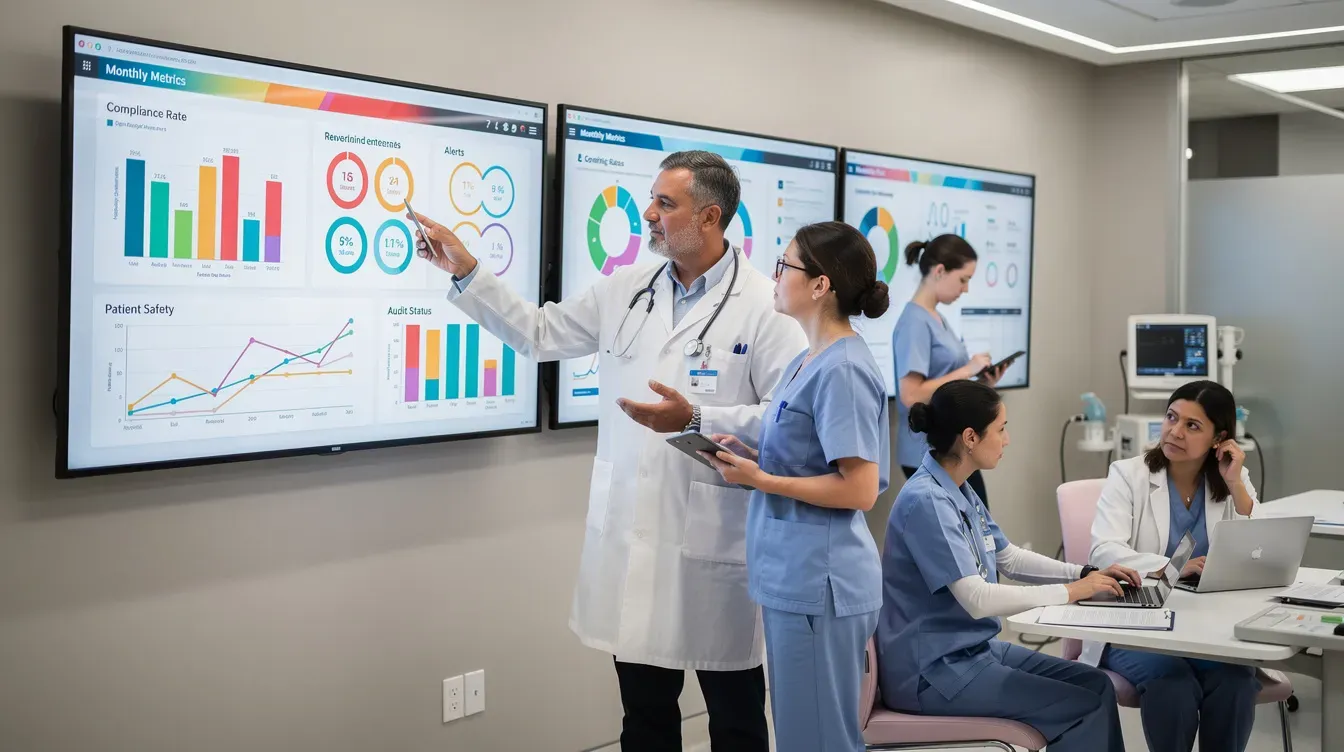
- Enterprise risk register: Aligned with HHS/OIG guidance, tracking key compliance metrics and compliance status across facilities. Real time dashboards provide insights into compliance status and demonstrate compliance to stakeholders effectively through enhanced reporting.
- Compliance training: Embedded LMS or integration with platforms like HealthStream. Automated assignments by role and location, license renewal tracking, and dashboards for overdue education support compliance programs across medical practices.
- Vendor management: A vendor inventory with contract terms, BAA status, risk tiers, and scheduled assessments. Support questionnaires, evidence uploads, and corrective action plans for all business associates.
- Operational modules: Checklists for DEA controls, billing audits against payer rules for revenue cycle management, medical inventory management modules, and lab compliance with CLIA help streamline healthcare operations and support medical services across the medical industry.
- Patient facing capabilities: Secure patient portals for privacy requests, consent tracking, and complaint submission, feeding directly into investigation workflows. Custom healthcare software can streamline patient data management processes including medical history and chronic disease management.
Compliance software automates routine compliance processes, and automated compliance processes reduce manual effort and save time. SoftDoes helps clients define an MVP feature set versus phase two enhancements so teams hit regulatory priorities first and expand into analytics and AI assisted compliance later, supported by operationalized machine learning and MLOps practices.
Run a Compliance Aware SDLC: Build, Validate, and Launch Safely
Your software development team must embed regulatory compliance into every sprint rather than checking it only at the end. User friendliness impacts the effectiveness of compliance software, so UX work must include real users and follow a product development and engineering approach that balances usability with safety.
- Discovery and UX: Compliance officers, privacy staff, nurse managers, and pharmacy leaders participate in interviews and usability tests. This ensures workflows mirror actual audit and incident management processes in medical organizations.
- Compliance acceptance criteria: Each user story should reference a regulation (e.g., "must log PHI access," "must restrict to assigned facility"). SoftDoes treats this as part of the normal definition of done.
- Testing: Unit and integration tests for security critical components, role based access tests, data integrity checks for medical history or risk scores, and regression tests for core compliance workflows. Centralized documentation ensures easy access to compliance related materials during testing.
- Independent validation: Schedule a third party penetration test before go live, perform a HIPAA risk assessment on the deployed environment, and remediate findings with documented sign offs. This is how you achieve audit readiness.
- Go live strategy: A limited pilot in one facility or department, tight monitoring, and a 4 to 8 week hyper care period with your development team and compliance leads on standby.
SoftDoes provides production runbooks, incident response playbooks, and on call procedures so healthcare organizations can operate the platform confidently after launch. The healthcare software development cost depends on scope, but a focused MVP for one health system typically runs in the low six figures, and the startup MVP development cost framework provides a useful way to think about scoping and budgeting.
Operate, Evolve, and Scale Your Compliance Platform
Continuous compliance monitoring is essential for ongoing operational effectiveness in healthcare software development. Compliance is never a one off project and should be treated as part of your broader digital transformation strategy. Your healthcare compliance management software needs a governance group (compliance, IT, security, operations) meeting regularly to review dashboards, open risks, and the feature backlog.
- Ongoing support tasks: Patching, dependency upgrades, cloud security posture checks, DR tests, access review cycles, and alert tuning. Compliance software provides real time visibility into compliance activities across all facilities.
- AI and analytics: Healthcare software should incorporate AI development and deployment for risk assessments and ensuring compliance as part of governance. AI enhances real time compliance monitoring in healthcare organizations, automates risk assessments to identify compliance issues proactively, and AI driven analytics improve reporting accuracy for compliance activities. AI tools can streamline documentation management for compliance purposes, and AI technologies help predict compliance risks before they escalate, especially when built on solid enterprise data management and platform foundations. Use machine learning for predictive analytics, trend analysis across incidents, and natural language search across policies. Future trends point to proactive risk management powered by data analytics becoming standard.
- Scaling: Scalability is important for compliance software as organizations grow, and partnering with a custom software and digital transformation provider ensures the platform can evolve with new regulatory and operational demands. Configure for different state rules, facility hierarchies, and branding for patient portals. Integrate additional EHRs or pharmacy systems acquired through mergers, benefiting from custom software development services for regional healthcare organizations. Healthcare systems expanding across states need a provider data management platform that adapts. Remote patient monitoring and chronic disease management modules can be layered on as compliance platforms mature.
The right healthcare compliance software solution helps healthcare organizations comply with both current and emerging healthcare regulations. SoftDoes supports clients after go live with flexible engagement models, from small enhancement pods to fully managed product teams, and invites organizations to contact the team and schedule a consultation when they are ready to explore next steps. Choosing the best healthcare compliance software approach depends on your compliance efforts, organizational complexity, and whether you want to automate compliance processes at scale to mitigate potential compliance failures. As the medical industry evolves, healthcare operations demand compliance solutions that keep pace with every shift in compliance standards and regulatory requirements, including health insurance portability mandates.



Comments (0)
No comments yet.