

90+
Active Client Partnerships
80+Person
Product & Engineering Team
100%
Your Code & IP Ownership
U.S.-Led
Delivery & Accountability
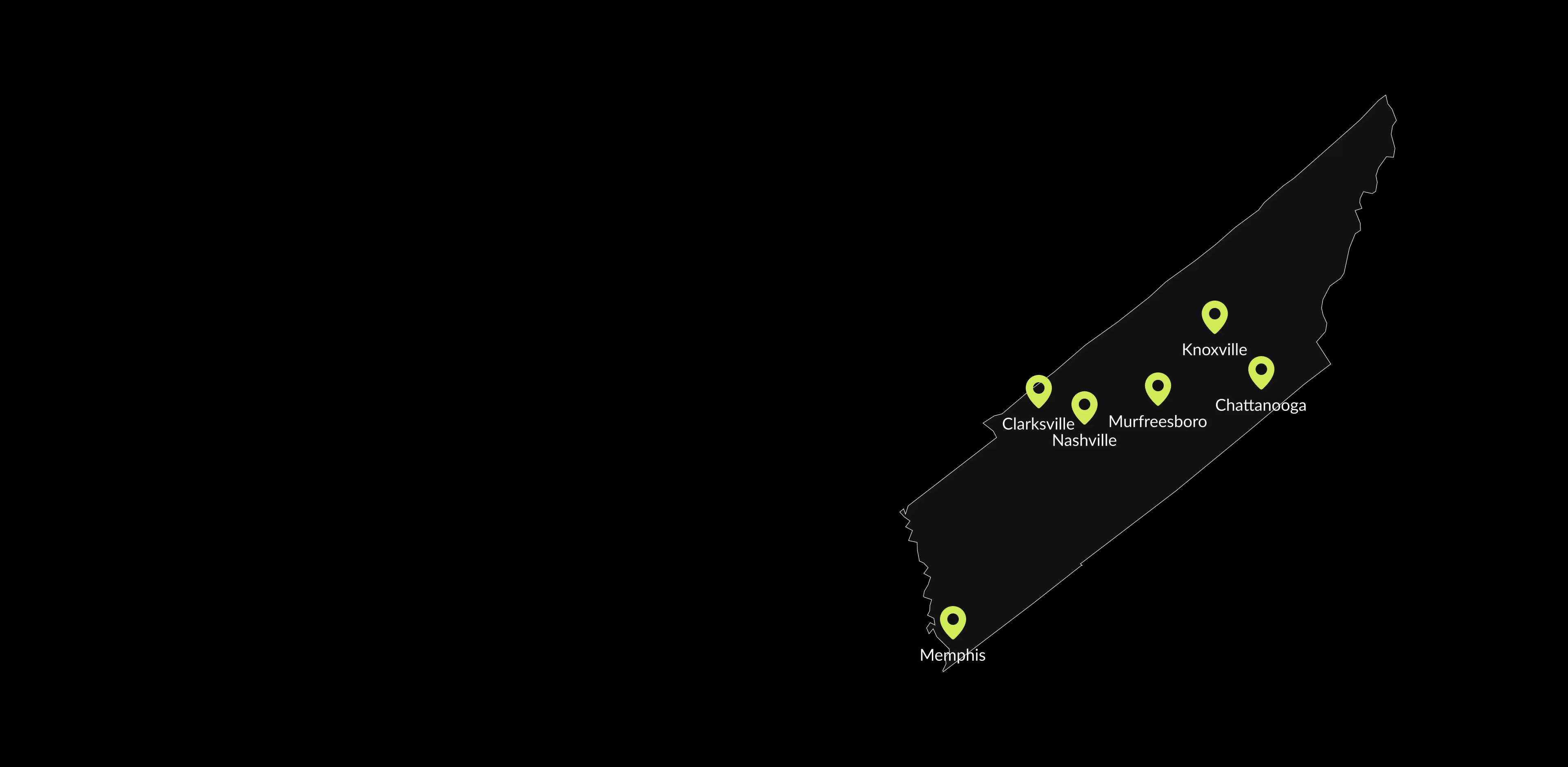
Where we operate
SoftDoes collaborates with organizations across Tennessee on complex software development, architecture advisory, artificial intelligence, data engineering, cloud infrastructure and product design. Our engineers work remotely with Tennessee teams as a default mode and join on site for discovery workshops, architecture sessions or critical planning milestones when proximity matters.
Nashville
Our team handles complex integrations and legacy modernization for Middle Tennessee organizations. SoftDoes untangles tightly coupled systems so teams can add features without disrupting existing operations.
Explore
Memphis
We untangle fragmented workflows and oversized data estates that accumulate across departments in Memphis organizations. SoftDoes analysts map every redundant handoff and re entry point, then restructure information flows so that operational teams act on trusted, timely data.
Explore
Knoxville
Our Knoxville team applies machine learning experiments and modern cloud practices under clear architectural guidance. SoftDoes strengthens internal IT capabilities in platform engineering, observability and secure deployment.
Explore
Chattanooga
We cooperate with Chattanooga companies to engineer custom platforms and event driven integrations that produce cleaner data flows and more predictable release cycles. SoftDoes refines user experiences across web applications and mobile apps until every interaction feels deliberate and coherent.
Explore
Clarksville
Our architects counsel Clarksville teams on fundamental technology decisions, testing discipline and long term maintainability so that each iteration adds genuine capability. SoftDoes instills clarity into codebases through documentation, automated verification and traceable design rationale.
Explore
Murfreesboro
Our team translates Murfreesboro organizations’ complex requirements into practical digital products through focused planning, iterative implementation and continuous validation. SoftDoes coordinates with local leaders and partners across Tennessee.
Explore






What We Solve

- 01
Removing friction between core systems
- 02
Turning legacy platforms into assets
- 03
Making product roadmaps executable
- 04
Bringing clarity to critical data
- 05
Aligning teams around modern engineering
A focused partner for complex initiatives
SoftDoes is a custom software development company that unifies software engineering, architecture advisory, artificial intelligence, data engineering, cloud infrastructure and product design into a single, coherent engagement. Fewer outages and faster iteration cycles emerge when architecture decisions are deliberate and testing is automated from the first sprint. Cleaner user flows across web apps and mobile apps result from research driven design working in lockstep with engineering rather than as an afterthought. Organizations that bring us their hardest problems leave with systems they actually trust to run their operations.
Product & platform engineering
Robust web and mobile platforms pair product engineering with user centered design to create intuitive journeys, consistent cross device behavior and more efficient operations.
Architecture & advisory expertise
Rigorous architecture consulting aligns technical decisions with business needs, keeping Tennessee systems adaptable, understandable, and ready for integration as requirements evolve.
Intelligent automation, ML, & AI
Analytics models and intelligent components that uncover hidden patterns, automate repetitive decisions and refine complex operational sequences, reducing manual review and accelerating anomaly detection.
Data foundations & cloud environments
Resilient data pipelines and cloud environments improve consistency, access, security, and query performance, giving Tennessee teams a dependable foundation for analysis and experimentation.
Frequently Asked Questions
Everything you need to know about working with SoftDoes. Can’t find an answer?
How does software development in Tennessee with SoftDoes usually start?
An engagement typically begins with a brief introductory call where we learn about your current systems, pain points and ambitions. This initial conversation is not a sales pitch. It is a diagnostic exchange where both sides determine whether there is a genuine fit. From there, SoftDoes proposes a discovery phase. During discovery, our team reviews existing codebases, infrastructure, user journeys and organizational constraints. We conduct workshops with key stakeholders, sometimes on site in cities such as Nashville or Memphis, sometimes remotely depending on the complexity and preference of the client. By the end of discovery, you receive a documented understanding of the current state, a prioritized list of risks and opportunities, and a preliminary roadmap for moving forward. Expectations around communication cadence, tooling, responsibilities and decision rights are captured in a working agreement so that nothing is left to assumption. This process usually takes a few weeks, depending on the number of systems and teams involved. The goal is to turn ambiguity into clarity before committing engineering hours to implementation. Tennessee organizations that have been through this phase consistently report that the structured beginning prevented costly missteps later. Whether you are a startup refining your first product or an enterprise managing a portfolio of integrated platforms, the entry point is the same: honest assessment, clear documentation and mutual agreement on what matters most.
What affects the timeline for custom software work in Tennessee?
Several factors influence how long a project takes. The complexity of existing systems is the most significant. An organization running a single monolithic application faces different challenges than one managing dozens of interconnected tools across multiple departments. Integration count matters because each external connection requires analysis, interface mapping and testing. Security and compliance expectations also affect timelines. Projects operating in regulated contexts need additional verification steps, threat assessments and documentation that cannot be shortcut. Team availability on the client side plays a role too. When decision makers are accessible and feedback loops are short, work advances more quickly. Delays in review cycles or shifting priorities on the business side often extend timelines more than any technical obstacle. SoftDoes does not quote fixed timelines before understanding the full picture. After discovery and architecture planning, Tennessee organizations receive a realistic schedule with clear milestones and assumptions documented. Qualitatively, focused engagements around a single platform or feature set can take a few months, while broader modernization initiatives may extend over several quarters as requirements expand in scope and scale. The phased approach ensures that working software reaches users at regular intervals, so value is realized throughout the process rather than only at the end.
How do you handle integrations with tools already used by Tennessee teams?
Integration work begins during discovery. SoftDoes maps every system your organization depends on, identifies data flows between them, and catalogs the interfaces each system exposes, whether those are APIs, file exchanges, event streams or direct database connections. This review surfaces undocumented dependencies and fragile handoffs that would otherwise cause problems during implementation. For each integration point, the team defines a clear contract: what data crosses the boundary, in what format, at what frequency, and what happens when something fails. Error handling and retry logic are designed upfront, not patched in after a production incident. Logging and observability are embedded so that your team can trace a transaction across multiple systems without guesswork. Common integration scenarios in Tennessee organizations include connecting internal platforms with identity management systems, analytics engines, payment processors or third party vendor portals. SoftDoes uses standard protocols and well documented interfaces wherever possible, avoiding proprietary middleware that locks you into a specific vendor. The result is a system that remains maintainable and extensible long after the initial engagement concludes. Every integration is tested under realistic conditions, including load patterns that mirror your actual usage, so surprises at launch are minimized.
What is your approach to security and compliance for Tennessee projects?
Security enters the engagement at the architecture phase, not as a final checklist. During planning, SoftDoes conducts threat assessments specific to the project's domain and deployment model. Access controls follow the principle of least privilege. Encryption protects data in transit and at rest. Authentication and authorization mechanisms are designed to meet the regulatory context your organization operates within. Throughout implementation, automated security checks run as part of every code change. Dependency scanning catches known vulnerabilities before they reach production. Code reviews include a security lens, with professional discipline applied to input validation, session management and error disclosure. Tennessee software developers on our team focus on regulatory compliance in projects from the earliest sprint. Systems must pass audits to remain operational in regulated industries, so audit logs and compliance strategies are established during discovery sessions. For organizations operating under frameworks such as HIPAA, SOC 2 or PCI DSS, SoftDoes structures testing and documentation to support audit readiness without creating bottlenecks. Penetration testing and vulnerability assessments occur before launch and at regular intervals afterward. The objective is to create systems where compliance is a natural property of the architecture, not an expensive retrofit triggered by an upcoming review.
How do you work with in house engineering teams in Tennessee?
SoftDoes adapts to the structure and culture already present in your organization. Collaboration modes vary based on the kind of technical solutions an internal team is pursuing. Sometimes our engineers embed directly within your squads, contributing code alongside your staff. Other times we operate as a parallel work stream handling a distinct component, with regular synchronization points. In advisory engagements, senior architects join planning and review sessions without writing production code, focusing instead on architecture direction and risk identification. Shared tooling is essential. We align on your existing repository, CI pipeline, issue tracker and communication channels rather than introducing separate infrastructure that fragments visibility. Code review practices are mutual: your team reviews our work and we review theirs, reinforcing consistent standards and shared ownership. Coding conventions, branching strategies and documentation expectations are agreed upon early and revisited as the engagement matures. Staff augmentation is also an option when Tennessee teams need additional capacity for a defined period without changing their internal process. SoftDoes engineers integrate into existing rituals, follow established norms and contribute from day one. The overarching principle is respect for what your team has already created, combined with practices that measurably improve delivery cadence, test coverage and system health over time.
What does software development in Tennessee cost with SoftDoes?
Cost depends on scope, system complexity, the number and nature of integrations, security requirements and the level of ongoing involvement after launch. There is no universal price list because every organization's situation is different. A focused engagement around a single platform feature carries a very different investment profile than a multi quarter modernization initiative touching dozens of data systems and user interfaces. After the discovery phase, SoftDoes presents a transparent structure that breaks the engagement into milestones with associated budgets and assumptions. You see exactly what each phase covers, what it costs and what must be true for those estimates to hold. If priorities shift, the financial picture is updated accordingly so there are no hidden overruns. Prioritization and phasing are the most effective levers for managing cost. Not everything needs to happen at once. SoftDoes works with your leadership team to sequence investments so that the most impactful work happens first and each phase funds clarity for the next. This approach prevents the common pattern where a large budget is committed upfront to a vaguely defined scope, only to run out before the most important capabilities are complete. Tennessee organizations consistently find that disciplined planning saves more than any negotiation on hourly rates.
Can you modernize a partially outdated system instead of replacing it?
Yes. Full replacement is sometimes the right answer, but it is rarely the only one. SoftDoes evaluates legacy platforms to determine which components warrant preservation, which need refactoring and which should be retired. Techniques such as modular decomposition, strangler patterns and interface abstraction allow new functionality to coexist with legacy code while gradually shifting traffic and responsibility to modern components. Consider a Tennessee organization running a critical internal application on aging infrastructure. Rather than shutting the system down and rebuilding from scratch, SoftDoes might wrap the existing database in a clean API layer, introduce automated tests around the most fragile modules, and begin migrating user facing features to a modern front end one module at a time. Each step is deployable on its own. The old system continues operating safely while the new architecture absorbs more responsibility with each iteration. This incremental approach reduces risk dramatically. There is no single cutover moment where everything could fail. Business continuity is maintained throughout. Teams gain familiarity with the new architecture progressively rather than facing a sudden shift. For Tennessee organizations managing entrenched platforms that still serve essential functions, this is often the most responsible path forward and the one that produces a tangible return on investment earliest.



