If your company still calls GPT 4o, GPT 5.2, or any legacy snapshot in production, this guide is for you. OpenAI recently released GPT 5.6 as a family of three models, Sol, Terra, and Luna, and the retirement dates for older versions are approaching fast. Here is what U.S. and Canadian engineering teams need to know to migrate safely.Table of contents1. Key Takeaways2. What's New in GPT 5.6 and Why It Matters Now3. Understanding GPT 5.6 Sol, Terra, and Luna4. Deprecations, Deadlines, and Model Lifecycle Risks5. A 15 to 30 Minute GPT 5.6 Migration Audit6. Choosing Between GPT 5.6 Sol, Terra, and Luna for Real Workloads7. Safety, Compliance, and Reliability When Migrating to GPT 5.68. Cost Management: Prompt Caching, Pricing, and Usage Controls9. How SoftDoes Helps Enterprises Migrate to GPT 5.610. Benefits of Working with SoftDoes on GPT 5.6 Migration Key Takeaways
- Start with a fast audit of every OpenAI model ID in your code, config files, and data pipelines. Prioritize models marked for deprecation in 2026.
- Most users will eventually move to GPT 5.6 variants. Plan your migration now even if you are still on GPT 4o or GPT 5.2, because those retirement dates have already passed or are weeks away.
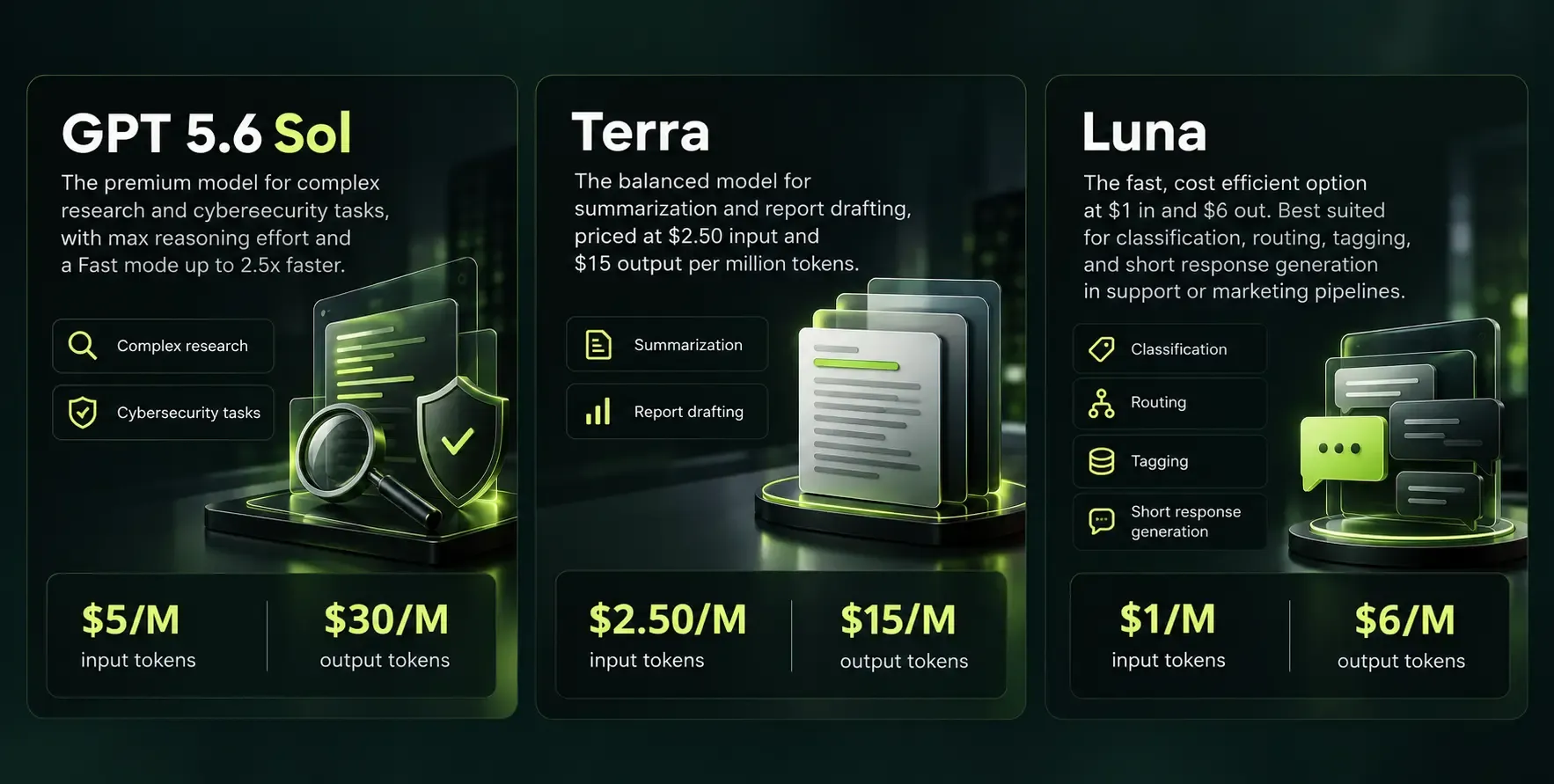
- Use GPT 5.6 Sol for high risk workflows like cybersecurity and policy reasoning, Terra for everyday knowledge work, and Luna for high volume, low cost tasks.
- Take notes on timing, routing choices, and main migration risks. The key points are that pricing ranges from $1 to $30 per million tokens, and ten models shut down on October 23, 2026.
- SoftDoes can help with migration planning, testing, and rollout for U.S. and Canadian enterprise teams.
What's New in GPT 5.6 and Why It Matters Now
GPT 5.6 is not just another version bump. OpenAI announced and released it in mid 2026 as a complete new model family, present across ChatGPT, Codex, and the API. GPT 5.6 features three models: Sol, Terra, and Luna, each tuned for different workloads rather than one default assistant for everything. GPT 5.6 supports up to 1.05 million tokens in context and up to 128K output tokens, a significant leap over past generations.
GPT 5.6 is currently available to about 20 trusted partner organizations in limited preview, but Sol is already shaping the migration guidance and replacement picks for deprecated models. Most users are expected to complete migration over the next 6 to 12 months. OpenAI gives at least six months' notice for generally available models and shorter windows for previews, so teams cannot wait until the last week to react.
GPT 5.6 also features advanced multi agent coordination capabilities for automation, making it a meaningful upgrade for engineering teams building agentic systems. The framework increases token efficiency for multi step workflows, meaning your pipelines can do more with fewer requests.
Understanding GPT 5.6 Sol, Terra, and Luna
Think of the three GPT 5.6 variants as a routing toolkit, not just small, medium, and large sizes. GPT 5.6 architectures introduce a tiered structure for task management, and each variant may evolve independently over time.
GPT 5.6 models support native compaction and retained reasoning across model turns, which means context carries forward more reliably in multi turn conversations.
Deprecations, Deadlines, and Model Lifecycle Risks
In the OpenAI ecosystem, deprecation means formal notice that a model is becoming legacy. After the retirement date, calls to that model return errors like model_not_found. The life cycle is: active, deprecated, then retired.
The emotional impact of these shutdowns is real. OpenAI will retire GPT 4o on February 13, 2026. OpenAI's deprecation notice for GPT 4 models was issued on January 29, 2026, giving users just two weeks to prepare. Users reported feeling grief after GPT 4o's removal. On Reddit and community forums, users expressed shock and sadness over GPT 4o's abrupt shutdown. One user described GPT 5 as a "skin of my dead friend." Some users even held funerals for their AI companions after shutdowns. OpenAI acknowledged users might develop emotional bonds with models, and experts criticized the sudden removal of AI models as harmful. These reactions highlight why teams get stuck when they become attached to a specific model version.
The sad truth is that waiting leads to broken pipelines. Here are the dates that matter now:
Date |
February 13, 2026 | GPT 4o retired (already passed) |
August 10, 2026 | gpt-5.2-chat-latest and gpt-5.3-chat-latest deprecated |
October 23, 2026 | Ten OpenAI models shut down, including GPT 3.5 turbo and GPT 4 era snapshots |
December 11, 2026 | GPT 5 and o3 snapshots (e.g., gpt-5-2025-08-07) retired |
OpenAI provides two weeks' notice for some model deprecations but at least six months for GA models. Check the official deprecation page regularly. If you ignore these deadlines, production requests will fail. Any comment from your team that "we will deal with it later" should be treated as a risk flag.
A 15 to 30 Minute GPT 5.6 Migration Audit
Migrating to GPT 5.6 involves a structured approach to address runtime differences. Here is a quick checklist a tech lead can complete in under an hour:
- Search your entire codebase, back end services, serverless functions, and config files for hard coded model IDs. Pull every reference to strings like gpt-4-turbo, gpt-5-2025-08-07, or any legacy version.
- Export API usage data from OpenAI or your observability stack. Identify which models still receive active production traffic and what they cost month over month.
- Group use cases into categories: conversation and chat, analytics and summarization, coding and DevOps, cybersecurity, and back office automations.
- Map each category to Sol, Terra, or Luna based on risk tolerance, required accuracy, latency, and budget. The idea is to decide before deadlines, not during an outage.
- Log which workflows rely on specific behavioral quirks of older models. Migration to GPT 5.6 involves addressing behavioral differences rather than just API compatibility.
Choosing Between GPT 5.6 Sol, Terra, and Luna for Real Workloads
Once you complete the audit, the next step is to plug each workflow into the right GPT 5.6 variant. Even if you are evaluating alternatives from other providers like Claude Sonnet, Claude Opus, or Google Gemini, understanding the GPT 5.6 tiers makes sense for any OpenAI dependent architecture.
Many organizations will mix models. For example, Sol in security operations, Terra in customer success knowledge bases, and Luna in routing and tagging pipelines. Applications migrating to GPT 5.6 may require adjustment for existing prompts due to behavioral differences, so do not treat this as a simple find and replace. Using Sol everywhere is the wrong approach because it will drive up costs, while forcing Luna on complex reasoning tasks will prove damaging to accuracy. Include model selection rules in your architecture docs so new services default to the right choice. It is ultra important not to let teams pick variants ad hoc without governance.
Safety, Compliance, and Reliability When Migrating to GPT 5.6
GPT 5.6 Sol's deeper reasoning comes with stricter safety and policy controls. U.S. and Canadian companies in finance, healthcare, education, and energy should align migration with internal risk frameworks and regulatory obligations like HIPAA, SOC 2, and PCI.
- Build test suites covering hallucination checks, prompt injection resistance, data leakage, and policy alignment before flipping production traffic.
- Implement data governance frameworks that log which variant handled each request for audit trails.
- Validate that your rollout plan includes rollback strategies if a GPT 5.6 variant produces unexpected outputs.
- Run regression tests comparing outputs from your old model against the chosen 5.6 variant for every critical task.
SoftDoes can help teams design red team scenarios, compliance reviews, and rollback strategies for model changes across cloud infrastructure in North America.
Cost Management: Prompt Caching, Pricing, and Usage Controls
GPT 5.6 includes prompt caching for cost efficiency, and migrating to GPT 5.6 may reduce operating costs through efficient tier management. Pricing for GPT 5.6 ranges from $1 to $30 per million tokens depending on the variant and direction.
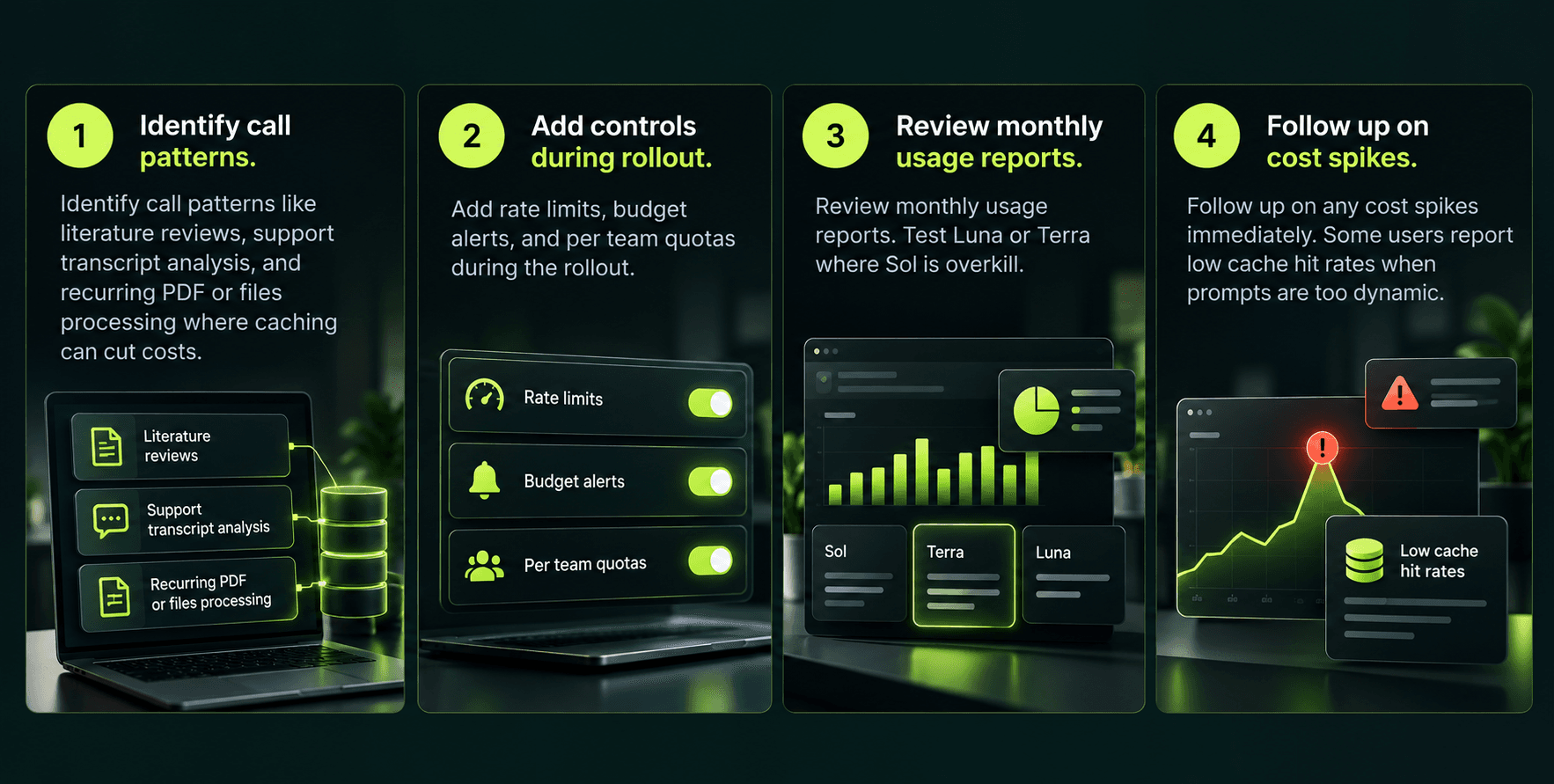
Prompt caching in GPT 5.6 is cheaper when cached input is used compared to uncached input. Cache reads cost roughly 10% of the standard input rate, while cache writes cost 1.25x. GPT 5.6 introduces explicit cache breakpoints to improve prompt caching efficiency. The minimum cacheable prefix is 1,024 visible tokens, and cached prefixes last at least 30 minutes. This is a relief for teams running research style or ETL workloads that repeatedly process the same documents.
To keep your bill under control:
How SoftDoes Helps Enterprises Migrate to GPT 5.6
SoftDoes is a software engineering and AI partner for U.S. and Canadian enterprises moving to GPT 5.6. Here is how we support migration:
- Codebase audits to find every legacy model ID and map it to the right Sol, Terra, or Luna replacement.
- Routing strategy design so your architecture handles variant selection through config or SDK wrappers, not hardcoded strings.
- Secure data pipelines and AI development integrating GPT 5.6 into your existing analytics stacks, including retrieval augmented generation for domain specific knowledge.
- Regulated industry expertise in finance, healthcare, and education, with a focus on compliance, observability, and reliability.
Ready to start? Schedule a short assessment with SoftDoes to review your current OpenAI footprint and build a GPT 5.6 migration roadmap. If you need to hire specialized AI engineers, we can help with that too.
Benefits of Working with SoftDoes on GPT 5.6 Migration
For CTOs, CIOs, and product leaders considering their next move, here is what working with SoftDoes delivers:
- Reduced migration risk through structured planning, automated testing, and staged rollouts instead of rushed last minute cutovers in June or any other deadline month.
- Cost control by choosing the right mix of Sol, Terra, and Luna, applying prompt caching strategies, and designing efficient prompts that keep the price manageable.
- Full stack capability spanning custom software development, cloud architecture, UI/UX, and API integration around GPT 5.6. We do not just offer model selection advice.
- Flexible engagement models for North American clients, from short consulting engagements to complete product delivery teams.














Comments (0)
No comments yet.