Loan origination software is the system that moves a loan from application through approval, documentation, and funding. It handles application intake, data verification, underwriting, disclosure generation, closing, and handoff to servicing. In the U.S. and Canada, where compliance obligations span TRID, HMDA, RESPA, CECL, CFPB 1071, and OSFI rules, the right loan origination system directly determines how fast you can approve, how accurately you comply, and how much each loan costs to produce.The best loan origination software in 2026 is not one platform. It depends on whether you are a high volume mortgage bank, a credit union focused on consumer and indirect lending, a fintech launching embedded finance products, or a private lender running fix and flip loans. Your lending products, technical maturity, regulatory exposure, and business strategy all shape the answer.
This guide focuses exclusively on North American use cases, regulations, and market realities. It will define how the shortlist was built and the evaluation criteria applied, rank seven of the top loan origination systems with concrete recommendations, provide a quick comparison and decision framework to help you choose the right loan origination system, and show when off the shelf versus custom LOS - built with a partner like SoftDoes - makes sense.
How We Chose the Best Loan Origination Software for 2026
Rather than assembling a generic "top 10" list, we built this shortlist by matching specific platforms to the lender profiles that actually exist in the U.S. and Canada. Each platform was reviewed against its real world fit for distinct lending models, from mortgage heavy independent banks to API driven fintechs.
Data sources included market adoption figures, public vendor filings, published case studies, product documentation, and product updates released between 2024 and 2026. We also drew from analyst reviews and community feedback on platforms like Software Advice and Capterra.
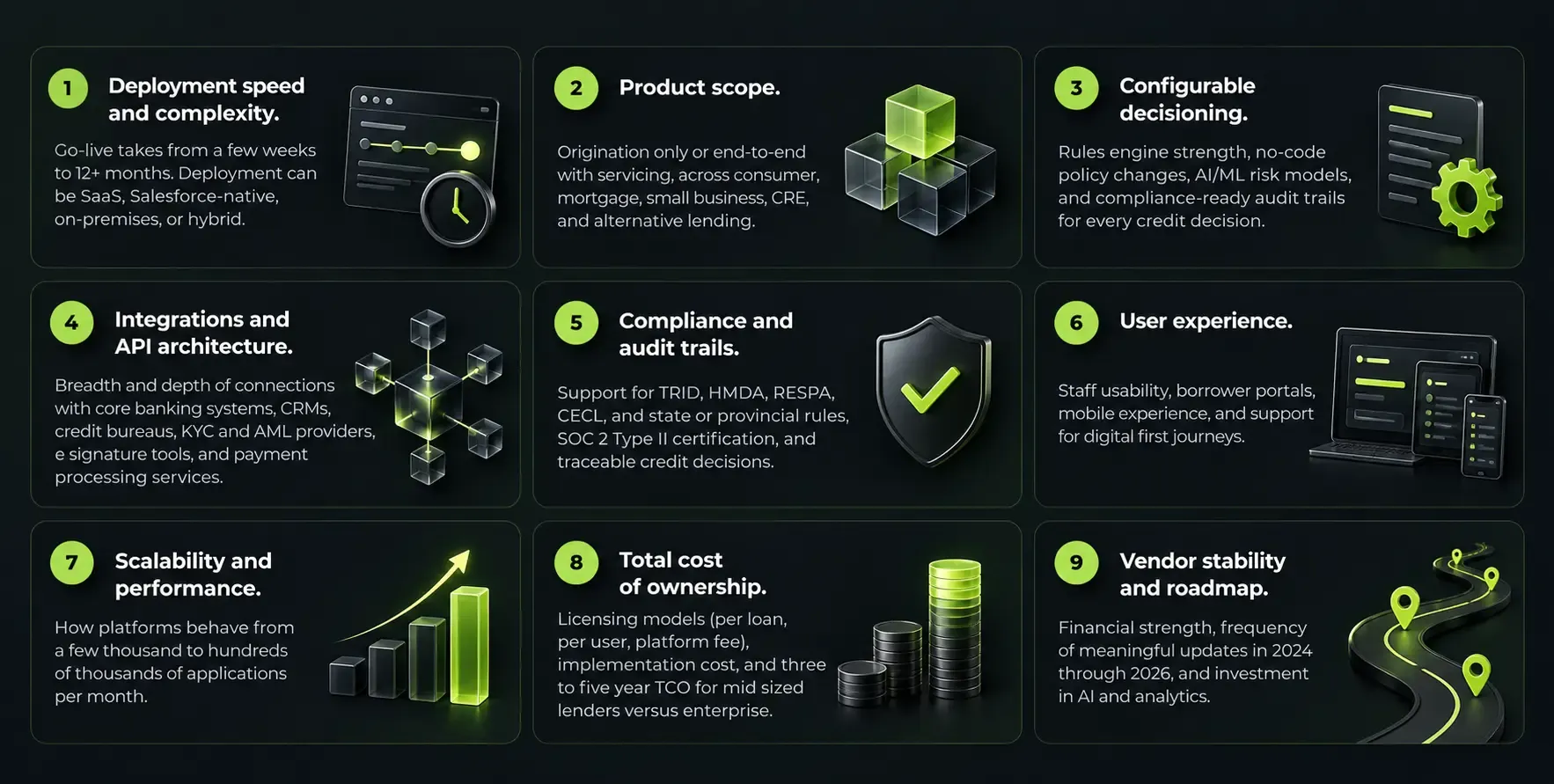
Core Evaluation Criteria
Here is how each platform was judged:
Rankings prioritize operational impact - speed, error reduction, compliance, and customer experience - over sheer feature count. Evaluation of loan origination platforms should always consider workflow automation and compliance capabilities together. Key features include application intake, workflow automation, and real time decisioning, which is essential for any modern loan origination system.
The Best Loan Origination Software in 2026 for North American Lenders
The list below is ordered by overall fit and impact for typical U.S. and Canadian lenders. It intentionally mixes enterprise banking suites, mortgage focused LOS platforms, API first and fintech focused systems, and options suited to alternative and non bank lenders. Each entry includes who it is best for so you can quickly self identify.
1. ICE Encompass - Best for High Volume U.S. Mortgage Lenders Needing Deep Compliance
Encompass by ICE Mortgage Technology remains the de facto standard origination software for U.S. residential mortgage lending. It offers deep TRID, HMDA, and RESPA support, a massive integration marketplace, and proven enterprise scale for mortgage lenders of all sizes.
Why It Stands Out
Encompass delivers end to end mortgage origination from application through post closing and investor delivery. Compliance checks are embedded directly in loan workflows, and disclosures update automatically as regulations change. It is built for lenders who treat mortgage lending as their primary business line and need tight connections to pricing engines, eClose tools, and secondary market investors.
Best For
- Independent mortgage banks funding high volumes in the U.S.
- Large banks and credit unions where mortgage origination is a major product line.
- Lenders needing tight integration with ICE's pricing, eClose, and servicing tools.
- Mortgage brokers who operate within the ICE ecosystem.
Key Strengths
- End to end mortgage origination workflow from application through post closing and investor delivery.
- Robust regulatory workflows and automated disclosures tailored to U.S. mortgage rules.
- Large marketplace of pre built integrations covering credit, VOE/VOI, appraisal, eClose, MI, and pricing engines.
- Battle tested scalability for enterprise origination volumes.
- ROI data from a 2026 MarketWise Advisors study showed approximately 15.5% more closings without additional staff, cycle time reduced by roughly 3.75 days per loan, and an overall return on investment of about 7.53×.
Possible Limitations
- Implementation projects are long and resource intensive, especially for mid size and large shops.
- Less flexibility for non mortgage products or highly experimental lending models, making it more of a mortgage only tool than a multi product platform.
- UI and configurability can feel dated compared with newer, lighter weight SaaS origination technology.
2. nCino - Best for Banks Standardizing Origination on Salesforce
nCino is a Salesforce native cloud banking platform built for commercial lending, small business credit, and mortgage origination. It gives banks a unified view across lines of business inside the same loan file, reducing context switching for bankers.
Why It Stands Out
For institutions already invested in Salesforce, nCino eliminates the gap between CRM and lending workflows. It supports commercial lending workflows, small business origination, and mortgage operations with strong pipeline visibility and analytics. Salesforce based platforms like nCino typically take four to six months to implement, reflecting the depth of configuration involved.
Best For
- Regional and super regional banks using Salesforce as a CRM and platform of record.
- Institutions with complex commercial and small business credit workflows.
- Teams with internal Salesforce admin capacity or partner relationships.
Key Strengths
- Native Salesforce data model and UI, enabling lenders to work across the same loan file simultaneously without separate systems.
- Powerful workflow automation and pipeline visibility for commercial lending.
- Broad ecosystem of Salesforce compatible apps and integrations.
- Bank grade security and compliance posture for North American regulators.
- In FY2025, nCino reported approximately 2,700 customers worldwide, 115% ACV retention among U.S. mortgage customers, and an 80% reduction in small business origination cycle time for some community banks.
Possible Limitations
- High licensing and implementation cost, including Salesforce platform expenses.
- Multi vertical platforms typically require three to six months for full implementation across commercial and mortgage suites.
- Overkill for smaller credit unions or mono line lenders with simple origination needs.
3. MeridianLink - Best for U.S. Credit Unions and Community Banks
MeridianLink is a mainstream loan origination platform for consumer lending across community financial institutions in the U.S. With over 1,800 community banks and credit unions on the platform, it dominates the community bank market.
Why It Stands Out
MeridianLink excels at consumer and indirect lending, with packaged compliance tools and pre built decisioning tuned for smaller institutions. Community banks focused on auto, personal, card, and home equity products find it ready to go with minimal customization. Platforms with pre built workflows like MeridianLink deploy in two to eight weeks for standard configurations.
Best For
- Credit unions focused on auto, personal, card, and home equity lending.
- Community banks modernizing legacy systems for origination without building from scratch.
- Institutions seeking reasonable implementation timelines compared with enterprise platforms.
Key Strengths
- Pre built workflows tuned to consumer and indirect lending in the U.S.
- Built in decisioning and integrations with major U.S. credit bureaus including Equifax, Experian, and TransUnion.
- Pre built integrations can save ten to fifteen minutes per deal by eliminating manual data entry.
- Proven track record with hundreds of community institutions.
- Recent enhancements like MeridianLink Pathway provide personalized adverse action experiences.
Possible Limitations
- Less flexibility for highly customized or niche credit products.
- Limited appeal for digital lenders or fintech teams wanting API first tooling.
- UX may feel less modern compared with newer SaaS tools built for digital transformation.
4. LoanPro - Best API First Platform for Unified Origination and Servicing
LoanPro is an API first lending platform that covers the full loan lifecycle - from origination through loan servicing, collections, and payment processing - in a single system. It supports the entire loan lifecycle for lenders who want programmatic control over every step.
Why It Stands Out
LoanPro eliminates the split between LOS and servicing systems that plagues most lenders. Unified platforms reduce data fragmentation across systems and lower operational costs by keeping borrower data, credit decisions, and repayment logic in one place. One published case study showed a client reducing loan delivery time by approximately 97% after integrating their website with LoanPro APIs.
Best For
- Digital lenders and fintechs in the U.S. and Canada building differentiated lending products.
- Non bank lenders who want full data control and real time programmatic access.
- Banks piloting new digital loan products outside legacy cores.
- Multi product lenders who need to serve multiple credit products from a single servicing platform.
Key Strengths
- Rich, well documented APIs and webhooks for custom front ends and lending workflows.
- Unified ledger and servicing functions reducing system sprawl and operational overhead.
- Strong support for many loan types: consumer, auto, small business, and lines of credit.
- Good fit for advanced analytics and embedded finance models.
- API first architecture allows for better integration with external services including core banking platforms, KYC, and fraud providers.
Possible Limitations
- Requires strong internal engineering or a development partner to unlock full value.
- Less out of the box process for traditional mortgage or highly regulated niche products.
5. TurnKey Lender - Best for Automated Decisioning Across Multiple Loan Products
TurnKey Lender is a cloud lending platform with strong AI driven credit decisioning built in. It covers origination, underwriting, servicing, and collections across consumer, SME, BNPL, auto, and microfinance products.
Why It Stands Out
AI driven decisioning can reduce underwriting time by 30%, and TurnKey Lender emphasizes automation and AI driven credit evaluation as core capabilities. AI capabilities differ in kind across loan origination platforms, and TurnKey Lender stands out by offering pre configured models designed to accelerate approvals without requiring data science teams.
Best For
- Small and mid sized lenders in the U.S. and Canada.
- Non bank lenders expanding from one product into SME, BNPL, or microloans.
- Institutional lenders who want fast, relatively out of the box credit scoring and origination.
Key Strengths
- End to end workflows from application through servicing for multiple asset classes.
- Built in decision engines and AI models for faster approvals and credit decisioning.
- Cloud deployment with relatively quick implementation for a full stack platform.
- Supports embedded lending scenarios for merchants and platforms.
Possible Limitations
- Customization beyond standard models can increase costs and timelines.
- Explainability and model governance need careful review for U.S. and Canadian regulators and bank partners.
- Less historical presence in deeply regulated mortgage investor delivery workflows.
6. DigiFi - Best for Embedded Lending and Developer Led Teams
DigiFi provides API first lending infrastructure favored by fintechs and embedded finance programs. It is designed for teams that want to build custom borrower journeys and integrate lending into non financial apps.
Why It Stands Out
Integration flexibility is crucial for connecting lending software with core banking systems and third party services. DigiFi gives developer led teams modular APIs to compose origination components exactly as needed. Custom integrations may require four to eight weeks of engineering work, but the payoff is a fully tailored origination workflow.
Best For
- Fintech startups introducing credit in their product roadmaps.
- Retailers and platforms adding BNPL or in app lending.
- Developers who want maximum control instead of a rigid off the shelf LOS.
Key Strengths
- Lightweight, modular APIs for origination components.
- Good fit for fast experimentation with pricing, lending products, and UX.
- Cloud native architecture for rapid scaling.
- Strong support for building custom lending flows from the ground up.
Possible Limitations
- Not a turnkey enterprise LOS; requires engineering resources or a software partner.
- Less suitable for large regulated banks needing deep mortgage or commercial features out of the box.
7. Blend - Best Front End Experience Layered on Existing LOS
Blend focuses on enhancing borrower facing application experiences. It sits in front of existing LOS and core systems, providing a modern digital layer for application intake, verifications, and status tracking.
Why It Stands Out
Digital borrower portals enable mobile friendly application submissions and document uploads. Blend excels at reducing friction in the borrower journey without requiring lenders to rip out their existing origination technology. Digital lending tools enhance customer experience through simplified applications and document collection.
Best For
- Banks and credit unions wanting a better borrower portal while retaining their existing LOS.
- Mortgage and consumer lenders prioritizing conversion rates and digital brand experience.
- Financial institutions that need to improve the front end without overhauling back end systems.
Key Strengths
- Slick borrower interfaces, pre filled applications, and real time status tracking.
- Integrations with income, asset, and identity verification tools to reduce friction in the origination workflow.
- Proven deployments with major U.S. financial institutions.
- Complements enterprise platforms and legacy systems instead of replacing them.
Possible Limitations
- Not a full LOS or servicing platform; must integrate with other systems for the broader loan management system.
- May add complexity if the core origination platform is outdated or inflexible.
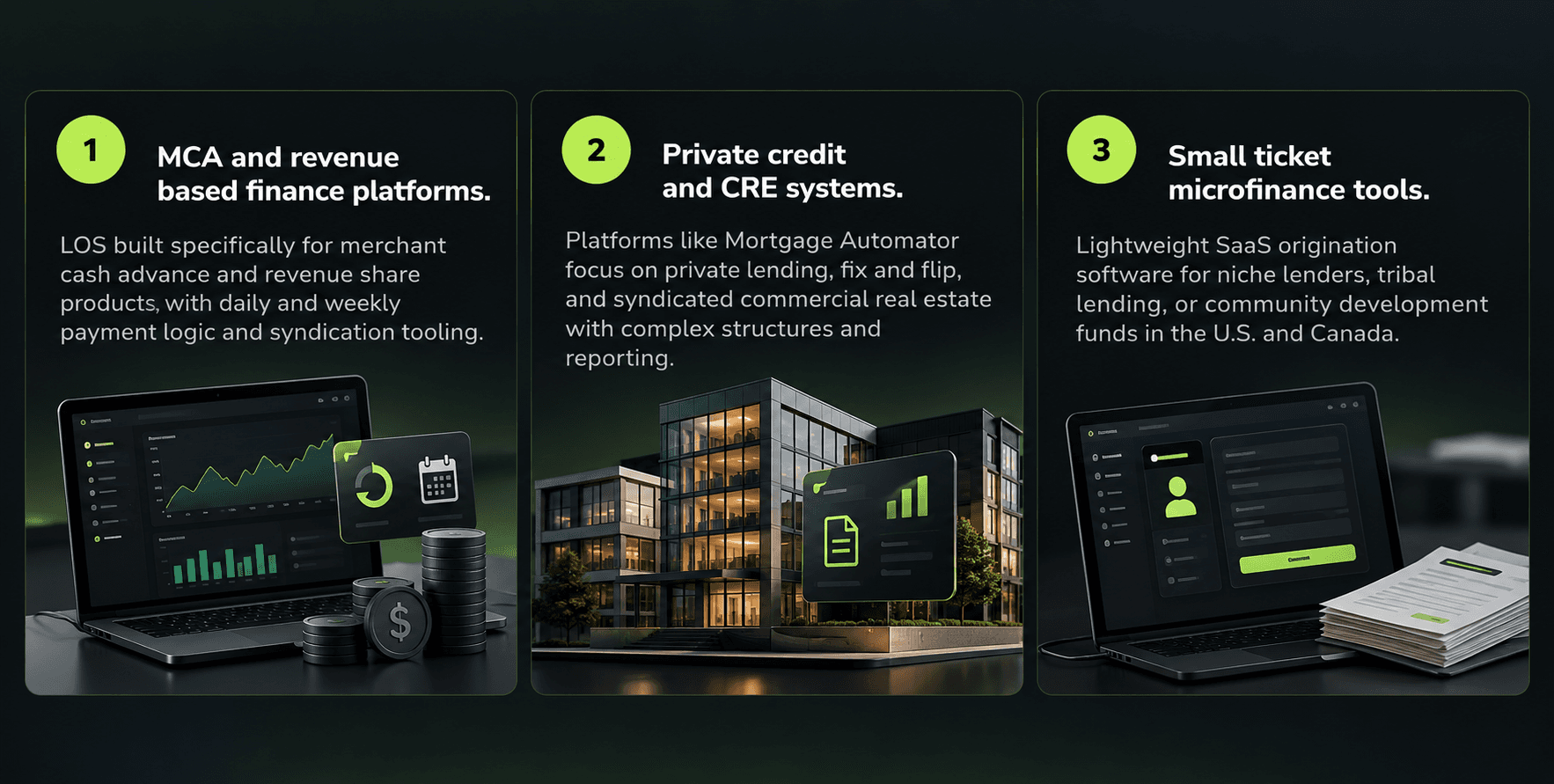
8. Specialized and Niche LOS Options to Watch in 2026
The loan origination software landscape features platforms tailored to specific lending niches. Some lenders in North America need highly specialized tools that general purpose platforms cannot deliver cleanly:
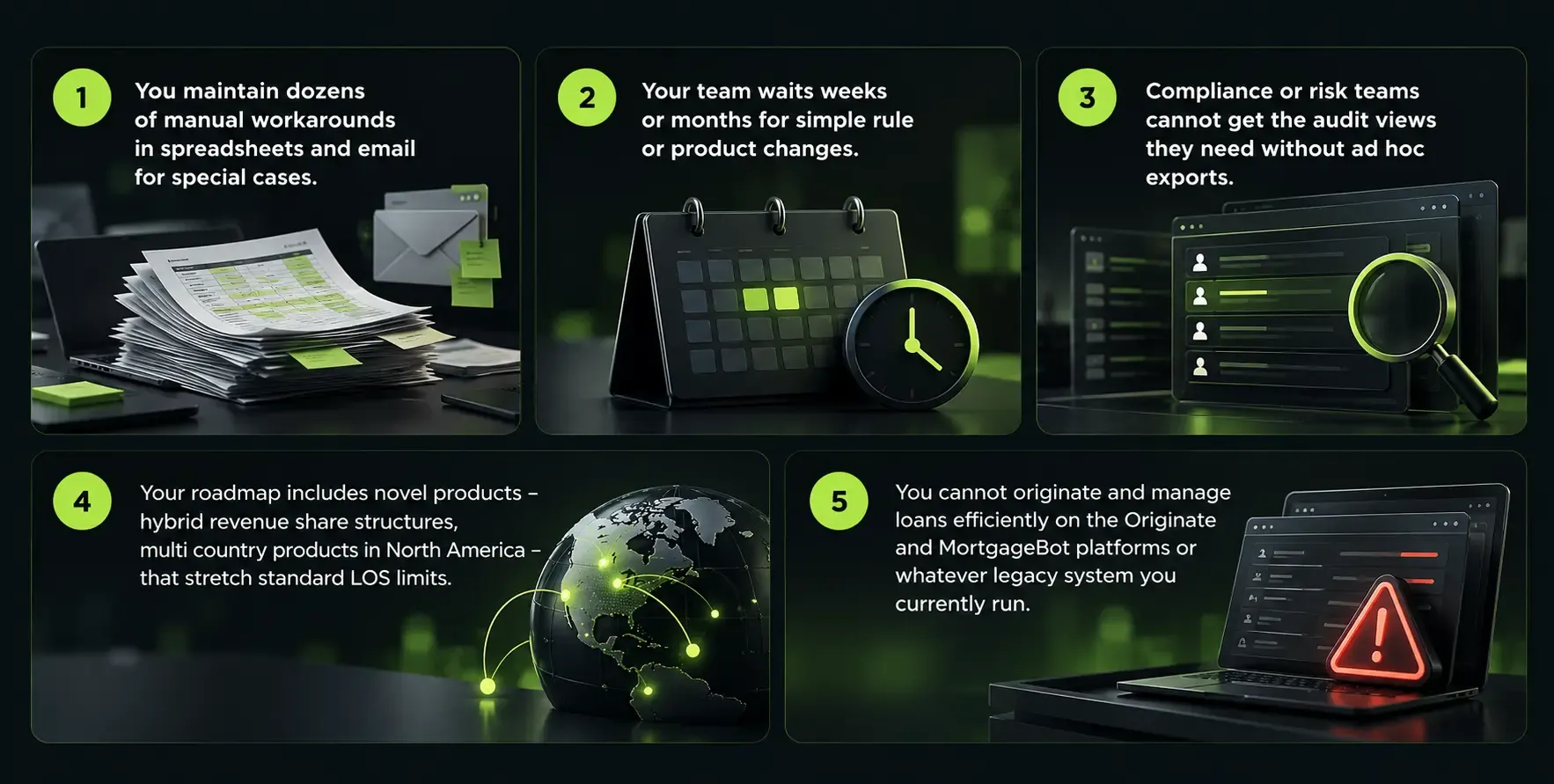
If your lending model stretches standard LOS limits, exploring a tailored or custom build with a partner like SoftDoes may deliver stronger competitive advantages than adapting generic origination software.
Quick Comparison of the Best Loan Origination Software in 2026
Here is a scan and choose recap of the main fits. No code decision engines allow real time credit policy adjustments across most of these platforms, but each serves a different lender profile:
- ICE Encompass - Best for high volume U.S. mortgage lenders needing deep regulatory coverage and investor connectivity.
- nCino - Best for banks unifying commercial, small business, and mortgage origination on Salesforce.
- MeridianLink - Best for credit unions and community banks modernizing consumer and indirect lending.
- LoanPro - Best for API first lenders wanting unified origination and servicing with deep configurability.
- TurnKey Lender - Best for small and mid size lenders that want fast, AI driven automation across many loan types.
- DigiFi - Best for embedded lending and fintech teams who want to build custom origination flows.
- Blend - Best for institutions that want a modern borrower front end on top of existing LOS.
How to Choose the Right Loan Origination Software for Your Lending Model
Loan origination software selection impacts approval speed and costs more than almost any other technology decision a lender makes. The best origination software is the one that aligns with your lending products and channels, your technical maturity and resources, and your regulatory exposure and growth plans.
Choosing software based on operational needs enhances efficiency. Most lenders who struggle with their LOS chose a platform that was a poor fit for their actual lending model rather than a bad product overall. The next three filters help you avoid that mistake.
Choose Based on Lending Products and Channels
Start with a clear map of what you originate and how you distribute it. Mortgage heavy versus diversified consumer portfolios, commercial and CRE versus small business versus retail credit, and direct to consumer versus broker, branch, embedded, or partner driven channels all point to different platforms.
Loan origination handles application and approval processes. Loan management covers servicing, repayments, and collections. Origination systems focus on pre disbursement activities, while management systems take over after loan funds disburse. Most lenders prefer integrated systems for origination and management, and mismatching LOS focus - for example, using mortgage only tools for BNPL - leads to heavy workarounds and hidden costs. Shortlist platforms that show case studies in your exact asset classes and that can serve multi product lenders if your roadmap calls for it.
Choose Based on Architecture and Integration Strategy
Architecture determines how fast you can move and how flexible your stack remains. End to end suites offer standardization while composable, API first building blocks offer agility. Cloud SaaS versus hybrid versus on premises matters for U.S. and Canadian data residency and security expectations.
Most modern loan origination systems integrate with core banking platforms via APIs, but integration complexity varies significantly between vendors. Typical integration must haves include core banking, CRM, data warehouses, credit bureaus, KYC and AML, fraud tools, income and asset verification, e signature, and payment rails. Unified platforms reduce data fragmentation and operational overhead across these connections. A partner like SoftDoes can help evaluate API quality and plan integration architecture before you commit.
Choose Based on Change Velocity and Governance
The critical question in 2026 is: how fast can you safely change credit policies, workflows, and lending products? Some platforms offer no code rule engines where risk teams adjust thresholds and criteria directly. Others require vendor tickets or IT projects for every change. Configurability enables quick adjustments to credit policies without coding, which matters enormously in a volatile rate environment.
Compliance tools must be embedded in loan origination workflows, not bolted on after the fact. Automation in loan origination improves operational efficiency significantly, but only when paired with transparent decision trails, reason codes, and model documentation. U.S. regulators and Canadian OSFI expect clear governance for AI based lending models, which is driving many institutions to embrace AI across lending operations. Require live demos of rule changes and decision audit logs before committing to any platform.
When Custom or Hybrid LOS Makes Sense (and How SoftDoes Can Help)
Some lenders will outgrow off the shelf LOS or have requirements that no standard platform can meet cleanly. Implementation timelines range from two weeks to six months for commercial platforms, but implementation timelines for LOS can also range from weeks to months for custom or hybrid approaches depending on scope.
"Custom" in 2026 often means building a tailored origination layer on top of existing cores, composing APIs from platforms like DigiFi or LoanPro with custom UI and workflows, or extending a base LOS with proprietary risk and data models. Automated workflows can streamline the loan lifecycle from application to funding regardless of the build approach.
Signals You've Outgrown Off the Shelf LOS
How a Development Partner Like SoftDoes Approaches Custom LOS
- Discovery: Mapping current LOS, loan types, integration landscape, and regulatory constraints in the U.S. and Canada.
- Architecture: Choosing between enhancing existing LOS, composing API first components, or building a new origination core.
- Delivery: Iterative development with test environments, integration to bureaus and KYC/AML providers, and parallel run pilots.
- Operations: Observability, performance tuning, and governance for AI and ML decision models.
The goal is not to reinvent generic LOS features. It is to give lenders competitive differentiation exactly where they need it - in credit decisioning, borrower experience, or enabling lenders to launch products their competitors cannot match.
Benefits of Working with SoftDoes on Your Loan Origination Stack
SoftDoes is a software engineering partner for financial institutions and fintechs across North America. Here is what we bring to the table:
- Custom LOS and integrations. Design and build origination layers that integrate with core banking, LOS, loan management system, and data platforms you already use.
- AI driven decisioning. Implement explainable AI and ML scoring and decision engines tailored to your risk appetite and regulator expectations, supported by robust MLOps for compliant model deployment.
- Cloud and data engineering. Deploy secure, scalable LOS components on AWS, Azure, or GCP with North American data residency and strong observability, including custom AI solutions for regulated markets like New York.
- Regulated industry experience. Apply patterns from work in finance, healthcare, and other regulated sectors to your compliance and audit needs.
- UX for borrowers and staff. Craft modern borrower portals and internal consoles that reduce errors and training time, improving operational efficiency across the full loan lifecycle.
- Flexible engagement models. Support everything from architecture advisory to full cycle product development and long term engineering pods.
- Total cost control. Help you estimate and manage total cost of ownership over three to five years so there are no surprises.
Explore our financial services practice to see how we work with lenders and fintechs.
Which Loan Origination Software Is Best for You?
There is no single best loan origination system. The right answer depends on your lending model, your technical resources, and your growth plans. Here is a quick decision guide:
- Choose ICE Encompass if residential mortgage in the U.S. is your core business and you need deep compliance and investor integrations.
- Choose nCino if you are a bank on Salesforce standardizing commercial, small business, and mortgage origination across banking functions.
- Choose MeridianLink if you are a credit union or community bank modernizing consumer and indirect lending with point solutions that work out of the box.
- Choose LoanPro if you are a fintech or non bank lender building configurable, API driven lending products on an API first lending platform.
- Choose TurnKey Lender if you need a fast, relatively out of the box platform with strong automation across many loan types.
- Choose DigiFi if you are embedding lending into an app or marketplace and have developer capacity.
- Choose Blend if enhancing digital borrower experience on top of an existing LOS is your top priority.
If none of these fits neatly - because your products, risk models, or compliance needs are unique - exploring a custom or hybrid approach with SoftDoes may be the right next step.
Final Thoughts
The 2026 LOS market is mature but still changing quickly around AI, compliance, and digital journeys. Modern loan origination demands more than a basic origination workflow. It requires a platform that balances immediate needs like compliance and speed to market with future flexibility across the entire loan lifecycle.
Lenders should validate vendor claims with demos, proof of concepts, and clear three to five year TCO views. Treat LOS selection as a strategic tech decision - not just a procurement exercise. The platform you choose will shape your operational costs, your ability to launch new lending products, and the experience your borrowers have for years to come.














Comments (0)
No comments yet.