


































































Hire ECMAScript Developers With U.S. Support

Hire Ecmascript Developers at SoftDoes — vetted, senior engineers backed by a U.S. delivery team. Start with one, scale to a full team.

  • Senior Ecmascript Engineers

    Only vetted developers with 5+ years of experience.

  • 24h Candidate Match

    Receive the first matching profiles within one business day.

  • Delivery Team Included

    We provide a complete delivery team to ensure results.

net-developers-iowa certificate
angular-developers-oklahoma-city certificate
app-development-kansas certificate
ai-company-kansas certificate
ai-company-south-dakota certificate
computer-vision-denver certificate
drupal-developers-wyoming certificate
flutter-developers-maryland certificate
generative-ai-boston certificate
generative-ai-seattle certificate
java-developers-alabama certificate
java-developers-idaho certificate
laravel-developers-denver certificate
machine-learning-kansas-city certificate
nextjs-developer-portland certificate
nodejs-developers-albuquerque certificate
php-developers-little-rock certificate
python-django-developers-denver certificate
react-native-developer-indiana certificate
react-native-developer-nashville certificate
software-developers-albuquerque certificate
software-developers-west-virginia certificate
swift-company-alabama certificate
web-developers-little-rock certificate

Hire remote Ecmascript Developer

Discover developers that match your project requirements.

No exact match for this specialty yet — here are related experts from our network.

Aditya P.
Available Now
Aditya P.Verified in SoftDoes
DevOps Engineer/ Site Reliability Engineer
US 🇺🇸English (B2)Senior
GoPythonUNIX Shell ScriptingPHP

Principal DevOps / Site Reliability Engineer with 14+ years of software engineering experience (including freelance development) and 9+ years of professional DevOps/SRE experience. Expert in designing and automating scalable cloud infrastructure across AWS, GCP, Azure, a company Cloud, with deep expertise in Kubernetes, Docker, OpenShift, Terraform, Ansible, GitOps (ArgoCD/FluxCD), CI/CD, Go, and Python. Experienced in building multi-cloud, high-availability platforms, infrastructure automation, cloud migrations, and developer platforms. Currently working as Principal Engineer at FOX, previously held senior engineering roles at Hippo Insurance, a company, and Morgan Stanley.

Andrea M.
Available Now
Andrea M.Verified in SoftDoes
AI Solutions Architect/Engineer
IT 🇮🇹English (C1)Senior
PythonLangChainLangGraphGoogle Cloud

I am a solutions architect and engineer with 5+ years of experience in designing and implementing cloud-based AI solutions. Solid skills across applied AI, software engineering, cloud architecture and DevOps practices, built on years of field experience, allow me to drive AI initiatives from concept to production, leveraging AI tools to boost delivery speed without compromising on deliverable quality.

Andrew V.
Available Now
Andrew V.Verified in SoftDoes
Senior Python Engineer
CA 🇨🇦English (C1)Senior
PythonDjangoFastAPIFlask

Senior Python Developer with 11+ years of experience designing scalable backend systems and microservice architectures across data analytics, logistics, and fintech platforms. Proven track record leading engineering teams and delivering cloud-native solutions on AWS and Kubernetes. Recently led development of AI-powered and real-time observability platforms using modern Python frameworks and large-scale data technologies. Strong background in system architecture, distributed systems, and mentoring teams in Agile environments.

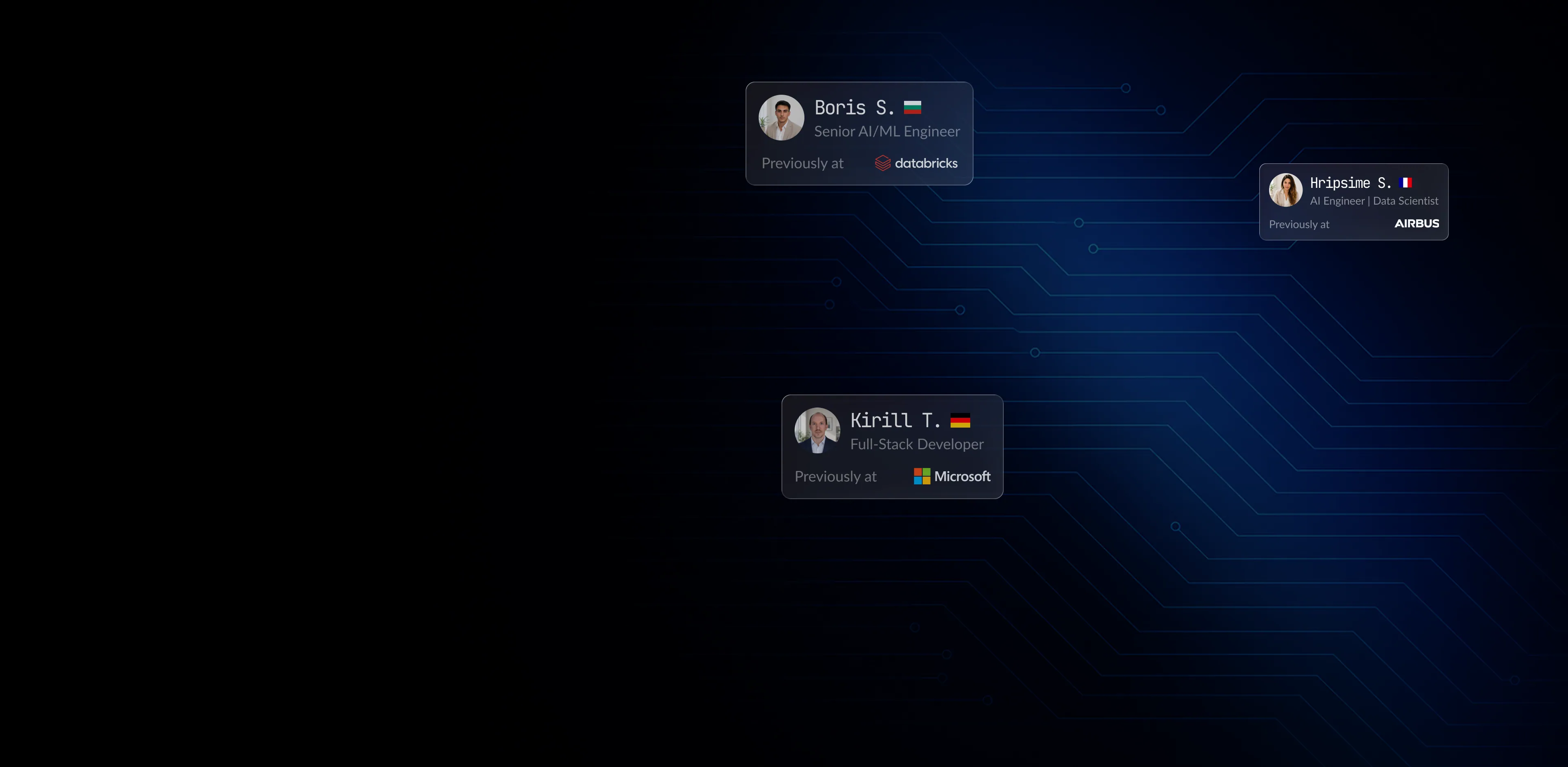
Boris S.
Available Now
Boris S.Verified in SoftDoes
Senior AI/ML Engineer
BG 🇧🇬English (B2)Senior
PythonSQLBashFastAPI

Senior AI/ML Engineer with 10+ years of experience designing and deploying large-scale machine learning and generative AI systems in production environments. Specialized in LLM architectures, agentic AI systems, distributed ML infrastructure, and end-to-end MLOps platforms. Proven track record of delivering high-impact AI products including diagnostic AI systems improving accuracy by 38% and enterprise ML platforms accelerating data pipelines by 40%. Experienced in leading cross-functional teams, architecting scalable AI platforms, and driving AI innovation across healthcare, enterprise analytics, and automation domains.

Eugene M.
Available Now
Eugene M.Verified in SoftDoes
DevOps Engineer
ES 🇪🇸English (C2)Senior
AWSGoogle CloudKubernetesTerraform

10+ years in IT, 7+ years focused on DevOps/SysOps/SRE. Currently - Tech Lead at a U.S. company.

Hripsime S.
Available Now
Hripsime S.Verified in SoftDoes
AI Engineer | Data Scientist
FR 🇫🇷English (C1)Senior
Deep LearningMachine LearningInterpretabilityConvolutional Neural Networks

AI engineer with 6+ years of professional experience, available to start a new challenging role in stimulating and innovative company.

Mario J.
Available Now
Mario J.Verified in SoftDoes
Senior Data Engineer
GT 🇬🇹English (C1)Senior
PythonSQLPandasPySpark

Over the past 8 years, I have gained ample experience in ETL/ELT, Snowflake, Airflow, and Data Warehouse. I have been responsible for Data Lake Support and creating new ETL/ELT processes within AWS using either Snowflake, Glue, Airflow, dbt, Xplenty, Docker, or Custom Python Scripts with APIs. I have also worked as an Application Architect, which includes over 50 different services across AWS. I needed to create pipelines, organizations, and permissions within AWS Infrastructure to meet business requirements while optimizing costs. My previous work includes over four years as a Data Analyst, creating and supporting BI Tools like Sisense, Quicksight, and Power BI/Tableau. I managed and created dashboards, widgets, and Data Architecture with Sisense and Redshift. I was also the Support Engineer for Sisense Installation and Maintenance. I would describe myself as reliable and able to undertake complex situations with unique solutions. I have over 7 years of experience in the Data sector, over 17+ years of SQL experience, and 20+ years as a Developer. I’m also a mid-QA Automation Engineer, which gives me a better idea of the attention to detail a developer needs to attain to complete development within the time limit and without affecting PROD releases. My other skills include being a Sysadmin in both Windows and Linux environments, a company Web Services AWS, a company 365 Portal, JumpCloud, 1Password, and Slack. I also have DBA knowledge, including creating servers and Data Warehouses. I'm an expert in MS Office and can automate with macros. I’m also a Cybersecurity advocate since I’m always looking for ways to protect data and user permissions. I have been in Agile Development with Jira in Kanban and Scrum for the past 4 years. And I have also created bots to automatize process alerts and configurations with Slack APIs and AWS to help my teammates get prompt feedback from the ETL pipelines.

Raphael O.
Available Now
Raphael O.Verified in SoftDoes
Snr. Staff Software Engineer
US 🇺🇸English (Native)Senior
LeadershipAgileBig dataAPI design

I am a technical leader and problem solver who designs and delivers scalable, distributed software and AI systems that create measurable business value. I have led cross-functional teams and platform initiatives, translating complex requirements into reliable, production-ready solutions built on open standards. My experience spans architecting, mentoring, and driving execution across diverse technology stacks, with a strong focus on operational excellence, product impact, and long-term system sustainability.

Santiago G.
Available Now
Santiago G.Verified in SoftDoes
DevOps Engineer
US 🇺🇸English (C1)Senior
LinuxBashDockerAnsible

Energetic, adaptable, mission-focused and multilingual MBA professional with more than 20 years of experience in IT, Business Intelligence, Marketing and Finance in 4 multinationals. Proven track record of finding creative solutions to solving challenges. Effective presenter who collaborates well in teams and across divisions. Passion for learning and acquiring new skills every day.

Thierry M.
Available Now
Thierry M.Verified in SoftDoes
Senior Infrastructure / Production Engineer
US 🇺🇸English (C1)Senior
AWSGoogle CloudAzureKubernetes

15+ years of experience designing and operating large-scale distributed systems and latency-sensitive production platforms. Expertise in multi-region Kubernetes infrastructure, hybrid cloud environments, and production reliability engineering, with a strong focus on scalability, fault tolerance, observability, and operational automation. Deep experience building and operating hybrid bare-metal and cloud platforms (AWS, GCP), including Kubernetes infrastructure, traffic routing, CI/CD systems, and production observability stacks supporting globally distributed workloads. Strong background in incident response, Linux systems, networking, distributed systems troubleshooting, and infrastructure automation using Terraform and Python. Focused on end-to-end ownership of production infrastructure platforms while partnering closely with engineering teams to improve reliability, security, deployment consistency, and operational efficiency.

Thomas S.
Available Now
Thomas S.Verified in SoftDoes
Technical leader at a company AI Core
DE 🇩🇪English (C1)Team Lead
LeadershipMentorshipGenerative AIPyTorch

Technical leader at a company AI Core, building and operating cloud-native AI platform services from prototype to production. Hands-on across backend engineering, distributed systems, and Kubernetes, driving technical direction and delivery across teams without direct authority.

Tzechung K.
Available Now
Tzechung K.Verified in SoftDoes
Lead AI/ML Developer
US 🇺🇸English (Native)Senior
Claude CodeOpenAI CodexGoogle AntigravityLLM Fine-Tuning

Software Engineer with 10+ years of AI/ML experience and proven expertise in developing LLM-powered applications, generative AI systems, and ad engines. Strong track record of scaling ML platforms from inception to 1,500+ users at a company, building production AI systems, and creating innovative ad solutions. Experienced in full software development lifecycle with deep knowledge of PyTorch, TensorFlow, and modern AI frameworks including LangChain, LangGraph, and various LLM APIs.

Discover More Ecmascript Developers in the SoftDoes NetworkRegister to view more

What our Ecmascript Developers
can build

Not sure which engagement model fits?

SoftDoes takes full ownership of delivery, combining project management, engineering, design, and QA into one accountable team focused on successful outcomes.

FIND THE
RIGHT expert, FASTER

Choose a role. Filter by technology.
Discover developers that match your project requirements.

What we do for you

From sourcing and vetting to onboarding and ongoing support, we handle the entire process so you can focus on building products instead of managing hiring.

Sourcing and vettingAll our developers are fully vetted and tested for both soft and hard skills. No surprises.
Expert matchingWe match fast, but with a human touch. Your candidates are hand-picked for your request.
One Contract, Zero OverheadYou sign one agreement with us. We handle developer contracts, reporting, and payments.
Support and troubleshootingThings happen, but you have a customer success manager and a 100% free replacement guarantee.

$14.5 /per hour

  • Personal Recruitment
  • Payroll Management
  • Time Management & Reports
  • 24 Support
  • Free Trial
Eugene M.DevOps EngineerAWS / GCP / Terraform / Gitlab
AWS / GCP / Terraform / Gitlab
Rate$53 / hour
LanguagesEnglish
previously at

Unbeatable Transparent Pricing Model.

Work with senior-level engineers through a clear and scalable engagement model built for modern teams. No hidden fees, long hiring cycles, or unpredictable outsourcing costs — just vetted talent, flexible collaboration, and full operational transparency from day one.

Whatever your Ecmascript challenge, we've solved it before

Whether you're scaling your team, modernizing an application, or accelerating product delivery, our React engineers become an extension of your team from day one.

Scale your capacityQuickly add senior React developers without lengthy hiring cycles or onboarding delays.
Deep expertiseAccess engineers experienced with React, Next.js, TypeScript, modern frontend architecture, testing, and performance optimization.
Ship your roadmap fasterIncrease development velocity, reduce bottlenecks, and deliver new features with confidence.

Great engineering talent, simplified.

Remote developers - interviewed, verified, and ready for you.

Frequently Asked Questions

Everything you need to know about deploying, scaling, and securing your neural agents with SoftDoes. Can’t find an answer?

How quickly can SoftDoes deploy senior engineers with proven ECMAScript expertise?

In most cases we can present qualified senior engineers within days of your discovery session, because our candidates are already vetted and actively available rather than sourced from scratch. Once you confirm a match, onboarding can begin almost immediately, with the engineer gaining repository access and shipping initial commits during the first weeks. The exact timeline depends on how specialized your requirements are, for instance deep Node.js module interop or a large TypeScript migration, but we scope that openly up front. Our goal is to compress the months a traditional hiring cycle consumes into a short, predictable ramp.

What pricing models and rates should we expect when hiring dedicated ECMAScript talent?

We typically work on transparent monthly rates for dedicated engineers, with pricing shaped by seniority, specialization and team composition. A single embedded specialist is priced differently from a full delivery pod that includes a technical lead and oversight. There are no hidden recruiting fees layered on top, and you avoid the benefits, equipment and turnover costs tied to full time employment. During discovery we map your goals to a recommended team shape and give you a clear quote, so you can compare total cost of ownership directly against in house hiring before committing to anything.

How is time zone overlap with North America handled for ECMAScript engineering teams?

Because we focus on clients across the US and Canada, we structure every engagement around meaningful working hour overlap with your team. Engineers join your standups, planning sessions and code reviews in real time rather than leaving everything to asynchronous handoffs. We agree on core collaboration hours during onboarding and align them with your release windows and incident response expectations. For teams spanning multiple North American time zones, we plan coverage so critical work and production support stay responsive. The result is collaboration that feels like an extension of your own office instead of a distant vendor relationship.

What does your technical vetting methodology look like for ECMAScript expertise?

Our vetting is run by practicing engineers, not keyword screeners. Candidates work through live problem solving on realistic code, such as refactoring callback based modules into clean async and await flows with correct error handling. They review build configurations and explain decisions about transpilation, polyfill targets, module boundaries and code splitting. We probe fundamentals like the event loop, closures, prototypes and coercion rules, then assess communication by asking them to explain tradeoffs to a nontechnical stakeholder. Finally we verify production history through detailed discussion of real projects, including what failed and what they learned from it.

Who owns the intellectual property produced by engineers working on our ECMAScript systems?

You do. Our agreements assign full ownership of all code, documentation and related work product created for your engagement to your company. Engineers work under confidentiality obligations, and access to your repositories and systems follows the security policies you define. When an engagement ends or an engineer rotates off, all work stays in your repositories and under your control, with no licensing strings attached. We are happy to walk your legal team through the contract terms during discovery so ownership, confidentiality and compliance expectations are completely clear before any engineer writes a single line of code.

How flexible are your contracts if our ECMAScript project scope or team size changes?

Flexibility is built into how we work. If priorities shift, you can scale a team up when a migration or launch demands more capacity, or scale down once the core work stabilizes, with reasonable notice rather than punitive lock in terms. You can also change the team shape, for example moving from a single embedded specialist to a full delivery pod. If an engineer is not the right fit, our replacement guarantee means we bring in a suitable alternative quickly at no additional risk to you, so your roadmap keeps moving while the team adjusts.

The Executive Guide to Hiring ECMAScript Expertise

A wrong hire in ECMAScript engineering rarely fails loudly. It fails quietly: a bloated bundle that slows every page, a half finished module migration that blocks releases, async code that drops errors in production and nobody notices for weeks. Meanwhile a slow hiring pipeline leaves your roadmap frozen while competitors ship. The right senior engineer reverses all of that within a single quarter, cutting load times, unblocking upgrades and stabilizing the codebase your revenue depends on. This playbook gives you a field tested strategy to define, vet, and integrate top tier ECMAScript talent without gambling your budget or your delivery schedule.

What Is Really at Stake When You Hire for the Language Itself

Beyond Syntax: How Senior ECMAScript Engineers Actually Operate

Most candidates can write JavaScript. Far fewer understand the language standard underneath it well enough to make sound architectural calls. If you need general product builders, our guide to hiring JavaScript developers covers that profile. This role is different: deep mastery of ECMAScript shows up as business impact, system resilience, and disciplined tradeoff management, not framework trivia.

  • Owning the runtime contract. A senior engineer knows exactly which standard features your target browsers and Node.js versions support, follows TC39 proposals through the staged process, and refuses to ship stage two experiments into production code that must stay stable for years.
  • Architecting with modules, not around them. They design clean ES module boundaries, manage CommonJS interop in Node.js, publish dual packages when consumers need both, and structure code so bundlers like Vite, esbuild, Rollup and webpack can tree shake aggressively and keep payloads lean.
  • Tuning compatibility budgets. They configure Babel or SWC transpilation, core js polyfills and Browserslist targets deliberately. Overpolyfilling quietly inflates every bundle you ship, while underpolyfilling breaks checkout for customers on older browsers. Getting this balance right is a revenue decision, not a build detail.
  • Debugging at the level of the event loop. When production behaves strangely, they reason about microtasks, Promise resolution order, closures and scope instead of guessing. That depth turns multiday incidents into focused fixes and prevents race conditions from reaching paying users in the first place.
  • Hunting memory leaks and performance drains. They track down lingering references in closures, event listeners and caches, understand prototypes behind class syntax, and use dynamic import for code splitting so heavy features load only when users actually need them, protecting both speed and infrastructure spend.
  • Leading modernization without stopping delivery. They migrate callback and jQuery era code to async and await, convert CommonJS to ES modules, and introduce TypeScript incrementally. The business keeps shipping features while the foundation gets stronger, instead of pausing for a risky rewrite nobody can finish.

The Business Case for Deep Language Mastery

  • Technical debt reduction. Legacy patterns like nested callbacks, global state and ad hoc module loaders make every change slower and riskier. An engineer fluent in modern ECMAScript retires that debt systematically, so each new feature costs less to build, test and maintain than the one before it.
  • Faster deployment cycles. Clean module boundaries, predictable async flows and a modern build pipeline shorten feedback loops for the whole team. Builds run faster, tests become more reliable, and releases stop depending on one veteran who remembers which fragile file must never be touched.
  • Infrastructure and delivery cost optimization. Smaller bundles through tree shaking, correct polyfill targeting and smart code splitting reduce bandwidth, CDN egress and client side processing. On server workloads, efficient async patterns and leak free code let the same hardware handle more traffic before you scale out.
  • System reliability. Precise handling of equality and coercion rules, nullish coalescing, optional chaining and error propagation in async code removes entire classes of production bugs. Fewer incidents mean fewer late night escalations, steadier customer experience and a support team that is not drowning in avoidable tickets.

Preparing Before You Open the Search

Start With a Hard Audit of Your Technical Constraints

Before you review a single profile, get specific about the problem you are paying to solve. Vague searches attract vague candidates.

Pinpoint the Bottleneck Your Hire Must Break First

Name the single systemic constraint that hurts most today. Is it a sprawling CommonJS codebase that blocks adoption of modern tooling? A bundle so heavy that mobile conversion suffers? Async code that intermittently swallows errors? A Node.js runtime stuck several versions behind because nobody trusts the upgrade path? Each of these demands a different emphasis in the person you hire. Write the bottleneck down in one sentence, attach the metric that proves it matters, and make it the first item in every interview. If you cannot articulate the constraint clearly, no candidate will solve it, regardless of how impressive their resume looks.

Decide Between an Embedded Specialist and a Delivery Pod

Next, decide how much autonomy the role carries. An embedded ECMAScript specialist joins your existing squad, raises the language standard across the team, reviews pull requests and leads targeted modernization work. That works when you already have strong product leadership and only need deep expertise. A dedicated delivery pod pairs senior engineers with a technical lead who owns a full workstream, such as a complete module migration or a performance overhaul, end to end. Pods suit organizations that lack bandwidth to manage the work internally. Choosing wrong means either paying for management you do not need or leaving a specialist without direction.

Weigh In House Hiring Against Vetted Dedicated Talent

Finally, be honest about deployment friction. A traditional full time hire typically means months of sourcing, interviewing, negotiating and notice periods before the first commit lands, plus benefits overhead and the real risk that the person underdelivers after you have invested heavily. Vetted dedicated remote talent compresses that timeline dramatically, because screening has already happened and engineers are available to start quickly. For North American companies, nearshore or timezone aligned engineers keep collaboration real time. The right answer often blends both: a dedicated senior engineer to break the bottleneck now, while you build permanent headcount at a deliberate pace.

Build a Requirement Profile, Not a Generic Job Description

  • Core outcome and mission. Define success as a business result, not a list of duties. For example: migrate the shared library to ES modules with dual package support within one quarter without breaking downstream consumers. A precise outcome filters out candidates who only want to describe tools they enjoy using.
  • Technical stack ecosystem. Specify your runtimes, target browsers, bundler, transpiler and testing tools, plus whether TypeScript is present or planned. A candidate who has tuned Browserslist targets and SWC pipelines in a similar environment ramps far faster than someone fluent only in a single framework layer.
  • Decision making authority. State clearly what this engineer can decide alone, such as adopting new language features, changing build configuration or setting lint rules, and what requires sign off. Senior talent wants real ownership; ambiguity about authority drives the best people away and leaves weaker ones paralyzed.
  • System impact. Describe which systems this person touches and what breaks if they get it wrong: checkout, authentication, shared component libraries, public APIs. This tells candidates the stakes, and it tells your interviewers which failure modes to probe hardest during the technical evaluation stage.

To Contact Page

Let’s Turn Your Idea into Scalable Software

Book a call with the representative to get answers to all the questions you may have.

Vetting Talent and Getting Them Productive Fast

A Vetting Framework Built for Real Production Work

Resumes full of keywords tell you almost nothing about whether someone can safely modernize a revenue critical codebase. Your process has to surface actual judgment.

Where Strong Candidates Actually Come From

Traditional recruiters screen for buzzwords. They see "ES6" and "async" on a profile and forward it, with no way to tell whether the candidate led a module migration or simply read about one. That pushes the real screening onto your senior engineers, who lose days to interviews that go nowhere. Pre screened engineering networks flip the equation: candidates arrive with verified production experience in ECMAScript, already assessed by practicing engineers. Drawing from a vetted talent network means your team spends interview time confirming fit and judgment, not filtering out people who never should have reached the calendar.

The Technical Evaluation Pipeline That Predicts Performance

Skip language trivia and whiteboard puzzles. Instead, run live problem solving on realistic code: give candidates a callback heavy module and ask them to refactor it to async and await while preserving error handling. Follow with a real world architecture review, where they assess a build configuration and explain how they would set polyfill targets, structure ES module boundaries and enable code splitting. Watch communication under pressure by introducing a production incident mid discussion. Finally, check cross functional fit: can they explain a tradeoff to a product manager in plain language without hiding behind jargon or condescension?

The First 90 Days: A Ramp Up Plan That Pays Off Immediately

  • Days 1 to 30: access and first wins. Grant repository, CI and environment access on day one. The engineer audits the build pipeline, transpilation targets and module structure, documents the top risks, and ships small production ready commits, such as fixing a polyfill gap or a leaking listener, within the first two weeks.
  • Days 31 to 60: owned workstream. The engineer takes full ownership of the bottleneck defined during your audit, whether that is a CommonJS to ES module migration, bundle size reduction or async error handling cleanup. Progress is measured against agreed metrics, and code reviews start lifting standards across the wider team.
  • Days 61 to 90: measurable impact and leverage. The primary workstream reaches production with visible results in build times, bundle size or incident volume. The engineer documents patterns, sets lint rules and conventions for modern ECMAScript usage, and mentors teammates so the improvements outlast any single person on the team.

Making the Final Call With Confidence

Signals That Separate Liabilities From Leaders in the Interview

Red flags

  • Over engineering simple problems. The candidate reaches for elaborate abstractions, custom build plugins or experimental proposals when a plain function and a standard feature would do. That instinct produces fragile systems that only its author understands, and it slows every engineer who inherits the code later.
  • Tool obsession over business outcomes. They talk endlessly about their favorite bundler or syntax trick but never connect choices to load time, reliability or delivery speed. Engineers who optimize for personal preference will happily rebuild your toolchain while your product roadmap quietly stalls.
  • No honest account of past failures. When asked about a migration or release that went wrong in an ECMAScript environment, they deflect, blame others or claim nothing ever broke. Senior people have scars. Inability to discuss them signals either limited real exposure or a dangerous lack of self awareness.
  • Shallow grasp of language fundamentals. They cannot explain microtask ordering, why loose equality surprises people, or how class syntax maps to prototypes. Without that foundation, they will misdiagnose production bugs and introduce subtle defects that surface only under real user load and traffic.

Green flags

  • Pragmatic tradeoff analysis. They weigh options openly: adopt a new feature now with a polyfill, or wait until target browsers support it natively? They articulate costs, risks and a recommendation, and they are comfortable choosing the boring option when it serves the business better than novelty.
  • Focus on data and system integrity. They worry about what happens to data when async operations fail halfway, how errors propagate, and whether immutable helpers like toSorted prevent accidental mutation. That instinct protects customers and keeps your systems trustworthy as complexity grows over time.
  • Proactive risk identification. Before touching code, they ask about downstream consumers, browser support, test coverage and rollback plans. They spot the risks in a migration before anyone asks, and they propose incremental steps that keep production stable while the work moves forward.
  • Command of ECMAScript edge cases. They explain nullish coalescing versus logical OR, BigInt pitfalls, top level await implications for module loading, and ES module versus CommonJS interop quirks with ease. This depth is exactly what turns a mysterious production bug into a quick, confident fix.

Why Leaders Partner With SoftDoes

SoftDoes is a North America focused custom software engineering and data and AI partner serving clients across the US and Canada. We deploy battle tested senior engineers with verified ECMAScript expertise, backed by engineering led delivery oversight rather than unmanaged freelancers. Our technical leads keep work aligned with your outcomes, whether we embed a specialist in your team or run full web app development engagements end to end. You get rapid deployment, the flexibility to scale up or down as priorities shift, and a zero risk replacement guarantee if the fit is not right. You carry the business goals; we carry the hiring risk.

The Bottom Line and Your Next Move

Engineering execution is business performance, and the depth of your ECMAScript talent decides how fast, lean and reliable your product can be. Do not let another quarter slip on a stalled migration, a bloated bundle or a hiring pipeline that never closes. Book a technical discovery session with SoftDoes solution architects, walk us through your bottleneck, and leave with a concrete plan and a shortlist of vetted senior engineers ready to deliver.

Flag icon

U.S.-Based

Discuss Your Project

This is a no-pressure, 30-minute conversation. We will talk through what you are building, identify risks or unknowns, and outline what it would take to do it right.

Certificates

Let's build together.

Talk with a senior engineer about your product idea, architecture, and what it would take to build it.

Upload File
