



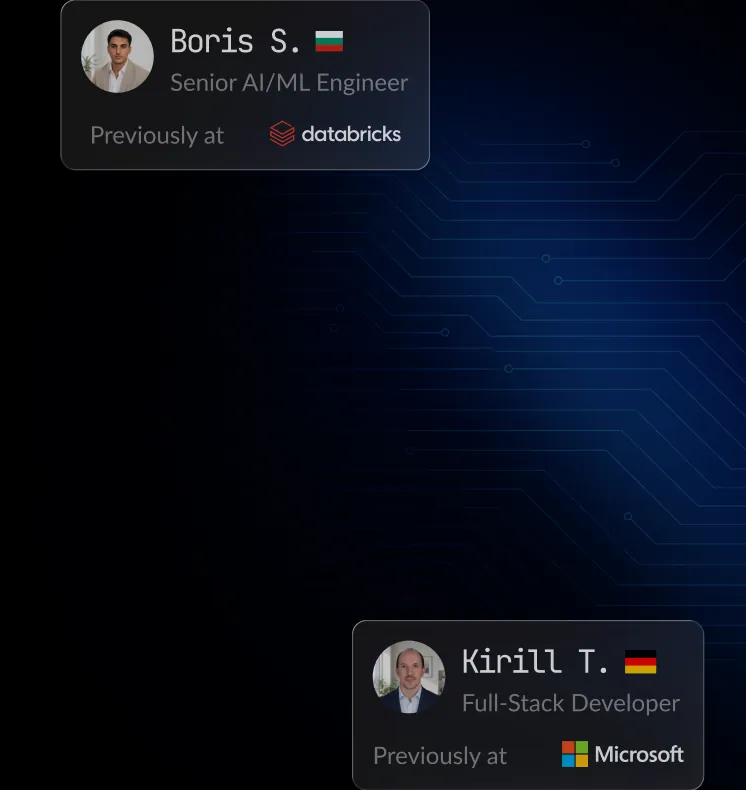

Hire Swagger Developers With U.S. Support
Need predictive analytics and AI-driven insights? Hire expert Swagger developer for smarter decision-making.
Senior Swagger Engineers
Only vetted developers with 5+ years of experience.
24h Candidate Match
Receive the first matching profiles within one business day.
Delivery Team Included
We provide a complete delivery team to ensure results.
























Hire remote Swagger Developer
Discover developers that match your project requirements.AS
A seasoned QA Engineer with a focus on both manual and automated for web and mobile enterprise-level solutions. Experienced in end-to-end tests, integration, performance, functional, and unit test coverage. Also, have a rich experience in support and communications with engineers and non-technical people.
AG
Senior Node Developer with hands-on experience in JavaScript, TypeScript, Express.js.
AH
Self-motivated and goal-oriented manual QA engineer, with strong attention to the details. Will be glad to ensure the functionality of the software is working properly, and identify critical issues that decrease user satisfaction. I like technologies and have a desire to improve software quality from the QA perspective. My strong sides are great analytical skills and attention to details. The most important for me is the result, and meeting the deadlines.
AD
I’m a manual QA engineer with a good understanding of various QA approaches, tools, and always work hard to ensure the software is running properly. In most cases, I’ve worked with the remote Agile teams, and actively took part in the team cooperation. My strong sides are: good soft skills, and passion for what I do. Honing skills is something I pursue, and don’t lose a chance to sharpen them, as well as discover something new in the QA field.
AK
Senior Node.js Developer offering 6+ years in the IT industry. My background includes expertise in developing web, client-server and other applications using Node.js, Express, Nest.js, LoopBack, and Sequelize. Highly motivated and passionate, committed to delivering the best outcomes, and consistently pushing the boundaries of what's possible. In addition, his communication skills are strong, and has experience mentoring colleagues. He is experienced in testing throughout the full system development life cycle.
DM
Senior BackEnd Developer with hands-on experience in JavaScript, Node.js, TypeScript.
DS
Knowledgeable, self-driven manual QA engineer with over 5 years of experience in the field. I have reach experience in autonomous work, work in team and being QA TeamLead on the projects. Good at software analysis, developing new test documentation, test strategies and plans, working in cros--functional remote teams. I have strong analytical skills, high attention to detail, and well- developed management skills.
IG
Team Lead Java Developer with hands-on experience in Java 11, Spring 5, Spring Boot 2.
IP
Middle+ Node/Nest Developer with hands-on experience in JavaScript, TypeScript, Express.js.
JU
I am a seasoned QA with strong analytical thinking and problem- solving skills. Being good at communication and organization, I always pay a lot of attention to the details and deliver a high level of accuracy.I have a profound understanding of the business structure, as well as requirements. I’m focused on both quality assurance, and business analysis, and ready to bring your software to fruition.
JS
QA Engineer with over 3 years of hands-on experience with a desire to develop skills in automated testing. I am conscientious about completing tasks and attentive to details. I have experience developing tests using modern tools like Cypress and Playwright to ensure the delivery of high-quality software. I am ready for new challenges in a dynamic development environment.
KM
I am an accomplished iOS developer with 5+ years of experience in creating cutting-edge applications. Proficient in Swift and Objective-C, I bring expertise in delivering high-quality, user-centric solutions. My commitment to staying current with the latest technologies ensures that I am well-prepared to tackle challenges in the ever-evolving iOS development landscape.
What our Swagger Developers can build

Which engagement model is right for you?
One engineer, ongoing delivery support, or a complete product team. You set the dial. The firm stands behind every level.

Strengthen your existing engineering team with senior specialists who integrate seamlessly into your workflows while you retain full ownership of priorities, roadmap, and day-to-day management.
- Senior engineer(s) integrated into your team.
- Fast onboarding into your workflow.
- Flexible monthly engagement.
- Replacement guarantee if needed.
- Direct communication and full transparency.

Ideal for teams that need experienced engineers backed by technical leadership, ensuring faster onboarding, predictable execution, and consistent delivery without adding management overhead.
- Dedicated senior engineer(s).
- SoftDoes delivery oversight.
- Regular technical and delivery check-ins.
- Optional code reviews and QA support.
- Escalation management.
- Replacement support.
- Flexible team scaling.

Launch products faster with a ready-to-work cross-functional team that brings together the right expertise from day one, helping you scale without the complexity of hiring each role individually.
- Engineers, QA, Designers, PMs, Tech Leads - assembled to fit your project.
- Cross-functional collaboration.
- One engagement structure and one point of contact.
- Easy scaling up or down.
- Team continuity throughout the project.
Need the outcome, not the team?
SoftDoes also delivers complete projects end to end.
- End-to-end project ownership.
- Dedicated Project Manager.
- Engineering, QA, Design, and Product expertise.
- Delivery planning and sprint management.
- Quality assurance throughout development.
- Transparent communication and regular progress updates.
- One accountable partner responsible for successful delivery.


Not sure which engagement model fits?
SoftDoes takes full ownership of delivery, combining project management, engineering, design, and QA into one accountable team focused on successful outcomes.
FIND THE
RIGHT expert, FASTER
Choose a role. Filter by technology.
Discover developers that match your project requirements.
Hire developers by role


Hire developers by tech stack






























Hire developers by industry











What we do for you
From sourcing and vetting to onboarding and ongoing support, we handle the entire process so you can focus on building products instead of managing hiring.




$14.5 / per hour
- Personal Recruitment
- Payroll Management
- Time Management & Reports
- 24/7 Support
- Free Trial

ONE ENGAGEMENT, NO SURPRISES
Work with senior engineers on a flexible monthly engagement. No recruiting fees, no long hiring cycle, no surprises in the invoice. Every placement is vetted, guaranteed, and backed by a firm you can reach when something needs attention.
Whatever Your Swagger Challenge, We've Solved It Before
Whether you're scaling your team, modernizing an application, or accelerating product delivery, our React engineers become an extension of your team from day one.



Great engineering talent, simplified.
Remote developers - interviewed, verified, and ready for you.
Frequently Asked Questions
Everything you need to know about deploying, scaling, and securing your neural agents with SoftDoes. Can’t find an answer?
How long does it typically take to hire developers with proven Swagger expertise?
Through traditional recruiting, finding an engineer with genuine OpenAPI experience often takes several weeks to a few months, because most applicants have only surface level exposure and screening them consumes significant internal time. Timelines grow longer when you also need specific framework knowledge such as Springdoc or Swashbuckle. With SoftDoes, the process is much shorter because our engineers are already vetted on real API contract work. We typically present a short list of matched candidates within days, and once you approve a profile, onboarding can start quickly, so your team begins seeing improvements to specs and tooling early.
What does it cost to hire a developer or team with deep Swagger expertise?
Cost depends on seniority, the surrounding stack, the scope of work and the engagement model you choose. A senior engineer who can set API governance and contract testing standards costs more than a mid level developer documenting existing endpoints, but they usually prevent expensive integration failures later. A dedicated pod adds backend, QA and DevOps capacity, which raises the monthly investment while shortening delivery time. SoftDoes provides transparent pricing after a short discovery call, where we review your API landscape and recommend the leanest setup that still meets your goals, so you avoid paying for capacity you do not need.
What engagement models are available for Swagger projects, such as a dedicated hire, a pod, or a contract?
SoftDoes offers flexible models that match how your API work is structured. A dedicated specialist works best when you need ongoing ownership of OpenAPI contracts, linting and SDK generation inside your existing team. A pod suits larger initiatives such as migrating a legacy Swagger 2.0 portfolio, launching a developer portal, or introducing contract testing across many services, since it combines spec, backend and QA skills. Project based contracts fit well defined scopes with clear deliverables and timelines. You can also start small with one engineer and expand into a pod as the work grows, without restarting the hiring process.
How do you ensure time zone alignment with a team skilled in Swagger?
SoftDoes focuses on clients across the US and Canada, so we match engineers whose working hours overlap meaningfully with your core business day. That overlap matters for API contract work, because spec reviews, breaking change discussions and partner integration issues often need quick answers from backend owners and product leads. During onboarding we agree on shared hours, communication channels, standup times and review expectations, so collaboration feels like working with an internal team. We also encourage written decisions in pull requests and spec comments, which keeps everyone aligned even when schedules differ slightly across offices and locations.
How does SoftDoes technically vet developers for Swagger expertise?
Our vetting goes well beyond checking for a keyword on a resume. Candidates walk through OpenAPI documents they have designed and explain decisions on reusable components, error models, security schemes such as OAuth 2 and JWT bearer, and versioning. They complete practical tasks like fixing an invalid spec, migrating a Swagger 2.0 document to OpenAPI 3, and describing how they would enforce Spectral rules and contract tests in CI. We also assess system design thinking around gateways, portals and breaking changes, plus communication skills, because good contract work depends on collaborating clearly with backend teams and API consumers.
What support is available for scaling the team after launch as our Swagger needs grow?
As your API portfolio expands, SoftDoes can add engineers to your existing setup or grow a single specialist into a full pod with backend, QA and DevOps support. Because our talent is already vetted, scaling does not require restarting a long recruiting cycle. We also provide replacement guarantees, so if an engineer is not the right fit or circumstances change, we bring in a qualified replacement with a proper handover to protect continuity. Regular check ins with your engineering leads help us anticipate upcoming needs, such as new partner integrations or gateway migrations, and plan capacity before it becomes a bottleneck.
How to Hire Developers Skilled in Swagger


Most teams discover a weak Swagger hire the hard way: the docs drift from the real endpoints, generated SDKs break on every release, and partners stop trusting your API. The right specialist does the opposite. They turn your OpenAPI contract into a single source of truth that drives documentation, client libraries, tests and gateway configuration, so integrations ship faster and break less. This guide explains what Swagger work looks like in production, how to define the role, where to source proven talent, how to vet candidates beyond the resume, and how to onboard them so they deliver value from the first sprint.
What Swagger Really Does for Your API Program
Inside the Daily Work of a Swagger Specialist
Swagger is the toolset built around the OpenAPI Specification, the standard format for describing REST APIs in YAML or JSON. The Swagger 2.0 spec was donated and renamed OpenAPI, and OpenAPI 3.0 and 3.1 are the current versions. In practice, a specialist uses it to make the API contract drive everything downstream.
- Designing and maintaining OpenAPI documents. Writing clear specs with reusable components, shared schemas, consistent error models and realistic examples, so every endpoint is described once and reused everywhere. A well structured document keeps docs, SDKs and tests aligned instead of forcing teams to patch three sources by hand.
- Choosing between design first and code first. Deciding whether to write and review the OpenAPI document before coding, or to generate it from annotations in Springdoc, Swashbuckle, NestJS Swagger or FastAPI. Each path trades consistency for speed, and a strong engineer knows which fits your release cadence.
- Generating client SDKs and server stubs. Running Swagger Codegen or the community OpenAPI Generator to produce libraries in dozens of languages, then tuning templates and configuration so the output is genuinely usable by partners. Poorly prepared specs produce clumsy SDKs, so this work starts upstream in the document itself.
- Linting and contract testing in CI. Enforcing style rules with Spectral and validating behavior with Dredd, Schemathesis or Prism mock servers. These checks catch breaking changes before merge, keep implementation and documentation in sync, and stop a quiet field rename from taking down an integration that a paying customer depends on.
- Migrating legacy specs. Converting older Swagger 2.0 documents to OpenAPI 3, fixing invalid references, removing outdated definitions and restoring trust in specs nobody has touched in years. This cleanup is common in mature API portfolios and usually unlocks better tooling, cleaner generated code and modern gateway features.
- Feeding gateways and developer portals. Publishing OpenAPI documents into AWS API Gateway, Azure API Management, Kong, Apigee, Postman, Redoc or Stoplight, and securing Swagger UI exposure deliberately. Public endpoints can reveal internal or admin routes, and outdated Swagger UI versions have had XSS issues, so this needs careful ownership.
Why Strong Swagger Skills Pay Off at the Business Level
When your API is the product or the backbone of your partner ecosystem, OpenAPI expertise directly affects revenue, support load and delivery speed. Here is where a skilled engineer earns their place, especially alongside broader API integration services.
- System stability. A validated contract enforced in CI means breaking changes are caught before release, not reported by customers. Consumers rely on predictable request and response shapes, and your support team spends less time debugging integrations that failed because documentation and implementation quietly drifted apart over several sprints.
- Faster delivery cycles. With design first workflows, frontend, mobile and partner teams can build against mock servers while the backend is still in progress. Generated SDKs remove repetitive client code, so new endpoints reach consumers sooner and each team stops waiting on another to finish before starting.
- Lower technical debt. Reusable schemas, consistent error formats and lint rules stop each team from inventing its own conventions. Over time that consistency makes the API portfolio easier to maintain, easier to version and far cheaper to migrate when you change frameworks, gateways or hosting providers.
- Scalable architecture. A clean OpenAPI document becomes the input for gateways, portals, security reviews and monitoring. As you add services, regions or partners, the contract scales with you, and new engineers can understand the whole surface quickly instead of reverse engineering behavior from scattered code.
Getting Your House in Order Before You Recruit
Clarifying What You Actually Need From a Swagger Engineer
Before you open a role, get specific about the problem you want solved. Are you documenting an existing API, building a new public platform, cleaning up years of legacy specs, or wiring contracts into a gateway and CI pipeline? Each scenario calls for a different profile. Agree internally on ownership, success criteria and the systems the hire will touch, so you can screen candidates against real work instead of a vague keyword match.
Mapping Project Scope and Architecture
Start with an honest audit of your current API landscape. List the services you run, the frameworks behind them, and whether specs exist, are generated from code, or are missing entirely. Note which APIs are public, partner facing or internal, because exposure level changes the security and versioning requirements. Decide whether you want to move toward design first or keep a code first approach with better annotations. Identify the gateways and portals the contract must feed, such as Kong, Apigee or Azure API Management. This scope document becomes the backbone of your job description and your technical interview tasks.
Choosing Seniority and the Surrounding Stack
Swagger skills rarely stand alone, so define the stack around them. A Java shop needs someone fluent in Springdoc, a .NET team needs Swashbuckle experience, and a Python or Node team should look for FastAPI or NestJS knowledge. Decide whether you need a senior engineer who can set API standards and governance across teams, or a mid level developer who can execute within an established design system. Senior profiles should understand authentication schemes like OAuth 2 and JWT bearer tokens, versioning strategy and CI integration. Matching seniority to scope keeps you from overpaying for simple work or underhiring for platform decisions.
In House Hires Versus Dedicated Remote Pods
Consider how the work will actually be delivered. An in house hire makes sense when API governance is a permanent function and you have the bandwidth to recruit, onboard and retain specialists over the long term. A dedicated remote pod fits better when you need a contract cleanup, a migration from Swagger 2.0 to OpenAPI 3, or a new developer portal on a tight timeline. Pods bring complementary skills, such as backend, QA and DevOps, so the spec, the tests and the pipeline move together. Many companies combine both: a small internal owner with an external pod handling delivery.
Building a Requirement Profile That Attracts the Right People
A strong requirement profile filters out generalists who simply list Swagger as a keyword. Cover these four elements clearly.
- The technical mission. State the concrete outcome, such as migrating the legacy specs to OpenAPI 3, launching a public developer portal, or introducing contract testing. Candidates who have solved that exact problem will recognize it immediately and respond, while weaker applicants will find it harder to fake their fit.
- The ecosystem and tooling. Name the frameworks, generators, linters and gateways involved, for example Springdoc, OpenAPI Generator, Spectral, Prism and AWS API Gateway. Specific tooling signals a serious engineering culture and lets candidates judge whether their experience genuinely matches your environment before they invest time in interviews.
- Team dynamics. Explain who the engineer will work with: backend teams, frontend consumers, partner integrators, security reviewers or product managers. API contract work is collaborative by nature, so describe review processes, ownership boundaries and how decisions about breaking changes are made and communicated across your organization.
- System impact. Describe what success changes for the business, such as fewer integration tickets, faster partner onboarding or reliable SDK releases. Engineers who think about consumers and outcomes, not just syntax, are the ones who build contracts that last, and they respond well to clear impact statements.

Let’s Turn Your Idea into Scalable Software
Book a call with the representative to get answers to all the questions you may have.
Sourcing, Vetting and Onboarding Swagger Talent
A Hiring Process That Separates Real Experts From Keyword Matches
Swagger appears on countless resumes, but real OpenAPI mastery is much rarer. Your process should test how candidates design contracts, protect consumers and wire specs into delivery pipelines, not whether they have opened Swagger UI before.
Where to Find Proven Candidates
Standard outbound recruiting means writing job posts, screening large volumes of applicants and running several interview rounds yourself. It works, but it is slow, and most of the pipeline will be backend developers with only surface level Swagger exposure. Pre vetted talent networks shorten the path because engineers have already been assessed on real API work, including spec design, code generation and contract testing. If speed and predictability matter, start with a curated talent network that can show a track record of OpenAPI delivery, then reserve your internal interview time for final fit and architecture discussions with a short list.
How to Vet Beyond the Resume
Ask candidates to walk through an OpenAPI document they designed and explain their choices on components, error models, security schemes and versioning. Give a practical task: review a flawed spec, fix invalid references, add a missing endpoint, and describe how they would lint and contract test it in CI. Add a system design question about rolling out a breaking change without disrupting partners. This reveals problem solving under real constraints. Finally, assess culture fit by asking how they handle disagreements with backend teams over contract design, since API work depends on clear communication and shared ownership.
Your First Ninety Days With a New Swagger Engineer
A structured ramp up gets your new hire or pod shipping production ready contracts quickly and safely.
- Days 1 to 30: access and audit. Grant repository, CI, gateway and portal access on day one. Pair the engineer with an API owner, share existing specs and integration pain points, and ask for a written audit covering spec quality, linting gaps, security exposure of Swagger UI, and a prioritized list of quick wins to tackle first.
- Days 31 to 60: first improvements in production. Expect the engineer to ship tangible fixes, such as adding Spectral rules to CI, introducing reusable schemas, or migrating one Swagger 2.0 document to OpenAPI 3. Keep the scope narrow and measurable so the team sees value early and trusts the new contract workflow before it expands further.
- Days 61 to 90: ownership and scale. Hand over ownership of the contract process: versioning rules, SDK generation, contract testing and portal publishing. The engineer should document standards for other teams, review spec changes in pull requests, and propose a roadmap for the remaining APIs, gateway integrations and partner facing improvements over the following quarters.
Choosing With Confidence
Warning Signs and Strong Signals in Swagger Interviews
Red flags
- The candidate only knows Swagger UI as a page that appears automatically and cannot explain the OpenAPI document behind it. That usually means they have never designed a contract, structured reusable components, or owned documentation quality across more than one service in a real production environment.
- They cannot explain the difference between Swagger 2.0 and OpenAPI 3, or why migration matters. Gaps here suggest limited experience with legacy portfolios, and they may struggle with components, request bodies, callbacks and the tooling improvements that newer versions of the specification make possible.
- They have no opinion on design first versus code first workflows. Experienced engineers have worked with both and can describe concrete tradeoffs for consistency, review speed and team coordination, rather than simply defaulting to whatever their last framework generated without much thought or discussion.
- They treat security as an afterthought, happily exposing Swagger UI in production with internal routes visible, or ignoring outdated versions. A senior engineer knows public documentation endpoints need deliberate decisions, authentication, and regular updates to avoid leaking admin routes or known vulnerabilities.
Green flags
- They talk about the spec as a contract with consumers, describing reusable schemas, consistent error models and realistic examples. Their focus is on what partners and frontend teams experience, which leads to SDKs and documentation that people actually adopt without constant support or clarification calls.
- They describe linting and contract testing in CI with specific tools like Spectral, Dredd, Schemathesis or Prism. Automation is how mature teams keep implementation and documentation aligned, and candidates who build it naturally reduce the risk of silent breaking changes reaching customers.
- They have shipped generated SDKs or server stubs with OpenAPI Generator and know how to tune templates and configuration. This shows they understand that generator output quality depends on how the source document is written, not only on the tool itself or its default settings.
- They can explain how specs feed gateways and portals such as Kong, Apigee, AWS API Gateway or Redoc. That systems view means they will connect API design to deployment, governance and developer experience instead of treating documentation as an isolated, purely cosmetic task.
What Sets SoftDoes Apart as Your Delivery Partner
SoftDoes is a North America focused software engineering and talent delivery partner serving clients across the US and Canada. We give you immediate access to pre vetted senior engineers who have designed OpenAPI contracts, migrated legacy specs and wired contract testing into CI. You get a team delivery model rather than isolated freelancers, so spec work, backend changes and QA move together. Replacement and scaling guarantees protect your timeline, and engagement models range from a single specialist to a full pod. If your Swagger work is part of a broader integration effort, you can also hire API integration developers from the same vetted bench.
Let's Get Your API Contract Under Control
If your API documentation drifts, your SDKs break, or your partners keep asking what an endpoint really returns, it is time to bring in proven Swagger expertise. Schedule a discovery call with SoftDoes. We will review your current API landscape, recommend the right profile or pod, and introduce vetted engineers who can start improving your OpenAPI contracts quickly. Tell us what you need to ship, and we will build the team to deliver it.


