If you're an L&D, HR, or IT leader at a U.S. or Canadian company weighing whether to build a custom corporate learning management system or subscribe to a ready-made platform, the answer depends on how central training is to your operations, how many people you need to train, and how tightly learning must connect to your core business systems. The short answer: For companies with fewer than 500 learners and standard compliance training or onboarding needs, an off the shelf LMS wins on speed and low upfront cost. For enterprise organizations with 1,000+ learners, multiple audiences, regulated workflows, or deep integration requirements, a custom LMS delivers better long-term value, lower per-user costs at scale, and the control needed to tie corporate learning directly to business outcomes. Many companies start off the shelf and migrate to custom once pain points justify it.
What Is a Custom Corporate LMS Platform?
A custom corporate learning management system is a learning platform designed and engineered specifically for one organization's workflows, audiences, and compliance requirements. Rather than adapting your processes to fit a vendor's product, a custom built LMS is shaped around how your teams actually work, often built by a software engineering partner like SoftDoes.
Defining traits of a custom LMS:
- Built around the company's workflows, roles, and approval chains (e.g., role-based learning paths for field technicians vs HQ staff).
- Deep integrations with your existing systems, including HRIS, payroll, CRM, data warehouses, and identity providers like Okta or Azure AD.
- Complete control over UX, branding, data model, reporting, and deployment, whether that's your preferred cloud provider, a private VPC, or on-premises infrastructure.
- Ability to embed advanced capabilities such as AI powered content creation, automated course recommendations, skills mapping, or industry-specific compliance logic, supported by robust MLOps practices for operationalizing machine learning.
- Higher initial investment and longer implementation timelines, but designed for long-term fit and full ownership.
Typical buyers are mid-market and enterprise companies (500+ employees) in regulated fields like healthcare, financial services, and energy, where corporate training is mission critical and not a side function. For healthcare organizations, partnering with healthcare software development experts focused on HIPAA-compliant solutions ensures the LMS aligns with strict regulatory demands. Developing a custom learning management system provides total control over design, ensuring every feature maps to actual training needs.
What Is an Off-the-Shelf Corporate LMS?
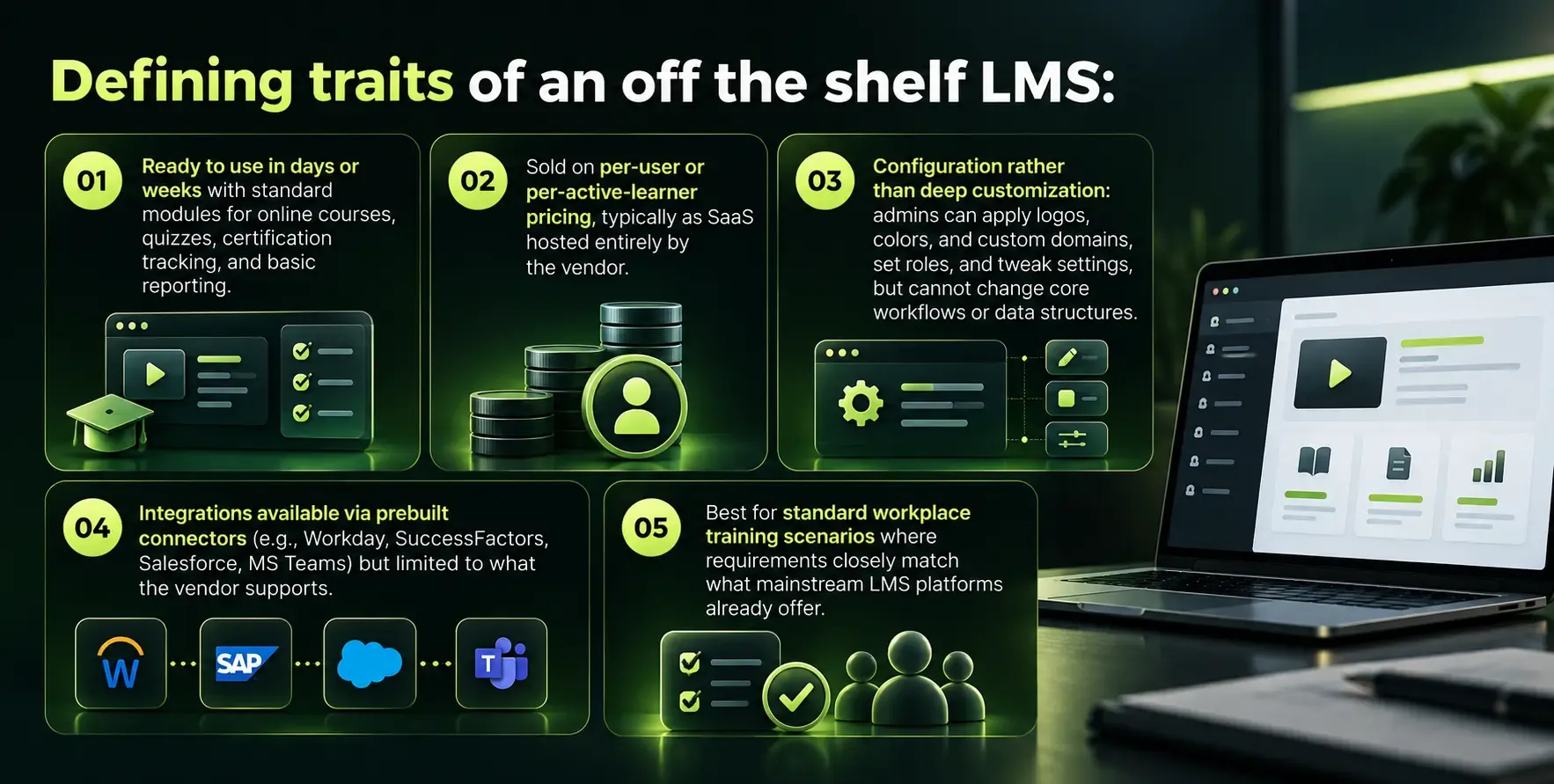
An off the shelf LMS is a subscription-based, prebuilt learning platform such as Docebo, SAP Litmos, Absorb, Cornerstone, or Cypher Learning. These LMS platforms offer standardized features designed to cover the most common corporate learning scenarios out of the box.
Vendors update features regularly, but the product roadmap is controlled by the vendor. Off-the-shelf learning management systems are essentially one-size-fits-all solutions, which works well until your training programs outgrow what the platform can handle.
Custom vs Off-the-Shelf Corporate LMS: Comparison at a Glance
The table below summarizes the main decision factors for U.S. and Canadian organizations evaluating custom LMS software development against a ready-made subscription.
Factor |
Best for | Enterprise or mid-market with complex, regulated, or multi-audience needs | Small to mid-sized teams with standard onboarding, compliance, and product training |
Upfront cost (Year 1) | $100,000–$500,000+ depending on scope | $8–$20/user/month (SaaS subscription) |
Time to initial launch | 3–6 months for MVP; 6–12 months for full rollout | 2–8 weeks for standard configuration |
Integration depth | Fully custom; built around your existing tools and data pipelines | Limited to vendor-provided APIs and connectors |
Compliance & data residency | Fine-grained control; architected to your security posture | Vendor-defined; shared responsibility model |
3–5 year total cost of ownership | Higher upfront, lower marginal cost per user at scale | Lower upfront, but per-user fees compound as learner count grows |
Decisive Factor #1: Upfront Cost vs Long-Term Total Cost of Ownership
Budget and total cost of ownership matter because L&D, HR, and IT leaders must justify every dollar to finance teams. The question isn't just "what does it cost today?" but "what will it cost over three to five years as we grow?"
Off-the-shelf LMS:
Most lms platforms in North America charge per active user per month, typically $4–$12 for basic tiers. A 1,000-employee company paying $8–$12 per active user per month faces $96,000–$144,000 annually in licensing alone, before adding implementation fees, premium support, content library subscriptions, or extra integration work. Off-the-shelf learning management systems may involve ongoing costs as user numbers increase, and large enterprise contracts can reach $100,000–$400,000+ annually. These training costs scale linearly with headcount.
Custom LMS:
Custom learning management systems require significant upfront investments for development. A focused MVP (courses, quizzes, completion tracking, admin dashboard) typically costs $25,000–$60,000 and takes roughly 8–10 weeks. A mid-tier enterprise build with SCORM/xAPI support, multiple integrations, multi-tenant capabilities, and branded UX falls in the $100,000–$150,000 range over 16–22 weeks. Complex builds with advanced analytics, AI features, and strict compliance requirements can reach $200,000–$500,000+. Recurring costs run 15–20% of the initial build annually for maintenance, hosting, and updates, but there are no per-user license fees.
Over 3–5 years for 3,000 learners, off-the-shelf licensing might total $400,000–$800,000, while a custom build plus maintenance could land at $300,000–$500,000+. Companies that invest in employee training are 24% more profitable, so the real question is which model delivers better ROI at your scale. Total cost of ownership should consider long-term expenses beyond initial setup for both options.
Winner: Off-the-shelf LMS for organizations with limited initial budget, small learner populations, or short planning horizons. The trade-off: per-user fees become increasingly expensive once your learner base and complexity grow past roughly 1,000–3,000 active users.
Decisive Factor #2: Time to Launch and Implementation Effort
Speed matters when you're onboarding new offices, facing an urgent compliance training deadline, or scaling rapidly through acquisition.
Off-the-shelf LMS:
An off-the-shelf learning management system offers faster implementation compared to custom builds. Pilot launches can happen in a few weeks; broader rollouts with SSO setup, role and permission mapping, user imports, and basic integrations typically complete in 1–3 months. Vendor-provided templates for onboarding and mandatory training accelerate readiness. Off-the-shelf LMS options typically launch faster than custom solutions, which is the platform's core advantage.
Custom LMS:
Teams like SoftDoes use a phased approach: discovery and solution design, UX/UI prototyping, MVP build, integrations, piloting, and rollout. A focused MVP takes 12–20 weeks. A fully featured enterprise platform with deep integrations into HRIS, CRM, and ERP typically needs 6–12 months. Internal effort is significant: subject matter experts, L&D leaders, IT, security, and compliance teams all need to contribute time for requirements, testing, and sign-off.
Winner: Off-the-shelf LMS if you must go live this quarter or prove value fast with limited internal bandwidth. The trade-off: the slower initial launch of a custom platform buys you a system tailored around existing processes instead of forcing process changes later.
Decisive Factor #3: Customization, UX, and Branding Control
Learner experience, accessibility, and brand alignment directly affect adoption, engagement, and completion rates. 94% of employees would stay longer with professional development opportunities, but they won't engage with a clunky, generic interface that feels disconnected from the company's identity.
Off-the-shelf LMS:
Typical branding options include logos, colors, custom domains, and limited layout control within vendor themes. Navigation, dashboards, and course flows are largely dictated by vendor presets. When you need to support very different use cases, like mixed employee and customer education portals with distinct UX needs, most shelf LMS platforms struggle. Customization in off-the-shelf options is constrained by vendor features.
Custom LMS:
Full design freedom covers information architecture, microcopy, accessibility strategy, and interaction models optimized for your workforce. Field staff on mobile devices get a streamlined mobile learning experience; desk workers get rich dashboards with personalized learning paths. Multi-portal setups allow tailored training for distinct audiences: separate branded experiences for dealers, franchises, partners, and internal teams. You can build personalized learning journeys with role-based widgets, social learning features, discussion forums, and industry-specific workflows like safety simulations for energy companies. Customization in a custom learning management system is limitless.
Winner: Custom LMS for organizations where brand, differentiated experience, and complex audiences directly affect revenue, safety, or compliance.
Decisive Factor #4: Integrations, Data, and Analytics
Integration with your HR system, CRM, and BI tools is often where corporate LMS projects succeed or fail. LMS integration reduces manual data entry and reconciliation, and effective LMS reporting helps identify skill gaps across departments.
Off-the-shelf LMS:
Common connectors include Workday, SAP SuccessFactors, BambooHR, Salesforce, Zoom, MS Teams, and Slack. But you must work within the vendor's APIs, data models, and limits on custom events or fields. Analytics typically offer strong operational dashboards but less flexibility for blending learning data with enterprise data lakes or tying training to business metrics. Advanced measurement that links training to performance data for ROI calculation is often out of reach without middleware or manual exports.
Custom LMS:
Architecture can be designed from day one for deep, two-way integrations: pushing completion data to HRIS, tying learning to performance reviews, or connecting training outcomes to sales results. Integration capabilities in a custom learning management system can be designed to fit specific internal systems. You can build data pipelines into Snowflake, BigQuery, or on-premises warehouses and expose custom KPIs in tools like Power BI or Tableau. Standards like SCORM, xAPI, and LTI are supported natively, and xAPI tracks learning activities beyond the LMS platform, including on the job training, blended learning activities, and virtual instructor led training sessions. Custom LMS development can lead to deeper integration with existing systems than any prebuilt connector.
Winner: Custom LMS if integration depth and custom analytics are critical, especially in data-rich or regulated sectors. The trade-off: more technical planning and ongoing engineering effort compared to checking boxes on vendor-provided connectors.
Decisive Factor #5: Security, Compliance, and Regulatory Requirements
North American organizations in healthcare face HIPAA requirements. Financial services companies must address SEC, FINRA, and SOX. Government contractors may need FedRAMP or CMMC compliance. Canadian organizations must comply with PIPEDA and provincial privacy laws. Data security is non-negotiable in every scenario.
Off-the-shelf LMS:
Vendor-managed learning management systems relieve organizations of many maintenance responsibilities and typically come with SOC 2 Type II certification, ISO standards, encryption in transit and at rest, and role-based access controls. However, you have limited control over data residency regions and logging detail, and must accept the vendor's shared responsibility model. When compliance training content and learner data must stay in specific jurisdictions or private networks, vendor hosting may not meet your requirements. Automated tracking of compliance training keeps organizations audit-ready, but only within the vendor's predefined audit trail capabilities.
Custom LMS:
You can architect the platform around your security posture: private VPCs, dedicated instances, and integration with existing security tooling (SIEM, IAM, DLP). Building to specific standards like HIPAA for healthcare, custom audit trails for financial services, or OSHA-specific compliance reports becomes part of the core design. A corporate LMS centralizes compliance certification and reporting exactly the way your auditors expect it. Custom retention rules and fine-grained access policies align with internal governance rather than a vendor's defaults. Standards support may require custom-built capabilities in a learning management system.
Winner: Custom LMS for organizations with strict regulatory or security requirements where control and auditability outrank convenience. The trade-off: higher responsibility and need for mature security practices, typically supported by a partner experienced in HIPAA-compliant integrations.
Decisive Factor #6: Scalability and Future Flexibility
Scalability covers both user volume (hundreds to tens of thousands) and functional evolution: AI capabilities, skills graphs, new content types, and expanding to multiple audiences over time.
Off-the-shelf LMS:
SaaS vendors handle infrastructure scaling for more users, regions, and storage, which is a genuine advantage. But per-user pricing hits hard as headcount or external learners grow. Customer education portals, partner training, and franchise programs multiply user counts fast. You also depend on the vendor's roadmap for adopting new technologies like AI, VR, or skills mapping when your organization is ready.
Custom LMS:
Cloud-native architectures using microservices on AWS or Azure scale predictably with usage, and there are no per-user fees to compound costs. You have freedom to plug in new capabilities: AI copilots, adaptive learning engines, automated course recommendations, or AI powered content creation tools as strategy evolves. A company can start with employee onboarding and later extend the same core platform to customers and partners without re-platforming, supporting structured learning paths, social learning, knowledge sharing, and external training from a single system. Companies using LMS see 24% higher profitability, and that return multiplies when the platform scales without licensing friction.
Winner: Custom LMS when you anticipate multi-audience expansion, heavy external usage, or rapid experimentation with new learning technologies. The trade-off: requires an ongoing product mindset and partnership versus a more static subscription tool.
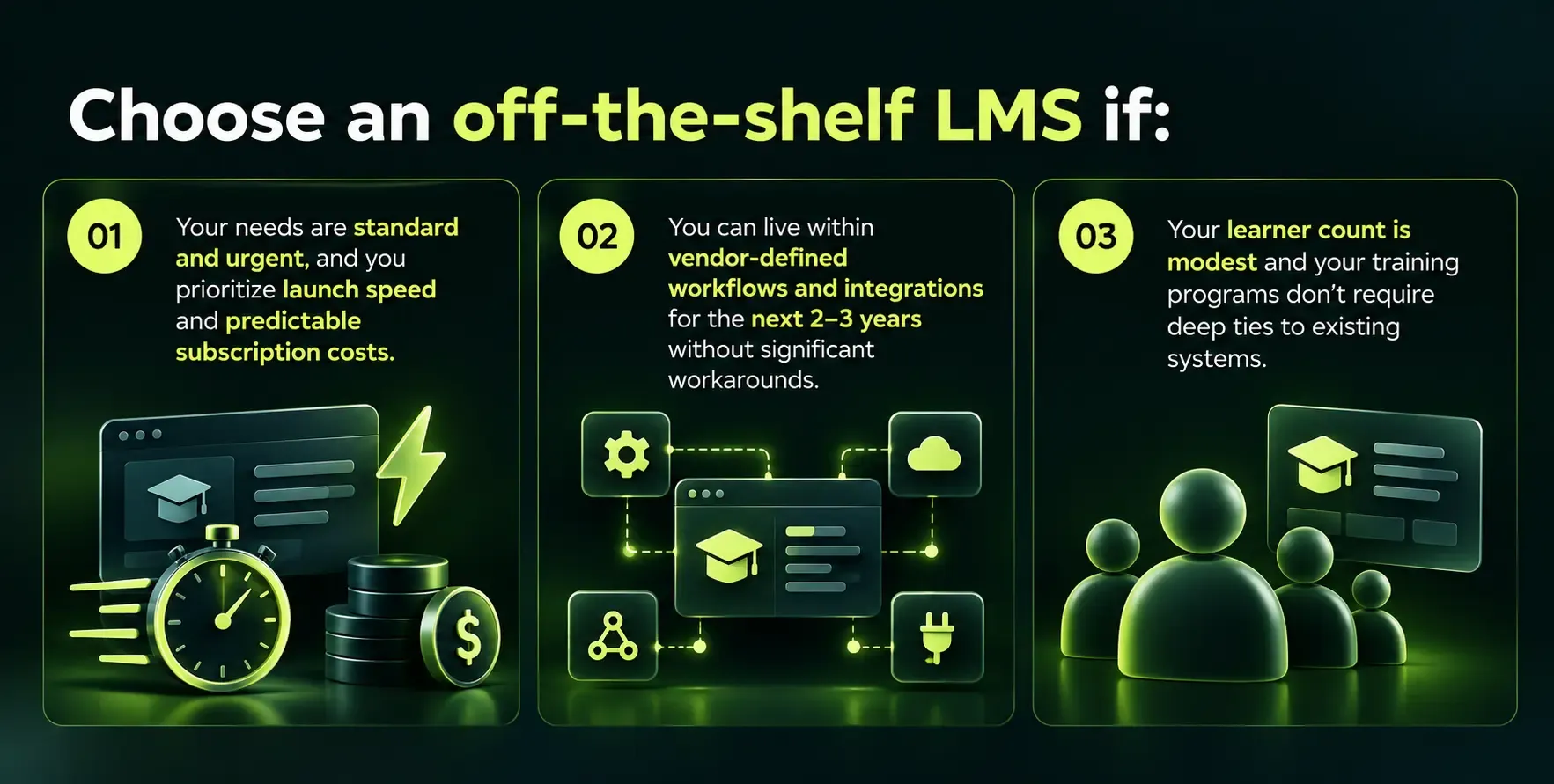
Who Should Choose an Off-the-Shelf Corporate LMS?
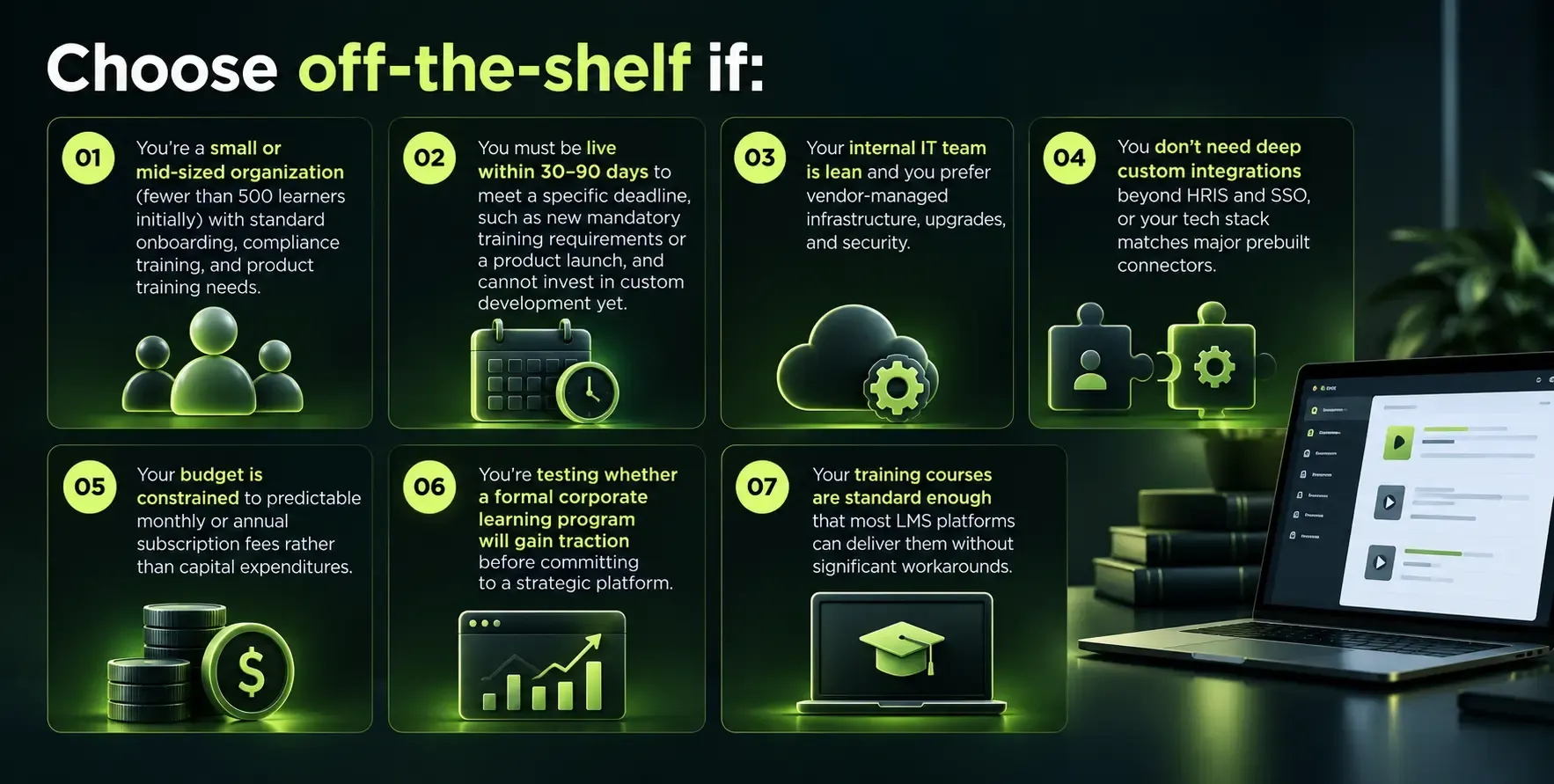
If the following describes your situation, a ready-made platform is likely your best starting point.
Many SoftDoes clients start on off-the-shelf LMS platforms and later transition to custom once pain points around integration, licensing costs, or limited customization justify the move. 87% of employees in top-performing businesses receive necessary training, and off-the-shelf can deliver that baseline effectively.
Who Should Invest in a Custom Corporate LMS Platform?
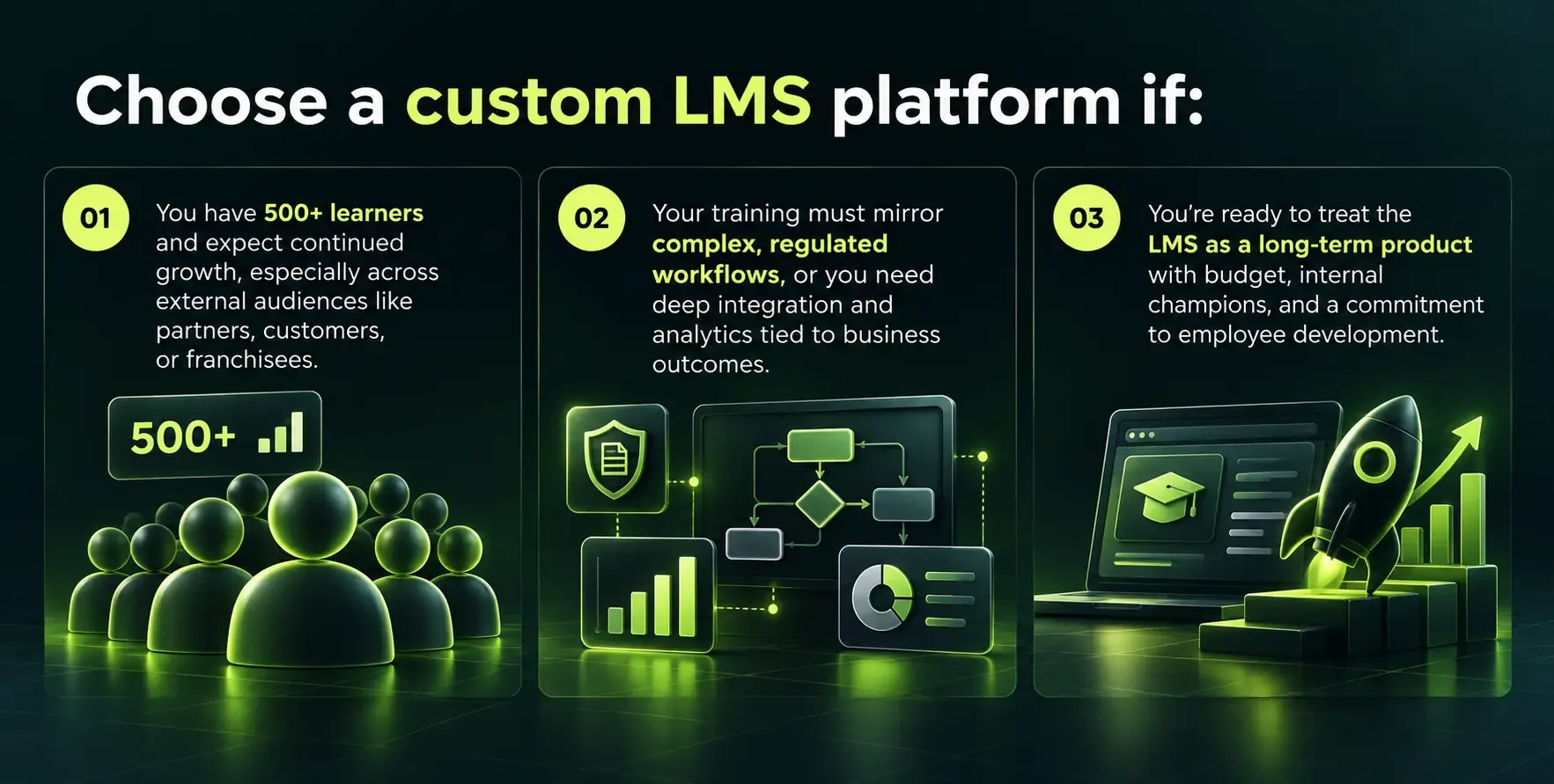
Choose custom LMS if:
- You operate in regulated industries in the U.S. or Canada (healthcare, banking, insurance, energy) with complex compliance rules that off-the-shelf workflows can't model cleanly.
- You need tight, two-way integration with multiple systems (HRIS, performance management, CRM, ERP, data warehouse) and want training data to drive business decisions. Custom LMS solutions align with specific business workflows.
- You serve multiple audiences (employees, franchisees, partners, customers) that each require distinct, branded experiences and permission models.
- Your current LMS is causing workarounds, spreadsheets, and manual data syncing that burn hundreds of admin hours per quarter on administrative tasks.
- You plan to leverage AI or ML for adaptive learning, skills intelligence, or personalized learning and don't want to wait on a vendor roadmap.
- Your 3–5 year horizon shows learner counts or learning programs scaling significantly, making per-user licensing unattractive.
- You view the LMS as a strategic asset: a customer academy that reduces support tickets, a safety platform that lowers incidents, or a professional development engine that closes skill gaps. Custom LMS can support complex training needs and compliance requirements.
- Your business growth depends on employee development that connects directly to business goals and business operations.
SoftDoes can help validate whether your needs truly warrant custom LMS software development or an interim hybrid approach before you commit.
Realistic Migration Paths: From Off-the-Shelf to Custom LMS
Many North American companies don't jump straight to custom. They evolve through stages, managing risk and preserving data at each step. LMS centralizes training, improving efficiency and tracking at every phase.
Stage 1 - Launch fast with off-the-shelf:
- Implement a SaaS LMS to cover immediate onboarding and compliance training needs.
- Use configuration and minimal scripting for small customizations: branding, role mapping, basic completion tracking.
Stage 2 - Extend and integrate:
- Add integrations and custom reporting via APIs, middleware, or data exports. An LMS must integrate with existing HRIS systems to avoid data silos.
- Identify recurring pain points: unsupported workflows, licensing pressure, limited analytics, inability to support external training or customer education.
- SCORM support ensures compatibility with existing course content, making eventual migration feasible.
Stage 3 - Move to custom or hybrid:
- Engage a partner like SoftDoes to design a custom platform that reuses data, content standards (SCORM/xAPI), and lessons learned from the off-the-shelf phase.
- Run a phased migration to avoid disruption, possibly keeping the subscription platform for specific use cases while the new core system comes online.
- Preserve learner progress, certification records, and training history throughout the transition.
Flix saved 135,000€ annually by using an LMS for training, demonstrating the kind of efficiency gains that compound when you move to a system designed around your specific operations.
How SoftDoes Approaches Custom Corporate LMS Development
SoftDoes is a software engineering partner for enterprises and scale-ups in the U.S. and Canada that need learning systems built around their actual operations, backed by custom software development expertise for regional businesses.
- Discovery & strategy: Workshops with L&D, HR, IT, and compliance teams to map training goals, user journeys, and integration landscape.
- Experience and architecture design: UX/UI prototypes for learner and admin portals. Target architecture for cloud, data, and security aligned with client policies, supporting mobile learning, blended learning, and virtual instructor led training.
- Iterative development: Agile delivery of core features (enrollment, content delivery, assessments, reporting) followed by advanced capabilities (AI, automation, multi-tenant support, creation tools).
- Integrations and data: Custom connectors to HRIS, CRM, and legacy systems. SSO setup and analytics pipelines into BI tools to connect learning to business metrics and measure program completion against real outcomes.
- Compliance and reliability: Engineering practices around security reviews, performance testing, and uptime SLAs for mission-critical training. Companies with LMS report better employee engagement and retention when the platform is reliable and accessible.
- Continuous evolution: Ongoing product management support for roadmap planning and iteration to add new audiences, content types, and automation as the learning programs mature. AI features enhance personalized learning experiences in LMS, and we build the architecture to adopt them as your strategy evolves.
Benefits of Working With SoftDoes on a Custom Corporate LMS
For decision-makers in the U.S. and Canada evaluating a comprehensive learning management system build, here is what SoftDoes brings to the table:
- Domain experience: Track record with enterprises in finance, healthcare, education, e-commerce, and energy, where compliance and reliability are non-negotiable and training directly impacts business operations.
- End-to-end capabilities: From product discovery and UX to backend engineering, AI/ML, cloud architecture, and ongoing support, all delivered by one team. No fragmented vendor relationships.
- Architecture for scale: Designs platforms to handle thousands of concurrent learners with predictable performance, low downtime, and no per-seat licensing surprises as you expand to external tools and audiences.
- Integration-first mindset: Focus on making the corporate LMS part of your digital ecosystem. APIs, event streaming, and secure data pipelines connect training to mission critical tools and core business systems.
- Flexible engagement models: Options for fixed-scope projects, dedicated teams, or long-term product partnerships to match your internal capacity and budget.
- Transparent delivery: Clear milestones, demos, and metrics so stakeholders can see progress and value early. Advanced reporting capabilities are crucial for measuring training impact, and we build that visibility into every phase.
Custom Corporate LMS vs Off-the-Shelf: Which Should You Choose?
There is no universal winner. The right choice depends on your organization's size, regulatory environment, growth trajectory, and how strategically you view corporate learning.
94% of employees stay longer with professional development opportunities, and 87% of employees in top-performing businesses receive necessary training. Whichever path you choose, the investment in corporate learning pays for itself. Map your priorities - speed, cost, control, integration depth - and consider a brief consultation with SoftDoes to validate your assumptions before committing budget to either approach.










Comments (0)
No comments yet.