Building an online marketplace is one of the most ambitious projects a company can take on. Whether you are launching a multi vendor marketplace for physical products, creating a service booking platform, or connecting professional sellers with business clients, the investment is significant and the variables are many. This guide breaks down marketplace development cost across every major dimension so you can plan with confidence, make smart trade-offs, and avoid budget surprises.Key Takeaways
Most marketplace MVPs in the U.S. and Canada land roughly between $70,000 and $250,000 for the initial build, while enterprise grade platforms regularly exceed $350,000. MVP marketplace development costs range from $60,000 to $100,000 on the lower end when scope is tightly controlled, and a focused MVP can be launched for around $60,000 if you strip down to the absolute essentials.
- Marketplace development costs are driven mainly by feature scope, custom development needs, and your chosen technology stack. Feature complexity is the largest cost driver in marketplace development.
- Your development approach (SaaS versus open source versus fully custom) can change the three year total cost of ownership by two to three times, even for the same marketplace app or marketplace website.
- Building a marketplace app and a marketplace website together typically adds 30 to 60 percent extra effort versus a single platform, especially if native iOS and Android mobile apps are required.
- Non development costs like marketing strategies, operations, maintenance, and infrastructure often equal 15 to 30 percent of the initial build each year.
- SoftDoes helps U.S. and Canadian companies map scope, optimize costs, and choose the right trade-offs before committing to a large marketplace investment.
What Shapes Marketplace Development Costs in 2026?
Marketplace development cost is not a single number. It includes both the build phase (design, engineering, QA, launch) and the run phase (hosting, maintenance, operations, marketing) over the first two to three years. Marketplace expenses include initial development, ongoing operations, and third party services. If your budget only covers launch day, you are planning to fail.
- Cost is a function of effort (total hours) times rate (hourly price driven by region and seniority) plus recurring spend on hosting, tooling, and support. Platform complexity influences development costs significantly, including feature requirements and user workflows.
- The big drivers include marketplace type (business to business, business to consumer, C2C, or service), whether you need a web platform, a mobile marketplace app, or both, feature depth (search, payments, dynamic pricing, inventory management), and third party integrations.
- In North America, typical blended hourly rates in 2024 through 2026 range from $90 to $190 per hour for experienced marketplace teams. These rates shape total budgets more than any other single variable.
- Any flat cost number you see online is only useful if the underlying assumptions (scope, team region, timeframe) are clearly stated. A $50,000 quote and a $300,000 quote might describe the exact same marketplace project at different levels of quality and completeness.
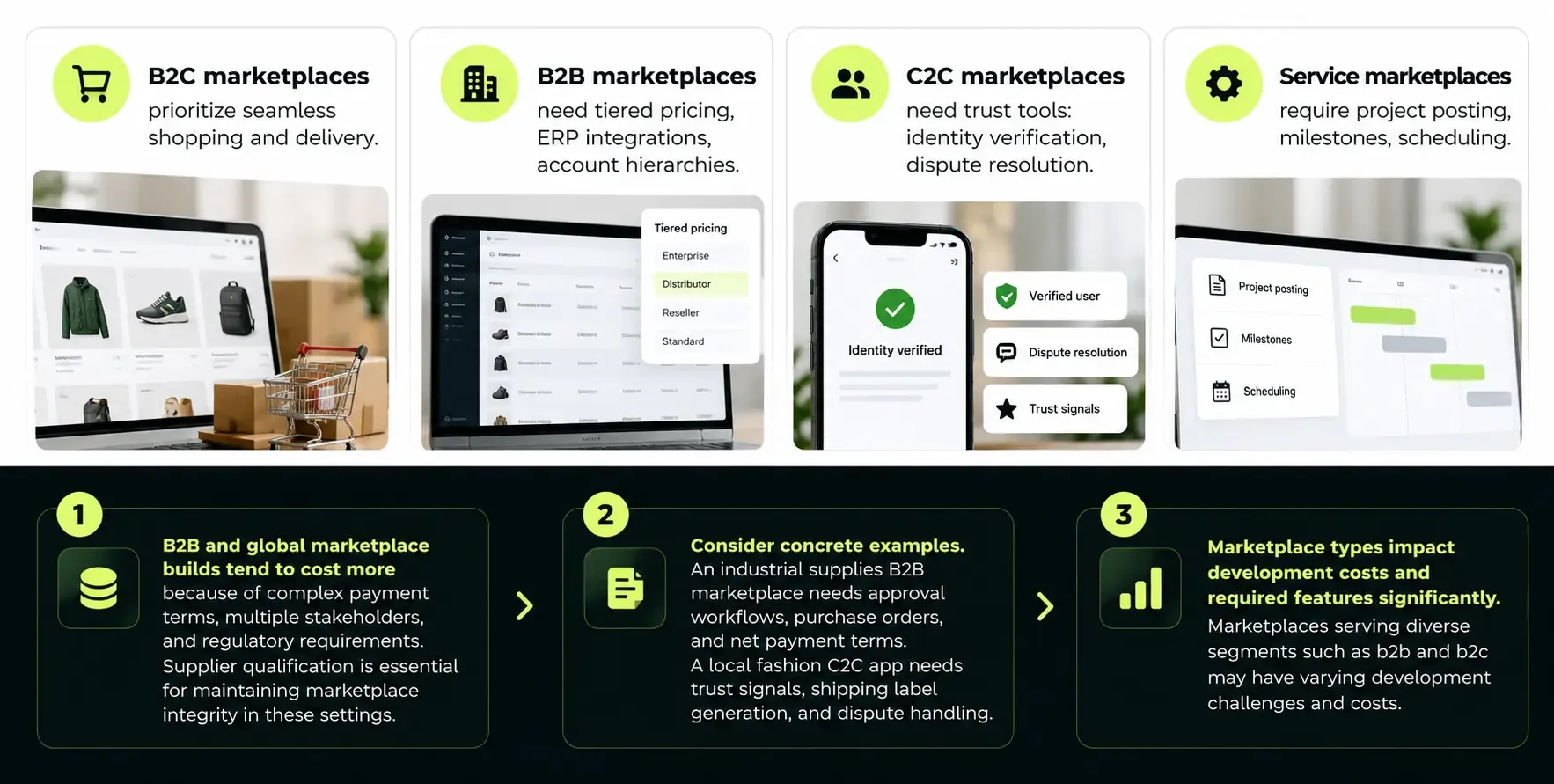
Choosing Your Marketplace Model and Its Cost Impact
Your marketplace model should be decided before detailed budgeting because it defines the complexity of every feature, flow, and integration you will need to build.
Development Approach: SaaS, Open Source, or Custom Development?
Your development approach can change both upfront marketplace website development costs and long term flexibility.
- SaaS marketplace builders (plug and play platforms or marketplace software) have the lowest upfront cost but limit your ability to implement custom workflows, dynamic pricing rules, and deep branding control. SaaS solutions require lower upfront investment for marketplaces, making them attractive for early validation.
- Open source frameworks offer a middle path with lower license costs, but you take on more responsibility for security, DevOps, and ongoing maintenance. Configuration of existing marketplace software typically requires 300 to 800 hours of work.
- Fully custom development (like SoftDoes delivers) provides the highest flexibility and is the best fit for complex or regulated use cases. Custom software development often has a higher initial cost compared to no code solutions, and custom development can exceed $300,000 for enterprise grade platforms. However, it often delivers better long term control and lower total cost of ownership at scale. Custom development requires approximately 2800 hours of development for a full featured build.
- Many U.S. and Canadian companies start on SaaS to validate their business model and marketing strategies, then migrate to a custom marketplace once they hit scale or outgrow the marketplace software's pricing and limitations.
Quick decision checklist for founders: How soon do you need to launch? What is your budget ceiling? Do you need unique features that no existing platform supports? Are you in a regulated industry? If you answered "soon," "limited," "no," and "no," SaaS might work for now. Otherwise, start planning for custom.
Core Feature Set and How It Drives Marketplace Development Costs
Features are the single biggest driver of marketplace development costs. Every extra feature adds engineering, QA, and ongoing support effort. Marketplace development requires specific features like user listings, reviews, and payment systems to function at all.
Buyer side features:
- Onboarding, product discovery, advanced search capabilities (essential for product discovery), filters, cart, checkout, multiple payment options, order tracking, and ratings and reviews
- User features typically cost between $40,000 and $70,000 to build well
- Personalization features can significantly improve user engagement and help retain customers over time
Seller side features:
- Registration and KYC, catalog management, pricing tools, inventory updates, a seller dashboard that provides tools for inventory and order management, payouts, and dispute handling
- A robust seller onboarding process is crucial for marketplace growth, and effective seller onboarding reduces barriers for new vendors joining your platform
- Seller performance metrics help maintain quality standards in marketplaces, allowing marketplace operators to maintain quality service
- Automated payout systems build trust with sellers by ensuring timely payments
Operator features:
- Admin panel, commission rules, fee management (platform fees configuration), content moderation, analytics and data analysis, and support tooling
- Marketplace platforms typically require distinct interfaces for managing buyers, sellers, and admins. Developing a marketplace platform involves multiple user interfaces for buyers, sellers, and admins.
MVP must haves versus Phase 2 nice to haves: Postponing non critical features can cut initial spend by 30 to 40 percent. AI recommendations, AR previews, loyalty programs, and sophisticated content marketing tools are common candidates for later phases. Advanced marketplace features like real-time chat and identity verification increase development complexity but can often wait until you have proven product market fit.
Payment systems alone require around 170 hours of development time. Integrating multiple payment gateways costs between $5,000 and $10,000. These numbers add up quickly, which is why a minimum viable product approach matters.
Tech Stack Choices and Their Cost Implications
Your tech stack (front end, back end, databases, mobile frameworks, cloud infrastructure) affects both development speed and your ability to optimize costs later. Choosing the wrong stack can lock you into expensive hiring or painful migrations.
- Popular web stacks for marketplace website builds in 2024 through 2026 include React or Next.js on the front end, with Node.js and TypeScript, .NET, or Python microservices on the back end. These are widely supported and make hiring easier.
- For mobile, you can go fully native (Swift for iOS, Kotlin for Android), or cross platform with React Native or Flutter. Cross platform tools reduce cost and time to market for a marketplace app, though they may have trade-offs in performance for very demanding use cases.
- Widely used stacks make it easier to hire North American engineers in the future. Niche technologies may lower initial bids but raise long term hiring and maintenance costs.
- Using cloud services (AWS, Azure, GCP) and managed databases can reduce DevOps overhead but add recurring infrastructure fees that should be in the budget from day one. Many teams rely on managed cloud services and infrastructure support to balance performance, reliability, and long term cost control.
- SoftDoes brings deep experience in modern, cloud native tech stacks that balance time to market with performance, security, and compliance demands across web application development and mobile.
Design, UX, and Branding: How Much Should You Budget?
UX and UI design strongly influence conversion, retention, and trust. In a competitive online marketplace, the quality of your design can be the difference between a platform that grows and one that leaks users at every step.
- Main design stages include discovery workshops, user flows, wireframes, visual design, responsive layouts, and design systems. UI/UX design can take 120 to 180 hours for a marketplace with moderate complexity.
- Design for a marketplace is more complex than for a traditional online store because it must support buyers and multiple sellers with different journeys, plus an admin experience. Intuitive UI/UX design boosts user engagement and conversions across all these personas.
- Design typically consumes 15 to 25 percent of the initial build budget. Quality UI/UX design can increase customer retention rates significantly, and investing in UI/UX design enhances overall marketplace performance. A well designed UI can reduce cart abandonment rates by 70 percent.
- Accessibility and mobile first design are important for North American users. Addressing these from the start avoids expensive rework later.
- SoftDoes includes UX research, usability testing, and conversion driven design in marketplace projects rather than treating design as a quick skin on top of code.
Region, Team Structure, and Hourly Rates
The same marketplace scope can cost three to four times more or less depending on where the team sits and how it is structured. Development team location significantly affects hourly rates for marketplace development.
- North American marketplace agencies typically charge $130 to $280 per hour in premium U.S. markets and $75 to $150 per hour in Canada. Nearshore partners in Latin America range from $40 to $80 per hour, while offshore teams may quote $20 to $60 per hour. Lower hourly rates do not always mean lower total cost once you account for rework, communication overhead, and quality gaps.
- A dedicated product team (PM, tech lead, developers, QA, UX, DevOps) almost always delivers better ROI than a loose group of freelancers, especially for a complex marketplace project with multiple vendors and user types.
- Hidden coordination overhead with very distributed teams can quietly expand budgets, especially on projects like a global marketplace with multiple currencies and tax rules involving multiple stakeholders.
- Enterprises and regulated industries in the U.S. and Canada often prefer partners like SoftDoes that can meet compliance, security, and documentation standards, even at higher headline rates. This is particularly true in financial services and highly regulated areas like custom healthcare software development.
- Hybrid models with a core team in North America and some nearshore roles offer competitive pricing while maintaining high quality and close collaboration.
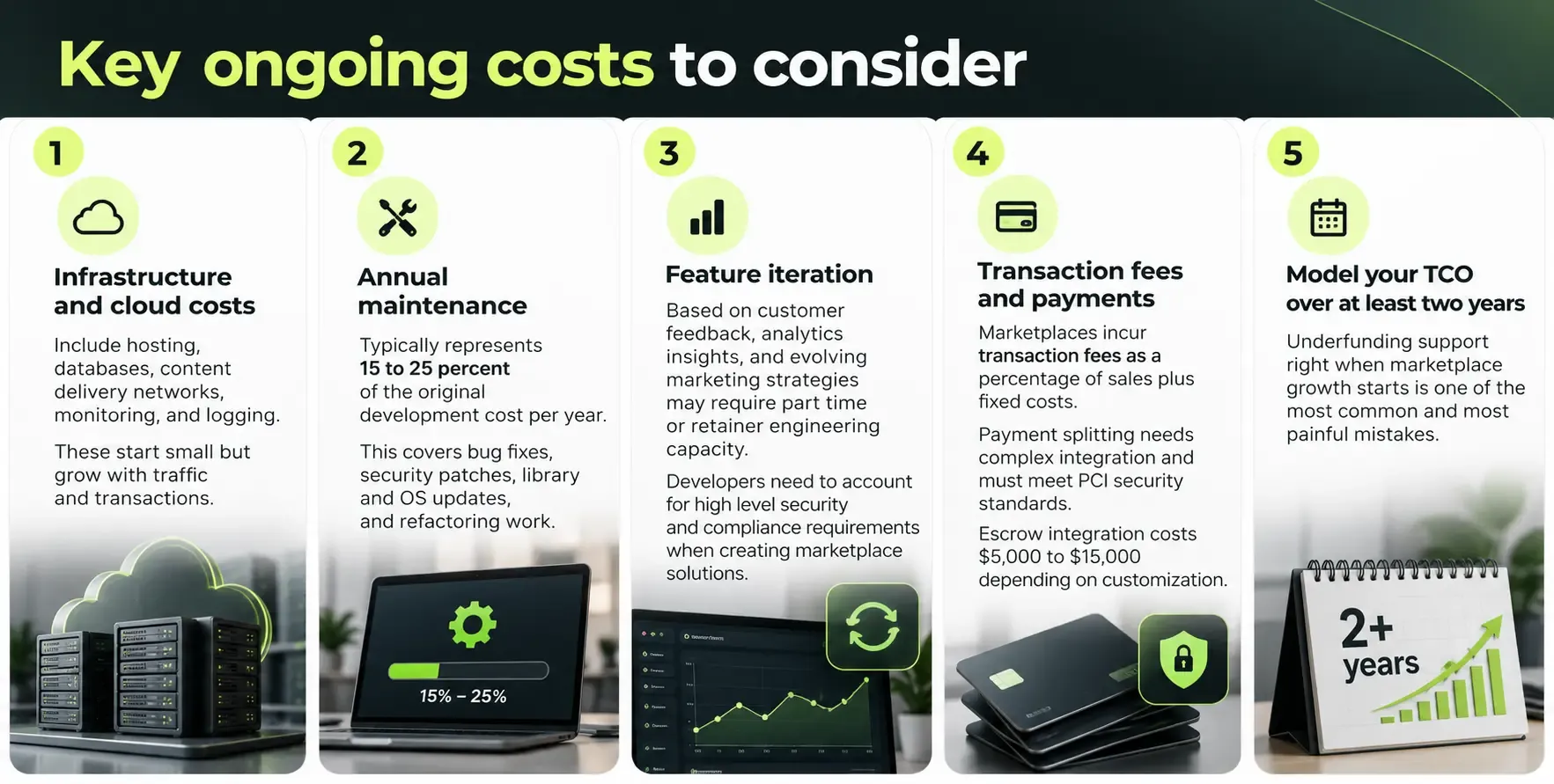
Hidden and Long Term Costs: Beyond the Initial Build
Total cost of ownership (TCO) across 24 to 36 months is what actually matters. Early budgets should not stop at launch day. Post launch budget should cover maintenance, support, and operational costs that keep the platform running and growing.
How Marketplace Type and Scale Affect Pricing Models and Revenue
Development costs should be evaluated alongside the revenue models that will pay for them. Your marketplace model and business objectives determine which monetization strategies make sense.
- Common monetization approaches include transaction commissions, subscription plans, listing fees, ads and sponsored placements, and premium analytics for sellers who want to sell products more effectively. Marketplace operators typically charge 8 to 15 percent commission on sales or transactions.
- Advanced pricing features such as volume discounts, dynamic pricing rules, and region based pricing add complexity but can increase revenue and competitive pricing flexibility. These features help both professional sellers and small businesses compete on a level playing field.
- Supporting a global marketplace with multi currency pricing, localized taxes, and different payment methods per country increases scope and QA effort. Accurate product data and transparent pricing become essential at this scale.
- Cost modeling should tie your feature roadmap to clear revenue hypotheses so you do not over invest in features that marketing strategy cannot realistically monetize. Many successful marketplaces start with simple commission models and layer on subscription tiers and dynamic pricing only after validating customer behavior and purchasing decisions with real data.
How to Optimize Costs Without Sacrificing Quality
This section is a practical checklist for founders and product leaders who need to control marketplace development costs without cutting corners that will hurt them later.
- Start with a tightly scoped minimum viable product focused on one or two critical user journeys. Building a "mini Amazon" from day one is the fastest way to blow through your budget. An effective way to manage marketplace costs is to validate demand before large scale development.
- Phase advanced features (AI recommendations, complex loyalty programs, AR, sophisticated content marketing tools) into later releases based on data and traction. Customer data and customer feedback from early users should drive what you build next.
- Reuse proven components for auth, payments, search, and notifications through APIs and cloud services instead of reinventing them.
- Maintain disciplined backlog management and clear success metrics. Change requests should be prioritized against business value. This protects against the scope creep that causes many marketplace projects to exceed their estimated cost by 40 to 100 percent.
- SoftDoes helps clients in the U.S. and Canada challenge assumptions, right size MVPs, and avoid overbuilding in early phases so you can invest where it matters most.
Marketing Strategy, Launch, and Non Technical Budget Items
A strong marketplace app or marketplace site still fails without a realistic marketing strategy and launch budget. Many founders put all their energy into the development process and leave nothing for getting potential customers through the door.
- Core marketing strategies for a new online marketplace in North America include paid acquisition (search and social), SEO and content marketing, referral programs, social media campaigns, and strategic partnerships. Market research helps you identify your target audience and tailor marketing efforts accordingly.
- Early marketing spend can easily match or exceed first year development cost if you plan to scale quickly in competitive categories. Building brand loyalty and long term relationships with both buyers and sellers takes sustained investment.
- Align your feature roadmap with marketing needs. Referral codes, promo pricing tools, and email automation should be technically supported so campaigns can run without engineering bottlenecks. A customer relationship management system helps track the sales cycle and repeat purchases.
- Build analytics from day one. Measuring CAC, LTV, and cohort behavior informs which marketing channels deserve more budget. Stock availability, reliable delivery, and inventory visibility all influence customer satisfaction and repeat purchases.
- Non technical line items to include in the overall budget: branding, copywriting, legal terms, customer support tooling, and ongoing mobile app development for post launch iterations.
Worked Example: Budgeting a 2026 Marketplace MVP
Imagine a U.S. startup building a niche B2C ecommerce marketplace where multiple sellers list curated home goods. The founder wants to launch a responsive marketplace website plus one iOS marketplace app, covering core buyer and seller features, payment splitting, seller onboarding with dashboards, and moderate integrations (payments, shipping, simple search and filters).
The team defines scope through a discovery phase, selects a modern tech stack (React, Node.js, PostgreSQL, AWS), and chooses a hybrid team model with a U.S. core (PM, designer, senior engineer) supplemented by nearshore developers for front end and QA.
By trimming a few non essential features (advanced AI search, in app messaging, AR previews) and reusing third party components for auth and payments, the team reduces the initial quote by about 25 percent without harming core value. The resulting build estimate comes in around $140,000 to $180,000.
They project an additional 12 to 18 months of infrastructure ($1,500 to $3,000 per month), maintenance (15 to 25 percent of build annually), and marketing expenses to ensure they do not under raise funding. A partner like SoftDoes would validate these assumptions, refine the scope, and produce a more precise estimate tailored to that specific marketplace idea through a custom web application engagement.
Benefits of Working with SoftDoes on Marketplace Development
SoftDoes is a software engineering partner focused on marketplace platforms for enterprises and scale ups in the U.S. and Canada. Here is what sets us apart for marketplace projects:
- Custom development expertise. We build mission critical systems with scalable marketplace architecture, secure payment flows, and the flexibility to support your own marketplace vision, whether you are connecting other businesses, third party sellers, or individual consumers on a single online platform.
- AI/ML and data engineering. We power features like personalized recommendations, fraud detection, and dynamic pricing with real data pipelines. These capabilities help sellers optimize listings and give buyers a better experience.
- Cloud and DevOps. Our managed cloud infrastructure practice helps optimize costs over time through right sized hosting, automation, and observability. Governance frameworks help manage risks in marketplace operations, and audit trails are crucial for tracking compliance in marketplaces.
- UI/UX and product consulting. We align design, user flows, and marketing strategies with measurable business objectives. Our approach is grounded in data analysis and real user behavior.
- Ready to get a real estimate? Contact SoftDoes for a scoped marketplace cost assessment rather than relying on generic online calculators. We will map your existing platform needs, business growth goals, and industry leaders in your space to deliver a plan that fits.
How SoftDoes Estimates and Controls Your Marketplace Budget
SoftDoes uses a transparent, assumptions first estimation process tailored to marketplaces. We believe transparent pricing in our engagements leads to better outcomes for everyone involved.
- Discovery workshops. We map transaction flows, seller and buyer journeys, and operational constraints before quoting.
- Build versus run cost separation. We show 12 to 24 month projections so finance leaders and multiple stakeholders can plan realistically and compare the estimated cost against expected revenue.
- Iterative delivery. Agile workflows with frequent demos, backlog grooming, and budget checkpoints keep scope and spending aligned.
- Risk reduction. Early technical spikes, security assessments, and performance testing for global marketplace scenarios catch issues before they become expensive, especially for healthcare software development initiatives where regulatory and data protection stakes are high.
- Flexible engagement models. We offer dedicated teams, co development with your internal IT, or specialized pods to fit different budget and governance needs across the development process.










Comments (0)
No comments yet.