Factories across the U.S. and Canada still run on disconnected machines, paper logs, and reactive maintenance schedules. Industrial IoT development services close that gap by connecting factory equipment with software analytics and cloud computing, turning raw machine signals into decisions that reduce cost and increase output. This article covers what it takes to build a smart factory, from sensors and edge gateways to AI powered predictive maintenance, and how SoftDoes delivers these projects for North American manufacturers.Key Takeaways
Industrial IoT development services convert legacy factories into connected, data driven operations. IoT sensors collect vibration, temperature, and current signals at the machine level. Edge gateways aggregate that data, translate industrial protocols, and buffer it during network outages. Cloud platforms or on premises servers store telemetry for analysis, dashboards, and applications. The industrial IoT market is projected to grow to $454.89 billion in revenue by 2029, with 9.84 billion industrial IoT connections expected globally by 2028. IIoT development services connect machines, sensors, and software to make smart factories possible.
The main value is not simply deploying more connected devices. Reliable system integration across PLCs, SCADA, MES, and ERP systems is what determines whether data flows or sits in silos. Data analytics turns raw telemetry into actionable insights: failure prediction, quality anomalies, energy waste patterns. Without that integration and analytics layer, sensor data stays decorative.
SoftDoes helps manufacturers in the U.S. and Canada cut unplanned downtime, reduce energy consumption, and lower maintenance costs through custom IIoT solutions. Custom IIoT solutions can reduce unplanned downtime by 50% when applied to critical assets. Core smart factory outcomes include predictive maintenance that catches bearing wear weeks before failure, real time monitoring dashboards that give plant managers full production visibility, and hazard monitoring systems that make shop floors safer. If you run a plant or OEM operation and want to see where IIoT fits your production lines, SoftDoes offers a discovery workshop to map your current state and identify quick wins.
What Is Industrial IoT and Why It Matters for Smart Factories
The Industrial Internet of Things refers to networked devices, sensors, instruments, and industrial machinery integrated through IT and OT convergence. Consumer IoT covers smart speakers and fitness trackers. Industrial IoT operates in harsh environments with strict demands on reliability, safety, and deterministic response times. It integrates with PLCs, SCADA systems, and industrial control networks using protocols like MQTT, OPC UA, and EtherNet/IP. IIoT connects physical factory equipment with software analytics and cloud computing to create intelligent systems.
Picture a metal stamping plant in Michigan running legacy presses. Each press gets vibration, temperature, and current sensors at the motor and gearbox level. Edge gateways installed nearby translate Modbus/TCP and EtherNet/IP data to MQTT and forward it to a cloud platform. Real time monitoring dashboards show production status. Maintenance alerts go to mobile apps on technicians' phones. Spare part orders feed into ERP systems so parts arrive before predicted failures occur. IIoT integrates sensors to monitor equipment health continuously across every connected asset.
The industrial internet enables three things that paper logs and weekly reports cannot: live visibility into machine status, faster quality control through anomaly detection before scrap accumulates, and coordinated decision making across production, maintenance, and supply chain management teams.
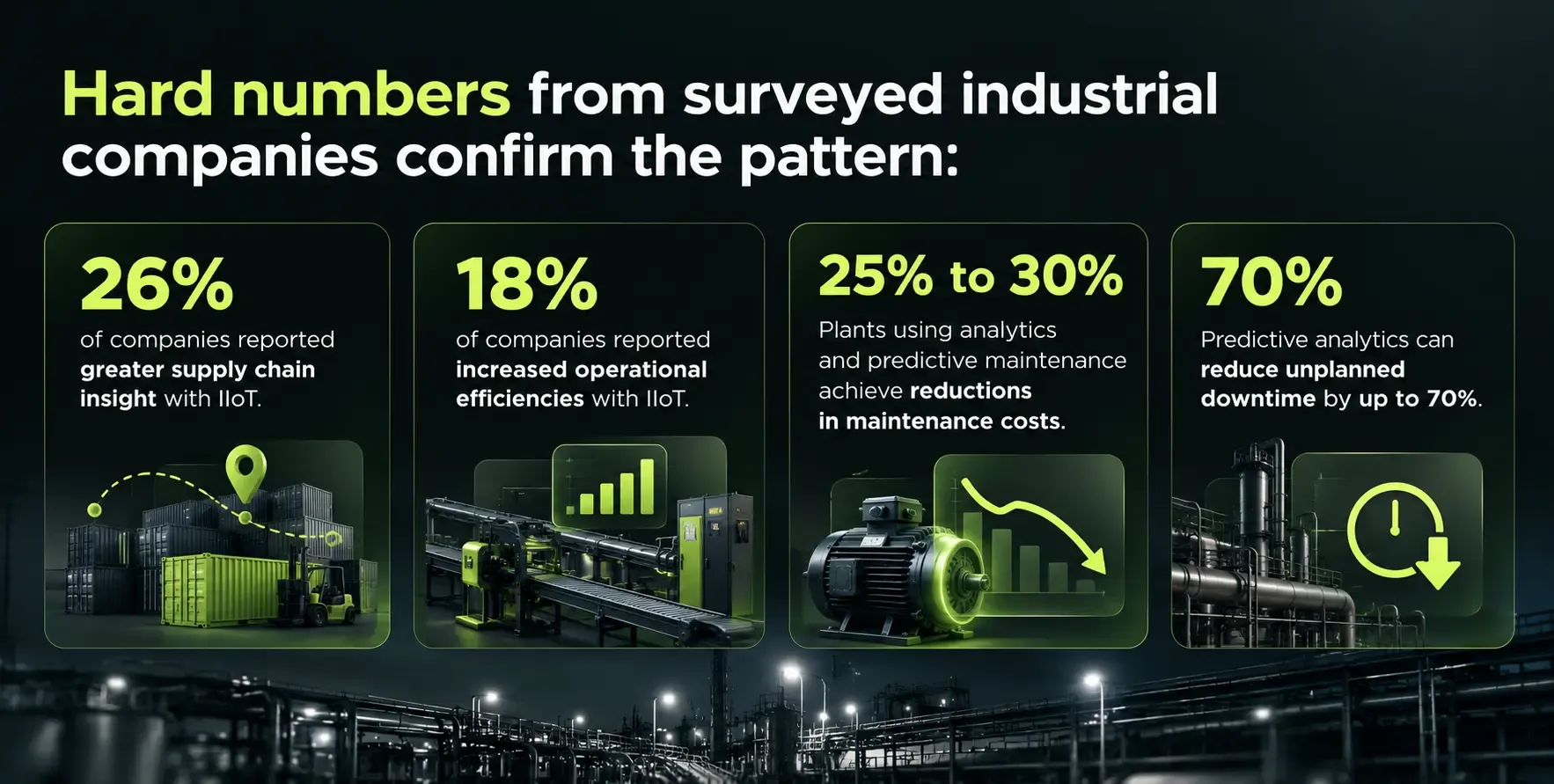
A Deloitte study found that predictive maintenance yields 53% less unplanned downtime and 79% fewer defects compared to reactive practices. U.S. plants that have fully deployed IIoT report OEE improvements up to 22% and unplanned downtime reductions of 18% to 27%.
SoftDoes focuses on mission critical IIoT solution engineering for enterprises and scale-ups in manufacturing, energy, food and beverage, and other regulated industrial sectors across the U.S. and Canada, drawing on its broader custom software development and IT consulting expertise.
Core Components of Modern Industrial IoT Systems
A modern industrial IoT system consists of layered components. Each layer has a specific job, and the system works only when all layers communicate reliably.
Layer |
IoT devices and sensors | Capture physical signals | Vibration sensors, thermocouples, current sensors, vision cameras |
Edge gateways | Aggregate, filter, translate protocols | Industrial PCs, embedded hardware running edge software |
Connectivity | Transport data | Ethernet, Wi-Fi, LPWAN, 5G, MQTT, OPC UA |
IoT platforms | Manage devices, ingest telemetry, secure comms | Azure IoT Hub, AWS IoT Core, custom platforms |
Analytics and AI | Process data, detect patterns, predict failures | Time series analysis, ML models, digital twins |
Applications | Present insights, trigger actions | Web dashboards, mobile apps, ERP integrations |
Industrial IoT platforms handle device management, firmware updates, identity management, and secure communications. AWS IoT Core connects millions of devices for industrial applications. Azure IoT Operations supports hybrid cloud to edge deployments. Google Cloud IoT integrates with existing industrial workflows. Cloud platforms enhance data management across industrial IoT systems, and cloud services enable real time analytics for the telemetry those sensor networks produce. For a comparison of which platforms fit specific manufacturing needs, SoftDoes published a detailed guide.
Real time asset monitoring integrates smart sensors with industrial gateways to feed these platforms. A line supervisor sees real time OEE on a dashboard. A technician receives a push notification on a mobile app when an anomaly triggers. An engineer runs a digital twin simulation to forecast the impact of a line change before committing to it.
SoftDoes Industrial IoT Development Services
SoftDoes is a software engineering partner that delivers industrial IoT development services for manufacturers and asset heavy enterprises across the U.S. and Canada. The company builds custom software, AI and ML solutions, and cloud and data engineering systems, all aimed at operational reliability, compliance, and scalability in real industrial environments.
Full cycle industrial IoT development at SoftDoes covers, and often starts from, broader IT consulting and technology strategy services:
- Consulting and strategy: assess the factory floor, OT and IT systems, data culture, business goals
- Architecture: define edge to cloud data flow, platform selection, security, system integration
- Software engineering: build edge software, back end microservices, device drivers, dashboards
- Data analytics: construct ML models, data cleaning pipelines, anomaly detection, predictive maintenance engines that analyze machine health to detect anomalies
- Cloud integration: connect to Azure, AWS, GCP, or private cloud with time series storage, identity, and security
- Testing: OT and IT integration tests, firmware tests, reliability under real world failure or network loss
- Support: monitor system health, retrain models, push updates, scale across plants
SoftDoes takes a vendor agnostic stance. If a plant already runs on Allen-Bradley PLCs and SAP ERP, the IIoT solution integrates with those existing enterprise systems rather than replacing them. The team works across discrete manufacturing (automotive, aerospace), process industries (chemical, food), energy, and logistics.
Industrial IoT Consulting and Smart Factory Roadmapping
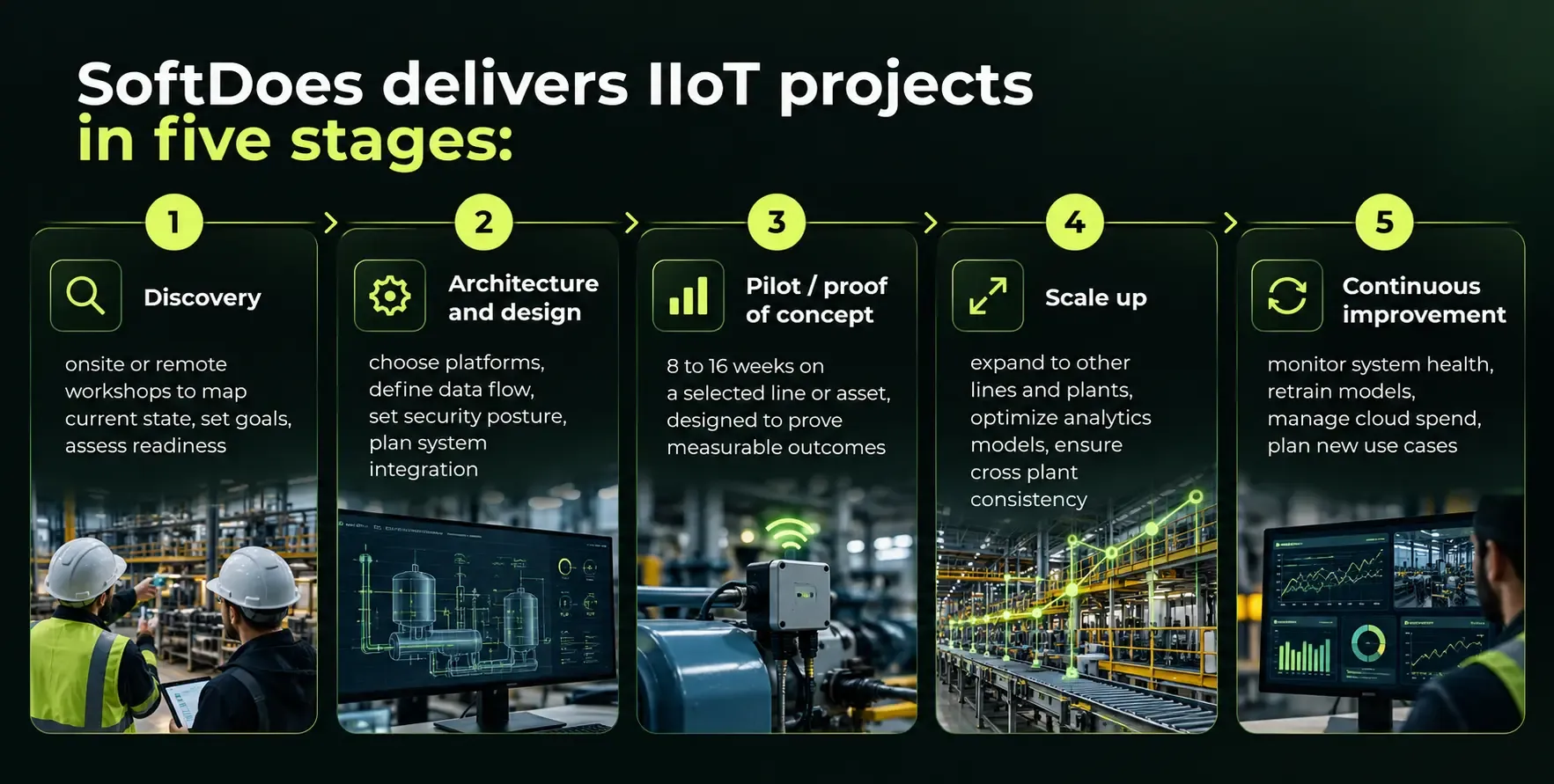
SoftDoes starts IIoT engagements with discovery workshops, either onsite at the plant or remote. The goal is to map current production lines, identify every data source, sketch the OT stack, list machines and industrial sensors in use, and measure baseline metrics like OEE, downtime, scrap, and energy consumption. Key performance indicators can track improvements like OEE and energy consumption from the beginning, giving every subsequent phase a clear benchmark. Data driven decision making eliminates guesswork from plant management.
IIoT modernization includes updating legacy devices and platforms where the ROI supports it. Consider a mid-size automotive supplier in Ontario planning a three phase smart factory program. Phase 1 (2026 Q3): pilot predictive maintenance on a stamping press line across 90 to 120 days. Phase 2 (2027): roll out dashboards and MES integration plant wide, achieving granular visibility that improves overall equipment effectiveness. Phase 3 (2028): scale across plants and embed AI based quality analytics. The roadmap balances quick wins with multi-year modernization of industrial IoT systems, ensuring early value and decoupled risk.
Custom IIoT Solution Development: From Edge to Cloud
SoftDoes builds custom IIoT solutions rather than reselling off the shelf products. IIoT development includes creating custom edge to cloud applications tailored to each plant's requirements, and every solution is shaped by the specific manufacturing processes and equipment on site.
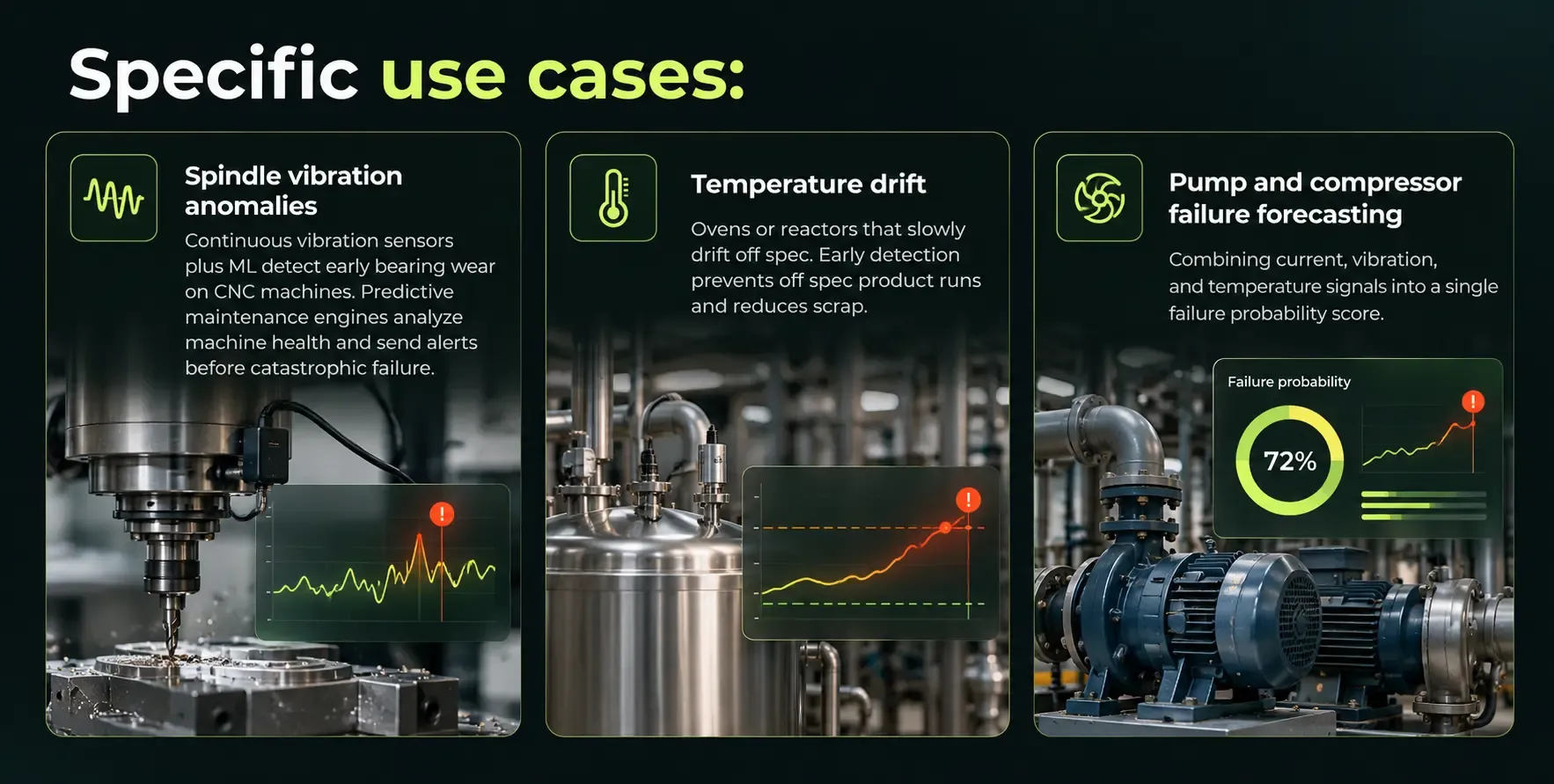
Edge software running on gateways handles data filtering, buffering during connectivity loss, and preliminary analytics. For example, an edge device running vibration anomaly detection can flag early bearing wear locally, act within milliseconds, and send the full signal history to the cloud when bandwidth allows. Edge processing keeps latency low for critical decisions.
Back end and cloud components include device management services (onboarding, firmware updates), time series data storage (InfluxDB, Timescale, or cloud native options), event streaming (Kafka, MQTT), and APIs for integration with existing systems. Cloud architectures also accelerate time to market by enabling faster iteration on dashboards and analytics modules. Automated data pipelines replace manual logs with data ingestion from PLCs, feeding clean data into analytics layers.
User facing apps include web dashboards for production and maintenance, mobile apps for technicians walking the floor, and alerts routed through Teams, Slack, or email. Solutions are built with maintainable software development practices: automated testing, CI/CD pipelines, and version control across edge and cloud components, all suitable for regulated industries and aligned with SoftDoes’ broader product development and engineering approach.
System Integration with PLC, SCADA, MES, and ERP
Many industrial IoT projects fail not at the sensor layer but at integration with existing systems. Compatibility, data normalization, and mapping contextual data (machine IDs, product types, shift schedules) are where gaps appear. IIoT system integration connects new assets to existing PLC and ERP systems, and doing it well determines whether the investment pays off.
SoftDoes connects new IIoT data streams with PLCs (Allen-Bradley, Siemens, legacy controllers), SCADA systems (Ignition, Siemens WinCC), MES platforms (Sepasoft, SAP, Microsoft), and ERP systems (SAP, Oracle NetSuite). Normalized data models and APIs allow IoT platforms to share accurate, contextualized operational data with planning, maintenance, and finance systems. For a deeper look at connecting these layers, SoftDoes published a step by step guide on integrating ERP, MES, IoT, and legacy systems.
A real world example: HNI, a furniture manufacturer, used Kepware to bridge PLCs with MES and ERP, enabling automatic material routing and real time emissions monitoring. Manual data entry dropped. Data silos disappeared. Similarly, Enviro Tech Chemical integrated PLC, ERP, and QMS systems so real time data flows replaced manual entry, improving traceability and quality control.
The result of solid system integration: end to end traceability from raw material to finished product, better scheduling based on real data, and more accurate costing per machine, per shift, per product.
Edge Computing, Data Analytics, and AI for Smart Factory Intelligence
The shift from cloud only analytics to a hybrid model is well underway in industrial settings. Edge computing handles low latency decisions on the factory floor. Cloud handles model training and heavy computation.
SoftDoes designs analytics pipelines that collect time series data, clean it, and feed it into ML models. Machine learning models can predict equipment failures by learning normal operating patterns and flagging deviations. AI powered predictive maintenance systems enhance predictive maintenance capabilities across entire production lines.
AI integration improves operational efficiency in industrial settings by turning sensor data into scheduled actions: maintenance windows timed to minimize production impact, process parameter adjustments that avoid waste, and energy load shifting during peak tariffs. AI models optimize energy use in industrial operations by identifying which machines draw power without producing output.
Digital twins facilitate real time asset monitoring and predictive maintenance by creating a virtual replica of the physical production line. Digital twin implementation creates virtual replicas of physical production lines. Digital twins can cut downtime and engineering costs by letting teams simulate changes before committing to them on the floor. Models can run in the cloud, on edge devices, or on edge gateways depending on latency and connectivity constraints.
Building Secure and Compliant Industrial IoT Systems
In industrial environments, a cyber incident can escalate into a safety incident. A compromised PLC can cause physical damage, environmental harm, or regulatory penalties. IIoT devices increase an organization's threat landscape, making security a design requirement rather than a retrofit.
SoftDoes follows multi-layer security practices informed by its work on secure, mission-critical defense technology software solutions:
- Device identity: every connected device gets a unique identity and certificate
- Encrypted communications: secure communication protocols protect sensitive data in transit
- Role-based access control: operators, engineers, and administrators see only what they need
- Multi-factor authentication enhances IIoT security measures for remote access
- Continuous monitoring: event logging, anomaly detection on network traffic
Secure software engineering includes code reviews, vulnerability scanning, and penetration testing that validates security across IIoT ecosystems. Secure development practices cover threat modeling, secure configuration management, and OT specific security procedures. ISO 27001 certification ensures security in IIoT development services. Industrial cybersecurity frameworks safeguard operational technology networks from threats at every layer.
In the U.S. and Canada, relevant standards include NIST SP 800-82 (the OT security guide, with draft Rev 4 released in September 2026), NIST SP 800-213 for IoT device cybersecurity, and the IEC 62443 series for industrial automation control system security. Security and compliance are built in from the design stage at SoftDoes.
Reducing Energy Consumption and Operating Costs with IIoT
Energy prices rose across North America between 2024 and 2026, pushing data driven energy management from a nice to have to a financial priority. In many factories, over 70% of operational costs come from energy: lighting, HVAC, compressed air, motors, and process heat.
SoftDoes uses industrial IoT development services to track power usage per line, per machine, and per product run. RFID and low-power sensors can monitor raw material consumption in real time alongside energy draw, connecting material waste to energy waste.
Analytics uncover patterns that walk throughs miss: idle time consumption where machines draw power without producing, compressed air leaks that account for 8% or more of total air system energy, and inefficient start and stop routines across shifts. Continuous monitoring can cut energy waste by up to 40% when paired with automated controls. Energy management helps optimize utility usage and reduce carbon footprints across facilities.
Consider a packaging plant that installs per machine metering and edge analytics. The system discovers compressed air leaks and idle machine draw. Automated shutoff rules and optimized scheduling reduce overall energy use by 10% to 15%. Those energy insights connect to sustainability reporting (ESG), utility rebates, tax incentives, and cost allocation by business unit, lowering operational costs while meeting compliance goals.
Example Smart Factory Use Cases Enabled by Industrial IoT
Predictive maintenance for critical assets
A U.S. precision component maker monitors CNC lathes and milling machines with vibration, temperature, and spindle current sensors. Edge analytics detect anomalies. Alerts go to technicians via mobile apps. Failure predictions feed into ERP so spare parts are stocked before breakdowns. One similar U.S. manufacturer reduced unplanned downtime by 67% across three CNC lines, saving over $4.1 million in the first year. AI powered systems enhance predictive maintenance capabilities across these asset families. A predictive maintenance monitor running on each gateway tracks degradation trends in real time.
Real time quality monitoring
Vision cameras inspect surface finish defects at speed on fast moving lines. Industrial sensors measure thickness and temperature during the process. An ML model flags rising defect rates. Real time variance detection can lower defect rates by catching drift before it produces scrap. Dashboards show the operator the trend; the quality team gets an alert to adjust machine setup immediately. Automating processes like inspection removes human error from repetitive quality control tasks.
Asset tracking and intralogistics
RFID or BLE tags on pallets and heavy tooling track location via edge gateways. Optimized routing inside warehouses reduces wait times. Inventory management ties into MES and ERP to maintain accurate counts. The result: fewer lost tools, faster changeovers, and lower carrying costs.
Safety and compliance
Ambient sensors measure temperature, humidity, and toxic gas levels. Guard sensors on industrial machinery detect when enclosures are open during operation. Worker presence detection in restricted zones triggers alerts or automatic shutdowns. Hazard monitoring is a core part of worker safety using IIoT sensors. All data is stored for compliance audits, giving plant managers a defensible record.
For each of these use cases, SoftDoes designs the full stack: sensor selection, edge processing logic, cloud storage, model training, dashboards, and integrations with existing systems.
How SoftDoes Delivers Industrial IoT Projects
Cross functional teams include software engineers, cloud and data engineers, data scientists, UI/UX designers, and cybersecurity specialists. Agile delivery means short sprints, frequent demos to plant stakeholders and OT teams, and rapid feedback loops. Project complexity determines team size and sprint cadence.
Long term support covers monitoring industrial IoT systems, updating models as operational data evolves, managing cloud costs, adding new data sources, and scaling to multiple sites.
Benefits of Working with SoftDoes for Industrial IoT Development
SoftDoes brings deep software engineering strength paired with industrial domain experience. For decision makers at U.S. and Canadian enterprises, the practical benefits include:
- Custom software engineering: IIoT solutions built for your specific connected industrial equipment and manufacturing processes
- AI and data science: ML models trained on your operational data for predictive maintenance, quality analytics, and energy optimization
- Proven track record in mission critical systems for regulated industries (food, pharma, energy)
- Flexible engagement: dedicated teams, staff augmentation, or end to end project ownership depending on internal capabilities
- Vendor agnostic platforms: build on Azure IoT Hub, AWS IoT Core, open source, or custom components, whichever delivers reliability and long term value
IIoT enhances productivity by reducing maintenance costs and improving quality control. Automation and data analytics improve operational efficiency in smart factories. Industrial Internet of Things development services empower manufacturers to transition to smart factories without ripping out everything they already have.
Ready to assess your current industrial IoT systems? Schedule a discovery call with SoftDoes to identify where IIoT delivers the fastest payback for your operation.
How to Start Your Smart Factory Journey with SoftDoes
Start by identifying one or two priority production lines or plants. Clarify business goals: is the target reducing unplanned downtime, cutting scrap, lowering energy bills, or improving safety compliance? Gather baseline metrics like OEE, downtime hours per month, and energy spend per unit. Smart devices and sensor networks only deliver value when there is a clear metric to move.
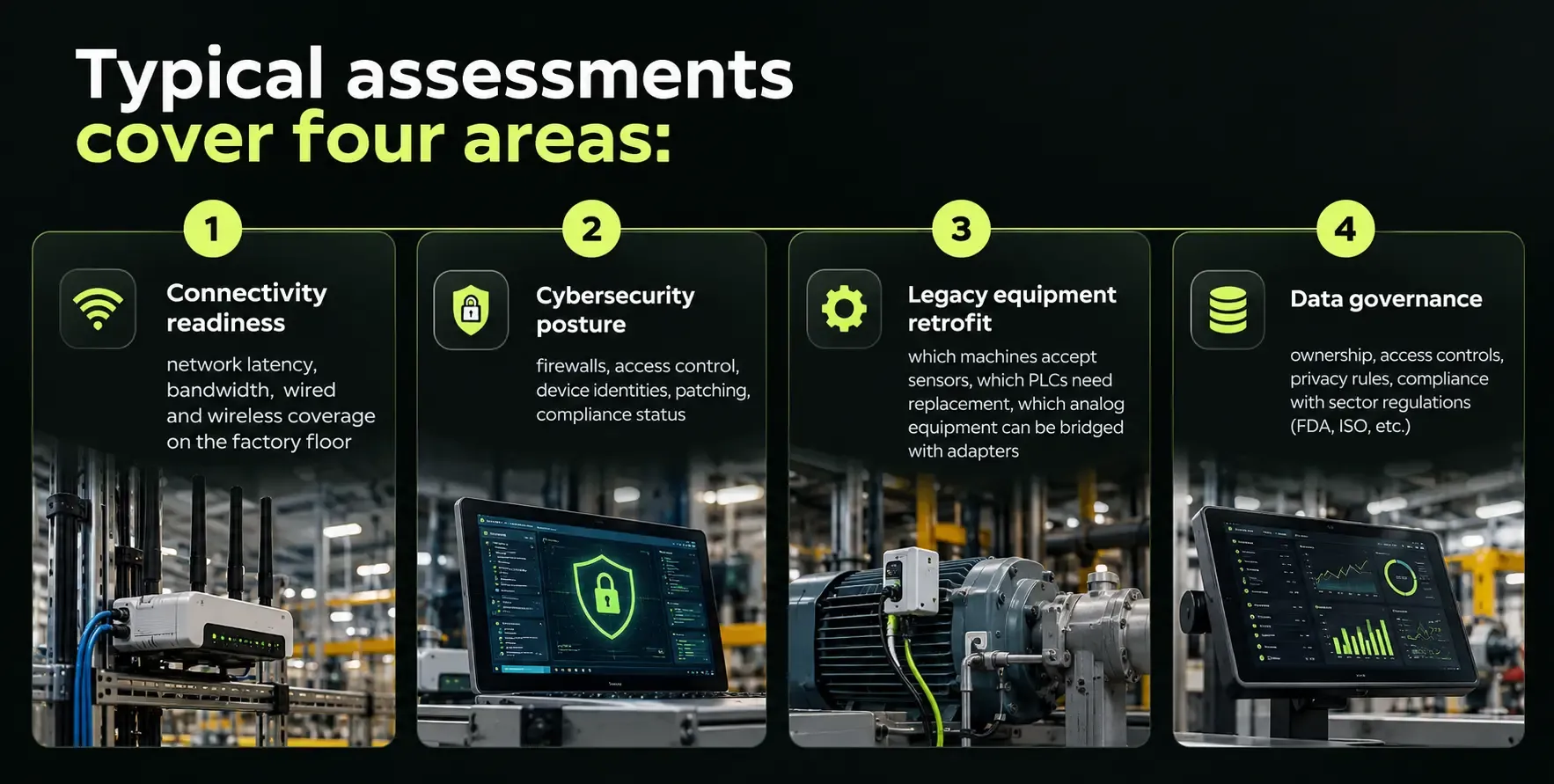
A typical initial engagement with SoftDoes includes remote and onsite discovery sessions plus a light technical audit. The team reviews existing PLCs, SCADA, MES, and ERP systems. They assess which legacy equipment can accept retrofit sensors, which analog equipment needs adapters, and which IoT platforms already in place can be reused. Legacy equipment can be integrated with modern digital systems without wholesale replacement in most cases. Industrial IoT projects often retrofit legacy machinery with modern sensors rather than scrapping it.
SoftDoes helps select the right combination of iot devices, edge gateways, and iot platforms, or builds on existing investments. The recommendation is always to start with a focused, measurable IIoT solution, for example predictive maintenance on a single asset family, rather than a massive big-bang program. Digital transformation in manufacturing works best when each phase delivers a measurable result that funds the next.
Request a brief assessment of your current industrial internet initiatives. SoftDoes will map your OT landscape, flag the highest ROI pilot, and outline a phased roadmap that matches investment levels with expected savings.










Comments (0)
No comments yet.