Most US and Canadian businesses start with off the shelf software, and for good reason. Pre built software like Salesforce or QuickBooks Online can be configured in days, costs nothing upfront beyond a subscription, and handles standard business processes without requiring a development team. For CRM, payroll, or project management tools, buying is almost always the right move.Custom software makes sense when the platform you need is either central to how you compete or is itself the product you sell. A logistics company whose routing engine determines its margins, a healthcare network that needs a HIPAA compliant care coordination portal, or a fintech startup launching a vertical SaaS product all face situations where off the shelf tools cannot deliver the workflows, data control, or user experience they need. Custom software provides complete control over features and processes, and that control becomes worth the higher upfront investment once your requirements are specific enough.
The crossover point tends to show up once you have roughly 50 to 100 internal users spread across 3 to 5 critical tools, or when your annual SaaS costs in a single domain approach the low six figures. At that point, a custom SaaS platform often delivers stronger ROI over a 3 to 5 year period. The rest of this article breaks down the key differences across cost, control, scalability, time to market, and risk, then gives a segmented recommendation.
What Is Off-the-Shelf SaaS?
Off the shelf software refers to cloud based software built for a broad market, hosted and maintained by a third party vendor, and sold on a subscription basis. Products like Salesforce, HubSpot, Shopify, QuickBooks Online, and Asana fall into this category. Users access them through a browser or mobile app and pay monthly or annually, usually per user or per usage tier.
The defining strengths:
- Fast rollout. Off the shelf software can be implemented in as little as 4 weeks, sometimes within days for simpler tools.
- Mature feature sets. These platforms have been refined over years with user feedback from millions of organizations.
- Predictable subscription costs. Vendors handle infrastructure, security patches, uptime, and ongoing maintenance.
- App marketplaces. Built in connectors to services like Stripe, Google Workspace, and Slack cover most common integration needs.
Typical use cases for US and Canadian businesses include customer relationship management, accounting, HR, marketing automation, project management, and help desk ticketing.
What Is a Custom SaaS Platform?
A custom SaaS platform is a web based system you design, own, and control, built around your specific workflows or offered as a software product to your customers. Custom software development can take weeks to months to complete, depending on scope and complexity.
The distinction between an internal platform (built for your own team's operations) and an external SaaS product (sold to customers) matters for architecture and compliance, but both share the same principle: you own the code, the roadmap, and the data.
Core strengths of a custom solution:
- Tailored workflows. Custom software can adapt to unique business workflows and requirements rather than forcing your team into a generic tool's logic.
- Full roadmap control. You set priorities for features, integrations, and the user model based on your own product roadmap.
- Embedded intelligence. You can build AI/ML pipelines, recommendation engines, or domain specific analytics directly into the platform.
- Flexible pricing and data models. Multi tenant architecture, custom billing logic, and proprietary data structures are all within reach.
Development typically involves a partner like SoftDoes, covering product discovery, UX/UI design, backend and frontend engineering, cloud infrastructure, data engineering, and iterative evolution, with dedicated teams that specialize in custom software development and IT consulting.
Custom SaaS vs Off-the-Shelf: How They Compare at a Glance
Here is a side by side view of the practical differences between these two approaches.
Factor |
Best for | Standard workflows, back office functions, small teams | Strategic or product centric platforms, regulated industries |
Typical initial cost | $0 to $10,000 (subscription start) | $80,000+ for a focused MVP at US/Canada rates |
Time to first value | Days to 4 weeks | 2 to 6 months for an MVP |
Pricing scalability | Linear per user subscriptions; costs grow with headcount | Mostly fixed platform costs plus cloud usage; marginal cost per user is small |
Control and customization | Configuration within vendor defined parameters | Full control over features, integrations, and data |
Data ownership | Vendor controlled; export options vary | You own all customer data and infrastructure |
Decisive Factor #1: Strategic Importance and Competitive Advantage
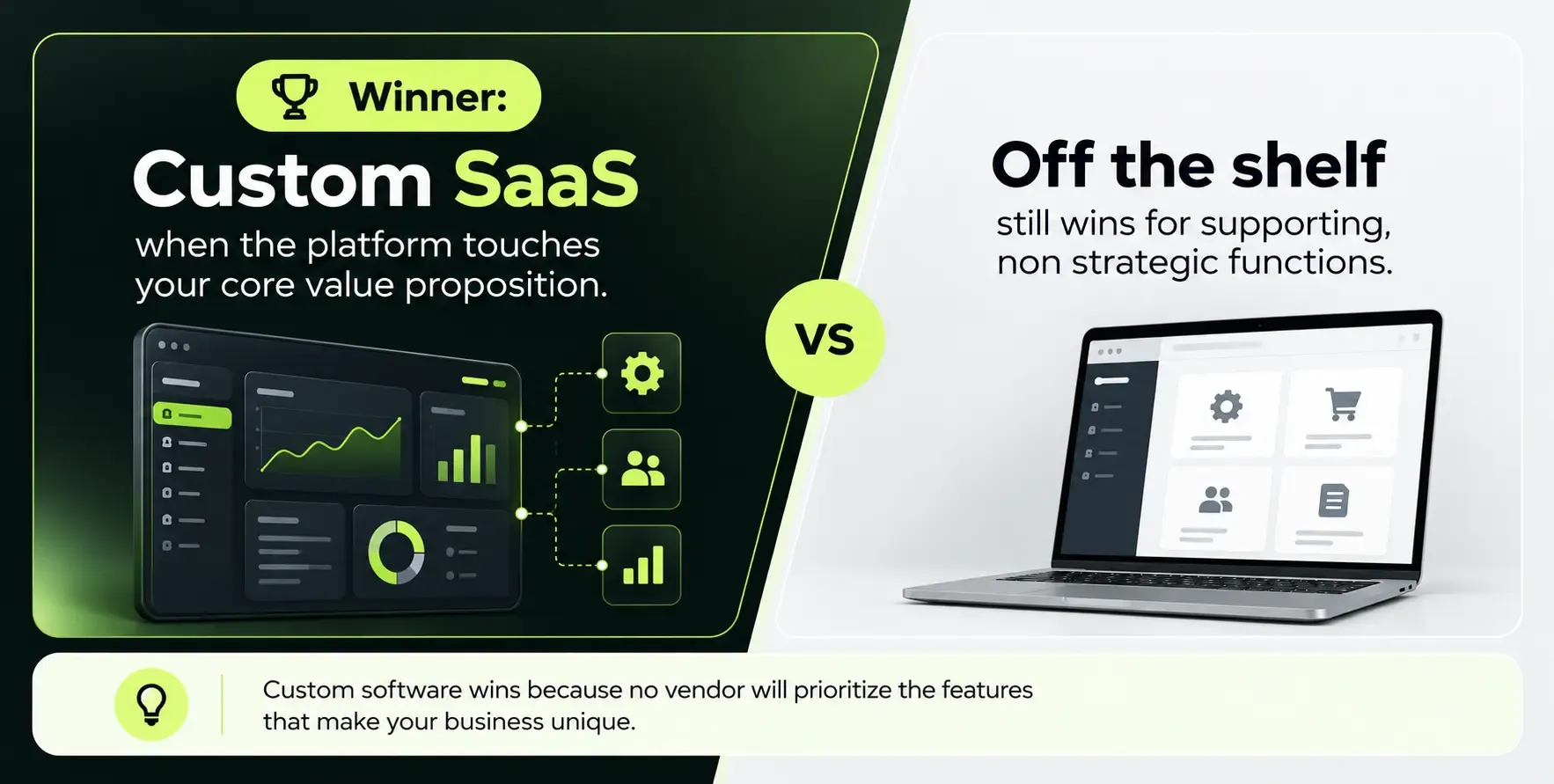
For growing US and Canadian companies, the question of whether software touches your competitive advantage usually matters more than the sticker price. Building a proprietary platform can create competitive differentiation that no off the shelf product can replicate, because the vendor's roadmap serves their entire customer base.
Standard back office functions rarely justify building custom software. Payroll processing, a basic CRM for a 15 person sales team, or generic bookkeeping are well served by existing SaaS products. The math changes when software encodes a proprietary process. A specialty lender's underwriting model, a healthcare provider's care coordination workflow, or a logistics company's routing optimization engine are all examples where the platform is inseparable from the company's margin structure.
A practical rule: if a workflow is part of your pitch to customers or directly affects your unit economics, leaning toward a custom software solution protects your edge. If the workflow is interchangeable with how any competitor operates, an off the shelf solution saves time and money.
Decisive Factor #2: Cost and ROI Over 3 to 5 Years
Comparing only the first invoice misses the point. The total cost of ownership should consider long term comparisons between buying and building software over a 3 to 5 year window.
Off the shelf cost drivers. Per user or tiered subscriptions typically run $40 to $150 per user per month for business grade tools. A 70 person sales team on a $90/user/month CRM pays roughly $75,600 in the first year; over three years, that adds up to about $226,800 before factoring in add ons or price increases. SaaS subscriptions often include hidden costs like add ons and integrations, overlapping subscriptions across multiple SaaS tools, admin overhead, training, and connector tools like Zapier. Off the shelf software costs can accumulate to five figures annually even for a single platform, and stacking multiple tools compounds that number.
Custom software cost drivers. US custom software projects typically cost $30,000 to $200,000 for small and mid sized business applications; enterprise platforms run $200,000 to $500,000 or more depending on modules, integrations, and compliance demands. The average US custom project runs about $132,480 over roughly 13 months. Ongoing maintenance usually costs 10 to 20% of the original build annually, covering bug fixes, cloud hosting, and incremental feature work. Custom software development costs range from thousands to millions, but the per user marginal cost stays low once the platform is live.
Recurring subscription fees for off the shelf software can become expensive over time, especially as teams grow. Custom SaaS requires higher upfront investment than off the shelf solutions, but custom software scales without linear per seat fees. Total cost of ownership for custom software can be lower over time when you have dozens of users and stable workflows.
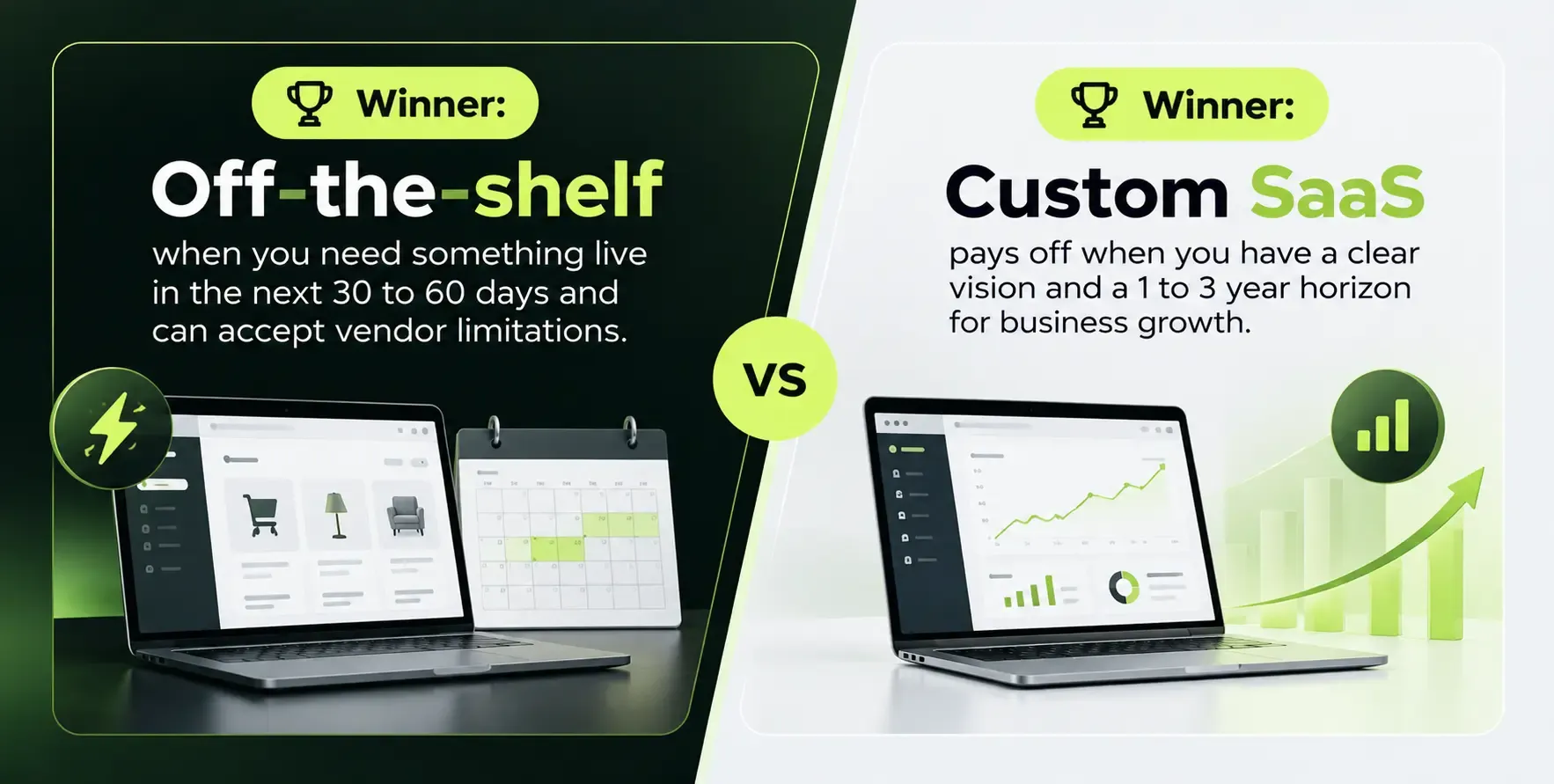
Winner: Off-the-shelf for the first 12 to 24 months and teams under roughly 30 to 40 users. Custom SaaS often pulls ahead financially once you cross 50 to 100 users and your SaaS costs in a given domain exceed about 30 to 40% of what a minimal custom build would cost.
Decisive Factor #3: Flexibility, Integrations, and Data Ownership
In 2026, most US and Canadian businesses run multi app stacks. The average mid market company uses dozens of SaaS tools, and integration complexity increases with multiple off the shelf tools. At the same time, data security and compliance requirements in finance, healthcare, and education are tightening.
Off the shelf tools offer rich app marketplaces and pre built connectors to services like Stripe, Google Workspace, and major CRM platforms. For standard integration needs, this works well. The limits show up when you need to customize data models, enforce strict retention policies, or connect to legacy software and proprietary systems. API quotas, rigid schemas, and vendor priorities for feature development constrain what you can do. Off the shelf software often has limited integration capabilities beyond what the vendor has pre built.
A custom platform lets you design one canonical data model across departments. Custom software can integrate seamlessly with existing systems, including legacy databases, internal data warehouses, and proprietary ML models. For organizations in regulated industries, custom solutions allow for tailored data structures and workflows that satisfy HIPAA, FINRA, or provincial privacy requirements. Custom solutions are essential for compliance in regulated industries where data ownership and residency are non negotiable.
Winner: Custom SaaS when unified data, custom integrations, or strict compliance drive the decision. Off the shelf wins only when your integration needs match what popular vendors already support and connecting multiple tools through existing connectors covers your requirements.
Decisive Factor #4: Time to Market and Execution Risk
Speed is not just how fast you launch; it is how fast you can learn and adjust.
Off the shelf SaaS can be configured in days or weeks. For validating a new process, testing a pilot program, or equipping a team that needs a tool next month, this speed is hard to beat. The trade off: once you hit edge cases or need features outside the vendor's roadmap, you wait for their release cycle or pay for workarounds. Off the shelf software offers quick deployment but may limit customization as your needs evolve.
Custom development follows a different timeline. Discovery, UX/UI design, build, testing, and staged rollout for a focused MVP typically take 8 to 12 weeks. Mid complexity platforms take 4 to 8 months, and enterprise systems can run 8 to 12 months or longer. Only about 30% of custom software projects meet all three targets of time, budget, and feature scope. The biggest risk factors are unclear requirements, overbuilding v1, and choosing the wrong development partner.
SoftDoes reduces this risk through structured discovery workshops, technical spikes, and an MVP first approach that focuses initial effort on core functionality rather than a bloated feature list. Custom solutions can evolve with business needs over time, and an iterative development process lets you incorporate user feedback before committing to the full platform.
When Off-the-Shelf Software Makes More Sense
There are clear scenarios where buying is smarter than building.
- Early stage startup still testing its offer. If workflows change every month, locking them into custom developed software is premature. Configurable SaaS tools let you pivot without rewriting code.
- Small team under 30 to 40 users. A team that needs a basic CRM, email marketing, or ticketing system without specialized logic will get 80 to 90% of the value from existing software at a fraction of the cost.
- Back office domains with mature tools. Payroll, generic accounting, and HR are well covered by existing SaaS products built for the US and Canadian market. Building your own solution here is almost never justified.
- Short lived initiatives. A 12 to 18 month pilot program or seasonal project does not warrant a custom build. Adapting business processes to fit off the shelf solutions is acceptable when the initiative has a clear end date.
- Limited budget and no product owner. If your total budget is under $50,000 and you lack an internal product owner to drive requirements and prioritize the product roadmap, an off the shelf product is the safer path.
For these cases, existing tools deliver the core functionality you need with minimal risk and effort.
When Building a Custom SaaS Platform Actually Makes Sense
These are the concrete signals that it is time to build your own solution.
- Your software is the product. If you are launching a vertical SaaS for clinics, franchises, or logistics brokers in North America, you need to own the IP. An off the shelf solution cannot serve as the foundation of your business model.
- You are hitting hard limits in multiple tools. When your team relies on a CRM plus spreadsheets plus custom portals and still cannot automate key workflows, the cost of connecting multiple tools and living with workarounds outweighs the cost of building.
- Per user SaaS costs are projected to exceed a realistic build cost. If your 3 to 5 year SaaS spend in a given domain crosses into the low six figures, a custom platform that flattens per user costs starts to make financial sense.
- Regulated data demands stricter control. Finance, healthcare, education, and energy organizations that need strict data residency, encryption, and audit trails often find that generic tools cannot satisfy compliance requirements.
- Customer experience depends on manual glue work. If your team stitches together data across systems manually to serve clients, custom platforms can enhance operational efficiency and capitalize on unique workflows.
- You want to embed domain specific AI. Recommendation engines, predictive models, or ML pipelines that a generic tool does not support require custom development to integrate properly.
- You need multi tenant capabilities. Serving multiple client organizations from one platform with strong data isolation is a common requirement for SaaS companies and managed service providers.
If 2 or 3 of these indicators apply to your situation, a custom software application is worth evaluating seriously.
A Simple Build vs Buy Framework for Your Platform Decision
This practical framework is designed for leadership teams evaluating custom software vs off the shelf options in 2026.
1. Is This Platform Core to How You Win or Get Paid?
Ask whether customers would notice if this platform disappeared tomorrow. A client portal for a US based lender, where borrowers check status and upload documents, is directly tied to the customer experience. An internal vacation tracking app is not.
If the answer is yes, weight toward custom SaaS. Custom development is ideal when existing solutions don't fit needs that are central to how you get paid. If the answer is no, the same tool used by thousands of other companies will work fine.
2. Are Your Workflows Stable Enough to Encode?
Volatile, still experimental processes fit better in configurable SaaS first. If your team has been using the same workarounds, spreadsheets, and manual handoffs for 12 or more months, you likely have a stable candidate for custom software. Customization improves alignment with specific business workflows, reducing unnecessary steps, but only when those workflows are well understood.
Document current flows and pain points before making the call. Discovery work, not assumptions, separates successful builds from the failures.
3. What Does the 3 to 5 Year Cost Curve Look Like?
Map expected headcount, seats, and SaaS spend over the next 3 to 5 years. Then estimate a simple custom SaaS budget: MVP build plus annual enhancement spend plus cloud and operations costs. Compare these curves side by side rather than reacting to this quarter's invoice alone. Custom software costs more in year one but flattens while subscription fees continue to climb.
Hybrid Approaches: Mixing Custom and Off-the-Shelf
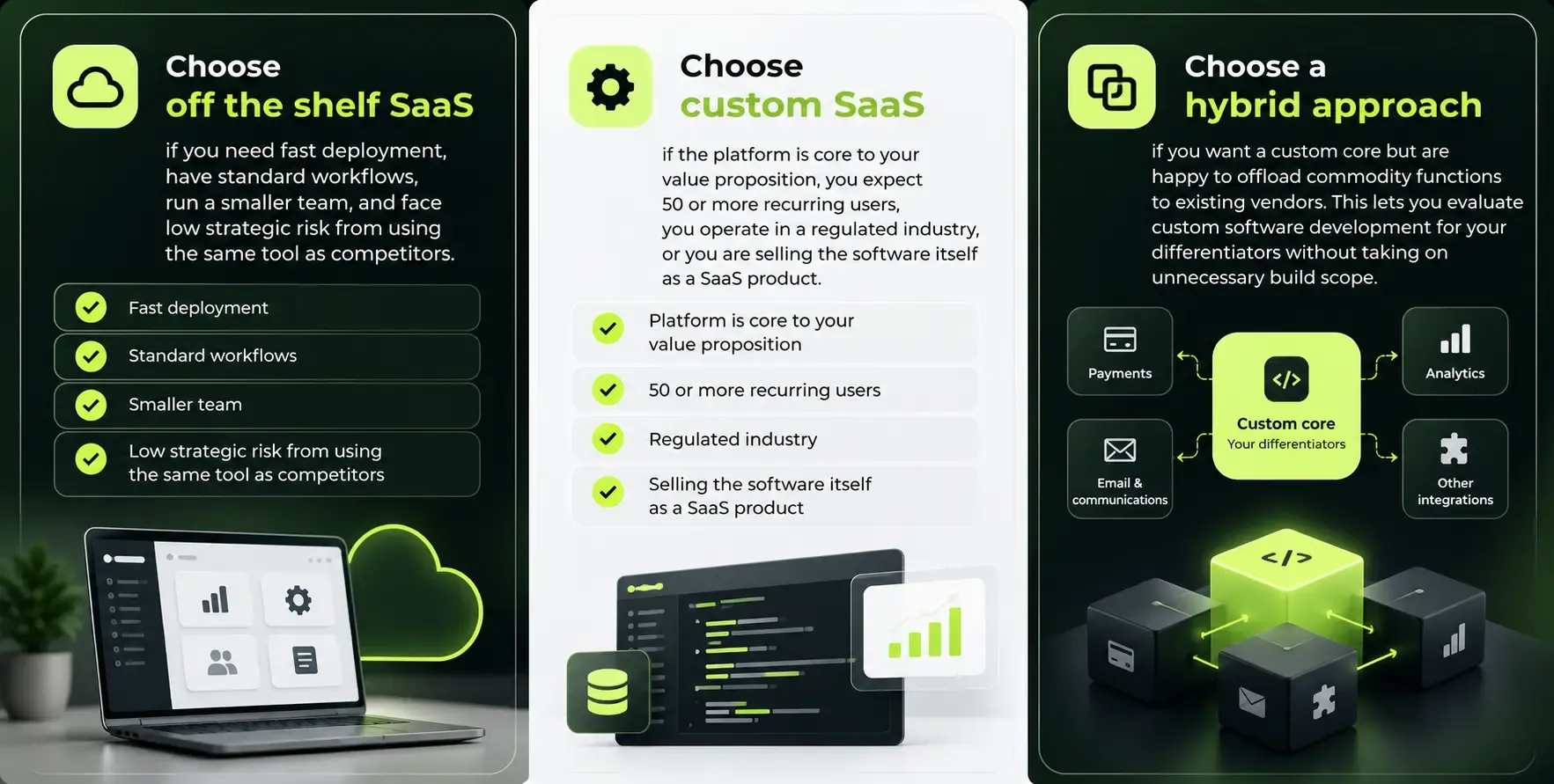
Many US and Canadian companies succeed with a hybrid stack rather than a pure build or buy decision. A hybrid approach combines standard software for common tasks and custom solutions for unique needs, and this combination is becoming the default software strategy for scale ups.
Common hybrid patterns:
- Custom operations hub. Build a central platform that integrates and orchestrates several SaaS tools (CRM, billing, support) through APIs, giving your team a unified interface without replacing every vendor, and lean on partners that offer end to end product development and engineering services to design and evolve that hub.
- Custom client or partner portals. Layer a branded, custom front end on top of your existing ERP or CRM, giving customers a tailored experience while keeping back end systems in place.
- Off the shelf services inside a custom SaaS product. Use established billing (Stripe), messaging (Twilio), and identity (Auth0) services as components within your own platform.
SoftDoes often recommends this route. It reduces time to market while preserving long term control over the components that differentiate your business.
Benefits of Working With SoftDoes on a Custom SaaS Platform
SoftDoes is a North America focused software engineering partner that works with enterprises and scale ups to design, build, and operate custom platforms.
- End to end capabilities. Product discovery, UX/UI design, backend and frontend engineering, cloud infrastructure, data engineering, AI/ML, QA, and DevOps under one roof.
- Regulated industry experience. Deep work with US and Canadian clients in finance, healthcare, education, and energy, as well as operational sectors like construction and manufacturing software development, including compliance requirements like HIPAA and FINRA.
- Architecture built for scale. Multi tenant design, data governance, and cloud architecture planned from day one to avoid costly rewrites later.
- Hybrid friendly approach. SoftDoes helps you keep the SaaS tools that work and only build what truly needs to be custom, avoiding unnecessary new software where existing vendors perform well.
- MVP first, ROI focused roadmaps. Start with the core problem, ship an MVP, then iterate based on user feedback and real data instead of overbuilding.
- Flexible engagement models. Dedicated development team or project based engagement, depending on your internal capacity and timeline.
Custom SaaS vs Off-the-Shelf Software: Which Should You Choose?
The right choice depends on where the platform sits in your business. Off the shelf software is designed for the mass market and lacks customization, but that is perfectly fine when your needs match the market. Custom software allows complete control over features and processes, and that control pays for itself when the platform encodes your competitive advantage or is the product you sell.
If you are weighing a build vs buy decision and want a concrete assessment, SoftDoes runs short discovery engagements to map your workflows, costs, and risks, then recommends off the shelf, custom, or hybrid saas solution with specific next steps.











Comments (0)
No comments yet.