Building a telemedicine platform in 2026 means navigating a complex mix of clinical workflows, privacy regulations, real time video infrastructure, and patient expectations that didn't exist five years ago. Whether you're a funded startup entering the telemedicine space or an established healthcare organization expanding into virtual care, the technical and regulatory decisions you make early on will define what your platform can do, what it costs, and how fast you can grow.This guide walks through every stage of how to build a telemedicine platform for the U.S. and Canada, from product strategy and regulatory compliance through architecture, core features, cost ranges, and post-launch operations.
Key Takeaways
- Building a telemedicine platform in the U.S. and Canada requires planning for HIPAA and PIPEDA compliance, secure data storage, and robust data security from day one. Skipping early compliance work leads to expensive rework later.
- Telemedicine app development costs range from $40,000 to $200,000, with a HIPAA compliant MVP for U.S. and Canadian teams typically landing between $80,000 and $150,000 depending on core features, integrations, and regulatory needs.
- A successful build must prioritize core features first (video visits, secure messaging, scheduling, EHR integration, payment gateways) and then layer advanced capabilities like remote patient monitoring and machine learning analytics.
- Choosing the right architecture, usually cloud native with microservices and API driven design, is as critical as UX because it determines scalability, performance, and long term maintenance cost.
- Partnering with an experienced telemedicine and healthcare software development company like SoftDoes reduces compliance risk, speeds delivery, and helps you avoid common pitfalls with integrations and audits.
Telemedicine in 2026: Why Build a Telemedicine Platform Now?
The telemedicine app market was valued at $87.21 billion in 2023 and the global telemedicine market is projected to grow at a CAGR of 19.3% by 2032. North America continues to lead adoption, with 83% of healthcare organizations planning to invest in telehealth by 2026. During the pandemic, 30.1% of outpatient visits were conducted via telemedicine, and that behavioral shift has stuck.
Patient expectations have moved toward digital first care. People now expect on demand access for mental health support, chronic disease management, and routine primary care. Connected wearable devices and home monitoring kits have made remote patient monitoring a standard part of healthcare delivery for conditions like hypertension, diabetes, and heart failure.
From a business perspective, telemedicine can reduce wait times to less than 15 minutes, and back to back virtual consultations can increase patient volume by 20 to 40 percent compared to traditional in office scheduling. Payers in both the U.S. and Canada increasingly reimburse virtual visits and remote monitoring, making telehealth app development strategically important for healthcare providers and digital health startups alike.
This article focuses specifically on how to build a telemedicine platform from scratch through custom development. The rest of the guide covers strategy, compliance, architecture, features, realistic costs, and how a partner like SoftDoes typically structures these projects.
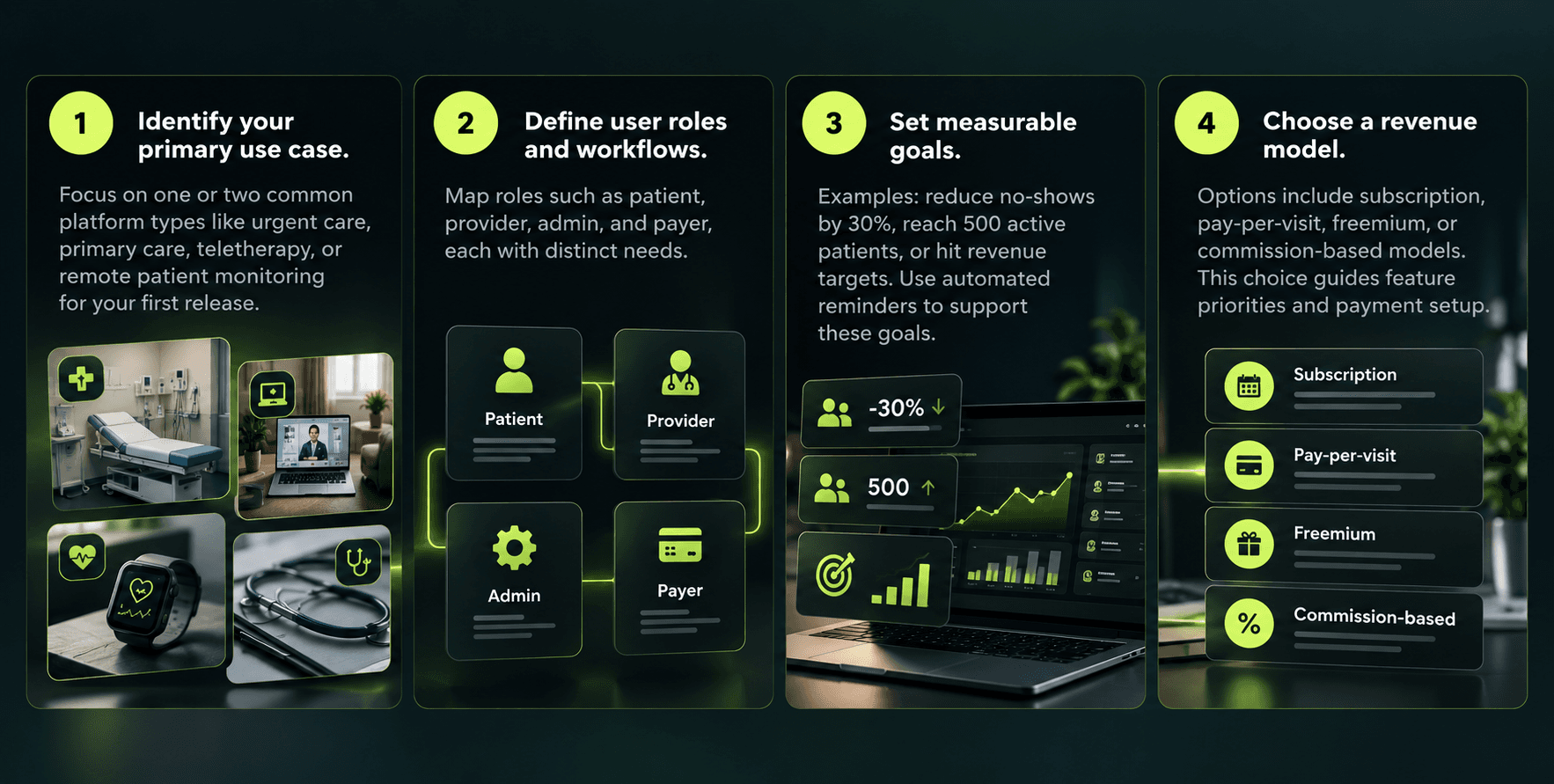
Define Your Telemedicine Product Strategy and Use Cases
Before writing a single line of code, narrow your scope. The fastest way to burn budget is building for every specialty at once. Here's how to focus your telemedicine platform development:
Types of Telemedicine and Where Your Platform Fits
Understanding telemedicine types is essential because each one shapes platform design, infrastructure requirements, and telemedicine app development cost differently.
Real time (synchronous) telemedicine involves live consultations via video or chat. This covers urgent care, family medicine, pediatrics, and therapy sessions in U.S. and Canadian settings. Video consultations must ensure patients have clear, real time synchronous visits without interruption. Implementing a virtual waiting room is a user experience consideration that keeps patients informed and reduces perceived wait times.
Store and forward telemedicine allows asynchronous data sharing for review. Patients upload photos, scans, or clinical data that healthcare professionals review on their own schedule. It requires secure file sharing, high resolution image handling, and strong privacy controls.
Remote patient monitoring tracks health data using digital technologies. Devices stream vitals like blood pressure, heart rate, glucose, SpO2, and weight from patients' homes into clinician dashboards. RPM is central to chronic disease management programs and triggers reimbursement under Medicare and some Canadian provincial payers.
mHealth companion apps support health management through mobile devices. These include medication reminders, educational content, secure chat, and wellness tracking. They typically extend the main telemedicine platform through APIs.
Teletherapy provides mental health services through digital platforms, supporting individual and group sessions for behavioral health.
Telepharmacy connects patients with pharmacists remotely for consultations, medication reviews, and prescription management.
Most telemedicine apps combine two or more of these types. Knowing which ones you need determines your infrastructure, compliance scope, and development timeline.
Regulatory Compliance: HIPAA, PIPEDA, and Clinical Rules
Regulatory compliance is critical when developing telemedicine platforms. It drives many technical and product decisions and directly impacts cost, timeline, and architecture.
HIPAA (U.S.)
Any telemedicine solution handling protected health information must comply with HIPAA privacy, security, and breach notification rules. This means:
- Encrypting all PHI in transit and at rest
- Maintaining audit trails documenting who accessed patient data, which is a legal requirement for compliance
- Signing Business Associate Agreements with every cloud provider, video SDK vendor, and subcontractor that touches PHI
- Conducting documented risk analyses before launch
- Regular compliance audits are necessary for telemedicine applications to maintain their standing
Healthcare providers must be licensed in the state where the patient is physically located during virtual visits. Controlled substance prescribing via telehealth remains restricted by DEA rules and varies state by state. Data protection regulations vary by state and can impact telehealth operations significantly, so mapping your target states early is essential.
PIPEDA and Provincial Laws (Canada)
In Canada, PIPEDA governs private sector handling of personal health information at the federal level. However, provinces like Ontario (PHIPA), Alberta (HIA), and British Columbia (E-Health Act) have their own health information statutes with distinct consent, data residency, and breach reporting requirements. Some provinces require that health data remain stored within provincial or national borders.
Confidentiality and informed consent documentation are essential before patient care is rendered, and these requirements tend to be especially strict in Canadian jurisdictions.
Clinical Licensing
Each Canadian College of Physicians and Surgeons sets rules for virtual care. Providers generally must be licensed in the province where the patient is located, and some provinces require special registration for out of province physicians offering telemedicine services.
Telemedicine apps must comply with HIPAA regulations in the U.S. Compliance costs for telemedicine apps can significantly impact budgets, but early legal and compliance reviews reduce overall telemedicine app development cost by avoiding late rework, such as redesigning data storage to meet residency rules or rebuilding consent flows.
Data Security and Data Storage Architecture
Security architecture must be designed before feature development. Telemedicine software development should include rigorous security testing and risk analysis as foundational steps.
Encryption and Access Control
Telemedicine platforms must use strong encryption for data in transit and at rest. End to end encryption is mandatory for secure communication in telemedicine, covering video calls, secure messaging, and file sharing. Strong encryption is critical for protecting patient data across every layer of the system.
Telemedicine platforms must implement role based access control to protect user data. Healthcare applications handling ePHI must implement secure identity management practices, including multifactor authentication and least privilege access.
Telemedicine apps require secure authentication to protect sensitive information.
Storage Patterns
Secure data storage requires VPCs, private subnets, and HIPAA eligible cloud services. Use cloud key management services (AWS KMS, Azure Key Vault, or GCP KMS) for encryption key handling. Clinical data should be kept separate from other application data for security and compliance purposes. Choose databases that support full audit trails and granular access logging.
When choosing a HIPAA compliant data integration partner, verify their approach to data residency. Design should factor U.S. only or Canada only storage pools, retention schedules, and data deletion workflows from day one.
Monitoring
Centralized logging, SIEM tools, intrusion detection, and anomaly alerts form the monitoring backbone. These systems protect sensitive patient data and provide the evidence trail needed during compliance audits.
Core Features: What Every Telemedicine Platform Needs
These essential features define most of the telemedicine app development cost and should be prioritized before any advanced AI or analytics work.
Patient Facing Features
- User registration and authentication. Telemedicine apps require secure user registration and authentication. Include identity verification and onboarding questionnaires to capture medical history.
- Profile management. Patients should be able to view and update patient records, manage insurance details, and track visit history.
- Appointment scheduling. Scheduling must sync with doctors' calendars and support time zone handling for cross state or cross province visits.
- Secure messaging. Secure messaging is essential for doctor patient communication, enabling asynchronous follow ups and pre visit questions.
- Visit history and medical records. Patients need access to past visit summaries, prescriptions, and shared documents.
Provider Facing Features
- Calendar and visit queue. Providers need real time views of upcoming appointments and the ability to manage availability.
- Clinical note entry. Structured note templates that integrate with electronic health records reduce documentation time.
- Video visit interface. Video consultation is a core feature of telemedicine applications. The interface should support screen sharing, in visit messaging, and easy access to patient history.
- E-prescribing. Integration with pharmacy networks for sending prescriptions electronically, with compliance for controlled substances where applicable.
Platform Wide Features
- Video and audio calls. High quality video conferencing with low bandwidth fallback options, which are necessary to support users with poor internet connections.
- Notifications. SMS, push, and email notifications for appointment reminders, prescription updates, and care plan alerts.
- Payment gateways. Payment gateway integration is necessary for transaction processing. Support credit and debit cards, HSA/FSA cards, and flexible billing models including payment processing for copays, subscriptions, and pay per visit.
- Basic reporting. Dashboards showing visit volume, revenue, patient satisfaction, and operational metrics.
- Accessibility. Digital health tools must often comply with accessibility requirements such as WCAG standards to serve all patient populations.
Advanced Capabilities: Remote Patient Monitoring and Machine Learning
Once the core platform is stable, you can expand into remote monitoring and intelligent features that differentiate your telemedicine solution in the healthcare industry.
Remote Patient Monitoring
A concrete RPM implementation involves integrating Bluetooth blood pressure cuffs, glucometers, and wearable devices that sync readings into clinician dashboards and trigger alerts when thresholds are crossed. Medicare covers RPM when patients transmit at least two readings every 30 days and providers review and manage treatment based on those data. New remote therapeutic monitoring codes (CPT 98979, 98984, 98985) added in 2026 further expand reimbursement for therapy and rehab services.
Machine Learning and AI
AI can enhance diagnosis accuracy in telemedicine applications by surfacing patterns that clinicians might miss in large datasets. AI powered symptom checkers can triage patients effectively, routing them to the right level of care before a provider ever joins the call. Machine learning models predict health trends before complications arise, supporting proactive interventions for chronic conditions.
AI also reduces administrative workload for healthcare providers through automated note summarization, visit transcription, and virtual health assistants that handle intake. AI can analyze patient data to improve treatment plans and support personalized treatment plans tailored to each patient's condition and history.
These advanced features significantly increase telemedicine app development cost and require careful data governance, model validation, clinician oversight, and clear disclaimers. Any AI tool used in clinical decision support falls under regulatory scrutiny from the FDA and Health Canada.
Telemedicine App Development Cost: Key Drivers and Ranges
Here's a realistic cost overview for developing a telemedicine app in the U.S. and Canada.
Typical Ranges
Build Tier |
Basic telemedicine app MVP | $80,000–$150,000 | 3–5 months | Video visits, scheduling, messaging, auth, payments |
Standard with integrations | $150,000–$300,000 | 5–9 months | EHR integration, e-prescribing, insurance workflows |
Enterprise / Advanced | $300,000–$500,000+ | 9–18 months | AI, RPM dashboards, multi region, deep analytics |
Core Cost Drivers
Nearshore or hybrid models (North American leads with offshore engineering) can reduce telehealth app development costs while still meeting HIPAA standards. However, the compliance and security expertise of telemedicine app developers should never be the area where you cut corners.
Post launch maintenance costs are typically 15 to 20 percent of initial development costs annually, covering hosting, monitoring, security patches, and feature updates. For context, a clinic doing 5,000 video visits per month might spend approximately $47,000 per month on running costs including video infrastructure, hosting, and support.
For a more detailed breakdown of how startup MVP development costs are structured, including the hidden expenses that catch teams off guard, it's worth mapping your feature list against real world benchmarks.
Step by Step Process to Build a Telemedicine Platform
Here's the standard telemedicine app development process that SoftDoes uses on healthcare projects, from discovery to launch.
Discovery and Requirements (Weeks 1–4)
Run stakeholder workshops with clinicians, operations staff, and business owners. Document user journeys for each role. Define scope boundaries, build a prioritized feature list, and identify compliance requirements.
UX/UI Design (Weeks 3–8)
Create low fidelity wireframes, then clickable prototypes. Test with real patients and providers. Focus on accessibility (WCAG compliance), clear navigation for older patients, and efficient workflows for providers who need to move between visits quickly. Good design work at this stage saves significant rework later in healthcare app development.
Development (Weeks 6–20+)
Set up environments and CI/CD pipelines. Implement frontend and backend features in two week sprints with frequent demos. Start with authentication, scheduling, and video infrastructure, then layer in messaging, payments, and integrations. Each sprint should include code reviews and automated testing.
Testing and Launch (Weeks 18–24)
Integration testing, performance testing with realistic video traffic, and security testing happen in parallel. Run a beta release with a limited clinic group. Gather feedback, fix issues, and gradually expand to broader rollout once performance and user satisfaction metrics are validated.
Choosing the Right Tech Stack and Architecture
Architecture decisions affect scalability, uptime, and long term maintenance of your telemedicine platform. Get these right early.
Frontend: React or Vue for web applications, React Native or Flutter for mobile. These frameworks support responsive, accessible patient and provider interfaces across platforms.
Backend: Node.js, Java, or .NET running on a cloud native stack with REST or GraphQL APIs. A microservices approach lets you scale video, messaging, and scheduling independently.
Infrastructure: AWS, Azure, or Google Cloud using HIPAA eligible services. Kubernetes or managed containers handle orchestration. Managed databases (PostgreSQL, MongoDB) with encryption at rest. CDN for media assets and static content.
Video: Start with managed video SDKs (Twilio Video, Vonage, Daily) rather than building custom WebRTC infrastructure. Move to a custom stack only when usage volume justifies it.
Architecture should assume future integrations with electronic health record systems via FHIR and HL7, analytics platforms, and third party machine learning services. Designing an automated data integration architecture from the start prevents painful rewiring later.
Integrations: EHR, Payment Gateways, Pharmacies, and Labs
Integrations often consume a large share of development effort and must be scoped clearly during discovery.
EHR Integration. Using standard protocols like HL7 and FHIR enhances interoperability for EHR systems. Many teams work with specialized partners for HL7 and FHIR healthcare data integration to sync demographics, medications, allergies, and visit notes between the telemedicine platform and clinical systems. Write back integration (updating patient records in the EHR from the telemedicine visit) is significantly more complex than read only access and requires careful data mapping.
Payment Gateways. Support credit and debit cards, HSA/FSA cards, tokenization for PCI compliance, refunds, and recurring billing. Subscription and pay per visit models each require different payment processing flows.
Pharmacy and E-Prescribing. Send prescriptions electronically to U.S. and Canadian pharmacies through networks like Surescripts or DrFirst. Controlled substance prescribing requires additional DEA compliance in the U.S. and provincial pharmacy board compliance in Canada.
Lab Integration. Order tests and receive structured results that appear in patient and provider views. Lab results must be mapped to standard formats and displayed in context alongside medical data and patient history.
Security, Testing, and Launch Readiness
Benefits of Partnering with SoftDoes to Build a Telemedicine Platform
SoftDoes is a North America focused software engineering partner frequently listed among leading healthcare software development companies, with deep experience in regulated healthcare technology projects. Here's what working with SoftDoes looks like:
- Compliance built in. Experience with HIPAA compliant and PIPEDA aware solutions, including audit logging, encryption, and regulatory documentation support for U.S. and Canadian healthcare clients.
- End to end delivery. Teams combine UI/UX designers, backend engineers, AI/ML specialists, and DevOps engineers to deliver complete custom software development from discovery through maintenance.
- Cloud and data expertise. High availability video infrastructure, secure data storage, and enterprise data management capabilities that scale with your patient volume.
- Flexible engagement models. Dedicated teams, project based, or hybrid arrangements tailored to your stage. Whether you're a startup validating a concept or a health system modernizing healthcare services, SoftDoes can help estimate telemedicine app development cost based on a detailed feature and compliance review.
- Faster time to market. Reusable components, proven architecture patterns, and early compliance planning reduce risk and speed delivery compared to assembling a team from scratch.
Post Launch Operations: Monitoring, Analytics, and Continuous Improvement
Data driven decisions matter more after go live than before.
Monitoring: Set up dashboards tracking uptime, error rates, video quality metrics, and response times. Configure alerting for critical issues like video infrastructure outages, authentication failures, or database latency spikes.
Analytics: Track patient and provider behavior through sign up funnels, visit completion rates, average visit length, and remote patient monitoring adherence. These metrics reveal where patients drop off and where providers lose efficiency.
Continuous improvement: Build a feedback loop where feature ideas and UX tweaks come from actual usage data, clinician feedback, and support tickets. Prioritize changes that improve clinical outcomes or operational efficiency.
Budget realistically. Budgeting 15 to 20 percent of initial telemedicine app development cost annually for maintenance, security updates, and enhancements is realistic for U.S. and Canadian deployments. Understanding modern data architecture costs helps you plan for scaling analytics and storage as your platform grows.













Comments (0)
No comments yet.