Wealth management software in 2026 covers the full operating system that advisory and wealth firms rely on every day. That includes portfolio accounting, trading and rebalancing, performance and client reporting, client portals, billing, compliance workflows, and data integration across custodians and asset classes. For RIAs, broker-dealers, private banks, and family offices in the United States and Canada, choosing the right platform is no longer a back office decision. It directly shapes the client experience, the quality of advice, and a firm's ability to grow.
This guide focuses on the best wealth management software platforms used by professional wealth managers, financial advisors, and investment professionals across North America in 2026. It does not cover personal finance app options or basic budgeting tools. The landscape today is split between advisor-facing platforms built for institutional use and consumer platforms designed for individuals managing personal finances. This article is about the professional side.
Why does technology choice matter so much right now? Fee pressure continues to squeeze margins. Clients, especially younger ones going through generational transitions, expect seamless digital experiences, mobile access, and real time transparency into their financial life. Alternative assets including private equity, hedge funds, venture capital, and private credit are a growing share of investment portfolios. AI-assisted operations are set to dominate wealth technology workflows, and cybersecurity has become a board-level concern for wealth management firms. At the same time, vendor concentration is increasing in the wealth management technology market, meaning fewer independent choices and more pressure to pick the right partner.
The ranking in this article was built on real market adoption, feature depth for professional wealth management, platform reliability during high volume periods like U.S. tax season, and advisor feedback. This guide is for firms choosing a new core platform, modernizing a legacy stack, or fintechs building wealth products from the ground up. Whether you manage $100 million or $10 billion, the goal is to help you make a decision grounded in practical realities.
How We Chose the Best Wealth Management Software
The goal of this section is to help you understand how to evaluate platforms. Every system on this list is production proven, meaning it is running in live environments at real firms.
Here is how we assessed each platform, with context specific to where the market stands in 2026.
Key Evaluation Criteria in 2026
- Performance and reliability. We looked for uptime targets of 99.9% or better, speed of nightly reconciliation, and stability under stress, particularly during U.S. tax season and volatile market days when trade volumes spike.
- Core capabilities. Portfolio accounting, multi-custody support, model management and rebalancing, performance attribution, fee billing, and householding. These are table stakes. Any platform that falls short on these basics didn't make the list.
- Advisor and client experience. Quality of advisor dashboards, white label client portals, and mobile apps matters more than ever. Reports need to be clear enough for HNW clients who expect consumer grade design. Platforms supporting strong user experience design tend to drive better client engagement and retention.
- Data and integrations. Custodial feeds from Schwab, Fidelity, Pershing, RBC, and others need to be reliable. CRM and financial planning software integrations, API depth, and open architecture are critical. Interoperability through open APIs is now a strategic requirement for platforms that want to survive in a multi-vendor ecosystem. Modern wealth management platforms aggregate held-away accounts and global custodial feeds to provide a complete picture. Data integration and reporting accuracy are among the most important factors when evaluating management software, and firms with mature data strategy and governance practices get far more value from their platforms.
- Advanced features. Support for alternative assets, private credit, SMAs and UMAs, direct indexing, and tax-aware rebalancing is no longer optional for many firms. Core features for financial planning software now include cash flow modeling and scenario analysis. Advanced analytics and custom reporting are expected.
- Security and compliance. SOC 2 certification, encryption at rest and in transit, audit trails, and suitability and KYC/AML workflows suited to U.S. and Canadian rules. Compliance and security measures are critical components of any wealth management software worth considering.
- Scalability. The platform needs to handle thousands of financial accounts, multi-office setups, and multi-entity family office structures without breaking or requiring heavy custom code.
- Pricing and total cost. Pricing models for wealth management software vary by service and asset management volume. We considered license fees, AUM-based pricing, implementation and data migration costs, and the internal staffing needed to run each platform day to day.
- Vendor stability and roadmap. Financial health of the vendor, their track record in wealth technology, and the pace of feature releases between 2024 and 2026. Platform choice depends on portfolio complexity and reporting needs, but it also depends on whether the vendor will still be innovating three years from now.
Wealth management platforms aim to enhance operational efficiency through automation. Every platform on this list demonstrates that principle in some meaningful way.
Best Wealth Management Software Platforms in 2026 for Professional Firms
Rather than listing dozens of options, this section focuses on a manageable set of best-in-class platforms. The ranking is opinionated: it's ordered by overall fit for independent advisors, RIAs, banks, and family offices in the U.S. and Canada. The best wealth management software depends on the specific needs of users, so some options here are full platforms while others are strong choices for specific use cases like UHNW clients or digital-first advisory models.
The wealth management software landscape features specialized platforms for high-net-worth individuals alongside broader tools built for the mass affluent.
1. Orion Advisor Tech – Best All-Around Platform for Independent RIAs
Orion Advisor Solutions has built one of the most comprehensive integrated wealth platforms available to U.S. RIAs. It covers portfolio accounting, trading and rebalancing, performance reporting, financial planning, and a client portal, all under one roof. In the T3/Inside Information software survey, Orion leads with roughly 17% market share in portfolio management and reporting tools among RIAs, making it the most widely adopted platform in its category.
Orion supports over 500 technology integrations, including connections to major custodians like Charles Schwab, Fidelity, and BNY Pershing. That breadth of connectivity is a major reason firms of all sizes gravitate toward it.
Why It Stands Out
Orion's strength is its "all in one" positioning. The platform delivers a deep portfolio engine, robust portfolio reporting, and strong integrations with CRMs and planning tools. For investment managers focused on model based public market portfolios, the rebalancing and tax-sensitive trading capabilities are especially useful during volatile markets when rapid, accurate execution matters most.
The platform also benefits from its acquisition of Redtail CRM, which gives advisors a native CRM experience without needing a third party integration.
Best For
Growth-oriented RIAs ranging from approximately $150 million to several billion dollars in AUM that want a single primary system. Orion fits firms serving mass affluent through HNW clients who need solid portfolio analytics, investment tracking, and client service tools but don't necessarily require the ultra-complex entity structures that family offices demand.
Key Strengths
- Flexible model portfolios with strong support for asset allocation and portfolio construction across multiple strategies
- Advisor productivity tools that consolidate daily tasks, from prospect management to review meeting prep
- Mobile-friendly client portal with performance visualization and document sharing
- Strong U.S. custodian coverage and growing integration ecosystem
- Regular platform updates with a clear product roadmap through 2026
Possible Limitations
- Alternative investment support is less deep than specialist platforms like Addepar, which can be a gap for firms with heavy private markets exposure
- Full-stack pricing can add up quickly if you enable all modules; smaller firms may need to be selective
- Implementation and onboarding for firms with complex historical data can take several months
2. Envestnet | Tamarac – Best for Established Firms Optimizing Operations
Tamarac, a division of Envestnet, is one of the most battle-tested platforms for mid-to-large RIAs in the U.S. market. It focuses on portfolio management, trading and rebalancing, client portals, CRM, billing, and fee calculation. Over 900 RIA firms collectively manage more than one trillion dollars in AUM through Tamarac, with firm sizes ranging from under $10 million to well over $10 billion.
Tamarac has built a reputation as a platform that serious operations teams rely on. Its quarterly enhancements in 2026 have focused on mobile client portal redesigns, expanded reporting flexibility, modernized billing interfaces, and improved trading transparency.
Why It Stands Out
Tamarac is known for powerful rebalancing, household-level management, and efficiency at scale. Its Unified Managed Account Solution (TUMA) allows firms to build and manage UMA models, consolidating SMAs and UMAs into a cohesive structure with daily syncing and sleeve-level performance reporting. For firms with complex books of business, this level of operational control is hard to match.
The platform is custodian-agnostic with strong connectivity across multiple custodians, and it supports effective money management workflows that connect to thousands of financial institutions for data feeds and reconciliation.
Best For
RIAs and multi-advisor practices with $500 million or more in AUM and established processes. Tamarac is ideal for firms that prioritize operational control and rebalancing scale over having everything from a single vendor. If your biggest bottleneck is trading efficiency and performance and risk analysis at the household level, Tamarac is purpose built for that.
Key Strengths
- Advanced rules-based trading with transparency features like "trade held by" columns for oversight
- Flexible reporting via Report Studio with grouping, custom fields, and client-facing summaries
- Strong custodian connectivity and open integration platform with a growing partner network
- Cloud-based PortfolioCenter Cloud offering for emerging practices, lowering the barrier to entry
- UMA/SMA model support with daily sleeve synchronization and reporting
Possible Limitations
- Configuration complexity is high; firms typically need dedicated admin or operations staff to manage the platform
- Built-in financial planning tools are less deep than specialist planning software, so most firms pair Tamarac with an external planning tool
- Licensing fees can escalate as you add modules, making total cost a concern for smaller firms
3. Addepar – Best for Family Offices and Complex, Multi-Asset Portfolios
Addepar is the platform of choice for firms that manage complex portfolios heavy in alternative assets, across multiple custodians and legal entities. It is purpose-built for UHNW households, single and multi-family offices, and wealth managers who need deep analytics across both public and private investments.
Approximately 40% of the assets managed through Addepar are in alternative investments, including private equity, real estate, hedge funds, and venture capital. The platform tracks over 250,000 unique positions in alternative assets, a scale that no general purpose RIA tool can match. Addepar integrates with over 100 custodians and data providers, making it one of the most connected platforms for data aggregation across diverse sources.
Why It Stands Out
Addepar's strength is its data aggregation, flexible entity modeling, and analytics that go well beyond what standard RIA systems offer. For family offices that manage complex ownership structures and trusts, Addepar supports multi-entity, multi-currency reporting and sophisticated look-through views into underlying holdings.
The platform also recently introduced native trading capabilities that process portfolio rebalances in approximately 500 milliseconds across thousands of accounts, integrating execution directly into the analytics workflow. Addepar aggregates information across public and private investments, providing a unified view that is essential for asset owners with diversified holdings.
Family offices require an investment book of record and secure document management. Addepar addresses this by connecting accounting and investment data into a single environment. Data aggregation is foundational for family office technology, and Addepar treats it as a first-class capability rather than an afterthought.
Best For
Single and multi-family offices, private banks, and RIAs serving ultra-high-net-worth households. The platform is aligned with firms that need multi-entity reporting, multi currency support, and deep visibility into private investments across complex portfolios.
Family office technology must support multi-generational wealth management. Addepar's entity framework handles the generational complexity of trusts, LLCs, partnerships, and layered ownership structures that UHNW families typically create.
Key Strengths
- Exceptional support for alternative assets including private equity, real estate, hedge funds, and private credit
- Flexible reporting engine with scenario analysis and custom analytics across any grouping of accounts or entities
- API and data access that allow firms to build custom workflows on top of the platform
- Native trading capability with fast execution, reducing the need for separate order management systems
- Family offices need secure document management and mobile access; Addepar delivers both through its portal
Possible Limitations
- Higher cost thresholds: estimates suggest Addepar pricing runs significantly above Tamarac, Orion, and Black Diamond for comparable mid-sized firms
- Implementation is complex and requires strong data governance discipline, especially for historical data migration of private market holdings
- May be more capability than needed for firms that primarily manage ETFs, mutual funds, and public market portfolios
4. Morningstar Office – Best for Research-Centric Advisory Practices
Morningstar Office combines portfolio accounting, reporting, and access to Morningstar's deep fund and security research data. It has been widely adopted by smaller RIAs and hybrid advisors across North America who value having research and portfolio analytics tightly integrated into their daily workflow.
It is worth noting that Morningstar has been sunsetting its legacy Office performance reporting product. Over 400 firms have committed to transition to other platforms such as SS&C Black Diamond, which captured a significant share of those migrations. Legacy software modernization is important for enterprises seeking updated digital systems, and the Morningstar Office transition is one of the clearest examples of that reality playing out in real time.
Why It Stands Out
Morningstar Office's differentiation is its deep fund and security research tools, tightly integrated into everyday portfolio work. For advisors who lean heavily on manager research, style analysis, and evidence-based investing, having that data inside the same system where they run portfolio analysis and reporting eliminates friction.
The platform's risk analysis and style tools remain strong for practices focused on asset managers and mutual funds, even as the broader market moves toward alternatives and private markets.
Best For
Practices that lean heavily on manager research, model portfolios, and evidence-based investing. It fits firms up to mid-market size that want one vendor for research and core portfolio management technology. Investment professionals who value Morningstar's proprietary ratings and fund data will find this integration uniquely useful.
Key Strengths
- Built-in Morningstar analytics, fund ratings, and style-box tools directly in the portfolio workflow
- Straightforward performance reporting and portfolio reporting for client communications
- Decent billing and fee management for smaller to mid-sized practices
- Strong fit for advisors focused on public markets, mutual funds, and ETF-based strategies
Possible Limitations
- Interface maturity is behind newer platforms; some users find the design and navigation dated
- With the sunsetting of legacy Office, firms need to plan their migration path carefully, as some features may be deprecated or moved into partner platforms
- Integration depth with certain CRMs and planning tools is more limited than fully open platforms like Orion or Tamarac
5. d1g1t – Best for Advanced Analytics and Goals-Based Wealth Management
d1g1t is a newer, analytics-heavy wealth platform that has gained traction among progressive RIAs and private wealth groups in 2026. The platform is built around goals-based planning, risk analytics, and deep advisor-client collaboration, offering capabilities that legacy systems struggle to match.
Originally launched with a strong footprint in Canada, d1g1t has expanded its reach into the U.S. market, appealing to firms that want to differentiate with quantitative rigor and forward-looking planning.
Why It Stands Out
d1g1t's core strength is its ability to run forward-looking scenarios, after-tax projections, and household-level optimization. Where most platforms focus on looking backward at performance, d1g1t helps advisors model what comes next. This includes stress testing, Monte Carlo simulations, and personalized projections that account for cash flow, tax brackets, and financial goals.
Client portals provide self-service visibility into net worth and performance, and d1g1t's portal design is notably modern, giving clients an intuitive way to see how their financial accounts are tracking toward long-term objectives.
Best For
Firms that want to differentiate with sophisticated planning and quant-style analytics. This includes Canadian dealers and banks, as well as U.S. RIAs that serve professionals and executives with complex compensation, concentrated stock positions, and multi-goal households. It suits portfolio managers who value depth in performance and risk analysis over breadth in trading infrastructure.
Key Strengths
- Powerful analytics engine with scenario modeling, Monte Carlo, and after-tax projections
- Modern UI designed for both advisors and client-facing visuals
- Strong support for goals-based financial planning that goes beyond basic projections
- Collaborative tools for advisor-client engagement, including shared dashboards and planning views
- Growing integration with Canadian custodians and regulatory frameworks
Possible Limitations
- Younger ecosystem than legacy vendors like Envestnet or SS&C; smaller partner and integration network
- More selective segment focus means it may not cover every operational need for large, complex RIAs
- Implementation timeline for firms migrating from older systems can be lengthy as historical data is mapped into the new analytics framework
6. GeoWealth – Best TAMP-Style Platform for Advisors Who Want Outsourcing
GeoWealth blends portfolio management software with outsourced investment operations, operating as both a technology platform and a turnkey asset management program (TAMP). It appeals to RIAs that want to offload trading, model management, order management, and some middle-office work so they can focus on client relationships and business development.
For lean advisory teams that lack dedicated operations staff, GeoWealth provides a way to deliver institutional quality investment management without building the internal infrastructure from scratch.
Why It Stands Out
GeoWealth's strength is in UMA support, access to strategist models, and operational leverage. Advisors can select from curated model portfolios, apply tax management features, and let GeoWealth handle the execution, rebalancing, and securities processing.
The platform also supports client reporting and investment portals that advisors can brand as their own, maintaining the perception that everything is handled in house.
Best For
Small and mid-size RIAs and advisor networks aiming to scale without building a large operations staff. If your firm manages under $1 billion in AUM and you want access to sophisticated asset management capabilities without hiring a full trading desk, GeoWealth is designed for that use case.
Key Strengths
- Turnkey model portfolios with access to third-party strategist models and UMA structures
- Tax management features including tax-loss harvesting and tax-aware rebalancing
- Advisor-branded client reporting and portal for maintaining client engagement
- Strong custodial relationships that simplify onboarding and account transitions
- Operational efficiency gains for firms that want to focus on advice rather than trading execution
Possible Limitations
- Less control for firms that want to run fully bespoke investment strategy internally; you are relying on GeoWealth's execution and model framework
- TAMP economics mean you're paying for the service layer on top of software, which can reduce margins compared to in-house execution
- Firms that later want to bring operations in house may face a transition challenge
7. SoftDoes Custom Wealth Management Platforms – Best for Firms Building Fully Tailored Systems
SoftDoes is a software engineering partner for financial services firms that have outgrown off-the-shelf platforms or need technology that doesn't exist on the market today. Rather than offering a prepackaged product, SoftDoes builds custom portfolio and wealth systems, or modernizes legacy stacks, for banks, RIAs, asset managers, and family offices in the U.S. and Canada.
Custom software development is needed for organizations in regulated industries where compliance, data governance, and unique workflows make generic platforms a poor fit. SoftDoes addresses this gap by designing systems from the ground up around a firm's specific requirements, from wealth management to other sensitive domains like legal practice software for law firms.
Why It Stands Out
SoftDoes designs platforms that match a firm's exact workflows: proprietary portfolio models, private markets data ingestion, custom fee structures, compliance rules specific to U.S. and Canadian regulations, and advisor UX tailored to how the firm actually operates.
AI technologies are becoming standard in wealth management software, and SoftDoes integrates AI and ML into custom platforms for real-time analytics, predictive risk monitoring, and regulatory demands. Firms that want to move faster on AI adoption in financial services can use these capabilities to enhance efficiency, compliance, and client experience. AI-driven tools can analyze investment patterns for better decisions, and machine learning enhances data accuracy in wealth management by catching anomalies in reconciliation, pricing, and trade data. AI can also automate document processing in wealth management, which is particularly valuable for private markets where unstructured documents and irregular cash flows are the norm.
SoftDoes builds on a cloud native platform architecture, ensuring high availability, geographic redundancy, and the ability to scale with growing AUM and user bases, drawing on its broader custom software and app development services for complex, regulated environments.
Best For
Large RIAs, banks, custodians, TAMPs, and fintechs that want proprietary technology as a strategic asset rather than a commodity subscription. This path fits firms consolidating multiple aging systems, launching a new digital wealth product, or building an in-house advisor workstation that brings together data from multiple sources.
Institutional investors and asset owners with unique investment operations that no vendor platform fully supports are also strong candidates for custom development, especially those seeking a partner with experience in custom software development for U.S. businesses.
Key Strengths
- Custom workflows designed around the firm's actual processes
- Deep integration with existing core banking, custody, general ledger, and fund accounting systems
- AI-driven insights for trading risk management, scenario modeling, and automated client communication
- Cloud native architecture with enterprise-grade security, SOC 2 alignment, and encrypted data handling
- Long-term engineering partnership that evolves with the firm's strategy
Possible Limitations
- Higher upfront investment compared to subscription-based tools; understanding fintech app development cost is essential before scoping a project
- Requires a clear product vision from the client side; firms without strong internal leadership on technology strategy may struggle to define requirements
- Governance effort from the client is ongoing; custom platforms need active product ownership
Quick Comparison of the Best Wealth Management Software in 2026
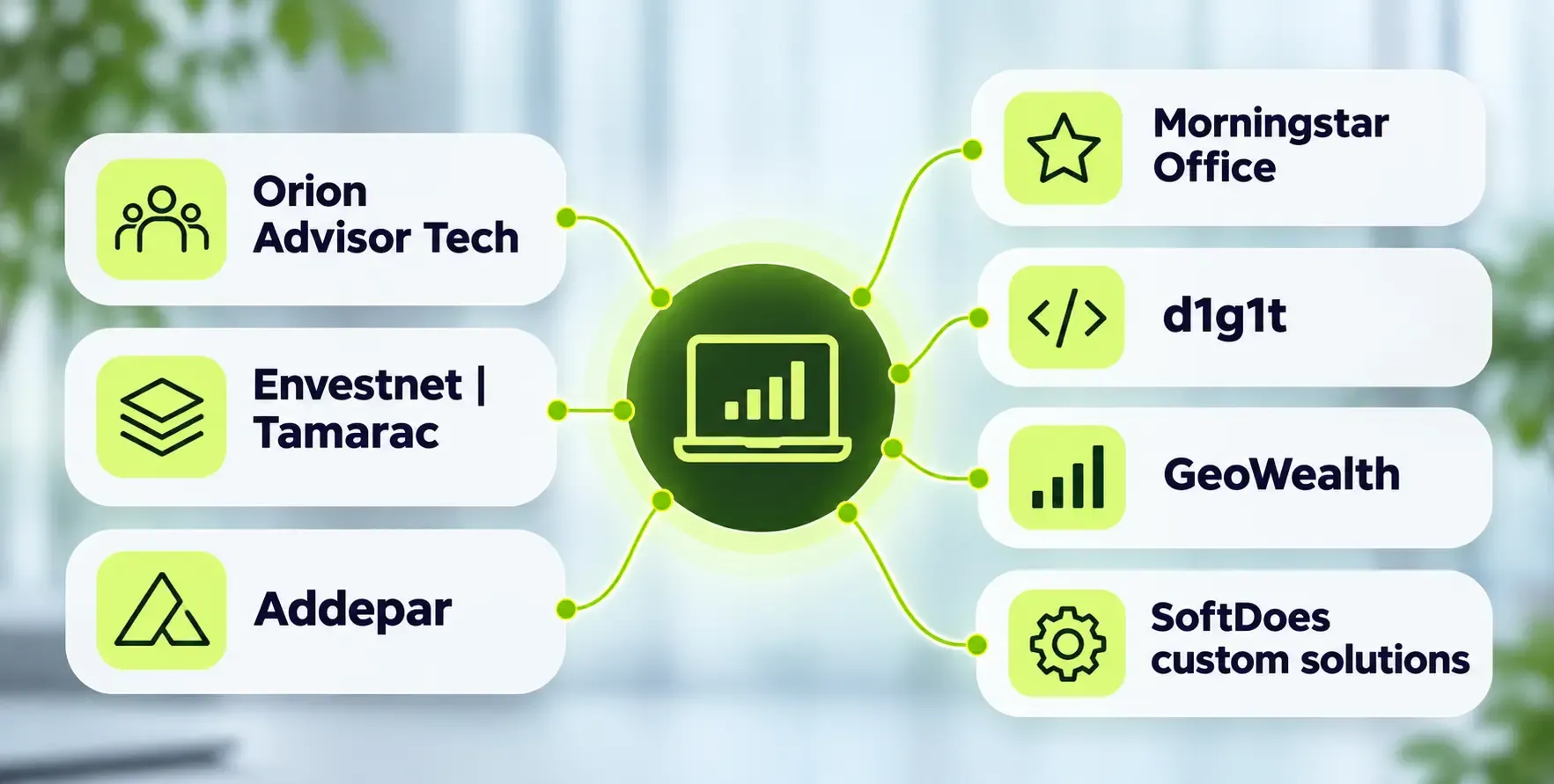
- Orion Advisor Tech – Best all-around platform for multi-custody RIAs that want an integrated stack.
- Envestnet | Tamarac – Best for established firms needing high-volume rebalancing and operational control.
- Addepar – Best for family offices and UHNW clients with complex, multi-asset portfolios.
- Morningstar Office – Best for research-driven advisors who lean on Morningstar analytics.
- d1g1t – Best for analytics-heavy, goals-based wealth management.
- GeoWealth – Best TAMP-style platform for advisors seeking outsourced investment operations.
- SoftDoes custom solutions – Best for institutions building proprietary, next-generation wealth platforms.
Each option serves a different profile. The right choice depends on your firm's AUM, client segment, investment style, data complexity, and whether technology is a utility for you or a competitive differentiator.
How to Choose the Right Wealth Management Platform
There is no single "best" platform that works for every firm. The right choice depends on your firm's size, client segment, investment style, and technology strategy.
Choose Based on Firm Size, Complexity, and Growth Plans
A solo advisor managing $50 million in ETF portfolios has entirely different needs than a multi-office RIA with $5 billion across thousands of investment accounts, or a family office managing multi-generational wealth across trusts, LLCs, and private holdings. Family offices often manage complex ownership structures and trusts, which demands platforms capable of entity-level reporting and flexible hierarchies.
For smaller firms, a turnkey SaaS like Orion or GeoWealth may be the fastest path to a professional-grade platform. For mid-sized firms, Tamarac or Black Diamond may offer the operational depth you need. For large institutions or firms where technology is a core differentiator, a custom platform built with a partner like SoftDoes becomes strategic rather than just operational.
Don't choose based solely on today's AUM or headcount. Think about where your firm will be in three to five years. A platform that works at $200 million may not work at $2 billion.
Choose Based on Investment Offering and Asset Mix
Firms focused primarily on ETFs and mutual funds need strong model management, rebalancing, and portfolio construction. Orion and Tamarac both excel here, with robust tools for asset allocation and tax-sensitive trading across public market portfolios.
Firms that also manage SMAs, options, direct indexing, alternative assets, and private markets need deeper capabilities. Addepar is the clear leader for complex portfolios involving private equity, real estate, hedge funds, private credit, and venture capital. Private markets generate unstructured documents and irregular cash flows, so platforms need to handle document management and data ingestion beyond standard custodial feeds.
Verify that any platform you evaluate supports your specific products. Direct indexing, donor-advised funds, and private credit each have unique data, reporting, and compliance requirements.
It is also worth noting that other vendors operate in the broader wealth technology ecosystem. Temenos offers a dedicated wealth management technology portfolio, and FNZ operates a global end-to-end wealth management platform. Both serve segments of the market, particularly larger financial institutions, that may overlap with the platforms listed here.
Choose Based on Data, Integrations, and Advisor Workflow
The best technology is useless if it doesn't fit into your advisors' daily routines. Map out a typical advisor day at your firm: prospecting, review meetings, trading, client reporting, compliance tasks. Then check how each platform supports that flow.
Integrations matter enormously. Your CRM, financial planning software, risk systems, and custodians all need to talk to each other reliably. Firms operating in both the U.S. and Canada need custodial feeds from providers on both sides of the border, plus support for transaction tracking in multiple currencies and tax jurisdictions.
If no single vendor covers your full workflow, custom development with a financial software development partner can glue multiple systems into a seamless advisor desktop. This is especially relevant for firms using best-of-breed tools for different functions, such as one platform for portfolio analytics and another for financial planning, that need a unified experience. Firms operating under especially stringent security and reliability requirements can benefit from a partner experienced in mission-critical, high-assurance software development.
Benefits of Working with SoftDoes on Wealth Management Technology
SoftDoes is positioned as a partner for firms that want to treat technology as a competitive advantage.
Tailored Platforms for U.S. and Canadian Wealth Firms
SoftDoes has experience building custom portfolio management systems, client portals, advisor workstations, and data layers for finance clients. These platforms are designed for North American regulations, custodial ecosystems, and reporting needs from the start.
For wealth managers who need to connect accounting and investment data across multiple systems, SoftDoes builds the data pipelines and integration layers that make that possible. Platforms must connect accounting and investment data for family offices in a way that supports both financial reporting and investment performance analysis. Data aggregation is foundational for family office technology solutions, and SoftDoes treats it as a core engineering challenge.
AI, Cloud, and Data Engineering Built In
Artificial intelligence is incorporated in modern wealth management tools for monitoring, anomaly detection, and workflow automation. SoftDoes can add AI-assisted analytics, automated alerts, and personalization on top of existing platforms or as part of a ground-up build. AI-driven solutions are becoming essential in wealth management software workflows, and SoftDoes embeds these capabilities directly into the platform rather than bolting them on as an afterthought.
AI assists in automating complex financial workflows like onboarding, report generation, and compliance checks. The industry emphasizes reliable data integration and AI governance in software systems, and SoftDoes builds with that governance framework in place from day one.
Cloud native, secure architectures scale with AUM and users across multiple offices. SoftDoes designs for high availability, encrypted data handling, and regulatory compliance, meeting the same standards expected of the leading commercial platforms.
Modernization Without Disruption
Many firms are stuck on aging systems that still hold critical historical data and run essential daily processes. SoftDoes handles legacy platform modernization through phased replacements: building APIs over old systems, migrating historical portfolio data carefully, and replacing modules incrementally rather than forcing a risky all-at-once cutover.
SoftDoes is experienced in working in regulated, high-availability environments similar to the leading wealth platforms, where downtime or data errors are not acceptable.
Which Wealth Management Software Is Best for You?
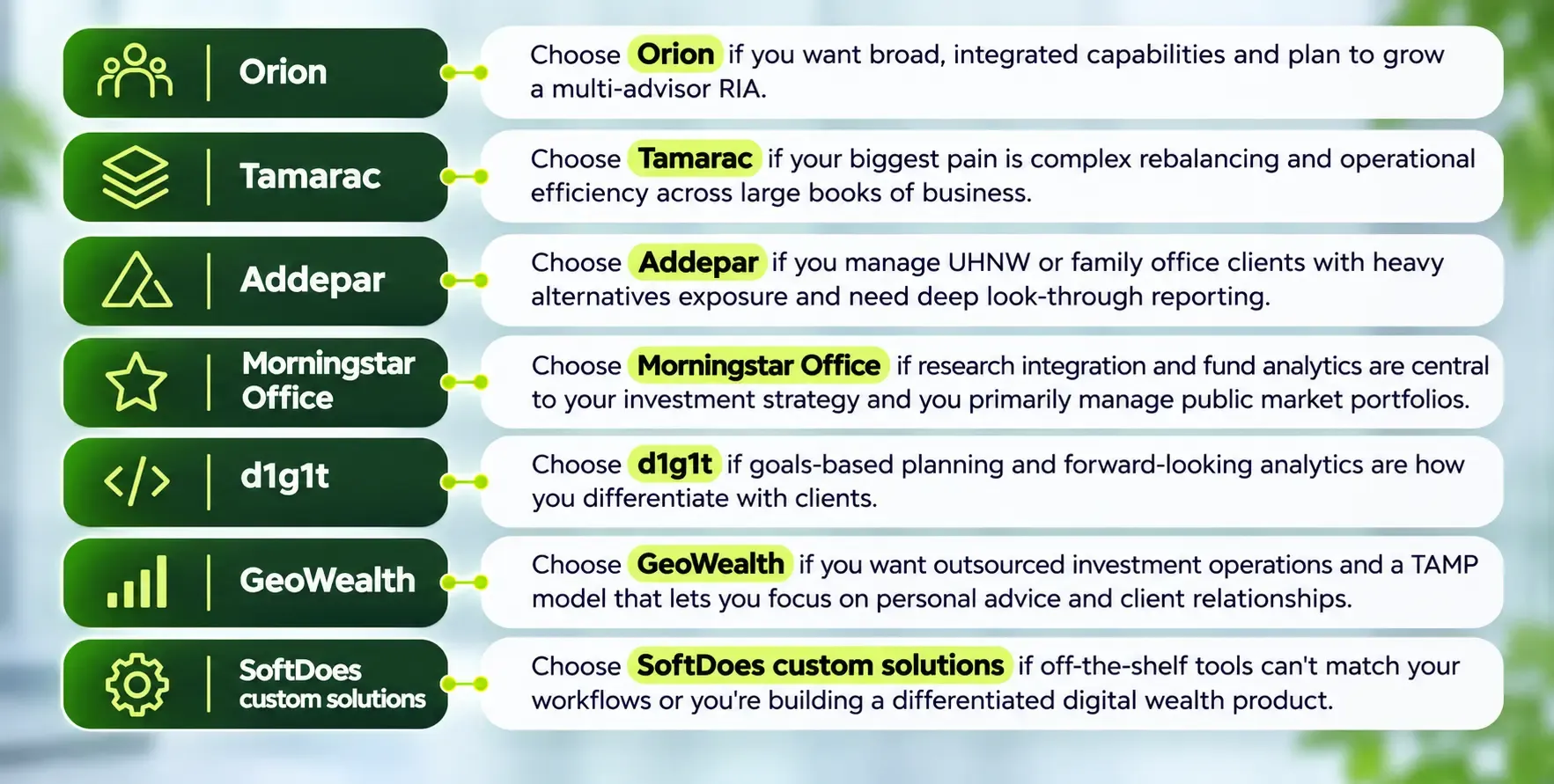
Here is a concise, decision-oriented summary to help you match your firm's needs to the right path.
Final Thoughts
The 2026 wealth technology landscape is mature but far from settled. Platforms continue to evolve toward deeper analytics, AI-driven automation, and greater transparency for clients who expect to see their financial data and investment performance in real time. Private market automation is central to wealth management technology trends, and every major platform is racing to improve support for complex assets and alternative investment classes.
No single winner fits every firm. The best choice depends on your scale, your investment strategy, and the promises you make to your clients. A firm that manages $300 million in ETF models has fundamentally different requirements than a multi-family office overseeing billions across private equity, real estate, venture capital, and public markets. Wealth management software is tailored for financial advisors, family offices, and enterprises, and each segment deserves a platform that truly fits.
Run pilots or proof-of-concept evaluations before committing. Think about how your platform will evolve over the next decade. And if your firm has unique needs, legacy challenges, or ambitions that go beyond what any packaged product can deliver, consider speaking with SoftDoes about a custom or hybrid solution. The right technology partner doesn't just implement a system. They help you build something that becomes a lasting competitive advantage.











Comments (0)
No comments yet.