Table of contents1. Key Takeaways2. What an AdTech Platform Is (and Why Build One)3. Mapping the AdTech Ecosystem Before You Build4. Choosing Your AdTech Platform Type and Business Model5. Define Core Use Cases, Target Verticals, and Brand Safety Needs6. Designing a Modern AdTech Platform Architecture7. Ad Servers, Ad Exchanges, and Where Your Platform Fits8. Key Functional Modules Every AdTech Platform Needs9. Tech Stack and Infrastructure for AdTech Development10. Privacy, Data Ownership, and Compliance by Design11. Fighting Fraud and Enforcing Brand Safety12. Step-by-Step: How to Build an AdTech Platform13. Building the Right Team and Operating Model14. Timelines and Costs of AdTech Development in 202615. Build, Buy, or White-Label: Choosing Your Path16. Ad Forecasting, Analytics, and AI/ML in Your Platform17. Benefits of Working with SoftDoes on Your AdTech Platform18. Common Pitfalls and How to Avoid Them Key Takeaways
- A modern adtech platform, whether it is a demand side platform, supply side platform, ad exchange, or ad server, must handle millions of ad impressions daily with latency well under 100 ms while enforcing strict brand safety and privacy compliance rules across the U.S. and Canada.
- The first and most important decision is choosing your platform type and business model. Everything else, from architecture and data flows to integrations and compliance, follows from that choice.
- In 2026, adtech development costs range from $150K to $1.5M depending on scope, traffic volume, and regulatory exposure. Timelines run from 6 to 24 months for platforms serving the North American market.
- Most successful businesses mix strategies rather than building everything from scratch. They build core decisioning logic in house, integrate existing ad exchanges and ad servers, and lean on cloud services for streaming and storage to reduce infrastructure costs.
- SoftDoes is a specialized engineering partner for custom adtech software development, high load systems, and AI features, helping companies ship reliable platforms without assembling every capability internally.
What an AdTech Platform Is (and Why Build One)
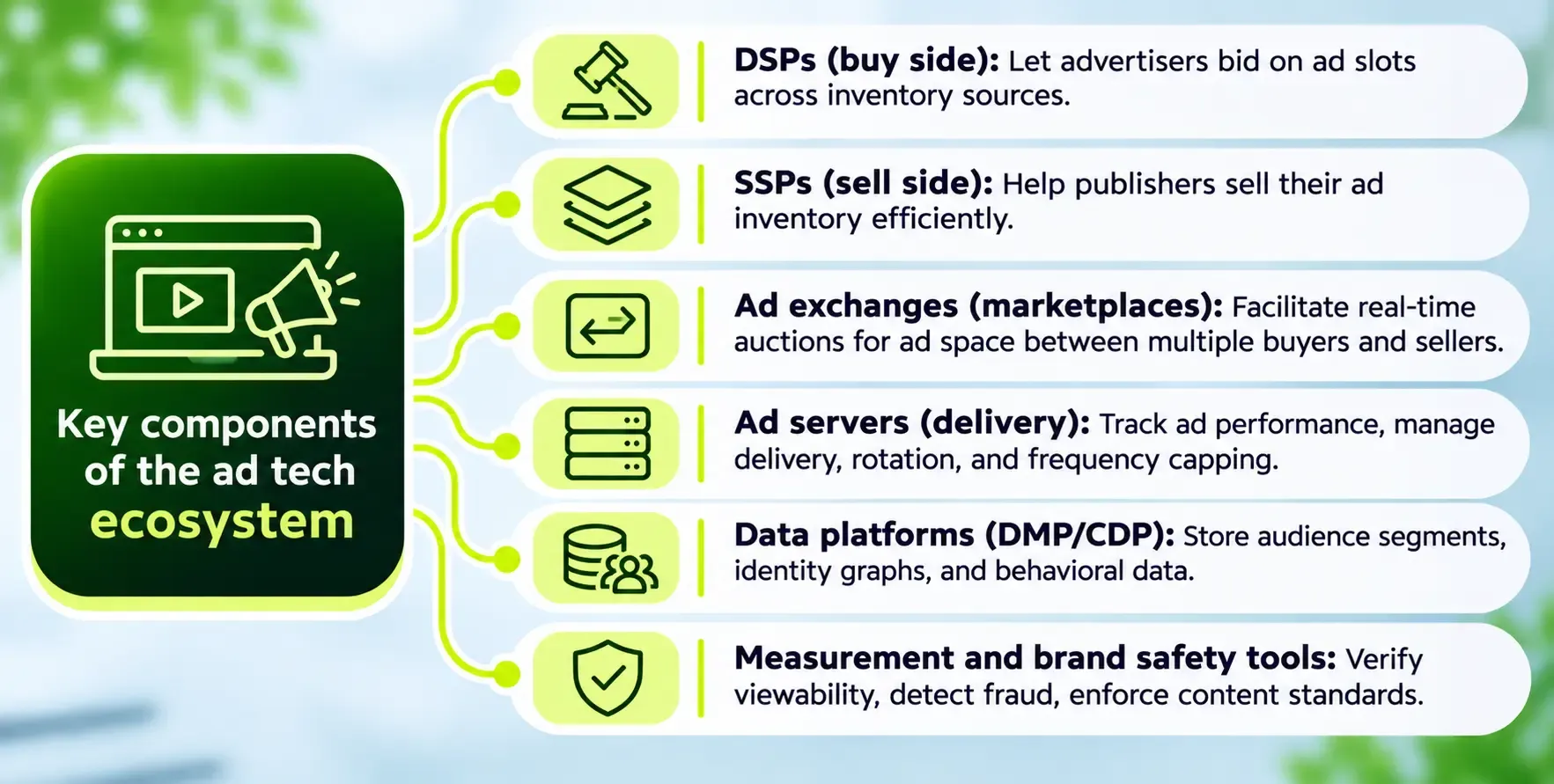
An adtech platform is the underlying technology that powers programmatic advertising. It is the software that buys, sells, serves, and measures digital ads across websites, apps, streaming services, and connected TV. The category includes demand side platforms, supply side platforms, ad exchanges, and ad servers, each playing a distinct role in the ecosystem.
Here is what happens every time someone opens a U.S. news site in 2026: the page triggers a supply side request, which flows to one or more ad exchanges. Multiple DSPs receive a bid request, evaluate it against targeting criteria and budgets, and return a price. The winning bidder's ad creative is served, and logging events fire. The entire process finishes in under 120 ms. Approximately 90% of US digital display ad dollars are now programmatically transacted through systems like these.
So why build your own adtech platform instead of renting one? Companies in the U.S. and Canada typically cite four reasons:
- Margin control. Avoiding revenue shares paid to third party platforms.
- Data ownership. Keeping customer data and first party audience insights in house.
- Brand safety. Enforcing ad quality rules that generic platforms cannot match.
- Custom workflows. Supporting verticals like CTV, retail media networks, healthcare, or finance with tailored campaign management and compliance.
Inefficient data flow across the advertising supply chain wastes approximately $22 billion annually in ad spend. Building a custom platform gives you precise control over where that money goes.
This guide walks through the full process: from choosing your platform type and designing architecture to selecting a tech stack, hiring a team, estimating costs, and avoiding the most common mistakes.
Mapping the AdTech Ecosystem Before You Build
Before writing a single line of code, you need to understand the ecosystem you are entering. Picture this: a user opens a mobile app screen. The publisher's SSP packages the available ad space and sends it to an ad exchange. The ad exchange facilitates real-time auctions for billions of bid requests daily, routing them to connected DSPs. Each DSP evaluates the opportunity against its advertisers' campaigns, returns a bid, and the exchange picks a winner. An ad server delivers the creative, logs the impression, and fires tracking pixels. Reporting and attribution systems record what happened.
Ad networks differ from pure programmatic players. Networks typically aggregate inventory and sell it as bundled packages with less transparency and more managed service. Building an adtech platform that connects directly to exchanges or replaces a network makes sense when you need operational efficiency and clearer accountability over where ads run.
Understanding this map first helps you choose which role to fill. Trying to rebuild the entire technology stack on day one is one of the fastest ways to burn through your budget.
Choosing Your AdTech Platform Type and Business Model
The single most important early decision is which platform you are actually building. Your choice of platform type shapes every downstream decision: latency targets, UI needs, data flows, partner integrations, and revenue model.
Demand side platforms serve brands, agencies, and advertisers. DSPs allow advertisers to buy ad impressions programmatically by connecting to ad exchanges to bid on impressions. The main value proposition is optimized media buying, audience targeting, and transparency of fees. Monetization typically includes platform fees, tech fees per impression, or a percentage of media spend. Self-service advertising platforms are a manageable starting point for new businesses entering the DSP space.
Supply side platforms serve publishers, app developers, and streaming platforms. SSPs maximize revenue by managing multiple buyer connections, running header bidding wrapper integrations, optimizing floor prices, and reporting yield data. Monetization comes from a take rate on publisher revenue.
Ad exchanges act as a neutral marketplace connecting multiple SSPs and DSPs. They require ultra low latency auctions and rigorous fraud control. Building a standalone exchange demands massive volume to justify the effort.
Ad servers handle ad delivery, creative rotation, frequency capping, pacing, and measurement. For publishers and niche media owners, an ad server is often the logical first build because the scope is contained and the value is immediate.
For 2026 growth areas like CTV, retail media networks, and in-game ads, founders often start with a focused vertical DSP or SSP paired with a reporting and billing layer.
Define Core Use Cases, Target Verticals, and Brand Safety Needs
Your target vertical determines almost everything about your platform's compliance burden, data handling, and feature set. A retail media platform for U.S. grocery chains needs product level targeting, integration with POS and external data, and inventory forecasting. Healthcare patient acquisition must handle sensitive data carefully, respecting HIPAA adjacent rules and avoiding medical claims. B2B SaaS lead gen requires CRM integration and lead verification. Local SMB self-serve advertising needs a simple UI with minimal compliance overhead but strong brand safety defaults.
Each vertical drives unique requirements:
- Healthcare: Strict handling of audience data, no use of personal health information for targeting, compliance with state and federal rules.
- Finance and defense: Risk disclosures, truth in advertising, careful handling of behavioral data and location data, and the same kind of high-assurance controls you would expect from mission-critical defense technology software development.
- Kids' content and education: COPPA limits on data collection, age verification requirements, and privacy-conscious practices similar to those used in custom education software development.
- News and media: Stricter brand safety rules around adjacency to sensitive topics.
When defining brand safety and ad quality policies, specify:
- Allowed and blocked content categories using a standard taxonomy
- Viewability thresholds (typically 50% of pixels visible for 1 second on display, 2 seconds for video)
- Domain blocklists, keyword filters, and contextual signals for content classification
- U.S. focused legal and policy constraints that shape what your platform will and will not serve
These policies feed directly into your filtering and bidding logic. Getting them right early avoids costly rework later.
Designing a Modern AdTech Platform Architecture
The architectural core of any adtech platform is the separation between the "hot path" and the "cold path." The hot path handles real-time bidding and decisioning. The cold path handles analytics, ML training, billing, and reporting.
A robust adtech stack typically has four primary functional layers. Here is how they map:
Hot path (Real-Time Transaction Layer):
- Load balancers and API gateways handling OpenRTB ad requests
- Bidder or decision engine evaluating each bid request against campaign rules
- In-memory profile and campaign stores for sub millisecond latency lookups
- Pre-bid fraud and brand safety filters
- Integration points with ad exchanges and ad servers
Cold path (Asynchronous Data Platform):
- Event streaming infrastructure for ingesting billions of events (impression, click, conversion logs)
- A data warehouse or lake for long-term storage and analysis
- Batch processing jobs for reconciliation, forecasting, and model training
- Ad forecasting software components for predicting inventory, CPMs, and reach
Cross-cutting services:
- Authentication and RBAC for user access control
- Configuration management for targeting rules, floor prices, and pacing logic
- Logging and observability (metrics, tracing, alerting)
- A central consent and privacy service that stores consent strings and enforces privacy decisions
Each bid request in RTB carries contextual data and audience data, so the bidder must resolve identity, match audience segments, apply targeting criteria, score the opportunity, and return a price, all before the exchange times out. DSPs connect to ad exchanges to bid on impressions, and both DSPs and SSPs use the OpenRTB protocol for transactions. The IAB sets these standards for programmatic advertising.
Traffic flow description: Bid requests arrive from SSPs or ad exchanges at the API gateway. The gateway routes them to the bidder, which consults in-memory campaign stores and audience profiles, applies brand safety filters, scores bids, and returns a response. The winning bid triggers the ad server to serve the creative. Events (impressions, clicks) flow into the streaming layer and then into the data warehouse for reporting and ML training.
Building an adtech platform requires extreme scale and low latency. RTB systems must handle millions of requests per second, and fast data flow enables real-time optimization of ad campaigns. Scalability and reliability are key considerations at every layer.
Ad Servers, Ad Exchanges, and Where Your Platform Fits
In 2026, ad servers do far more than serve a banner. They select ad creatives based on targeting rules, enforce frequency caps and pacing, log every impression and click, and support multiple formats including display, video, CTV, and in-app. Ad servers track ad performance and manage delivery across all of these channels. The Delivery and Event Layer serves ad creatives and captures user interactions in real time.
Ad exchanges orchestrate auctions between SSPs and DSPs. Their design prioritizes low latency matching, strict enforcement of fraud checks, and transparency through standards like ads.txt and sellers.json. Ad exchanges facilitate real-time auctions for ad space, and the volume they handle demands infrastructure that can scale elastically.
SoftDoes can help design interoperable components so that a custom DSP or SSP plugs into third party ad exchanges and ad servers without vendor lock-in, keeping your options open as you grow. This approach to software development focuses on clean interfaces and standard protocols.
Key Functional Modules Every AdTech Platform Needs
Despite differences between platform types, most adtech platforms share common modules that must be planned from the start. An initial MVP for adtech should focus on campaign management and ad serving capabilities, then expand from there.
Campaign and inventory management:
- UI for setting budgets, flight dates, and targeting by geo (using ip geolocation data), device, audience, and contextual data
- Managing ad space, placements, and creative uploads
- Support for multiple ad formats and channels
Targeting and decisioning:
- Audience rules built on user profiles, party data, and audience segments
- Contextual targeting based on page content, keywords, and contextual signals
- Frequency caps, pacing algorithms, and bid modifiers
- AI/ML scoring functions for conversion likelihood and bid optimization
Reporting and analytics (Management and Reporting Layer):
- Real-time dashboards for ad impressions, clicks, conversions, CPM/CPC/CPA, and margin
- Performance data exports and connections to BI tools
- Viewability and brand safety violation tracking
Billing and finance:
- Invoice generation, revenue share calculations, and configurable payment terms
- Support for U.S. and Canada tax rules
- Reconciliation with partners to catch discrepancies in log level data and raw data
Monitoring and admin tools:
- Alerts for latency spikes, error rate changes, and anomaly detection on traffic and spend
- Internal operations console for managing blocklists, data sources, and feature flags
- Tools for handling user loads during peak events
Tech Stack and Infrastructure for AdTech Development
In 2026, most high load adtech platforms use a mix of compiled languages for the bidder, mainstream web stacks for UI, and cloud native data infrastructure. Programming languages like Python, Java, and Go are crucial for adtech backend development, each serving different roles in the stack.
Real-time layer:
- High-Throughput Backend Services use languages like C++, Go, or Rust for the bidder and decision engine
- Fast Storage and Caching systems employ Redis for low latency lookups of campaign configs and user profiles
- NGINX or Envoy at the edge for load balancing and TLS termination
Data and analytics layer:
- Real-Time Data Ingestion systems use technologies like Apache Kafka for event streaming
- Big Data Analytics often utilizes ClickHouse or Apache Pinot for reporting across billions of rows of time-series ad logs
- Columnar storage formats (Parquet, ORC) optimized for analytical queries
- Cloud services such as AWS or GCP support scalable adtech infrastructure
UI and APIs:
- React or similar SPA frameworks for advertiser and publisher dashboards
- Node.js, Java, or .NET backend APIs with REST or gRPC endpoints
- Role-based access control and secure public APIs for third party integrations
Infrastructure approach:
- Kubernetes or managed container services for orchestration
- Autoscaling groups that respond to QPS changes
- Multi-region deployments across North American data centers for resilience and low latency
Scalable cloud environments are essential for adtech platforms, but the hottest path in your bidder may benefit from bare metal or co-location with exchanges when you need to shave every millisecond. Plan your database design early to support both real-time reads and batch analytics workloads.
Privacy, Data Ownership, and Compliance by Design
Privacy regulations like CCPA/CPRA, state level laws across multiple U.S. states, and Canada's PIPEDA shape every data flow in an adtech platform. These laws govern consent, opt-out of data sale or sharing, rights to deletion, and transparency about how customer data is used. In regulated verticals like healthcare, additional frameworks like HIPAA add even more constraints.
Consent and identity handling:
- Work with consent management platforms to collect and store user preferences
- Honor consent strings in OpenRTB fields (such as the GPP consent framework)
- Support both cookie-based IDs and identifier-less contextual targeting
- First-party audience targeting is more reliable than third-party cookies due to privacy concerns, so design your identity resolution stack accordingly
Data minimization and retention:
- Collect only the user-level own data you genuinely need
- Define retention periods and automate deletion workflows
- Provide routes for user access and deletion requests as required by law
Data ownership best practices:
- Ensure clients retain access to raw log level data
- Document how data is processed through your data integration pipelines
- Avoid black box models that block transparency into decisioning
SoftDoes architects consent aware data pipelines that enforce privacy constraints in both hot and cold paths, from filtering users without consent during bidding to encrypting and purging data in the warehouse on schedule.
Fighting Fraud and Enforcing Brand Safety
Invalid traffic and unsafe inventory can quickly erode trust and margins. Ad fraud detection integrates with vendors for brand safety, but it must also be a first class citizen in your own platform design. Fraud prevention must be integrated into the adtech ecosystem from the start.
Standard signals and tools:
- ads.txt and sellers.json for supply chain transparency
- SupplyChain object in OpenRTB for verifying intermediaries
- IP and device fingerprinting to flag bot traffic
- Viewability measurement via third party verification integrations
- Third party data vendors for cross-referencing suspicious patterns
Architectural hooks for fraud control:
- Pre-bid filtering to reject ad requests from blacklisted domains or suspicious sources before evaluation
- Post-bid log analysis to identify anomalies in win rates, click patterns, or impression volumes
- Anomaly detection on traffic sources using ML models
- Blacklisting and whitelisting mechanisms at the domain, app, and device levels
Brand safety controls:
- Keyword, category, and domain filters based on IAB content taxonomy
- Blocklists for sensitive topics, configurable per advertiser
- Stricter compliance rules for regulated verticals (finance, healthcare)
- Complete control over which content categories your platform will serve ads alongside
SoftDoes can embed ML-based anomaly detection into your data pipelines to flag suspicious exchanges, apps, or publishers in near real time, reducing wasted spend and protecting advertiser trust.
Step-by-Step: How to Build an AdTech Platform
Step 1: Discovery and platform definition. Run workshops to clarify your platform type (DSP, SSP, ad exchange, ad server), target audiences, key use cases, KPIs, and non-functional requirements such as latency, regional reach, and compliance. Define what success looks like: win rate, fill rate, CPM, margin, viewability.
Step 2: Architecture and technical design. Design request flows, data models for campaigns and events, partner integration patterns, and security and observability standards. Plan your data warehouse schema and streaming topology. Developing an AdTech platform can take several months due to engineering complexity, so get the design right before committing to code.
Step 3: Build the core decision engine. Implement the bidder or ad selection logic with simple auction models, pacing, and initial targeting. RTB allows advertisers to bid on ad impressions in real time, and your engine must respond to test ad exchange calls within strict timeouts, often under 100 milliseconds. Building an adtech platform may require expertise in machine learning even at this stage for basic bid scoring.
Step 4: Implement UI, workflow, and APIs. Create advertiser or publisher dashboards, admin interfaces, and REST or gRPC APIs for campaign management and reporting. This is your platform's face, so invest in usable workflows that reduce manual work through automation.
Step 5: Integrate with ad exchanges, ad networks, and ad servers. Add OpenRTB adapters, test with sandbox endpoints, then onboard a small number of partners for live traffic. Integration work can significantly increase adtech development costs, so budget extra time per partner.
Step 6: Add reporting, billing, and automation. Wire event streams into analytics and billing. Build scheduled reports and automate recurring operational tasks. Connect log level data to dashboards so clients can track performance data in real time.
Step 7: QA, load testing, and pilot launch. Simulate high QPS loads. Verify latency and counting accuracy. Run a closed beta with 2 to 5 trusted clients. Then progressively open to more traffic as confidence grows. Scaling from pilot to production follows proven patterns that avoid premature optimization.
Building the Right Team and Operating Model
For a first version build of an MVP DSP or SSP, plan for 6 to 10 engineers working over 6 to 12 months, plus product and QA support. The team needs to move fast while respecting the latency and reliability demands of the programmatic ecosystem.
Core roles:
- Low latency backend engineers (Go, Rust, Java, C++)
- Data engineers for streaming and warehouse pipelines
- Data scientists or ML engineers for bid optimization, ad forecasting, and fraud detection
- Frontend developers for dashboards and self-serve portals
- DevOps/SRE for infrastructure, monitoring, and incident response
- QA engineers for functional, integration, and load testing
- Product owner to drive priorities and partner with engineering resources
Engagement models:
- Fully in-house teams with deep domain knowledge
- Hybrid teams with an adtech focused partner like SoftDoes providing specialized engineering resources for the bidder, data pipelines, or AI capabilities
- Nearshore or remote squads aligned with North American time zones
Operational needs: Once live, your platform requires 24/7 monitoring, incident response processes, partner support for SSPs and exchanges, and a shipping cadence that delivers improvements without destabilizing the hot path.
Timelines and Costs of AdTech Development in 2026
All numbers below are directional estimates for the U.S. and Canada market in 2026. They vary by scope, traffic, and technology choices.
Platform Complexity |
Reporting/analytics layer or basic ad server | $80K–$250K | 3–8 months |
MVP DSP or SSP (core features, 5–10 integrations) | $150K–$400K | 6–12 months |
Full-featured DSP, SSP, or ad exchange | $500K–$1.5M+ | 12–24 months |
Storage costs and network egress tend to scale non-linearly as QPS increases and log volume grows. Monitor cloud spending from day one to avoid hidden costs.
Build, Buy, or White-Label: Choosing Your Path
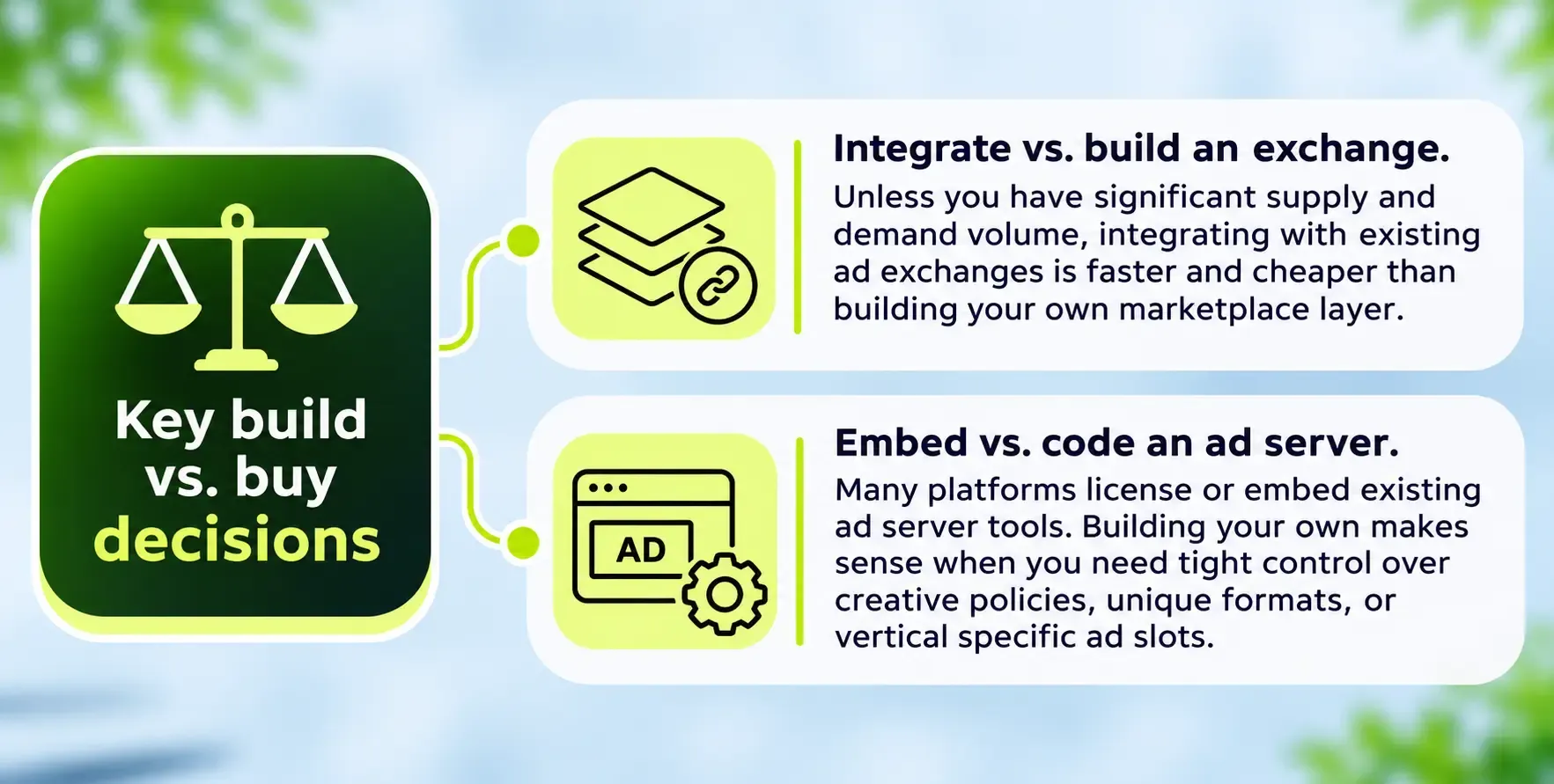
Very few companies start with a fully custom adtech platform. Instead, they mix building, buying, and integrating components. Understanding where a white label platform, white label solution, or custom development fits your strategy is critical.
White-label and SaaS pros:
- Faster time to market (often weeks)
- Lower upfront investment
- Access to mature ad exchanges, DSPs, SSPs, and ad servers
- Less initial compliance burden
White-label cons:
- Limited deep customization
- Revenue share fees that compress margins
- Less control over third party data and raw data handling
- Potential vendor lock-in
Custom development pros:
- Complete control over data, bidding logic, and integrations
- Ability to differentiate with unique targeting, formats, or vertical features
- Higher long-term enterprise value and competitive advantage
- Full ownership of your own data and algorithms
Custom development cons:
- Higher risk, cost, and longer timelines
- Ongoing maintenance and compliance responsibility
Hybrid strategies often work best: use a white label platform for initial validation, then build a proprietary bidder or data layer, or layer custom middleware and optimization logic on top of existing platforms. Align your choice with your paid media spend level, regulatory exposure, and strategic need for technology ownership.
Ad Forecasting, Analytics, and AI/ML in Your Platform
In 2026, forecasting and AI models are standard, for serious adtech platforms. Buyers expect actionable predictions, and sellers need yield forecasts to set floor prices and manage inventory.
What ad forecasting software should cover:
- Predicting inventory availability and CPMs for target audiences in specific North American markets
- Reach and frequency modeling given budget and targeting constraints
- Budget pacing optimization to distribute spend evenly or according to custom schedules
Common ML use cases:
- Bid price prediction to avoid overbidding
- Click and conversion probability estimation
- Budget pacing optimization
- Real-time anomaly and fraud detection
- Creative optimization based on performance data
Most heavy AI/ML training runs offline in the cold path. Lightweight model outputs are then used by the bidder or ad server in the millisecond decision path. Feature computation must be fast, relying on precomputed values rather than synchronous calls to slow databases.
Data flow impacts ad targeting precision and campaign effectiveness, so your data management software and ML pipelines need to be tightly integrated. SoftDoes can help design these workflows using data management platforms and data clean rooms so that prediction and optimization improve gradually without disrupting real-time performance.
Benefits of Working with SoftDoes on Your AdTech Platform
SoftDoes is a North America focused software engineering partner with deep experience in high-load advertising systems, AI/ML, and cloud native architectures. Here is what working with SoftDoes looks like:
- Custom adtech software development. SoftDoes builds DSPs, SSPs, ad exchanges, ad servers, and data/analytics layers tailored to specific verticals like finance, healthcare, and e-commerce. Your custom platform reflects your vertical's unique rules.
- Performance and reliability. SoftDoes designs low latency systems, including bidders that respond under strict timeouts, fault tolerant data pipelines, and scalable infrastructure that can grow from pilot traffic to billions of events per day.
- AI, data, and forecasting. SoftDoes teams integrate ML models for bidding, budget pacing, fraud detection, and forecasting. They ensure that model training happens in the cold path with careful inference layers in the hot path, balancing accuracy and speed.
- Compliance and security. SoftDoes brings expertise with U.S. and Canadian privacy laws, security best practices, audit-ready logging, and safe handling of sensitive vertical data across every layer of the stack.
- Flexible engagement. SoftDoes can act as a full engineering squad, a specialized extension to your in-house team, or a long-term partner for iterative platform evolution. Your team keeps full product and strategic control while SoftDoes handles defined engineering resources and workstreams.
Common Pitfalls and How to Avoid Them
Many adtech builds fail not for lack of ideas but because teams underestimate complexity, latency constraints, and the intricate process of partner integration.
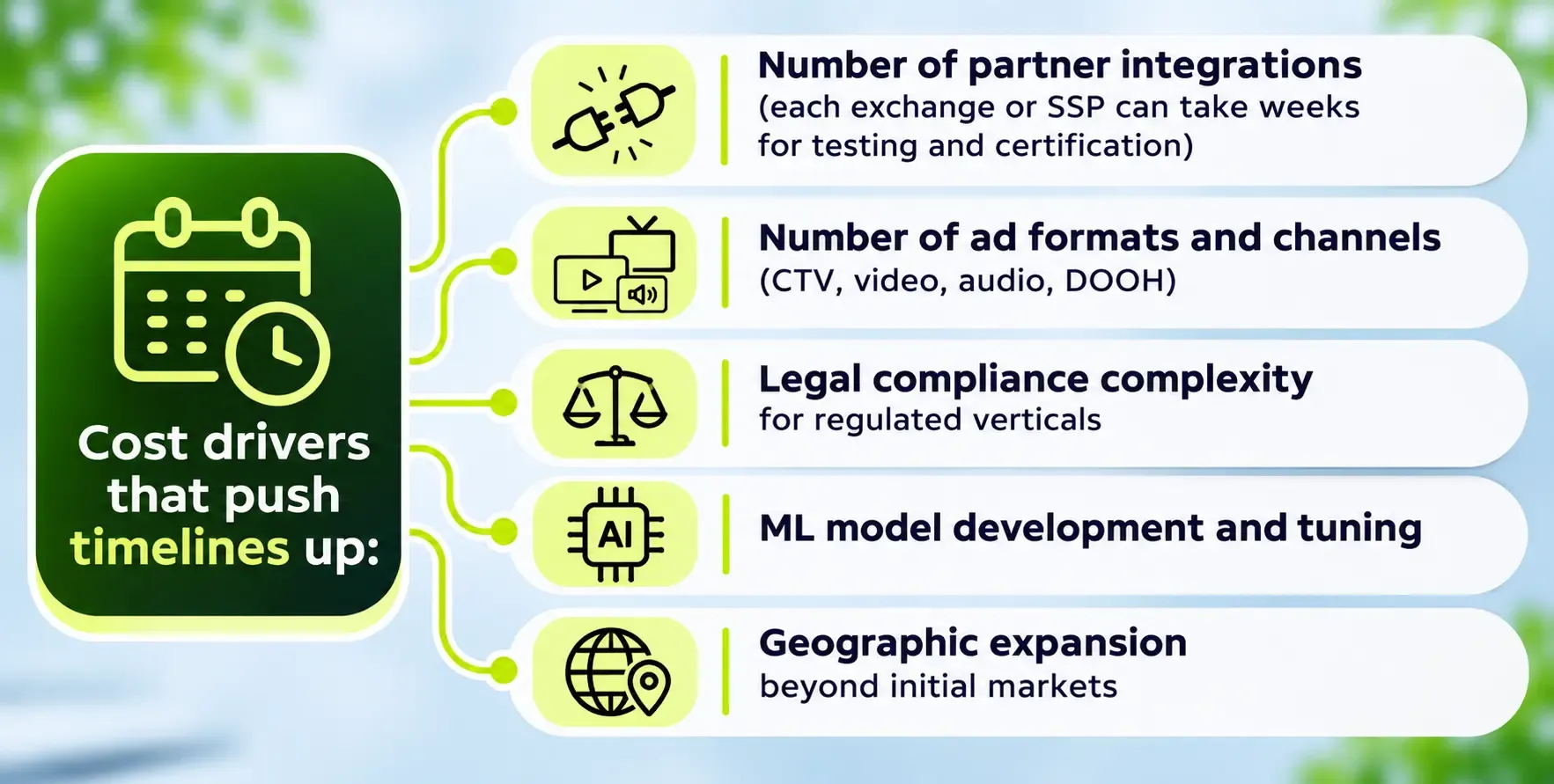
- Underestimating integration effort. Certification, testing, and troubleshooting with major ad exchanges and ad networks can take weeks per partner. Each integration involves protocol nuances, sandbox testing, and sometimes compliance review. Budget extra time.
- Putting heavy logic in the bidding path. Synchronous calls to slow databases or external APIs during auctions break timeouts and lose bids. All critical lookups for audience data, campaign rules, and targeting criteria need to be resolved from in-memory stores or prefetched data.
- Ignoring infrastructure and observability. Without thorough metrics, tracing, and alerting, system behavior during load spikes or failures becomes opaque. Cloud costs can also run away unseen, especially egress and storage costs, so cost monitoring from day one is essential.
- Treating privacy and brand safety as add-ons. Adding consent, data minimization, and brand safety filters late forces rework across the architecture. Design them into the core system from the first milestone. Automated data integration practices can help enforce these rules consistently across every pipeline.












Comments (0)
No comments yet.