Every security leader faces the same question at some point: should your organization build its own cybersecurity tools or buy software from a vendor? The stakes are high, and the wrong call can drain budgets, slow down your security team, or leave dangerous gaps in your defenses. This guide walks through the real tradeoffs, costs, and decision criteria for U.S. and Canadian organizations weighing the build vs buy cybersecurity software question in 2026.Key Takeaways
- Most organizations should buy foundational cybersecurity platforms (SIEM, EDR, email security, identity) and only build targeted capabilities where they need competitive differentiation or industry specific requirements demand it.
- AI assisted development reduces the upfront cost and speed of initial build, but it does not shrink long term support costs for audits, governance, threat evolution, or ongoing maintenance.
- Access control, identity, and vulnerability data layers are rarely worth building from scratch. Custom workflows, integrations, and risk scoring engines often are.
- Build vs buy decisions shape resource allocation and risk management across your entire security program. Treat them as strategic.
- SoftDoes helps North American enterprises run structured build vs buy analysis and then executes either path with secure by design engineering.
What "Build vs Buy" Means for Cybersecurity in 2026
When we talk about building software in cybersecurity, we mean designing, coding, hosting, and maintaining your own tools internally. That could be a custom threat hunting dashboard, an internal compliance engine, or AI agents that triage alerts. Buying, on the other hand, means acquiring commercial SaaS platforms, managed detection tools, or appliances where a vendor handles updates, threat research, and compliance support.
In 2026 there is really a third option that most teams land on: buy and extend. You purchase a foundational platform, then layer custom software on top through workflows, scripts, connectors, or AI agents tailored to your environment. This hybrid approach is where the practical middle ground lives for many organizations.
Cybersecurity is different from generic enterprise software in a few critical ways. Threat dynamics shift constantly. Regulatory pressure in the U.S. and Canada is steep, spanning SOC 2, HIPAA, PCI DSS, GLBA, and a growing patchwork of state privacy laws. The cost of a mistake is severe: the average breach now runs about $4.99 million, with AI enabled breaches averaging roughly $6 million. These realities raise the bar for any software decision, whether you build internal tools or purchase a commercial product.
This article is written from SoftDoes's perspective as a software engineering partner. The goal is balanced, practical guidance for security leaders making these calls.
When You Should Buy Cybersecurity Platforms Instead of Building
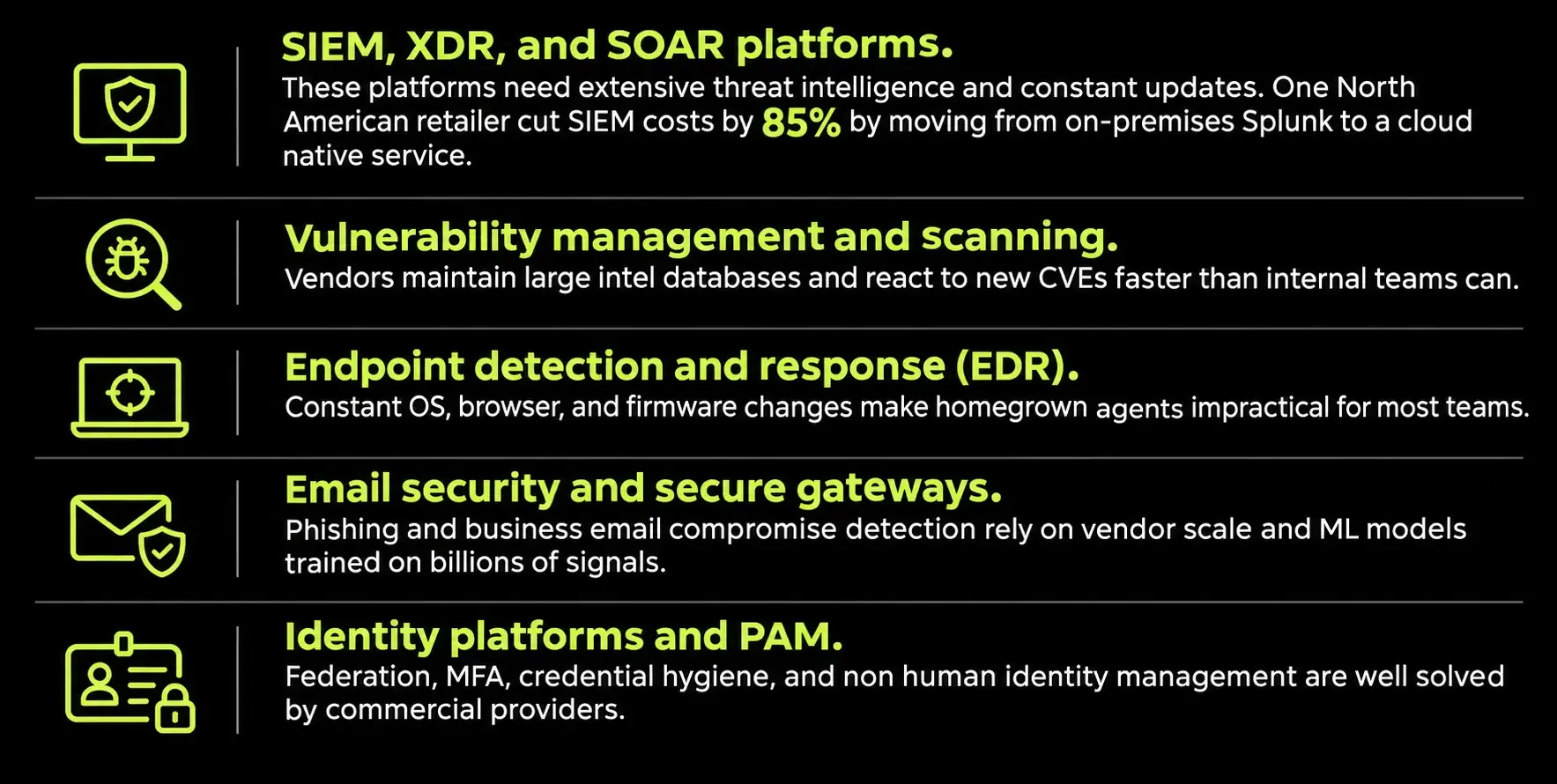
Buying software typically reduces upfront effort and speeds up implementation. For the following categories, purchasing a commercial platform is almost always the right answer:
Commercial cybersecurity tools often come with built-in compliance certifications, saving months of audit preparation. Using commercial off the shelf solutions can also reduce long term operational costs through vendor managed maintenance. Buying existing cybersecurity software enables rapid deployment and immediate functionality, which matters when your organization faces active threats or audit deadlines.
For these functions, building software usually makes sense only as extensions (dashboards, runbooks, custom correlation rules).
When Building Cybersecurity Software In House Makes Sense
Building in house should be reserved for areas that differentiate your risk posture or are genuinely unique to your environment. Custom cybersecurity software can be tailored to unique organizational requirements and workflows, and building custom cybersecurity software allows total control over features and architecture.
Strong build candidates include:
- Custom threat hunting consoles that blend internal telemetry with external data in ways no purchased platform supports natively.
- Unique access control and approval workflows driven by complex subsidiaries, legacy applications, or non human identities.
- Industry specific governance dashboards for board reporting in sectors like financial services, healthcare, energy, or education.
- Incident response tooling that maps directly to your internal playbooks, evidence collection, and communication processes.
Sectors with heavy regulation often push toward a custom build because off the shelf products don't reflect their data flows, exposure, or compliance requirements. For example, custom healthcare compliance software or practice specific legal software for law firms and in house teams may be the only way to satisfy overlapping HIPAA, state privacy, or legal confidentiality requirements.
Building cybersecurity software requires significant investment in specialized talent and ongoing maintenance. Talent scarcity is a real challenge, requiring experienced engineers and security specialists who are hard to find. Internal builds can take one to two years to reach maturity, and that timeline assumes you retain the people who started the project.
SoftDoes often sees strong build cases around integration glue, specialized analytics, and AI assisted decision support layered on top of commercial tools.
How AI Changes the Build vs Buy Decision in Cybersecurity
AI tools are shifting the economics of the build vs buy decision, but not as dramatically as the hype suggests.
- AI assisted development can reduce build time from months to days for certain tasks. AI tools like GitHub Copilot can generate code rapidly, handling scaffolding, boilerplate, and even initial detection rule drafts.
- AI generated code still requires ongoing maintenance and oversight. Governance, verification, false positives control, testing, and compliance auditing still require human review.
- AI has not changed the maintenance costs associated with builds. The long tail of updating integrations, adapting to new threats, and maintaining security hardening remains labor intensive.
- AI agents and AI assisted development can build workflows quickly but cannot replace deterministic scanning, cryptographic controls, or rigorous access control models.
- Token costs for agentic workflows can consume 5 to 30 times more tokens than simple prompts, which significantly impacts annual AI spend if you are running agents at scale.
At SoftDoes, we use AI agents as a reasoning layer for tasks like triaging alerts and summarizing evidence, while relying on proven security libraries and frameworks for core controls. The ai change is real, but it mainly compresses the initial implementation phase.
The Maintenance Tail: Why Cybersecurity Builds Get Expensive
The biggest mistake in any build vs buy analysis is underestimating the maintenance tail. Building software often costs two to four times its initial price over the full lifecycle. Maintenance often consumes more than half of a system's lifecycle cost.
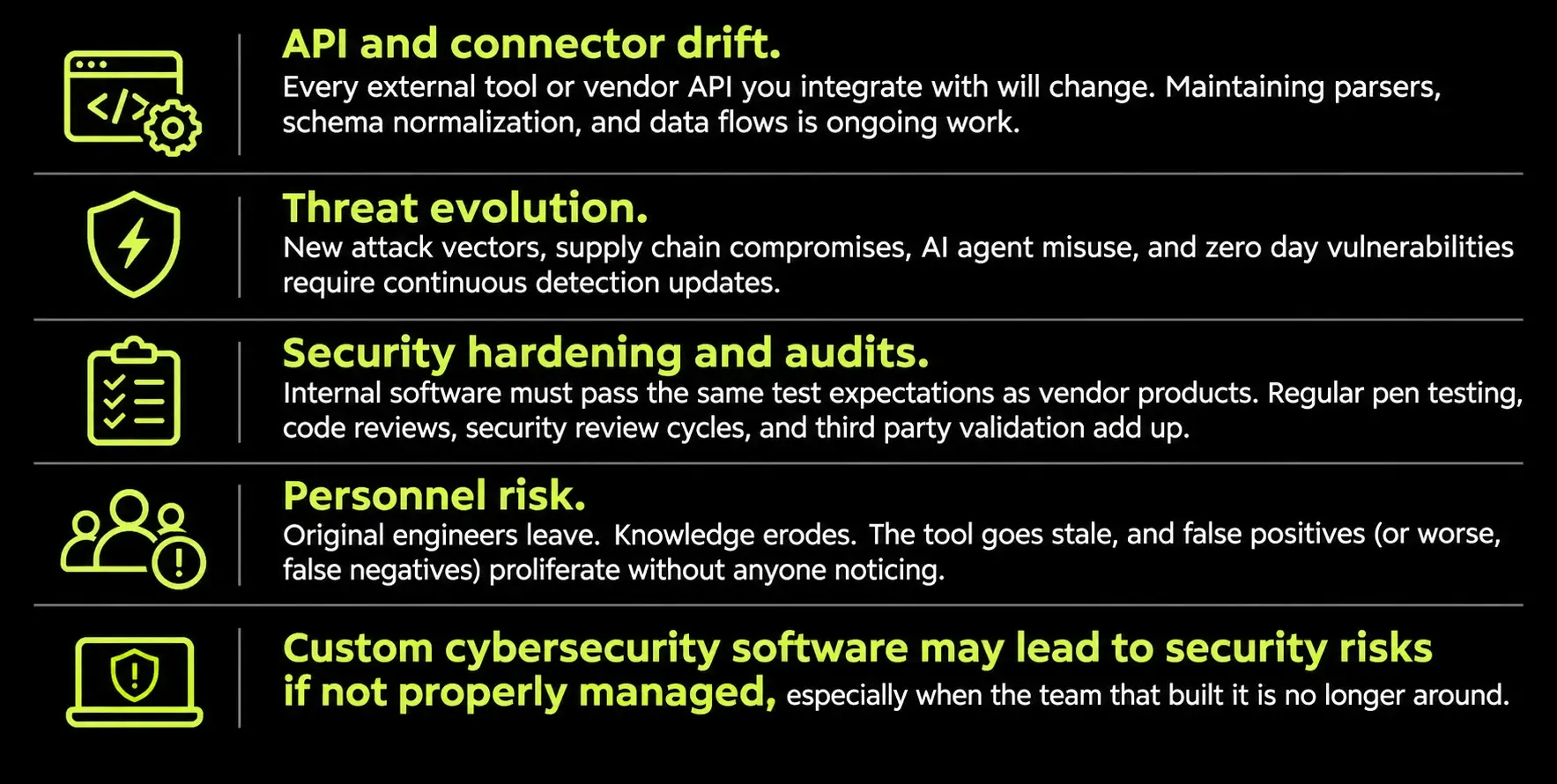
Here's what drives those costs for custom internal tools in cybersecurity:
SoftDoes advises clients to model 15 to 25 percent of the original cost per year for cyber tool maintenance, plus cloud and data pipeline costs, often as part of broader IT consulting and technology strategy engagements. A lean build that costs $200,000 upfront can easily reach $500,000 to $800,000 over five years once you factor in ongoing maintenance, infrastructure, and staffing.
AI Agents in Cybersecurity: What to Build vs What to Buy
AI agents are increasingly operating as autonomous or semi autonomous security assistants, handling repetitive tasks like alert enrichment, log correlation, and report drafting. The question is where to draw the line between building your own tools and purchasing mature products.
Where building custom AI agents makes sense:
- Summarizing long investigation timelines across multiple tools
- Correlating alerts from different vendor platforms into a unified view
- Drafting incident reports using your organization's templates
- Recommending remediation steps based on your own risk scoring
AI assisted development is effective for low stakes internal tools like these, where errors are caught during human review rather than silently deployed.
What should still be bought:
- Mature SAST, SCA, and secrets scanning engines
- Container and cloud posture management
- Threat intel feeds with strong validation pipelines
When budgeting, remember that agentic workflows can consume significantly more tokens than single prompts. That subscription costs line item for model hosting and API calls can grow fast. SoftDoes helps clients architect AI agents to call deterministic tools efficiently, reducing token usage and false positives while preserving accuracy.
A Practical Build vs Buy Decision Framework for Security Leaders
Seven criteria guide build vs buy decisions, covering cost, capability, and urgency.
Score each planned initiative on a 1 to 5 scale where 1 leans "buy" and 5 leans "build":
Decision Driver |
Strategic importance | Commodity capability | Competitive differentiation |
Regulatory exposure | Vendor satisfies controls | Unique compliance requirements |
Off the shelf fit | 80%+ match to needs | Less than 50% match |
Data residency | Vendor meets your region | Strict local control needed |
Internal engineering capacity | Limited or no security engineers | Strong engineering team |
Time to market | Urgent need | Can invest months |
Total cost (10 year view) | Vendor TCO is lower | Build TCO is lower at scale |
Encourage your security leaders to treat this framework as a conversation tool with finance and engineering. The buy decision or build decision should reflect your organization's actual constraints. SoftDoes can facilitate structured workshops to run this framework across one or more planned cyber projects.
Total Cost of Ownership (TCO) for Build vs Buy Cybersecurity Tools
Both sides consistently underestimate total cost by two to three times. Total cost of ownership includes hidden costs like maintenance and compliance that rarely appear in initial project budgets.
For building software, cost components include:
- Discovery, architecture, and writing code
- Engineering team salaries and product management
- Testing, security review, and certifications (SOC 2 first year costs alone can run $75,000 to $200,000 for mid market organizations)
- Infrastructure, observability, and disaster recovery
- Total cost of ownership for built software can exceed $750,000 over five years
For buying software, cost components include:
- Annual license fees and seat growth pricing
- Usage and data ingestion charges
- Support tiers and implementation tuning
- Integration projects and staff for ongoing configuration
- Buying software typically costs around $700,000 over five years, but buying cybersecurity tools may introduce recurring licensing costs that can escalate over time
Buying costs less upfront than building in nearly every scenario. But organizations waste an average of $19.8 million annually on unused software licenses, which means buying without governance creates its own waste.
Model a 5 to 10 year horizon that captures re platforming costs, threat landscape changes, and AI token budgets for AI agents embedded in workflows. SoftDoes typically prepares side by side 10 year TCO models for clients when stakes are high, whether for vulnerability platforms, identity governance, or data security hubs. The goal is to find the right answer for your organization.
Access Control, Identity, and the Data Layer: What You Should Rarely Build
Identity and access control are foundational and high risk places to miscalculate build vs buy. Getting this wrong can expose your organization to breaches costing millions.
Discovery and normalization of identities across cloud, SaaS, and on premises directories is a classic "buy" layer. The integration volume and change rate are enormous, and vendor lock in is manageable because the alternative (building your own identity graph) is expensive and brittle.
Building your own persistent permissions store or identity graph means maintaining connectors to every SaaS app, cloud provider, and directory your organization grows into. That is a recipe for technical debt and silent security gaps.
The right path is usually to buy the foundational identity and access control data layer (visibility, normalization, connectors) and build custom risk scoring, approval workflows, and exception processes on top. SoftDoes helps customers design and build that operational layer around purchased platforms to match their specific policies and regulatory needs.
Security Use Cases That Are Strong Candidates to Build
Some security capabilities deliver strong ROI when built custom. These tend to be areas where your business context, data, or regulatory environment makes generic tools insufficient.
- Risk scoring engines that combine your business context with off the shelf vulnerability data, weighting assets by revenue impact.
- Bespoke compliance dashboards for board reporting that map controls to the specific frameworks your auditors care about.
- Sector specific incident playbooks with automation for healthcare patient data, financial trading anomalies, or energy grid events.
- Internal red team tooling, custom honeytokens, and deception systems tuned to your network topology.
- Custom ML models for anomaly detection or fraud (card fraud, patient record misuse) trained on your own data distributions.
These are areas where existing tools either don't fit or provide only generic coverage. SoftDoes partners with security and risk teams to design and implement these specialized systems on top of commercial platforms, so you get full control where it matters and vendor strength where it doesn't.
Security Use Cases You Should Almost Always Buy
Misbuilding foundational controls carries outsized risk. If your custom system misses edge cases or lags behind vendor updates, the opportunity cost could be a multimillion dollar breach.
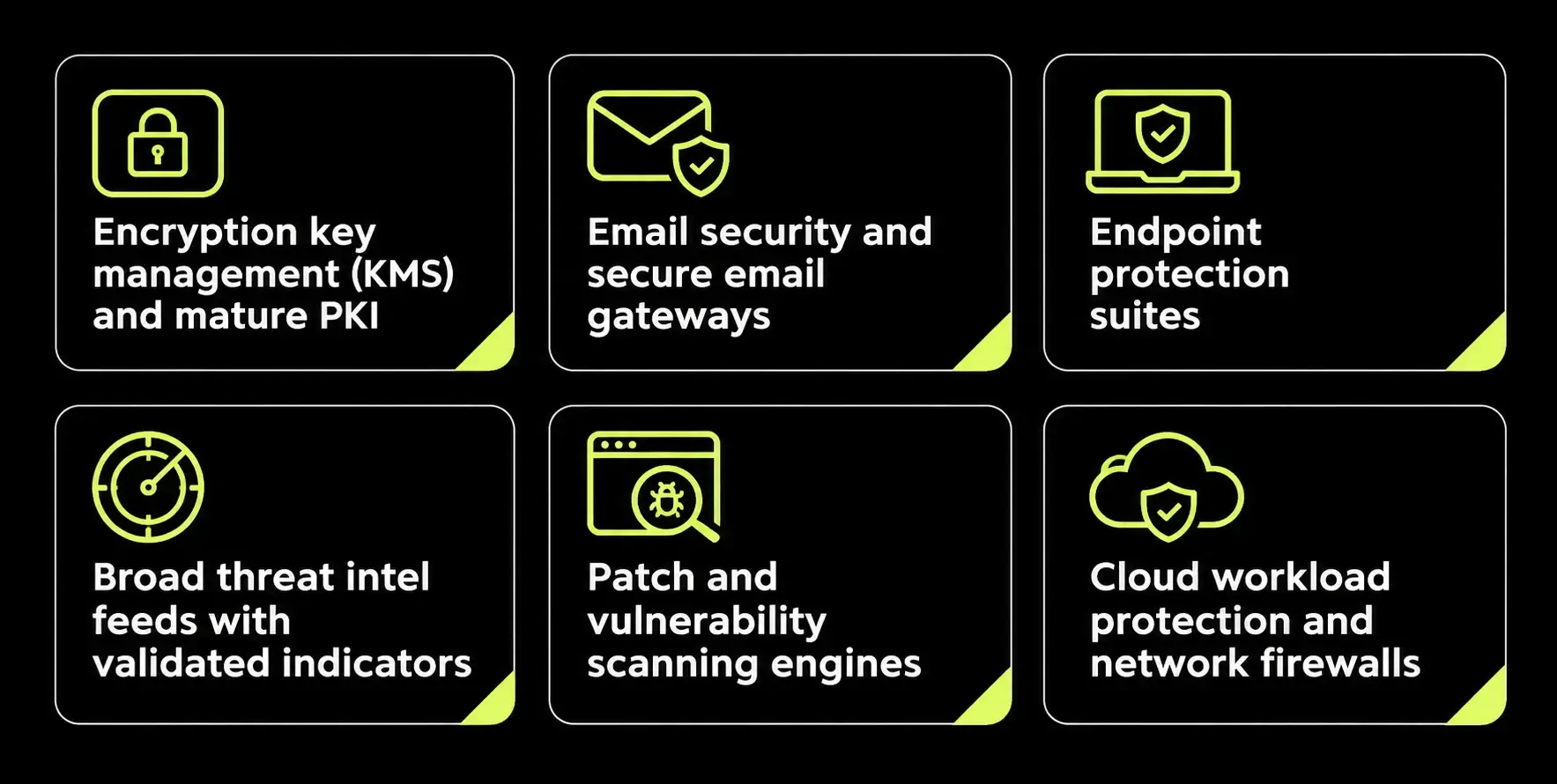
Categories best bought include:
These tools change too fast and require too much dedicated research to justify greenfield builds for most organizations. Even large enterprises in the U.S. and Canada usually only build thin layers around these platforms for reporting, exception workflows, and integrations. Buying is strategic when reliable capabilities are needed quickly and vendor managed maintenance keeps you current.
SoftDoes recommends buying in these categories and focusing your engineering capacity on integration, analytics, and automation instead. That is where smaller teams and larger ones alike get the most value from their build budget.
Benefits of Working with SoftDoes on Build vs Buy Cybersecurity Decisions
SoftDoes is a North America focused software engineering and AI partner for regulated industries. We don't sell security products. We help you figure out the right answer and then build or integrate accordingly.
- Vendor neutral advice. We evaluate your options across build, buy, and buy and extend without pushing a particular product.
- Deep experience in regulated sectors. We deliver in finance, healthcare, education, e commerce, and energy, all with compliance requirements baked in.
- Structured decision workshops. We run build vs buy frameworks with your security, finance, and engineering stakeholders to align on a path before writing code or signing contracts.
- End to end capabilities. From cloud security engineering to AI/ML for threat detection to secure by design practices, we cover the full lifecycle.
- Staffing flexibility. Whether you need to hire system security developers or data security developers, we match the right talent to your project.
Engage SoftDoes early, before committing to a platform or starting an in house build, to avoid expensive rework and security gaps.
How SoftDoes Runs a Build vs Buy Analysis for Cybersecurity Initiatives
Here is how a typical engagement works:
- Discovery. We clarify the system type (vulnerability platform, identity layer, TPRM tooling, or other priorities), its strategic importance, and your time to market needs.
- TCO modeling. We build a 5 to 10 year cost model for build vs buy, including maintenance, cloud infrastructure, AI token spend, and staffing, tailored to your U.S. or Canadian context.
- Vendor and fit assessment. We evaluate vendor fit, integration complexity, data sensitivity, and compliance obligations, then document key tradeoffs for executives.
- Recommendation and roadmap. The outcome is a written recommendation and technical roadmap, whether the right answer is buy, build, or buy and extend with custom software. This is not a one off deliverable; it becomes the foundation for your scaling strategy.












Comments (0)
No comments yet.