Every contract your organization signs carries risk, revenue, and obligation. When legal departments and procurement teams juggle thousands of agreements across spreadsheets, shared drives, and email threads, the cracks show up fast: missed renewals, slow approvals, compliance gaps, and decisions made without reliable data. This guide walks through everything involved in contract management software development, from strategy and architecture to AI capabilities and a step by step roadmap, so your team can build a system that actually fits the way your business works.Key Takeaways
- Custom contract lifecycle management software can automate the entire contract process, from authoring and negotiation to renewals and closeout, for U.S. and Canadian enterprises dealing with high volumes and complex workflows.
- AI powered contract analysis, structured approval workflows, and searchable centralized repositories reduce compliance risk and cut contract cycle times significantly.
- SoftDoes specializes in building tailored CLM and management software that connects with existing CRM, ERP, and e-signature tools, giving enterprise teams full control over their contract data.
- This article covers strategy, architecture, tech stack decisions, AI use cases, security and compliance, and a practical development roadmap to help legal leaders and procurement teams plan with confidence.
What Is Contract Management Software (and Why Build It Custom?)
Contract management software is a system that handles every stage of the contract lifecycle: request, drafting, negotiation, approval, execution, obligation tracking, renewal, and closeout. When that system covers the full span, it becomes contract lifecycle management software, or CLM.
Off the shelf CLM platforms like Ironclad, Icertis, or Agiloft work well for many organizations with standard workflows. But enterprises with complex contract types, strict compliance requirements, and tightly coupled internal systems often find that generic tools force workarounds or leave gaps. Custom development gives you flexibility, full ownership of contract data, and the ability to match how your legal workflows actually operate.
Consider a healthcare network in the U.S. managing over 5,000 annual contracts, covering vendor agreements, provider partnerships, data processing addenda, and patient service SLAs. Spreadsheets and generic document management tools can't enforce the approval routes, compliance checks, and audit trails that regulated environments demand. That's where custom software built by teams experienced in healthcare becomes a practical necessity.
Custom CLM tends to make sense when organizations have multiple contract types with different risk profiles, complex approval workflows, heavy integration needs with CRM or ERP, strict regulatory requirements, or when they need ownership over data and the ability to evolve features rapidly. The rest of this article focuses on how to design and build such a solution with an engineering partner like SoftDoes.
Core Goals of Modern Contract Lifecycle Management
Before choosing a tech stack or debating microservices versus monoliths, teams must define what they want comprehensive contract lifecycle management to achieve in business terms. Technology decisions flow from clear goals.
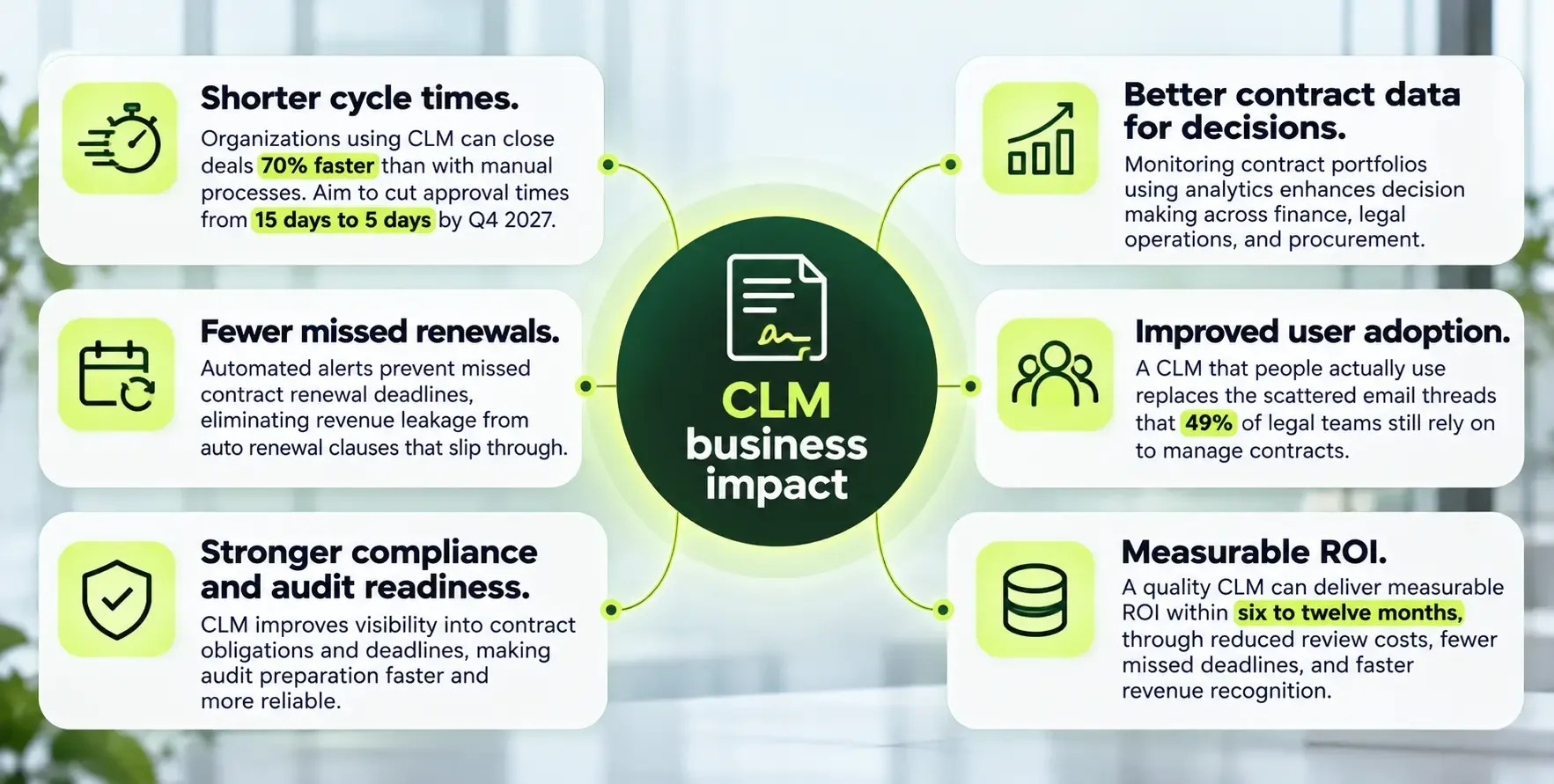
Here are the outcomes that matter most:
Full contract lifecycle management should serve legal, procurement, sales, finance, and vendor management. It's not a file cabinet. It's a decision engine.
Key Stakeholders: Legal, Procurement, Sales, and Finance
Successful management software projects start with a clear picture of who will use the platform every day and what they need from it.
Enterprise legal teams use CLM for standardized language, risk review, and audit trails. A typical general counsel pain point is slow reviews for NDAs and MSAs, especially when 77% of legal teams are already prioritizing increasing operations headcount just to keep up with volume. Legal departments need clause libraries, redlining tools, and version control that tracks changes in contract documents for compliance.
Legal and procurement teams collaborate closely on vendor contracts, SLAs, and renewals. Shared approval workflows reduce friction between departments. In 2023, procurement teams saved $66K through improved processes, and modern CLM platforms can improve supplier performance and compliance by giving procurement visibility into obligation management.
Sales teams need speed. Generating compliant sales agreements directly from their CRM keeps deals moving. Finance needs obligation tracking and renewal dates to support revenue recognition and spend forecasting. When contract insights flow to business users across departments, decisions improve.
Stakeholder interviews early in the project should document current contract management processes, manual workarounds, and the agreement details each group needs to track.
Understanding Your Contract Types and Volumes
Mapping contract types and contract volume is critical for scoping features and performance needs. Different contract types drive different system behaviors.
Typical contract types for enterprises in the U.S. and Canada include:
Contract Type |
NDAs | Legal | Confidentiality, jurisdiction |
Customer/Sales Agreements | Sales, Legal | Revenue terms, liability |
Vendor Contracts | Procurement | Obligations, spend, SLAs |
Employment Offers | HR, Legal | Compliance, benefits |
Partner Agreements | Business Dev | IP, exclusivity |
Data Processing Addenda | Legal, IT | Privacy, data residency |
SOWs and MSAs | Procurement, Legal | Scope, pricing, renewals |
Annual contract volume and peak periods, such as fiscal year-end or major procurement cycles, influence scalability, repository design, and notification systems. A contract taxonomy spreadsheet, listing types, metadata fields, risk levels, and jurisdiction rules, is one of the most valuable early project artifacts. Engineers use it as a blueprint for the data model, search indexing, and workflow configuration.
From Manual Chaos to Structured Contract Data
Most organizations store contracts as scattered PDFs and Word files across email, network drives, and legacy tools. This limits search capability, reporting accuracy, and risk analysis. In fact, 49% of legal teams manage contracts through scattered email threads, which means key contract data lives in inboxes instead of systems.
"Contract data" in practice means: parties, effective dates, renewal terms, pricing, SLAs, jurisdiction, and custom fields relevant to the business. Structured data is what separates a contract repository from a file dump.
Custom development can enforce structured metadata capture during contract creation or ingestion, rather than relying on manual tagging after the fact. When someone drafts or uploads a contract, the system prompts for required fields and eliminates the manual data entry that causes errors and delays.
Once contract data is structured, it powers dashboards, renewal forecasting, obligation tracking, and AI powered contract analysis. For example, extracting auto renewal clauses and notice windows across thousands of existing supplier contracts becomes a query instead of a legal team spending weeks reading PDFs. Centralized repositories store all contracts and facilitate searches, making it possible for any authorized user to find what they need in seconds.
Essential CLM Features to Design Into Your Platform
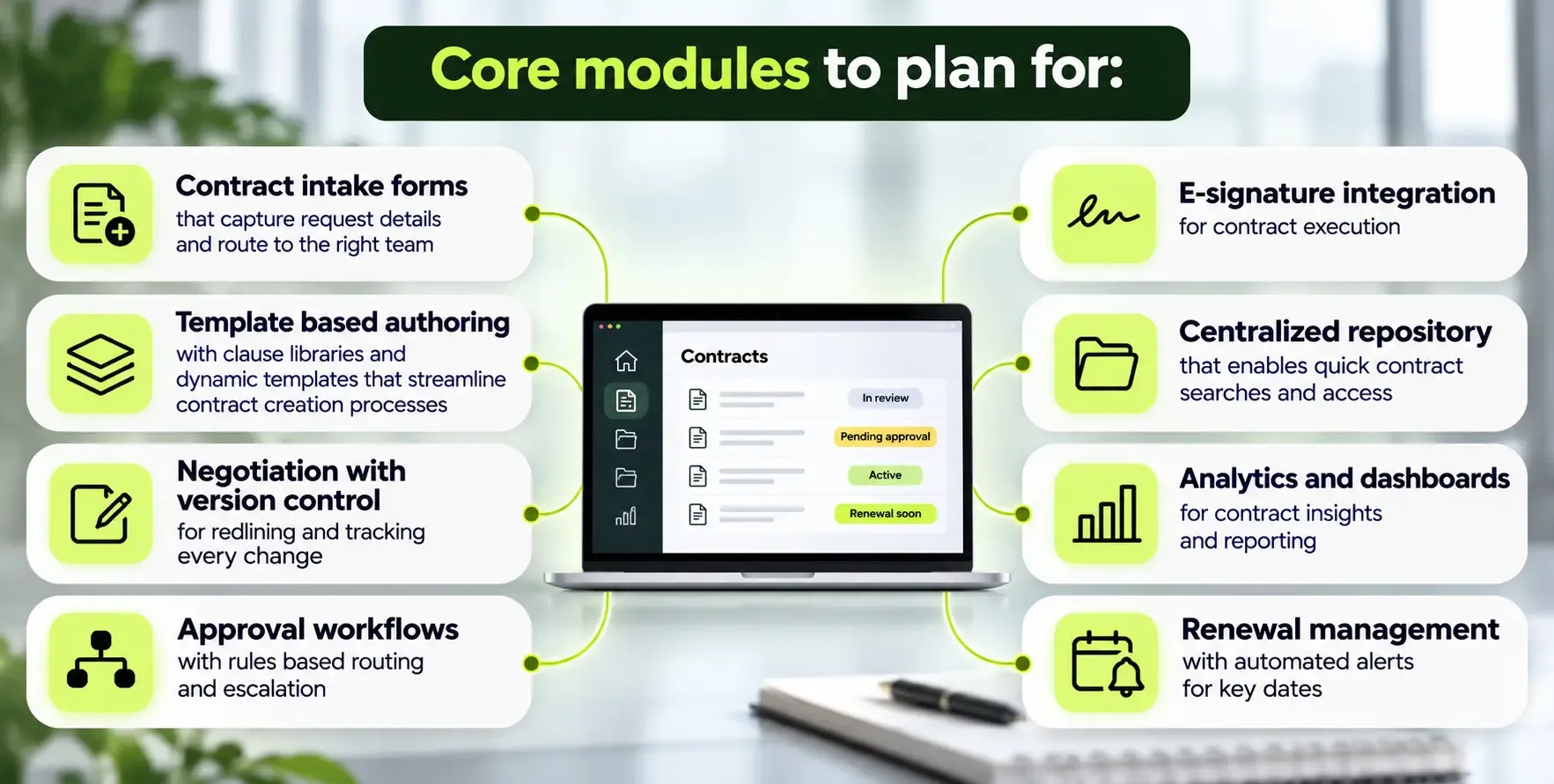
While every system is unique, modern contract lifecycle management software shares a common feature set that covers the entire contract lifecycle.
User experience influences adoption rates of contract management systems. Simple dashboards, clear status indicators, and role-based views per department are essential. Legal review screens look different from procurement's renewal tracker, which looks different from a sales rep's contract stands view.
Prioritize features into must-have, should-have, and later-phase items to keep initial scope realistic. SoftDoes often prototypes the highest value features first in a clickable UI mockup so legal and procurement stakeholders can validate the design before development begins. Automating document generation from templates reduces human error and keeps the contract drafting process consistent across business teams.
Designing Smart Approval Workflows
Approval workflows are the backbone of any contract management processes and a common source of delays when poorly designed. Automated workflow routing eliminates bottlenecks in approvals and keeps the contract process moving.
Rules based approval routing can be configured by contract value, risk level, contract type, or jurisdiction. For example:
- Deals over $250,000 always include CFO sign off
- Vendor contracts in regulated industries require compliance officer review
- NDAs under a standard template auto approve after legal review
Sequential approvals work when each reviewer depends on the previous one's input. Parallel approvals speed things up when reviewers are independent. Escalation rules, such as reminders after 3 days and escalation to a manager after 7, improve throughput and prevent contracts from stalling in someone's inbox.
The best approach is human readable workflow builders so legal operations teams can adjust approval processes without developer support. Automated workflows reduce contract cycle times by 39%, which means getting this right has a direct, measurable impact on how fast your organization closes deals.
Integrations matter here too. Approvals triggered in Slack, Microsoft Teams, or email that sync status back to the CLM system keep people in their preferred tools while maintaining a single source of truth.
AI Powered Contract Intelligence and Automation
AI powered contract capabilities have moved from "nice to have" to expected for enterprise legal teams in North America. Currently, 69% of legal professionals use AI in their work, and AI contract review adoption rose 75% year over year.
Concrete AI use cases in contract lifecycle management include:
- Clause extraction: automatically identifying auto renewal, notice periods, indemnity, and liability clauses
- Deviation detection: flagging language that deviates from approved playbooks
- Risk scoring: rating contracts based on exposure factors
- Metadata population: filling in key terms, dates, and parties without manual entry
- Plain language summaries: making contract analysis accessible to business users who aren't lawyers
AI powered data extraction enhances contract analysis by pulling structured data from unstructured documents. AI powered tools can extract key terms and flag risks across thousands of agreements in hours instead of weeks. AI can reduce contract review cycles by up to 39%, and AI reduces manual contract review time significantly, freeing legal teams to focus on judgment calls rather than repetitive reading.
Looking ahead, AI can handle 50% of procurement contract management tasks by 2027, and retrieval augmented generation (RAG) pipelines are already achieving roughly 80% accuracy in identifying problematic clauses in industrial settings.
Design considerations matter: explainability, showing source clauses next to AI suggestions, and storing AI decisions with the contract record for auditability. AI can automate contract review and risk detection, but human review remains essential for high risk agreements. AI capabilities can significantly improve contract workflows when implemented appropriately, with clear playbooks and validation guardrails.
SoftDoes can build AI features and workflow automation using cloud services such as AWS, Azure, or GCP, or private models depending on security and compliance requirements.
Integrating CLM with CRM, ERP, and E-Signature Tools
Standalone contract management solutions often fail because users prefer to stay in systems they already use daily. Integrating with existing enterprise systems streamlines contract workflows and prevents the CLM from becoming yet another tool people avoid.
Common integrations include:
System Type |
CRM | Salesforce, HubSpot | Generate and track sales agreements |
ERP | SAP, Oracle, NetSuite | Procurement, invoicing, spend tracking |
E-Signature | DocuSign, Adobe Acrobat Sign | Contract execution and signing |
Integrating e-signatures expedites the contract signing process and removes the last manual step before execution. For connecting your CLM to CRM, ERP, and internal tools, REST APIs, webhooks, iPaaS tools, and direct SDKs are the standard technical options. An API first architecture is important for long term flexibility.
Bidirectional sync of contract data, such as renewal dates and amounts, keeps revenue forecasts and vendor spend reports accurate. Teams should create integration sequence diagrams early in the project so both business and engineering sides align on data flow. If your organization runs on Salesforce, working with experienced Salesforce integration consultants can accelerate this work.
Security, Compliance, and Audit Trails by Design
Contract management software holds sensitive information, from customer data and pricing to intellectual property and contractual commitments. Security can't be bolted on later. CMS development requires a balance of security and user experience from the start.
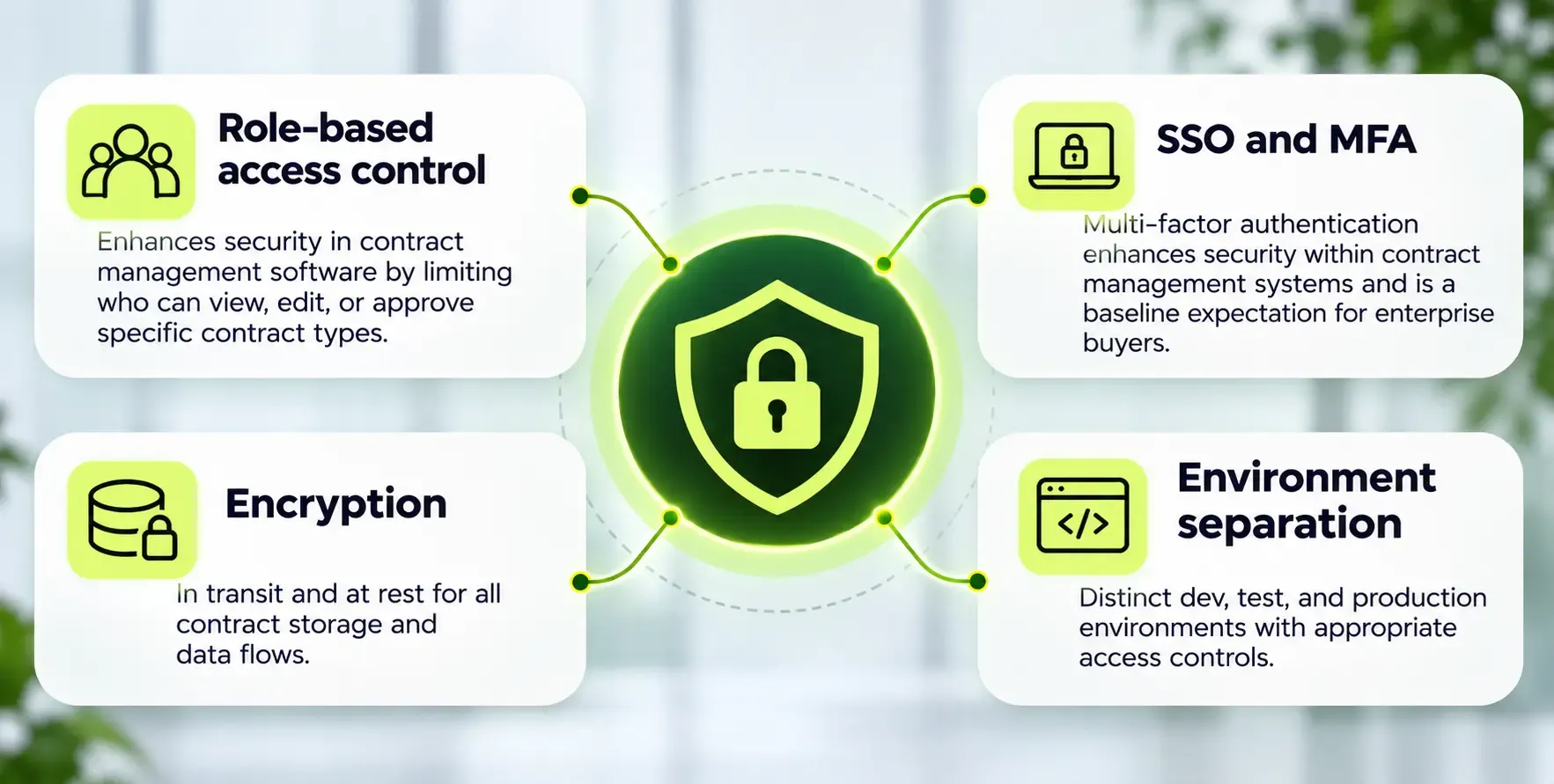
Core security practices to implement:
Compliance with regulations is essential in contract management. North American enterprises typically expect SOC 2 compliance, and healthcare organizations need HIPAA alignment. Canadian companies must address PIPEDA and provincial privacy laws. For organizations doing business across borders, data residency requirements may dictate where contract data is stored.
Detailed audit logs are non-negotiable: who viewed, edited, approved, exported, or downloaded each contract, with timestamps and IP data. Version control tracks changes in contract documents for compliance and provides evidence during audits.
AI specific security questions should be addressed early: where AI models run, how training data is handled, and whether contract data is excluded from public model training. Secure authentication measures such as MFA are recommended in CMS across all user roles.
User Experience and Driving User Adoption
Even the best engineered contract lifecycle management tool fails if everyday users avoid it and fall back to email and shared drives. User centered design is vital for effective contract management software, and 75% of legal teams are improving their approach to legal technology, which means they're ready for better tools if the experience is right.
UX patterns that drive adoption:
- Clear dashboards showing "My contracts" for each role
- Simple intake forms with guided fields
- Consistent labels and minimal clicks for frequent actions
- Role-based views: legal workflows differ from what sales teams or business users need
Involving representative users from legal, procurement, sales, and finance in usability testing of clickable prototypes before development sprints prevents expensive rework. User experience influences adoption rates directly, so test early and test often.
Change management basics matter: tailored training sessions, short how-to videos, contextual help, and internal champions within each department. In Cimplifi's case, they achieved 100% adoption by enforcing that contracts cannot be signed outside the system, combining policy with a good user experience.
SoftDoes typically plans post-launch UX refinements based on real usage analytics and support tickets from the first 60 to 90 days.
Technical Architecture Choices for CLM Platforms
Architecture choices determine scalability, performance, and ease of future changes. A scalable architecture is crucial for contract management solutions that need to grow with contract volume and organizational complexity.
Common patterns for CLM platforms, especially when you lean on cloud computing and infrastructure services for elasticity and security:
- Cloud-native deployments on AWS, Azure, or GCP for elasticity and managed services
- Microservices or modular monolith approaches, depending on team size and scale. Microservices offer independent scaling of components but add operational complexity; modular monoliths are simpler to start and can be broken apart later
- Database strategy: relational databases for transactional contract data, plus search engines like Elasticsearch for full text contract search
- Separated core services: document storage, workflow engine, search and indexing, analytics, and AI components should be distinct for maintainability
Event-driven design, where the system sends events when a contract changes status, simplifies integrations and reporting. A contract moving from "pending approval" to "approved" can trigger downstream actions: updating the CRM record, notifying finance, logging the event for audit.
SoftDoes helps clients align architecture with their cloud strategy and existing DevOps practices, whether that means integrating with a custom ERP, partnering on enterprise and software architecture services, or connecting to a data warehouse for analytics.
Step-by-Step Roadmap for Contract Management Software Development
A typical 6 to 9 month roadmap covers mid-size enterprise deployments. Implementation of CLM software can take from days to six months depending on scope and complexity. Here's what a realistic timeline looks like:
Stage 1: Discovery and Requirements (3–6 weeks) Stakeholder interviews, contract taxonomy creation, current process mapping, and technical requirements. Deliverables: user journeys, prioritized feature backlog, integration map.
Stage 2: UX/UI Design (3–5 weeks) Wireframes, clickable prototypes, usability testing with legal and procurement stakeholders. Deliverables: validated design system and screen flows.
Stage 3: MVP Development (8–12 weeks) Build core modules: repository, intake, authoring with templates, basic approval workflows, and e-signature integration. Deliverables: working MVP deployed to a staging environment.
Stage 4: Pilot Rollout (4–6 weeks) Deploy to a subset of users and contract types. Collect feedback, fix issues, refine workflows. Deliverables: pilot report, refined backlog for full launch.
Stage 5: Full Rollout and Enhancements (ongoing) Launch to all users, add AI features, advanced analytics, and additional integrations. Deliverables: production-ready release, training materials, project management handoff.
An agile approach with 2-week sprints and regular demos to legal and procurement stakeholders lets teams course-correct early. For example, a fictional mid-market financial services company with 3,000 annual contracts might complete discovery in 4 weeks, design in 3, MVP in 10, pilot with their NDA and vendor contract workflows in 5, and go live at month 7.
Data Migration and Legacy Contract Ingestion
Years of legacy contracts scattered across email, network drives, and older tools must be centralized in the new platform.
Steps to follow:
- Inventory existing repositories and identify all locations where contracts live
- Define metadata to capture during migration: parties, dates, contract type, value, key dates, and custom fields
- Map fields from legacy formats to the new data model
- Plan phased migration instead of a "big bang" move, starting with the most active or highest risk contracts
AI-assisted OCR and clause extraction can speed up tagging of scanned PDFs and older agreements. In the case of a New Jersey investment manager, 4,200 agreements were ingested, fully classified, and tagged, resulting in zero missed notice windows since deployment.
Validating migrated contract data through sampling and user review before decommissioning legacy systems is critical. SoftDoes often runs a migration pilot with 300 to 500 contracts first to fine-tune classification rules before scaling to tens of thousands. For complex data integration challenges, this phased approach prevents costly errors.
Analytics, Dashboards, and Reporting
One of the biggest advantages of structured CLM is visibility into how contracts perform over time. Without analytics, you're sitting on data you can't use.
Key metrics to report:
- Average cycle time by contract type
- Contracts expiring in the next 30, 60, or 90 days
- Risky clause usage frequency
- Bottlenecks by approver or department
- Contract value under management
- Renewal management effectiveness
Design dashboards for different roles:
Role |
Executives | High-level KPIs, total contract value, compliance risk |
Legal Ops | Workload, contract review backlog, risk flags |
Procurement | Supplier obligations, contract renewals, spend under contract |
Finance | Revenue tied to contracts, renewal dates, forecasting |
Benefits of Working with SoftDoes on CLM Development
SoftDoes is a software engineering partner focused on complex, regulated, and mission-critical systems for U.S. and Canadian enterprises. We bring technical expertise in building custom management software, AI/ML solutions, and integrations with major CRMs, ERPs, and cloud platforms across finance, healthcare, energy, and education, including construction and manufacturing software development for operationally intensive industries.
What sets SoftDoes apart for CLM projects:
- Domain knowledge meets engineering. We combine contract lifecycle management understanding with cloud-native architectures, secure development practices, and data engineering for contract analytics.
- Proven integration capability. Whether your business tools include Salesforce, NetSuite, SAP, or proprietary internal systems, we connect contract data to the systems your teams already use.
- Flexible engagement models. End-to-end product delivery, augmenting an internal team, or modernizing an existing contract management solution with AI powered features. We meet you where you are.
- Pilot-first approach. We start with discovery, validate with a working prototype, and scale based on real results.
If your organization is evaluating contract management software development, a short discovery engagement with SoftDoes can map your current processes, identify quick wins, and produce an actionable roadmap. You can start with a low-commitment discovery call with a software development company. We work with legal leaders, procurement teams, and IT to build systems that enterprise teams actually want to use.
Common Pitfalls in Contract Management Software Projects
Many CLM initiatives struggle or stall. Knowing the common failure patterns helps you avoid them.
- Overloading the first release. Trying to ship every feature in V1 leads to delays, budget overruns, and low adoption. Start with the highest value modules and expand.
- Underestimating data migration. Legacy contracts may be in poor condition, with inconsistent formatting, missing metadata, and agreements buried in email attachments.
- Ignoring user feedback. Building in isolation without input from business teams means the system won't match real legal workflows or business processes.
- Skipping change management. Without training, internal champions, and clear policy, users cling to shared drives and email.
- Mirroring broken processes. Replicating inefficient manual workflows in software codifies the problem instead of solving it. Simplify before you automate.
- Treating AI as magic. AI powered contract analysis needs clear playbooks, validation, and guardrails. Without human oversight, automated contract analysis can miss non-standard clauses or unusual formatting, as happened in a documented case where a price escalation buried in a footnote went undetected.
Mitigation strategies include phased rollout, executive sponsorship, pilot programs, regular usage reviews, and an iterative backlog managed with input from legal and procurement leaders.
How to Evaluate a Development Partner for CLM Projects
Choosing the right engineering partner for custom software development is as important as choosing features or tech stack.
Evaluation criteria:
- CLM domain experience. Has the partner built contract lifecycle management or adjacent legal and procurement systems?
- AI and data engineering skills. Can they deliver AI powered contract intelligence, not just basic workflow automation?
- Security and compliance knowledge. Do they understand SOC 2, HIPAA, PIPEDA, and role-based access patterns?
- Integration track record. Can they connect contract data to your CRM, ERP, and business tools reliably?
- Communication practices. Do they offer transparent reporting, regular demos, and professional services that scale with your needs?
Ask prospective partners for case studies, reference calls, and example architectures for prior management software projects. An initial paid discovery or proof of concept validates collaboration style, technical approach, and early ROI before committing to a full build.
SoftDoes offers flexible engagement models and transparent communication practices tailored to enterprise and scale-up teams. Custom pricing reflects the scope, complexity, and integration requirements of each project.











Comments (0)
No comments yet.