Key Takeaways
Custom construction estimating software lets U.S. and Canadian contractors replace spreadsheets with a single cloud based platform for takeoff, pricing, and bid management. Instead of forcing teams into generic workflows, a purpose built system reflects a company's specific cost codes and pricing rules, supporting unique estimating methods and workflows from day one.
Tailored solutions deliver more accurate and repeatable estimates than off-the-shelf tools because they embed the markups, approval chains, and regional labor rates a contractor actually uses. Integrating the estimating platform with construction project management, accounting, and CRM systems cuts manual re-entry and reduces bid errors across the full construction project lifecycle.
AI and advanced estimating features like automated quantity extraction and predictive pricing are now practical to build into modern, secure cloud architectures. These capabilities can run alongside a comprehensive cost database and a reliable estimation engine without requiring a massive internal IT team.
SoftDoes is a software engineering partner that designs and develops custom construction estimating platforms, from MVP to enterprise grade systems, for contractors and construction tech companies across North America, backed by custom software, AI, and cloud engineering expertise.
Why Custom Construction Estimating Software Matters in 2026
The global construction estimating software market reached roughly USD 1.5 billion in 2025 and is projected to grow to USD 3.8 billion by 2033 at a 12.3 percent CAGR, with North America accounting for about 37.7 percent of global revenue. Behind those numbers is a shift: U.S. and Canadian contractors are moving away from spreadsheets to protect thin margins in an environment of rising material costs and persistent labor shortages.
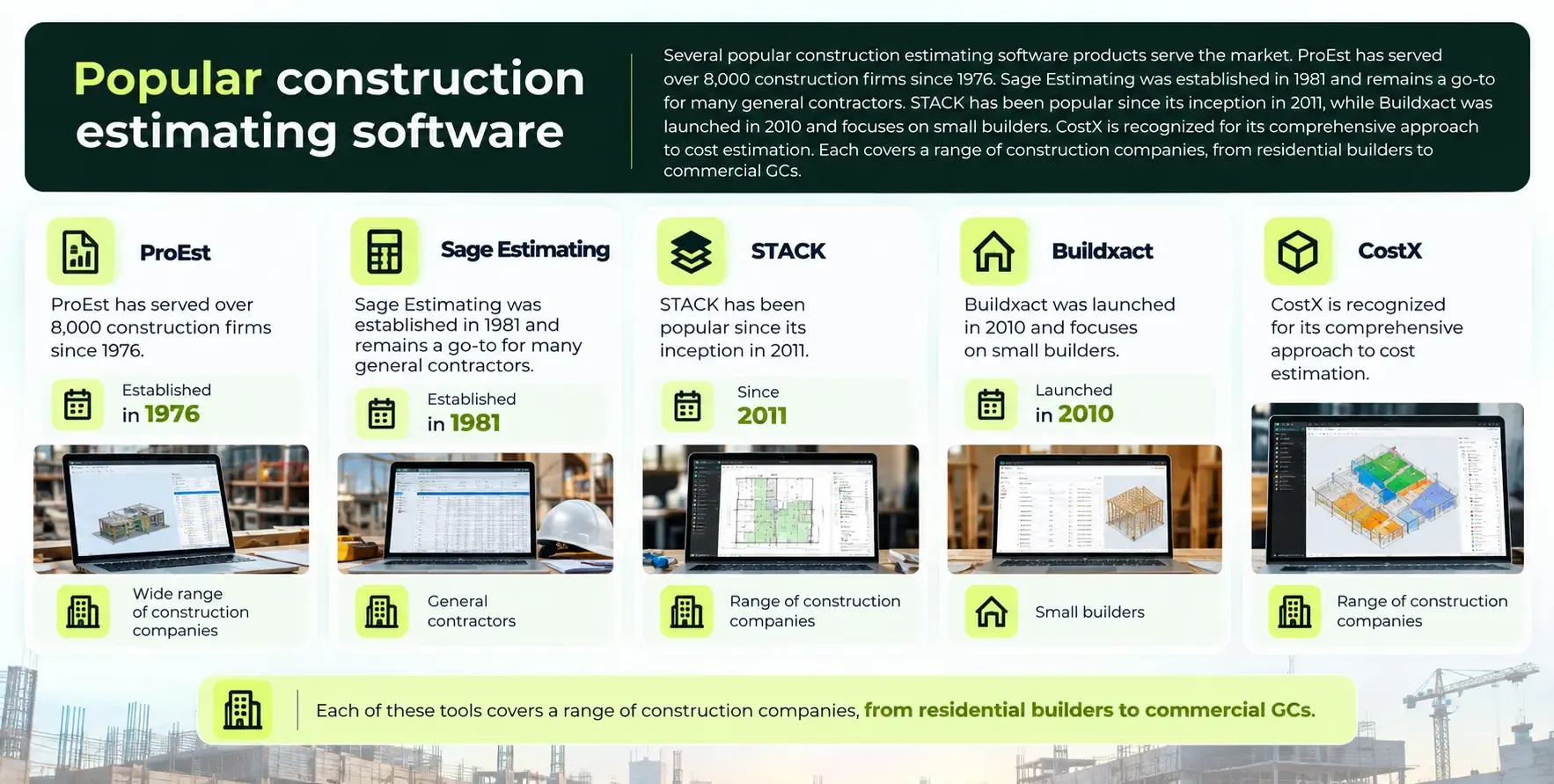
The difference between the best construction estimating software available off the shelf and a custom built system comes down to fit. Off-the-shelf platforms like ProEst, STACK, or Sage Estimating serve broad audiences with generic cost codes, standard markup structures, and fixed workflows. A custom system, by contrast, embeds the exact processes a specific contractor, GC, or construction tech startup already follows in preconstruction and estimating. Construction estimating software reduces errors and improves accuracy when it matches how teams actually work, rather than forcing them to adapt. Estimating software transforms preconstruction workflows by eliminating spreadsheets and replacing them with structured, repeatable processes.
This article walks through the key modules, architecture choices, AI opportunities, ROI, and how a partner like SoftDoes approaches custom software development for construction estimating.
What Is Construction Estimating Software (and When Do You Go Custom)?
Construction estimating software is any tool that calculates total job cost, covering labor costs, material costs, equipment costs, subcontractor pricing, overhead, and markup, and produces consistent proposals. A modern estimating platform combines building estimating software, quantity takeoff, a comprehensive cost database, and bid management in a single interface.
Off-the-shelf tools work well for small trades and simple, repeatable jobs where overhead and markup are fairly standard. Custom becomes justified when a contractor operates multiple branches with different union and open shop rules, runs complex multi-trade projects, or needs niche pricing structures that generic SaaS cannot accommodate. A union contractor in Ontario, for example, may need prevailing wage rates by trade and region baked into every estimate. A large U.S. GC spanning multiple states needs tax rules, labor codes, and markup logic that vary by jurisdiction. Custom estimating software development tailors platforms to match specific construction workflows rather than forcing companies to adapt to rigid templates. Workflow alignment in estimating software prevents companies from adapting to generic structures that do not reflect how they actually bid work.
Core Modules of a Custom Construction Estimating Platform
Every custom estimating platform for construction businesses shares a common set of modules. The specific implementation varies, but the functional bones are consistent. SoftDoes typically models these as independent services or bounded contexts so updates to one module do not break another, and the system scales without full rewrites.
Here are the modules that nearly every platform needs:
- Digital takeoff: measure lengths, areas, counts, and volumes from PDFs, CAD files, or BIM models. Integrated takeoff tools streamline the estimating process by linking measurements directly to cost items.
- Cost items and assemblies: atomic cost elements (a single material, labor rate, or piece of equipment) and bundled assemblies (e.g., "metal stud wall with insulation and drywall") stored in a comprehensive cost database. Construction estimating software should include a comprehensive cost database to drive consistency.
- Estimation engine: transforms quantities into cost, layers on indirects, overhead, risk contingency, and markup to produce the bid number.
- Bid management: tracks invitations, due dates, subcontractor quotes, alternates, and addenda. Bid management features help track subcontractor proposals and scope boundaries.
- Proposal generation: branded templates with configurable sections that auto-populate pricing, scope narratives, and clarifications.
- Reporting and analytics: win rates, estimate vs. actual variance, estimator performance, and trade productivity.
Multi-user collaboration allows simultaneous access for multiple estimators, which matters when a GC has a team of five or ten estimators working different bid packages. Customizable reporting provides tailored views of cost data, so a chief estimator sees different KPIs than a VP of preconstruction.
Modular design lets companies phase implementation. Start with basic estimating (takeoff, cost database, estimation engine), then layer on advanced estimating features, historical cost analysis, and construction project management capabilities over time.
Digital Takeoff and Quantity Measurement
Digital takeoff replaces paper plans and scale rulers with on-screen measurement. Estimators click on digital plans, whether PDFs or BIM models, and the system calculates lengths, areas, and counts. Estimating software speeds up takeoffs by up to five times compared to manual methods.
There are two main approaches:
Approach |
2D takeoff | PDFs, CAD drawings | Residential projects, renovations, simpler commercial work |
BIM/3D takeoff | Revit, IFC models | Large commercial, infrastructure projects, MEP-heavy scopes |
Best practices for building custom takeoff include snapping to drawing features, supporting both imperial and metric measurement units, maintaining links between quantities and cost items, and tracking plan revisions with version control.
SoftDoes can embed computer vision and AI so the system auto-detects walls, doors, fixtures, or rebar from construction drawings. AI automates drawing analysis and quantity extraction. One U.S. contractor case documented by iTechGuides showed takeoff time dropping from 60 minutes manually to about 10 minutes with AI assistance. That said, outputs still require human validation, especially for ambiguous or low-resolution drawings.
Comprehensive Cost Database, Items, and Assemblies
A comprehensive cost database is a structured store of labor rates by trade and region, material SKUs, equipment rental rates, production factors, waste percentages, and subcontractor pricing. Effective estimating software centralizes cost databases for efficiency, so estimators pull from one source of truth instead of personal spreadsheets.
Customized cost databases maintain up-to-date regional pricing for materials and labor. For North American contractors, that means supporting cost data variations across U.S. states and Canadian provinces, plus distinctions between union and open shop rates. Cost codes should follow CSI MasterFormat or a company's own numbering scheme. Role-based controls determine who can edit rates; a field supervisor should not be able to change the electrical labor rate in the middle of a bid.
Assemblies bundle multiple items into reusable scope templates. A "concrete slab with reinforcement and finishing" assembly, for example, includes concrete, rebar, forming materials, labor hours by trade, equipment, and waste factor. Assemblies let estimators price complex scopes quickly and consistently.
Integration with supplier and dealer feeds provides live pricing for volatile materials like lumber and steel, while contractors maintain their own negotiated price lists inside the platform. Historical data in estimating software improves future estimate accuracy by benchmarking current bids against completed jobs. A historical cost database becomes a competitive advantage that grows with every project.
Estimation Engine: From Quantities to Final Price
The estimation engine is where quantities meet money. It multiplies takeoff measurements by cost data, then adds indirect costs (site supervision, temporary facilities), overhead, risk contingency, bonds, insurance, and markup to produce the project estimate.
Configurable business rules handle taxes across U.S. states and Canadian provinces, prevailing wage requirements (Davis-Bacon on federal projects in the U.S.), union premiums, and statutory benefits in Canada (CPP, EI). Approval workflows trigger reviews when margins fall below a threshold or when discounts exceed a set percentage.
Automated calculations in estimating software prevent manual errors that creep in when estimators work across dozens of spreadsheets. Automating calculations and workflows accelerates bid preparation and project delivery. Construction estimating software reduces errors through systematic workflows where every number is traceable from takeoff measurement to final price.
SoftDoes typically implements the estimation engine as a tested, auditable component. Finance teams and leadership need to trust the math across every construction project, so every calculation is transparent and reproducible.
Bid Management and Proposal Generation
Custom estimating software can centralize bid management so that invitations, due dates, drawing revisions, and subcontractor quotes all live in one place instead of scattered across email threads and shared drives.
Key features include:
- Bid leveling: comparing multiple subcontractor proposals side by side, normalized for scope boundaries, quantities, and alternates
- Scope clarifications: tracking questions, RFIs, and addenda against each bid package
- Inclusion/exclusion tracking: documenting what is and is not covered to reduce disputes after award
Proposal generation pulls data directly from the estimate into branded, customizable templates. Sections for scope of work, professional proposals, clarifications, exclusions, alternates, and pricing tables populate automatically. Custom estimating solutions enhance estimation accuracy and speed of proposal generation, which directly affects how many bids a team can turn around each month.
Accurate estimates improve win rates on profitable work because the contractor prices the job correctly, avoids leaving money on the table, and does not accidentally underprice risk. Estimates protect profit margins by preventing costly mistakes that show up as change orders after the contract is signed.
Cloud Based vs On-Premise Architectures for Estimating Platforms
More than 53 percent of construction estimating software deployments globally used cloud models in 2025, with North America leading that trend. For mid-2020s construction businesses in the U.S. and Canada, the choice between cloud based and on-premise architecture comes down to a few factors.
Cloud based benefits:
- Browser access from office, home, or job site
- Easier updates and feature rollouts
- Native integration with other cloud systems (accounting, CRM, project management platforms)
- Cloud-based solutions enable real-time collaboration among team members, which matters when multiple estimators work on the same bid
When on-premise or private cloud still fits:
- Strict IT policies or legacy data centers that cannot be migrated quickly
- Specific compliance or data residency requirements
- Hybrid patterns where the cost database and estimation engine run in a private cloud while collaboration modules sit in a public cloud
SoftDoes primarily designs secure, scalable cloud architectures on AWS, Azure, or GCP but can align with a client's preferred deployment model when internal policies require it.
Integrations with Construction Management, Accounting, and CRM
Integrating construction estimating with construction project management, job costing, and accounting is one of the highest-value steps a contractor can take. Without it, estimators finish a bid, then someone re-keys the numbers into the job cost system, introduces errors, and loses the link between estimated and actual costs. Custom software allows for integration with existing enterprise systems and databases, closing that gap.
Integration patterns range from REST APIs and webhooks to flat-file imports and iPaaS platforms. What matters most is clean data contracts and versioning so that a change in one system does not silently break another. SoftDoes plans for bi-directional data flows so estimates feed into project budgets, and actual costs flow back into historical estimate benchmarks, creating a closed loop.
Software integration allows seamless data flow from estimates to project execution. A seamless transition from estimating to project execution prevents data loss. Integrating estimating software with project management tools enhances cost control across the entire construction project lifecycle.
Advanced Estimating Features and Analytics
Advanced estimating goes beyond line-by-line pricing. It includes parametric estimating, conceptual estimating based on historical dollars per square foot, automated spread of markups and contingencies, and pricing structure modeling for different bid strategies.
Analytics that matter to construction professionals:
- Win rate by estimator, trade, or project type
- Cost variance by trade (estimated vs. actual)
- Historical productivity factors by crew or subcontractor
- Historical cost analysis comparing current bids to completed projects of similar scope
Reporting and analytics features compare estimated costs against actual project costs, which is how contractors learn whether their pricing is tight or loose. Tailored analytics help protect profit margins by modeling pricing fluctuations in materials and labor. Estimators can easily track revisions and changes through audit trails in software, so every adjustment is logged and attributable.
Dashboards should serve different roles. An executive sees project profitability and backlog quality. A chief estimator sees cost trends and estimator workload. A project manager sees budget vs. actual on active jobs. SoftDoes can embed data warehouses or lakehouses to consolidate cost and estimate data for long-term decision support and financial reporting.
AI and Machine Learning in Construction Estimating Software
A 2025 KPMG Canada survey of 265 construction companies found that 53 percent listed AI-driven software as a high priority. The use cases in estimating are concrete and already in production at some firms.
Practical AI applications in construction estimating:
Use Case |
Drawing analysis | Computer vision reads PDFs to identify walls, doors, fixtures, rebar |
Scope classification | NLP parses specifications and RFP text to categorize scope items |
Price prediction | ML models trained on historical data predict unit prices for new bids |
Anomaly detection | Flags line items that deviate from historical norms for the same scope |
Document processing | AI assists in document processing and estimate variance analysis |
The critical principle: AI should assist estimators, not replace them. The system suggests quantities or rates; humans review and approve before a bid goes out. AI model accuracy degrades with poor data, and every output needs validation, especially for complex assemblies or unusual site conditions.
SoftDoes helps clients plan realistic AI roadmaps. The best approach starts with narrow, high-impact use cases (like auto-takeoff for a single trade) and validates model accuracy on U.S. and Canadian project data before scaling to more complex predictions, similar to how its custom AI solutions and consulting are applied in other industries.
Security, Compliance, and Data Ownership
Bid pricing, subcontractor quotes, and historical cost data are among the most sensitive information a construction company holds. A competitor who sees your markup rules or sub pricing can undercut you on every bid.
Data ownership requires explicit agreements. The contractor must own cost databases, historical estimates, and any AI training data generated from their projects. Export mechanisms should be built in from the start so the company is never locked into a single vendor.
Security and data ownership are crucial when selecting a development partner. SoftDoes designs systems with U.S. and Canadian security expectations in mind, working alongside clients' infosec teams to meet internal policies, SOC 2 alignment, and any public procurement transparency requirements.
Planning a Custom Estimating Software Project: Discovery to MVP
A structured discovery phase maps current estimating workflows, identifies common exceptions, and documents integrations needed with other construction management software. This phase typically involves workshops with estimators, project managers, and finance stakeholders.
The goal of discovery is to define an MVP scope focused on the capabilities that deliver the most value first. For most contractors, that means:
- Core estimation engine with configurable markup and business rules
- Digital takeoff for the most common drawing types
- A cost database populated with the company's actual rates
- Basic bid management and proposal output
Practical timelines: discovery runs two to four weeks; an MVP build takes three to six months; subsequent releases add modules like analytics, AI-assisted takeoff, and deeper integrations based on estimator feedback and real bids. SoftDoes runs these workshops to prioritize features and avoid overbuilding in version one.
Budgeting and ROI for Custom Estimating Software Development
Cost drivers for a custom build include scope breadth (how many modules), AI complexity (custom models vs. vendor APIs), the number of integrations, performance requirements, and the effort needed to migrate data from legacy systems or spreadsheets. Ongoing costs include hosting, monitoring, and iterative enhancements.
ROI metrics that justify the investment:
- Reduced estimating time per bid (measured in hours)
- Higher win rate on profitable projects
- Fewer change orders due to missing scope
- Better cost predictability (estimated vs. actual variance)
Track baseline KPIs before implementation. If your average estimate takes 40 hours and your win rate on targeted bids is 18 percent, those numbers become the benchmarks against which improvements are measured. Construction estimating software enhances project management capabilities by feeding accurate cost data into scheduling, procurement, and resource planning.
SoftDoes helps clients build business cases that connect development investment to tangible gains in backlog quality, project profitability, and margin.
Change Management and User Adoption
Even the best construction estimating software fails without user adoption. Veteran estimators who have worked in spreadsheets for 20 years will not switch overnight because someone installs a new tool.
A practical change management plan includes:
- Early involvement: recruit "power users" during discovery. They shape the system and champion it later.
- Pilot projects: run two or three real bids through the new platform before full rollout. Fix friction points on low-stakes work.
- Training: pair system training (where to click) with process training (why the workflow changed). One without the other breeds confusion.
- Staged rollout: roll out by region, division, or project type rather than flipping the switch company wide.
SoftDoes collaborates with internal champions to gather feedback, refine UX, and remove friction in the first months after launch. The customer support team on the client's side plays a critical role in fielding questions during this period.
Benefits of Working with SoftDoes on Custom Estimating Software
SoftDoes is a North America-focused software development partner with experience in construction and manufacturing software, AI, and cloud engineering. Here is what that means in practice for a custom estimating project:
- Domain-aware business analysis: SoftDoes analysts learn cost codes, assemblies, bid leveling rules, and construction management needs before writing a line of code. The result is an estimating solution shaped by how your estimators actually work.
- UI/UX tailored to estimators: interfaces designed for the estimating workflow, not generic dashboards. Screen layouts prioritize speed and accuracy for people who build detailed estimates under deadline pressure.
- Cloud native architectures: secure, scalable platforms on AWS, Azure, or GCP with encryption, role-based access, and audit trails built in from day one.
- Integration depth: bi-directional connections to accounting systems, ERP systems, CRM, and project management platforms so cost data flows without manual re-entry, creating seamless data flow across the organization.
- Flexible engagement models: full product teams, staff augmentation, or co-delivery with in-house IT. Models fit both enterprises and growing scale-ups.
Clients can expect faster estimate turnaround, fewer bid errors, centralized cost intelligence, and a proprietary estimating platform that evolves with their construction business, delivered by a custom software development team in Kansas City.
How to Choose a Custom Estimating Software Development Partner
For many contractors, evaluating partners for estimating platforms mirrors the broader process of choosing a software development company without wasting budget, where factors like domain expertise, communication quality, and delivery discipline determine long-term success.
Choosing the right partner matters more than choosing the right tech stack. Here is what to evaluate:
- Construction estimating domain knowledge: choose a company that understands construction estimating workflows, not just generic software development. Ask them to explain what bid leveling is, how assemblies work, or what prevailing wage rules involve.
- Integration expertise: evaluate the company's integration expertise with project management systems, accounting software, and data integration platforms. Ask for examples.
- AI capability: check if the company has experience with AI in estimating software or adjacent domains. Ask how they validate model accuracy and handle edge cases.
- Security posture: assess their approach to data ownership, encryption, access controls, and compliance with U.S. and Canadian requirements.
- Cloud and mobile: assess the company's ability to support cloud architecture and mobile apps for field access.
- UX design for specialized users: estimators are not casual app users. They need fast, dense interfaces with keyboard shortcuts and minimal clicks. Ask to see UX work for similar professional tools.
SoftDoes meets these criteria and brings repeat relationships in other mission critical estimating, job management, and project management domains, as well as data-driven software for complex, regulated industries like oil and gas.
Future of Custom Construction Estimating: 2027 and Beyond
The next wave is tighter integration between estimating, BIM, field productivity data, and procurement. When a GC can feed actual labor productivity from the job site back into the cost database in near real time, future estimates become more accurate with every completed project. Takeoff and estimating software will play a central role in this evolution, enabling seamless data flow and more precise cost forecasting.
AI-assisted estimating will mature. Systems will learn from won and lost bids, change orders, and actual costs to recommend pricing adjustments. The AGC reported that 35 percent of U.S. construction firms planned to increase estimating software investment in 2025; that number will likely climb as firms see competitors bidding faster and more accurately.
Custom platforms will increasingly become strategic assets. A contractor whose estimating platform reflects ten years of cost trends, regional labor data, and project data has a pricing advantage that no off-the-shelf tool can replicate. For residential construction and infrastructure projects alike, the firms that invest now will own a data moat their competitors cannot easily cross in the construction industry.
If you are exploring what a tailored estimating platform could look like for your organization, SoftDoes can help you move from concept to working software.












Comments (0)
No comments yet.