Table of contents1. Key Takeaways2. Why eLearning Platform Development Matters in 20263. What Is an eLearning Platform? (And When You Need a Custom One)4. Core Use Cases for Custom eLearning Platforms in North America5. Essential Features for a Modern eLearning Platform6. Course Creation, Custom Content, and Authoring Workflows7. End-to-End eLearning Platform Development Process8. Development Costs: What It Really Takes to Build an eLearning Platform9. What Drives eLearning Platform Development Costs Up or Down?10. Team Models: In House, Freelancers, or Partnering with a Product Engineering Firm11. Technical Architecture, Scalability, and Integrations12. Data, Analytics, and Learning Outcomes13. Security, Compliance, and Accessibility Requirements14. Benefits of Working with SoftDoes on eLearning Platform Development15. How to Plan Your eLearning Platform Budget and Roadmap Key Takeaways
- An eLearning platform is an ongoing system. Custom eLearning platform development makes sense when your workflows, compliance needs, or multi tenant requirements outgrow generic tools.
- In 2026, development costs for a focused MVP typically range from $50,000 to $100,000, mid scale platforms from $90,000 to $160,000, and advanced multi tenant platforms can exceed $180,000 and reach over $320,000. Key cost drivers include essential features, integrations, content production, and team model.
- A practical roadmap starts with discovery, moves through instructional design and prototyping, and includes quality assurance testing and a pilot launch before full rollout. Budget for ongoing support after launch.
- Real world scenarios like corporate training, K through 12, higher education, and B2B EdTech each bring unique requirements around compliance, accessibility, and analytics that shape the platform architecture.
- Organizations that keep strategic ownership in house while partnering with a product engineering partner like SoftDoes for custom software and app development services for core platform engineering tend to ship faster and maintain better long term quality.
Why eLearning Platform Development Matters in 2026
When universities and corporations pivoted to remote instruction after 2020, most treated it as temporary. Six years later, the shift is permanent. Hybrid and virtual classroom models are standard at North American universities. Corporate reskilling programs run year round. K through 12 districts routinely blend in person and online courses. The global e learning market was expected to reach $325 billion by 2025, and strong EdTech activity in North America continues to push that number higher.
eLearning platform development, in practical terms, means building custom web and mobile systems that let organizations create courses, enroll learners, track progress, deliver assessments, and report outcomes. It goes well beyond buying a subscription to a generic tool. eLearning platforms provide flexibility for learners to study at their own pace, and investing in eLearning can enhance customer retention and engagement across both education and enterprise contexts. Platforms that promote continuous learning and personalized education paths are now baseline expectations.
This article walks product owners, L&D leaders, and EdTech founders through what it takes to plan, build, and launch a custom eLearning platform in 2026. We cover essential features, realistic development costs, team models, compliance considerations for U.S. and Canadian organizations, and how to choose between building in house and working with a partner. The guidance comes from SoftDoes' perspective as a custom software development partner, but the general advice is vendor neutral.
What Is an eLearning Platform? (And When You Need a Custom One)
An eLearning platform is an ongoing system that supports content creation, enrollment, delivery, progression, assessment, certificates, reporting, and user management. It is not a single course or a one off SCORM module. Think of it as infrastructure that evolves with your organization.
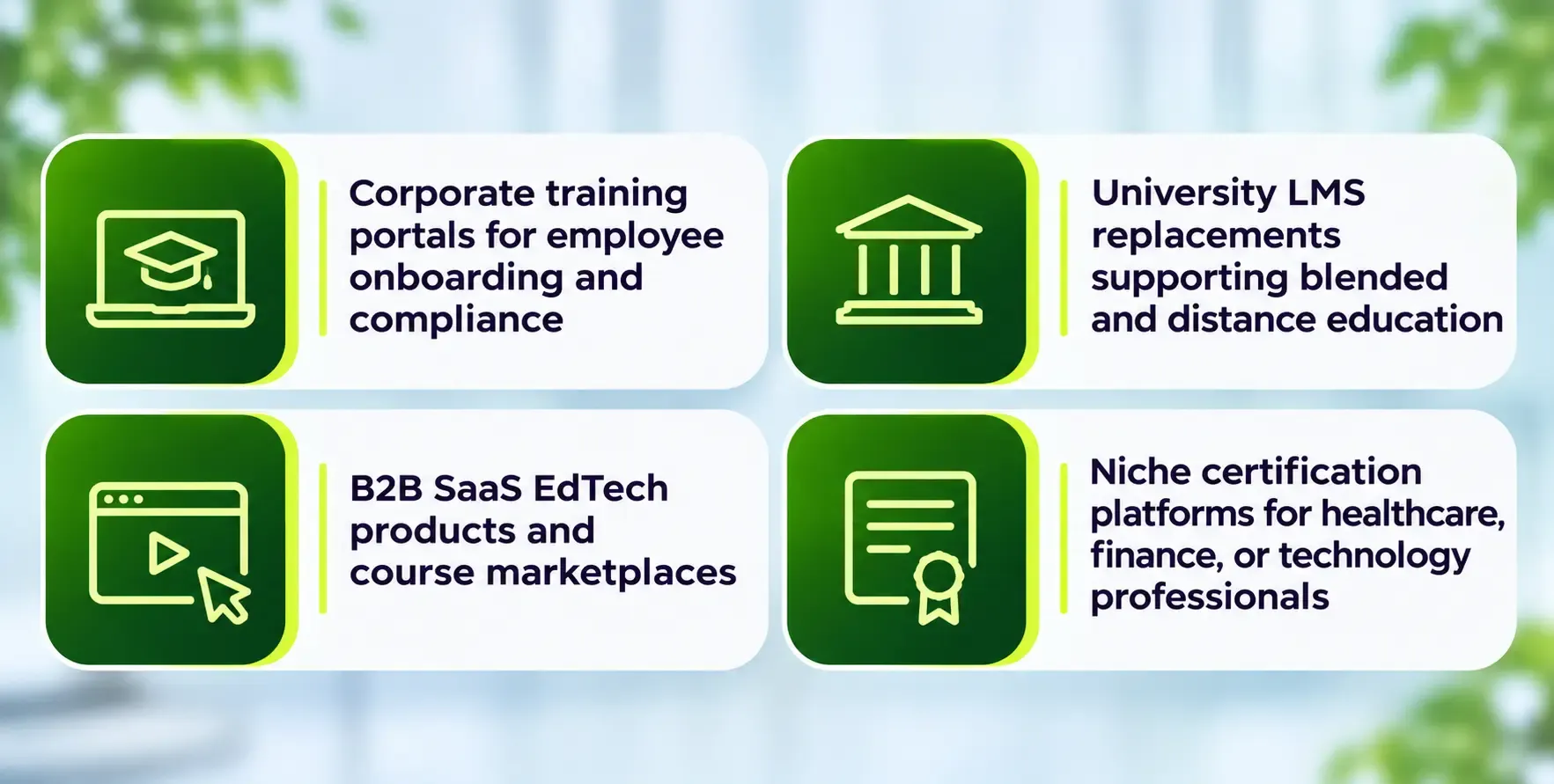
The landscape includes several platform types. MOOCs allow global access to lectures and assignments. Course marketplaces connect educators with students for course sales. Virtual Learning Environments use interactive methods for teaching. Learning management systems deliver and assess training courses. Computer-Managed Assisted Learning platforms personalize learning experiences. Even podcast platforms deliver educational content through audio courses. In the U.S. and Canada, the most common custom builds fall into four categories:
Typical capabilities include user management with role based permissions, searchable course catalogs, custom course paths, interactive assessments, certificates, analytics dashboards, and integrations with HR or student information systems. Before building, conduct market research to define your target audience and identify competitors already serving your space.
Signs you need a custom LMS rather than an off the shelf tool:
- Multiple user types or brands with different permissions and white labeling needs
- Non standard assessment logic or recertification workflows
- Deep integrations with HRIS, SIS, CRM, or payment gateways
- Regulatory compliance and audit trail requirements specific to your industry
- Analytics and custom reporting needs beyond what SaaS dashboards provide
- Multi tenant architecture for serving partners or clients through a single codebase
Generic management systems are fine when workflows are standard, scale is moderate, and branding requirements are minimal. When those conditions no longer apply, custom development is the practical path forward.
Core Use Cases for Custom eLearning Platforms in North America
Enterprise compliance training. Healthcare providers, financial institutions, and manufacturers must comply with standards like OSHA and HIPAA. These platforms track re certification, issue certificates, and produce audit ready records. A healthcare organization rolling out standardized clinical training across multiple states, for example, needs role based dashboards, region specific content, and granular reporting at the facility level.
Corporate skills development programs. Large companies build internal academies for upskilling, leadership development, and technical certifications. These require content versioning, manager dashboards, integration with HR systems, and progress tracking tied to performance reviews. The platform must support cohort learning and personalized paths so different teams get relevant content.
K through 12 and higher education blended learning. Educational institutions need systems supporting both live and asynchronous content, integrating with student information systems, gradebooks, and accreditation standards. Scale, device diversity, and accessibility are critical, especially when serving learners across provinces or states.
Public facing course marketplaces. Organizations offering courses or credentials to external customers need multi tenant portals, payment gateways, content licensing, and white labeling. A Canadian tech company building a partner certification program, for instance, requires branded portals for each partner, e commerce functionality, and usage analytics. In 2022, EdTech investments in the UK alone reached approximately $583 million, underscoring the global appetite for this model. In North America, these platforms are a growing segment of the EdTech landscape.
SoftDoes typically scopes projects around clearly defined use cases and measurable success metrics like time to competence reduction, completion rates, or audit ready records, leveraging its custom e-learning platform development services to align UX, integrations, and analytics with those goals.
Essential Features for a Modern eLearning Platform
Essential features drive both the learner experience and the development effort. Getting the priority right between MVP and full build saves money and time.
Learner facing features:
- Responsive UI with simple navigation and responsive design for accessibility
- Searchable and filterable course catalog
- Progress tracking by lesson, module, and course
- Discussion forums and messaging for social learning and peer interaction
- Mobile friendly content consumption with offline support where needed
Interactive quizzes enhance learner engagement and retention. Microlearning improves knowledge retention by breaking courses into shorter modules. Effective learning paths improve individualized student experiences through tailored recommendations. E learning platforms should integrate gamification to enhance learner engagement and boost user retention.
Admin and instructor tools:
- Course creation studio with media upload (video, PDF, interactive content)
- Question banks and interactive assessments with branching decision trees
- Content versioning for custom course material
- Role based permissions for authors, reviewers, and admins
- Certificate engine for issuing and managing credentials
- Grading workflows and immediate feedback mechanisms
Technical capabilities:
- An eLearning platform must support SCORM and xAPI standards for content interoperability
- Single sign on and SCIM for user provisioning
- API based integrations and notifications (email, SMS, in app)
- Content localization and multi language support
- Implementation of an analytics dashboard to monitor learner progress and engagement
- User friendly dashboards that improve navigation and user experience
- Support for various media formats is necessary for engaging e learning content
Accessibility features must comply with WCAG 2.1 standards. A custom eLearning platform can include a certificate engine, collaboration tools, and virtual classroom integrations from day one or in later phases.
MVP vs full build: An initial MVP might include basic course delivery, enrollments, interactive quizzes, progress tracking, and simple reporting. Later phases add adaptive learning powered by artificial intelligence, complex gamification, advanced product design, and additional features like multi tenant support.
Course Creation, Custom Content, and Authoring Workflows
Intuitive course creation is a competitive advantage. L&D teams and instructors need to build courses without relying on engineering for every update. A clear content management system workflow facilitates easy updates and organization of courses.
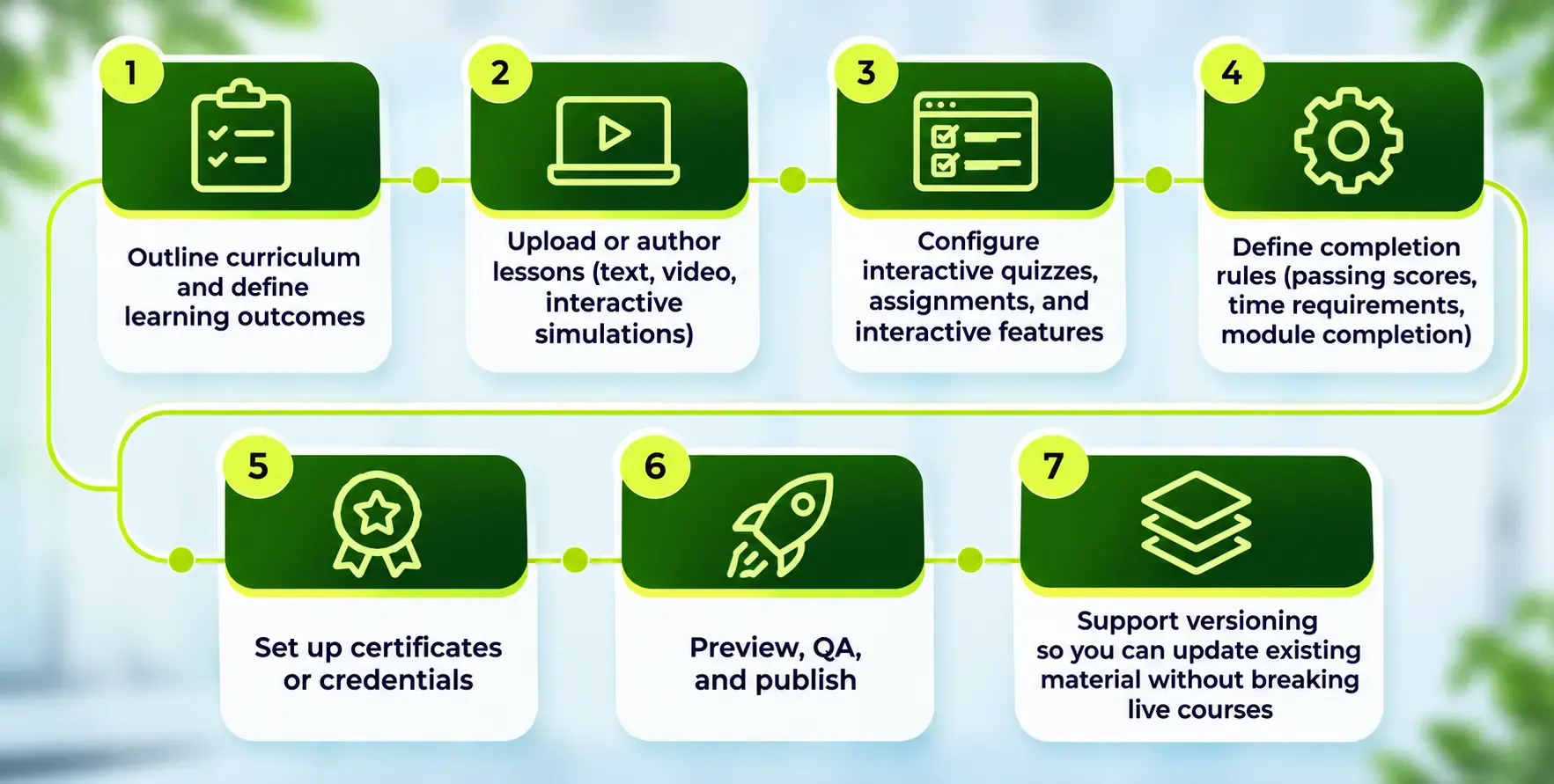
Ideal end to end course creation workflow:
Custom courses fit specific needs more closely than off the shelf courses. They often include unique company terminology and scenarios relevant to your organization. However, off the shelf courses are faster and cheaper to implement, and custom development takes longer than purchasing ready made courses. Many organizations use both custom and off the shelf solutions, relying on licensed content for general topics and building custom course content for proprietary processes or compliance.
A robust eLearning platform in 2026 should support video streaming, interactive simulations (HTML5), PDFs, SCORM packages, live session integrations via web conferencing APIs, and even a slide deck import for rapid course authoring. Instructional design should guide the structure.
SoftDoes often builds internal authoring tools or integrates best of breed authoring software depending on whether clients have in house teams or rely on external content partners.
End-to-End eLearning Platform Development Process
Most successful builds follow a similar sequence. Here is the practical roadmap:
- Discovery and needs analysis is the first step. Product owners, L&D leaders, and subject matter experts align on business goals, user personas, and measurable outcomes (e.g., reduce training time by 20%, track completion rates by region).
- Instructional design follows the needs analysis phase. Learning objectives, curricula, and assessment strategies are mapped before any code is written.
- Solution architecture. The team selects the technology stack, defines the data model, plans for scalability, and designs integrations. Selecting the right tech stack impacts scalability and performance of e learning platforms.
- UX and UI design. User experience should focus on simple navigation and responsive design for accessibility. A storyboard and prototype are created before production.
- Iterative development. Agile sprints deliver core features first. Early user testing with a small learner cohort catches usability issues and content gaps.
- Quality assurance testing occurs before the course launch. Regular testing and quality assurance are essential for maintaining platform performance. A successful e learning platform requires robust architecture and intuitive user experience.
- Pilot launch. Release to a limited group under real world conditions to validate workflows and surface technical problems.
- Post launch, ongoing support and maintenance are essential. Iterative improvement based on feedback, performance data, and evolving business needs drives the next phase.
Aligning on measurable learning outcomes during discovery, not just a feature list, is what separates platforms that deliver ROI from those that become expensive shelf ware.
Development Costs: What It Really Takes to Build an eLearning Platform
Development costs for a complete platform differ significantly from the cost of building a smaller app or module. Here are concrete 2026 cost bands for U.S. and Canada based projects:
Platform Tier |
Basic / Focused MVP | $50,000 – $100,000 | Core course delivery, video, quizzes, progress tracking, certificates |
Mid Scale Platform | $90,000 – $160,000 | Multiple user roles, SSO, HRIS integration, stronger UX, larger content volume |
Advanced / Multi Tenant | $180,000 – $320,000+ | Marketplace features, complex analytics, mobile apps, AI features, compliance modules |
SoftDoes provides detailed, line item estimates so clients can see how decisions about essential features, content strategy, and integration scope affect overall development cost.
What Drives eLearning Platform Development Costs Up or Down?
Cost variation is less about hourly rates and more about platform scope, complexity, and governance. Budget surprises usually trace back to scope change discovered late in the process.
Main cost drivers:
- Interactivity level of learning experiences (simple video vs. branching decision trees and simulations)
- Number of user roles and flows (learner, instructor, admin, manager, partner)
- Volume of educational content and custom course templates
- Richness of analytics, custom reporting, and assessment scores tracking
Technical cost drivers:
- Number and depth of integrations (HRIS, SIS, payment gateways, single sign on)
- Need for offline access or native mobile support
- Regulatory compliance requirements (handling PHI in healthcare, FERPA for student records)
- Multi tenant architectures for serving multiple brands or clients
Organizational factors:
- How many stakeholder review cycles are expected (more review cycles slow the timeline and increase cost)
- Whether in house teams can own content production
- How often online courses must be updated due to policy or product changes
- Whether legacy systems need migration or integration
Careful scoping before development and a phased roadmap reduce the risk of cost overruns. A project manager who enforces scope discipline and aligns stakeholders early is worth the investment. Understanding the trade off between fixed price and project based pricing models helps set realistic expectations. Scope change late in development is the most common source of budget overrun.
Team Models: In House, Freelancers, or Partnering with a Product Engineering Firm
How the work is organized shapes development costs as much as the feature list.
In house teams bring strong institutional knowledge and faster iteration for ongoing needs. But fully staffing a team (UX designer, frontend and backend developers, QA, DevOps, data engineer) can cost $700,000 to $1,000,000 or more per year in salaries before benefits. Hiring specialized roles in cloud, security, or data engineering is difficult in a competitive market.
Freelancers offer lower per hour cost for small, well defined tasks. The trade off is higher project management overhead, fragmented responsibility, and risk for complex eLearning platform builds. They work best for isolated modules like a video player or a specific assessment engine.
A product engineering partner like SoftDoes provides cross functional teams including product, UX, engineers, QA, and data specialists with clear accountability for delivery, quality, and long term maintainability. This model works especially well for platform development projects that require deep expertise across disciplines.
The hybrid approach works for many organizations: keep strategic ownership and content expertise in house while partnering with a firm like SoftDoes for core platform engineering and complex integrations.
Technical Architecture, Scalability, and Integrations
Architecture decisions made now must anticipate growth: more learners, more content, and more complex assessments over the next three to five years.
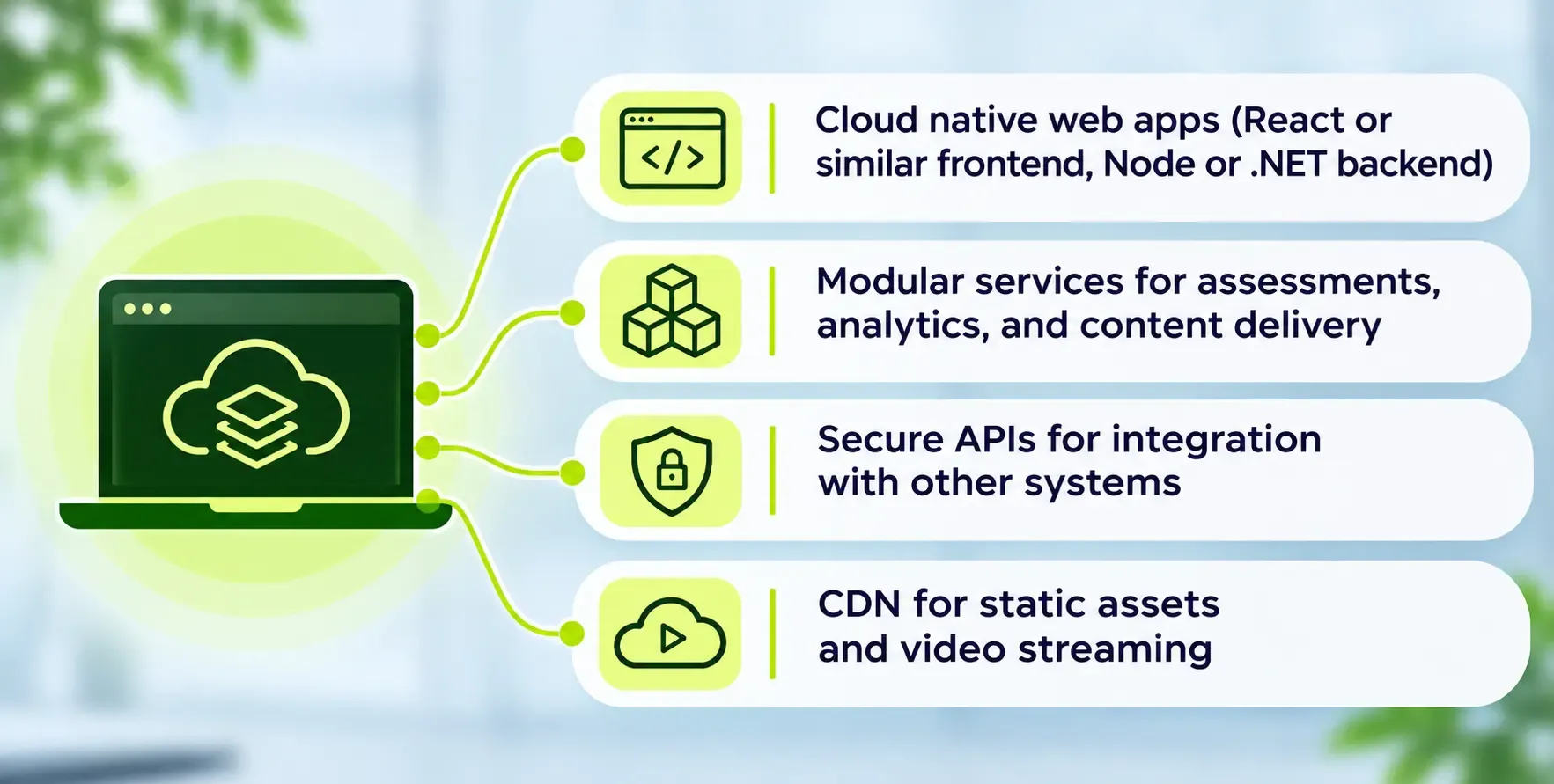
Common architectural patterns:
Cloud based infrastructure enables scalable and reliable video streaming for e learning. Selecting the right technology stack impacts scalability and performance long term.
Typical integrations North American clients request:
- HR systems like Workday or SuccessFactors for user provisioning and completions
- Student information systems for higher education
- CRM platforms like Salesforce for B2B EdTech and financial services training
- Video conferencing tools (Zoom, Teams, Webex)
- Payment gateways for offering courses to external customers
Scalability considerations: multi tenant vs single tenant setups, regional data residency inside the U.S. or Canada, and strategies to handle peak loads during enrollment or mandatory compliance deadlines.
SoftDoes designs eLearning platform architectures with observability, data security, and performance monitoring from day one.
Data, Analytics, and Learning Outcomes
The real value of modern eLearning platforms is not just hosting educational content but measuring learning outcomes and business impact.
Core analytics capabilities:
- Completion and user engagement dashboards
- Assessment scores and cohort comparisons
- Exportable reports for audits, leadership reviews, and regulatory compliance
- Custom reporting by region, department, or role
Advanced options organizations increasingly expect:
- xAPI based learning records capturing fine grained learner behavior
- Skill proficiency models mapping course content to competency frameworks
- Predictive analytics to spot at risk learners or underperforming courses
Artificial intelligence and machine learning can be layered in over time: content recommendations, question difficulty calibration, and automated feedback summaries for instructors. These capabilities can change behavior by surfacing insights that were previously invisible to L&D teams. SoftDoes offers data engineering and ML expertise to help clients structure learning data pipelines and build actionable analytics without overcomplicating the first release.
Security, Compliance, and Accessibility Requirements
Security and regulatory compliance are non negotiable for U.S. and Canadian organizations, especially in healthcare, finance, and education.
Core security practices:
- Secure authentication and data protection are critical components of e learning platforms
- Role based access control
- Encryption in transit (TLS) and at rest
- Logging, monitoring, and regular vulnerability assessments
- Human review of security configurations alongside automated scanning
Regulatory and policy areas to consider:
- FERPA for student records privacy in higher education
- HIPAA for protected health information in healthcare training
- PIPEDA and provincial privacy laws in Canada (BC, Alberta, Quebec each have specific requirements)
- COPPA if minors are involved
- Contractual data privacy obligations
Accessibility: Designing to meet WCAG 2.1 AA guidelines means supporting screen readers, captions, keyboard navigation, and testing with assistive technologies during QA. Canada's Accessible Canada Regulations explicitly require WCAG 2.1 AA conformance for many public digital platforms.
Building for accessibility and security from the start costs significantly less than retrofitting later. SoftDoes has experience building compliant platforms where these requirements are part of the architecture.
Benefits of Working with SoftDoes on eLearning Platform Development
SoftDoes specializes in complex, mission critical digital systems including custom EdTech and eLearning platforms for U.S. and Canadian organizations, with deep custom software development services for Texas companies.
- End to end product engineering from discovery through launch, with dedicated teams covering product strategy, UX, frontend and backend development, QA, and DevOps
- Strong UI/UX design focused on learner engagement, user retention, and accessibility from day one
- Deep cloud and data engineering expertise ensuring scalability, reliability, and performance under real world load
- AI and ML integration for personalization, analytics, and connecting eLearning platforms with enterprise systems via secure APIs
- Flexible engagement models supporting both one time platform builds and longer term partnerships where SoftDoes augments or collaborates with in house teams
- Post launch support options including monitoring, security updates, bug fixes, and feature enhancements
Treat SoftDoes as a strategic product engineering partner. Collaborative roadmapping, transparent communication, and ongoing support options mean your platform keeps improving long after launch.
How to Plan Your eLearning Platform Budget and Roadmap
Trying to build a full marketplace scale platform in a single release is one of the most common and expensive mistakes. Planning budget, scope, and phases together avoids this.
- Define must have learning outcomes and business models before listing features
- Map essential features to those outcomes and estimate initial development costs
- Decide on in house vs partner roles early (and consider the hybrid approach)
- Prioritize a three to six month MVP covering core features and a few high impact courses
- Separate "platform" budget (engineering, design, infrastructure) from "content" budget (course creation, media production, existing material conversion)
Build a phased roadmap: MVP with core essential features, followed by quarterly releases adding integrations, analytics upgrades, and more sophisticated course types. Each phase should have clear success metrics tied to actual learner and business outcomes.
Rather than asking for a generic price, provide a partner like SoftDoes with a brief describing your use cases, user roles, target audience, must have integrations, and business models. That gets you a realistic, line item estimate you can actually plan around.










Comments (0)
No comments yet.