Game platform development is where studios and enterprises build the shared backend, tools, stores, and analytics that power not just one game but many. This article covers the strategy, software architecture, core modules, engine choices, and phased roadmap you need to launch or upgrade a game platform in the U.S. or Canadian market.Key Takeaways
- Game platform development means building the full ecosystem (backend services, client SDKs, admin tools, stores, analytics) that supports multiple games.
- In 2026, most new platforms are cloud native, data driven, and built around engines like Unity and Unreal Engine, with live ops as a core feature.
- Solid software architecture (modular, event driven, API first) is what makes cross-play, matchmaking, and in-game purchases reliable at scale.
- SoftDoes helps U.S. and Canadian companies design, build, and modernize custom game platforms with AI, cloud, and analytics built in from day one.
- This article walks through strategy, architecture, core modules, tools, and a phased roadmap for launching or upgrading a game platform.
What Is Game Platform Development?
Game platform development is the process of building the underlying services and tools that support multiple games: accounts, payments, social features, live ops, analytics, and more. It is not the same as building a single game client.
Major ecosystems illustrate how the gaming industry moved from standalone titles to live service platforms. Roblox, launched in 2006, offered user generated content, identity, economy, and social systems supporting millions of creators and experiences. Fortnite's platform evolution after 2017 added cross-play, seasonal content, and always-on live operations across console, PC, and mobile.
A game engine (Unity, Unreal Engine) provides rendering, physics, scripting, and asset pipelines on the client side. A game platform provides shared backend services (identity, payments, matchmaking), APIs, dashboards, and SDKs that connect many game clients to common infrastructure.
Typical stakeholders in U.S. and Canadian organizations include:
- Product owners who define features and business models
- CTOs and engineering leads who choose technology and software architecture
- Live ops managers focusing on events, remote config, and retention
- Compliance teams handling COPPA, payment rules, and data privacy
Strategic Foundations for a Game Platform
Strategy must come before picking technology. Choosing Unreal Engine or Unity before defining your business model, target market, and KPIs leads to rework.
Target platforms and markets. Decide early whether you are shipping on PC, PlayStation, Xbox, Nintendo Switch, iOS, Android, web, or some subset. Many teams start with North America and expand later, which simplifies data residency and compliance at launch.
Business models. Free to play with in-app purchases accounts for roughly 85% of gaming revenue in mobile and live service segments. Battle passes, subscriptions, and hybrid approaches (premium base with free expansions) each require different commerce module designs. Strategy genre revenue in midcore live ops games rose 17.9% year over year between December 2024 and November 2025, while RPG revenue fell 15.3% over the same window. The business model you choose shapes everything from payment flows to refund policies.
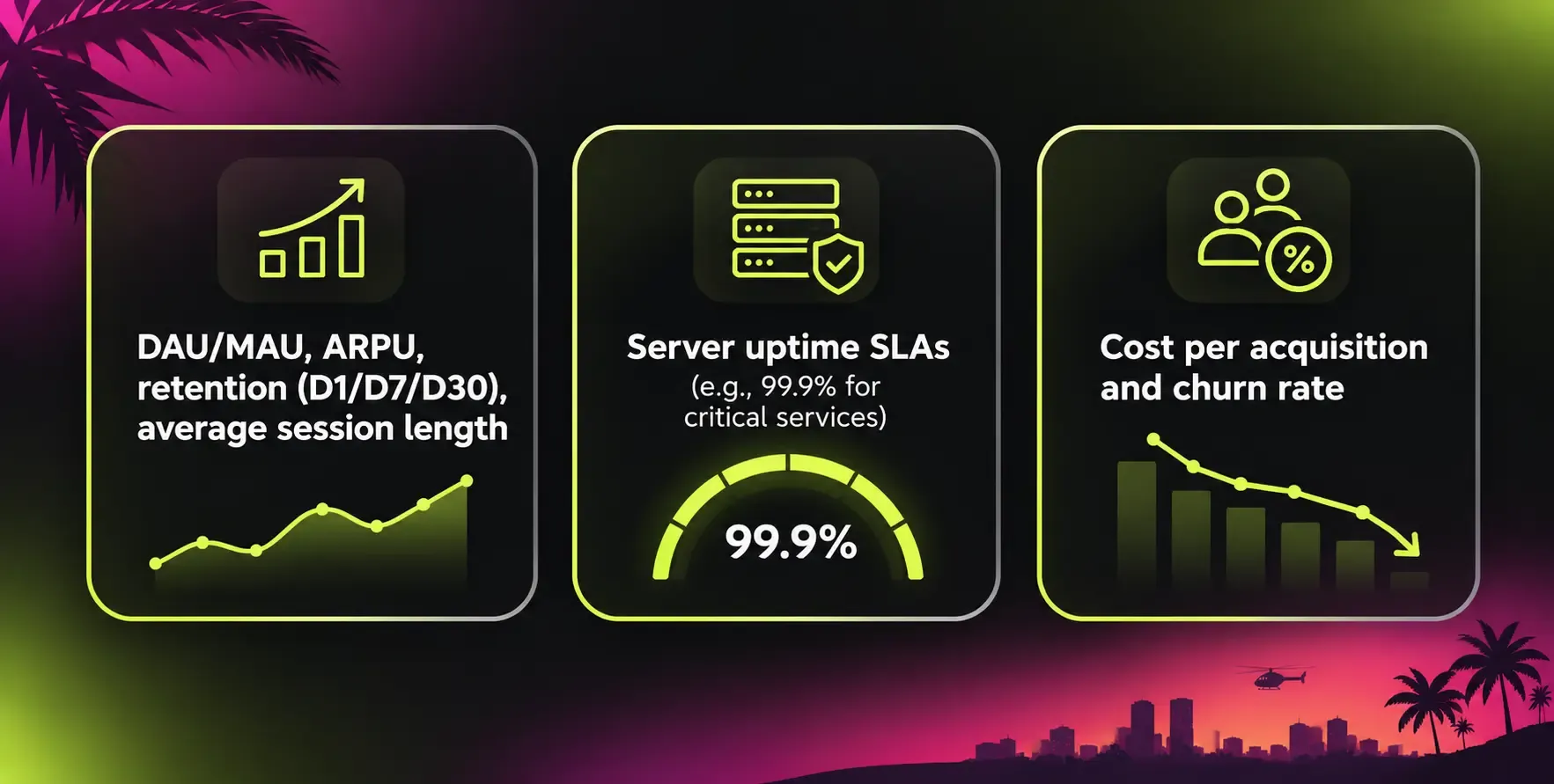
KPIs to define before architecture work starts:
Regulatory considerations. In the U.S., COPPA requires parental consent and strict handling of data for users under 13. In Canada, PIPEDA governs personal data. Payment compliance (PCI-DSS) and platform store rules (App Store, Google Play) affect design choices.
SoftDoes helps clients turn high-level goals into a concrete platform roadmap and feature backlog, aligning business models, target markets, and revenue streams through product management services before writing code.
Software Architecture for Scalable Game Platforms
Strong software architecture is the backbone for large scale, always-on game platforms. Architectural patterns help break down complexity in software systems, and the right pattern depends on your scale, team, and timeline.
Microservices. Microservices architecture allows independent operation of application components. Matchmaking, inventory, payments, and identity each run as separate services. Distributed services enhance the scalability of game platforms because each module can scale horizontally based on concurrent users.
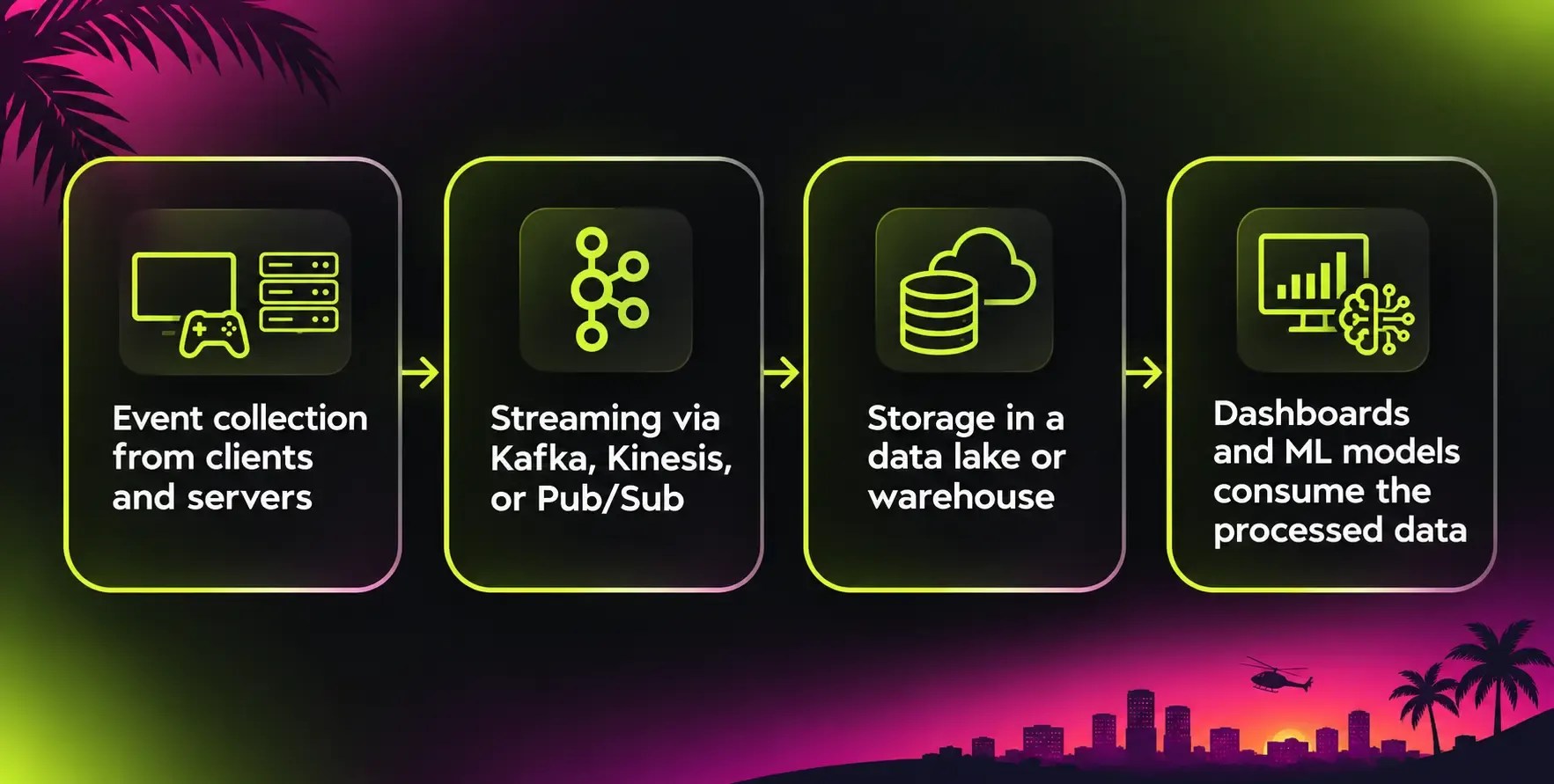
Event driven architecture. Event driven architecture enables asynchronous communication between components. A typical flow: a player purchase event triggers a validation service, which updates inventory, which feeds an analytics pipeline. Message brokers like Kafka or AWS Kinesis buffer and propagate these events, enabling high throughput and traceability.
Layered architecture. Layered architecture organizes software into separate, manageable layers. For smaller or early stage platforms, a layered approach works well. Teams can split into microservices later when traffic demands it. The model-view-controller pattern improves code organization in applications, keeping presentation, logic, and data handling separated.
Client-server architecture centralizes resource management for multiple clients.
Resilience and scaling. Real time gameplay has stricter latency requirements than conventional applications; circuit breakers, retries, and rate limiting prevent cascade failures. Scalable game platforms use autoscaling to match capacity with demand, and cloud hosting is important for handling traffic spikes during launches or seasonal events. High availability setups with multi-region failover keep players connected.
SoftDoes focuses on modular designs that support future features (cross-play, additional regions, AI-powered matchmaking) without full rewrites, drawing on its broader experience in custom software and digital transformation.
Core Backend Services and Platform Modules
Every serious game platform needs a set of core backend services. These are the components that back-end developers build, test, and operate.
Identity and accounts. SSO, OAuth2, OpenID Connect; parental controls for COPPA compliance; multi-factor authentication; account linking across platforms.
Player profiles and progression. Persistent data for levels, achievements, saved states. Cross-title progression if the platform supports multiple games.
Matchmaking. Real time or asynchronous; skill based, region based; party matching. Concurrent users measure platform capacity, and matchmaking is often the first module to feel the strain.
Social and communication. Friends lists, text and voice chat, guilds. Monitoring player experience is crucial for maintaining healthy communities.
Leaderboards. Seasonal resets, percentile rankings, anti-cheat integration.
Inventory and virtual economy. Virtual items, currencies, drop rates, rarity tiers. Storing data for millions of player inventories requires careful database design and the ability to retrieve data quickly under load.
Payments and commerce. In-game stores, subscriptions, battle passes, refund flows, fraud checks. Each platform (Steam, PlayStation Store, Xbox, App Store, Google Play) has its own revenue share rules and policies around money handling.
Live operations. A/B testing, remote configuration, feature flags, timed events, push notifications.
Logging, monitoring, and incident management. Error tracking, SLOs, alerting, and runbooks. These are part of the platform.
SoftDoes often designs these as independent services with public APIs so different games can mix and match capabilities over time, following the principle that game platforms require modular architecture for scalability and reliability.
Client Technology and Game Engines (Unity, Unreal Engine, and Beyond)
Client-side development connects the game to the platform: integrating SDKs, handling real time communication, and rendering the user interface using game engines.
According to the 2026 GDC State of the Game Industry report, 42% of developers primarily use Unreal Engine, 30% use Unity, 19% use proprietary engines, and 5% use Godot.
- Unreal Engine is suited for high end 3D visuals and AAA-scale projects. Unreal Engine is known for its high quality graphics capabilities and rendering tools. C++ and Blueprints connect to backend APIs. Best fit for PC and console titles that need high fidelity graphics.
- Unity supports over 25 platforms including iOS and Android, making it strong for mobile, cross-platform, and mid-core games. C# SDKs and asset bundles tie into platform services. Unity simplifies development for teams targeting multiple platforms at once.
- Godot is a free and open-source game development engine gaining traction among indie developers and lighter or experimental titles.
- CryEngine is renowned for its advanced visual capabilities and is primarily used for developing graphically demanding games.
- GameMaker Studio features a drag-and-drop interface for easy game development, lowering the barrier for 2D projects.
- RPG Maker is designed specifically for creating role-playing games, with templates and scripting tools tailored to that genre.
The platform backend should stay engine-agnostic via REST or gRPC APIs. Standardize SDK patterns across engines (authentication, telemetry, error handling) to simplify maintenance.
Essential Software Tools and DevOps for Game Platforms
Stable platforms rely on disciplined DevOps, CI/CD, and the right software tools.
Version control and CI/CD. Git is commonly used for version control in game development. CI/CD pipelines automate builds and testing for game platforms, using tools like GitHub Actions, GitLab CI, or Azure DevOps. Automated testing supports frequent releases without disrupting players.
Code editors and IDEs. Visual Studio Code is a standard code editor used in game development. Visual Studio is a popular IDE for game development on Windows, handling C++ (Unreal) and C# (Unity) projects.
Design and audio. Figma is widely used for designing menus and user experiences, from admin dashboards to in-game UI. Blender is free software used for 3D modeling, rigging, and animation of game assets. Audacity is used for audio trimming and editing to produce sound effects and in-game audio.
Observability. Centralized logging (ELK stack), metrics (Prometheus, CloudWatch), tracing, and alerting tied to on-call rotations. Monitoring player experience across sessions, regions, and devices lets teams improve performance before players notice issues.
Containerization. Docker and Kubernetes (or managed services on AWS, Azure) handle rolling updates and blue-green deployments.
Data and analytics tools. Snowflake, BigQuery, or cloud-native warehouses integrated with BI tools like Power BI or Looker drive live ops decisions and help teams build automated data integration pipelines.
SoftDoes designs pipelines where client builds (Unity, Unreal Engine) and backend services share consistent release workflows and environments.
Data, Analytics, and AI in Modern Game Platforms
Successful platforms in 2024 through 2026 are data driven and increasingly AI-assisted.
Typical data flow:
Metrics that drive decisions: churn probability, LTV forecasts, segmentation by play style, and monetization cohorts. These guide content updates, promotions, and resource allocation.
AI and ML use cases: smart matchmaking, dynamic difficulty adjustment, recommendation systems for in-game stores, and fraud detection for payments. About 40% of game developers now use generative AI internally for tasks like content generation or tool pipelines, though many express concern about using it for player-facing features.
Privacy. For players under 13 in the U.S., COPPA requires opt-in consent and the ability to delete personal data. Build data retention policies and deletion flows into the platform from the start.
SoftDoes offers AI and data engineering capabilities to embed analytics, dashboards, and ML services directly into the platform architecture.
Security, Compliance, and Reliability for U.S. and Canadian Platforms
Security should be integrated into the platform architecture from the beginning.
Core security practices:
- Encryption in transit (TLS) and at rest
- Secure credential storage and secrets management (e.g., HashiCorp Vault)
- Regular penetration testing and vulnerability scanning
- Least-privilege roles in cloud environments
Fraud and abuse. Account takeover, payment fraud, cheating in matchmaking, and harassment in chat all require automated detection, rate limits, and human moderation. Trust and safety frameworks combine code, process, and policy.
Compliance. COPPA for children's data in the U.S.; PIPEDA in Canada. PCI-DSS for payment processing. Store agreements for each console and mobile marketplace. FTC enforcement has penalized studios for misleading microtransaction disclosures.
Reliability. Define SLOs and SLIs (latency, error rate, uptime targets). Run chaos testing and load testing before seasonal events. Multi-region failover, runbooks, and post-mortem culture keep platform engineers prepared for peak traffic.
Phased Roadmap for Building a Game Platform
Phase 1 (3 to 4 months). Discovery workshops, requirements definition, reference architecture, and a proof of concept using one game client (Unity or Unreal Engine) with a minimal backend covering auth and telemetry.
Phase 2 (6 to 9 months). Build core services (accounts, matchmaking, inventory, payments). Set up CI/CD, basic analytics, an admin console, and ship the first production launch for a single title.
Phase 3 (next 6 to 12 months). Expand for multiple games. Introduce live ops tooling, A/B testing, and robust observability. Tune costs and game performance under real traffic with a large number of concurrent sessions.
Phase 4 (ongoing). Continuous optimization: cross-progression, additional regions, new engine integrations, and AI features where data is mature.
SoftDoes typically works as a long-term partner through these phases, adapting scope and team composition to client needs.
Benefits of Working with SoftDoes on Game Platform Development
U.S. and Canadian studios choose SoftDoes as a platform partner for several concrete reasons:
- Custom software development focused on scalable backend architectures, high availability, and performance under heavy player load.
- Combined strengths in game development tooling, AI and machine learning, data science, and cloud services aligned with modern platform needs.
- Flexible engagement models: dedicated teams, co-delivery with internal developers, or architecture and code audits for existing platforms.
- Experience in regulated industries (finance, healthcare, education) and energy, where SoftDoes builds data-driven oil and gas software that translates into secure, compliant platforms and payment flows.
- Long-term partnership covering platform modernization, API integration, UI/UX of admin tools, and continuous delivery practices.
Common Pitfalls and How to Avoid Them
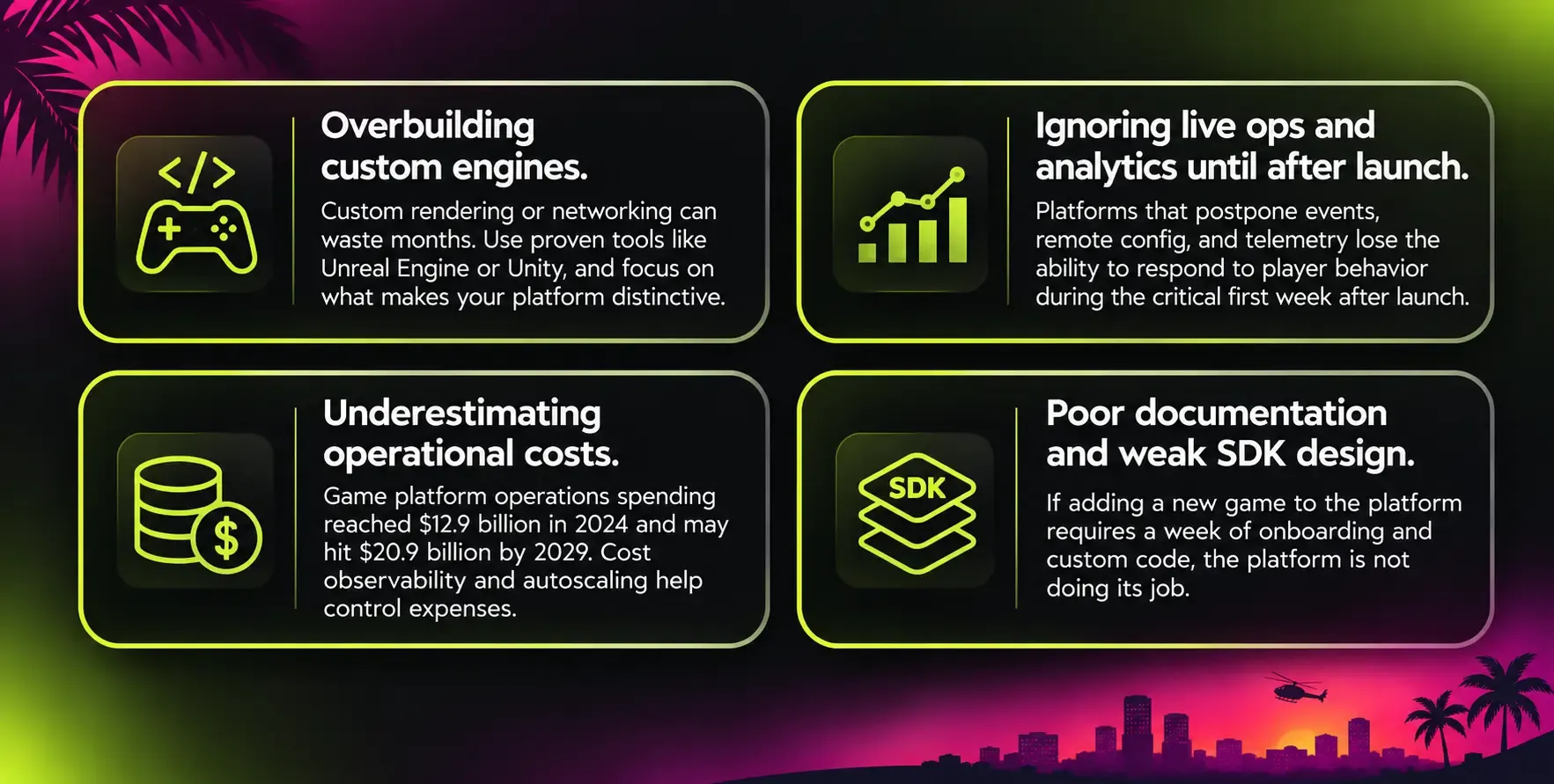
Many game platforms fail not because of bad ideas, but because of avoidable technical and organizational mistakes.
Regular architecture reviews, incremental delivery, and early load testing help teams catch these problems before they reach players. SoftDoes often starts with an audit of current systems to identify and prioritize fixes before scaling up.









Comments (0)
No comments yet.