


U.S.-Based
Custom AI voice agent development for phone calls
We build voice agents that answer and place calls, look up records and update your CRM or help desk. Each agent has clear rules for when a person takes over.
$9,000
Voice agent across several systems, from
$5,000
AI receptionist for one line, from
5.0
Clutch rating from 40 reviews
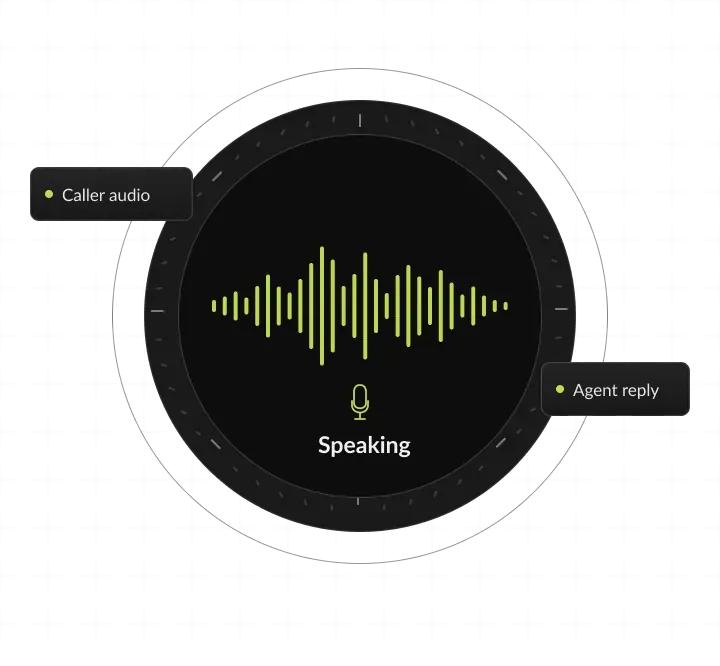
























How a voice agent call runs
One order call: the voice agent handles it, a specialist takes the exceptions and the record updates before the call ends.
A customer calls about an order
The call reaches the agent on your main number.
The voice agent handles it
It confirms identity, finds the order and answers.
A specialist takes exceptions
Refunds above your limit go to a person.
The record updates
Ticket, CRM note and recording are saved.
Voice AI agent development, in short
- Kansas City metro software and AI company
- Voice AI agents for support, sales and operations teams that handle hundreds of calls a week
- Agents run on Claude or OpenAI models and connect to your systems
- Builds from $9,000; calls at cost, about $0.10 to $0.20 a minute

Calls answered. Records updated.
- 01Build priceFrom $9,000 for a voice agent across several systems. Calls at cost, about $0.10 to $0.20 a minute
- 02One business lineAI receptionist: answering, booking and intake for one line starts at $5,000
- 03People take overBy your handoff rules, with a written summary
- 04You ownThe code, prompts, call flows and recordings
What is an AI voice agent?
An AI voice agent is software that holds a phone conversation and acts on it. It understands the caller, updates your systems, replies in a natural voice and hands off to a person by your rules. A voice agent does more than answer questions: it can confirm who is calling, find an order, book a visit or change an account, and the result is saved in your systems before the call ends.
How a call runs through a voice agent
Speech to text
The caller's words turn into text as they speak.
Understanding
A language model, such as Claude or GPT, works out the request and the next step.
Action
The agent reads or updates your CRM, help desk or scheduling system through its API.
Reply
Text to speech answers in a natural voice, inside the same call.
Record
The transcript, a summary and the outcome are saved where your team works.





Two ways to build one
A chained design runs speech to text, a language model and text to speech as separate steps. Each step can be checked, logged and swapped on its own. A speech-to-speech design uses one realtime model that hears, reasons and speaks in a single session. OpenAI's voice agents guide describes both designs, and we choose per call type after testing on your recorded calls.
How it differs from a phone menu
A phone menu routes callers by key press, and unclear requests usually end in the queue. A voice agent asks a follow-up question instead, then finishes the request or passes it on with a summary.
Types of AI voice agents we build
We build four types: an AI receptionist, a legal intake agent, a medical or dental receptionist and a multi-system voice agent. Prices are starting points from our price list. Support starts at $500 a month; call minutes and model usage are billed at cost, about $0.10 to $0.20 a minute.

AI receptionist
One business line: questions, booking, intake and transfers. Fits when calls go to voicemail after hours or at peak times.
Legal intake agent
Screening in English or Spanish, conflict checks and a new matter in the case system. Fits when a law firm loses new clients to voicemail.
Medical or dental receptionist (HIPAA)
Verified callers, booking by visit type and intake written into the EHR. Fits when patients wait on hold while staff work the front desk.
Voice agent across several systems
Support, account and outbound calls that read and update several systems. Fits when one call needs data from more than one system.
Phone systems and software we connect to
The agent sits on your phone system and writes to the tools your team already uses.
When an AI voice agent pays off
A voice agent pays off when your team takes hundreds of similar calls a week and callers wait or hang up today. It works best when the answers sit in systems it can reach.
Signs we see most often before a team asks for a voice agent:
- Callers wait on hold or reach voicemail at peak hours and after hours.
- Most calls are the same few requests: status, booking, changes and simple account questions.
- Staff retype call details into the CRM or help desk after every call.
- Call volume grows faster than your team can add people.
When to wait
If you get a few calls a day, an answering product or your own staff will cost less than a build. If every call needs judgment, such as complex complaints, start with call summaries and quality checks instead. If the answers are not written down, or your systems have no API, start with an AI readiness assessment.
What to prepare before the first call
A sample of recorded calls, such as 50 from a normal week; admin or API access to the CRM, help desk or scheduling system; handoff rules: who takes urgent calls, refunds above a limit and complaints; and the measure that matters: answer rate, hold time or calls finished without a person.
AI phone agents and call center software we build
Five kinds of voice work, each connected to the systems where the work gets recorded.
Inbound AI phone agents
Agents answer support, sales and booking calls, look up the caller's records and finish the request on the call. For example, a customer asks where an order is. The agent confirms the zip code, reads the status from your order system and texts the tracking link.
AI call center software for your queue
The agent takes tier-one calls in your contact center and passes the rest to people, with a summary on screen. For example, address changes and order status calls end with the agent. A billing dispute reaches a person with the summary already on screen.
Outbound calls to opted-in customers
Reminder, renewal and follow-up calls to customers who agreed to them, with each result logged in your CRM. For example, a week before a plan renews, the agent calls customers who agreed to reminders and logs each answer in Salesforce.
Conversational AI development for web and apps
The same agent can talk on your website or inside your app, with one set of rules and one record. For example, a shopper asks a question by voice on your website and gets the same answer the phone agent would give.
Quality checks on every call
Each call is transcribed and checked against your script, so supervisors review problems instead of random samples. For example, calls that skipped a required disclosure land in the supervisor's review list, with the moment it was missed. See AI agent evaluation.
What you get when the voice agent goes live
You get a working voice agent on your own phone and model accounts. You also get what you need to run it without us: call flows, prompts, tests and documentation.




AI voice agent ROI: a worked example
A voice agent pays back when the staff hours it saves cost more than the build, the support and the call minutes. The example below uses assumed numbers, so swap in your own. Example math with assumed numbers, not a client result. At these numbers, the build pays back in about three to four months; call minutes depend on call length and the model you choose. Run your own numbers in the AI ROI calculator, and estimate model usage with the LLM cost calculator. After launch, call reports show the real share of calls the agent finishes, next to this estimate.
From call recordings to a live voice agent
Four steps, each with something your team can review.
We review recorded calls, list the call types and pick the ones the agent takes first. You approve the call map, the handoff rules and the fixed price before any build. You get a call map and a fixed-price scope.
We write the call flows, connect your phone system and data, and set handoff rules. The agent answers on a test number, so no customer hears it yet. You get a working agent on a test number.
We run scripted calls and your team's own calls, then tune answers, voice and speed. Live traffic starts only after the agent passes the agreed test calls. You get a test report your team signs off.
We route a share of live calls first, then more as results hold, with weekly reviews. Transcripts and call results show where the agent needs tuning. You get call reports and a tuning log.
AI work in production
Two AI builds from our case studies, and the record behind them.

- Healthcare
Prior Authorization AI
Prior Authorization AI is a healthcare automation startup building AI-powered tools to streamline prior authorization for Medicare and Medicaid medical transportation providers in New Jersey.- 16Weekly hours saved
- 63%Admin time reduced
- 43%Fewer submission errors

- Startup
- Real Estate
Our Haus AI
A finance professional turned founder built Our Haus AI, an AI-powered collaborative workspace where homeowners and contractors scope, bid, contract, and document renovation projects together. SoftDoes took her prototype and made it production-ready.- 10XMVP scope delivered
- 2+years Ongoing partnership
- 1Fully owned Platform

- Real Estate
The building buyer
The Building Buyer is a Florida-based real estate investment firm co-founded by Dylan Troiano and Charles Hanlin. They acquire single-family, multifamily, and commercial properties across South Florida and beyond, with a focus on motivated seller opportunities.- 18Weekly hours saved
- 2+Years Ongoing partnership
- 1Fully owned Platform

- Healthcare
CareInTouch
CareInTouch is a Bay Area home health agency providing skilled nursing and therapy services to patients referred from hospitals and clinics. With over 100 staff, they operate in one of the most complex and compliance-driven healthcare markets in the country.- 40% Reduction In Billing Errors
- 100+Staff Operations Managed
- 0Missed Compliance Deadlines

- Startup
Sparkle The Cleaning Service
Sparkle The Cleaning Service is a Detroit-area residential cleaning company with 10 years in business, connecting homeowners with vetted, insured independent cleaners through a subscription-based marketplace platform.- 75% Platform Transparency
- 2XPlatform Growth
- 40%Higher User Retention

- Healthcare
FMY Orthodontics
FMY Orthodontics, a multi-location practice in West Tennessee, partnered with SoftDoes to replace a spreadsheet-based financial workflow with a custom web platform. The goal was to simplify how staff present treatment financing while allowing patients and families to review and complete decisions remotely.- 60%Workflow Reduction
- 75%Remote Adoption
- 5Locations Aligned

- Real Estate
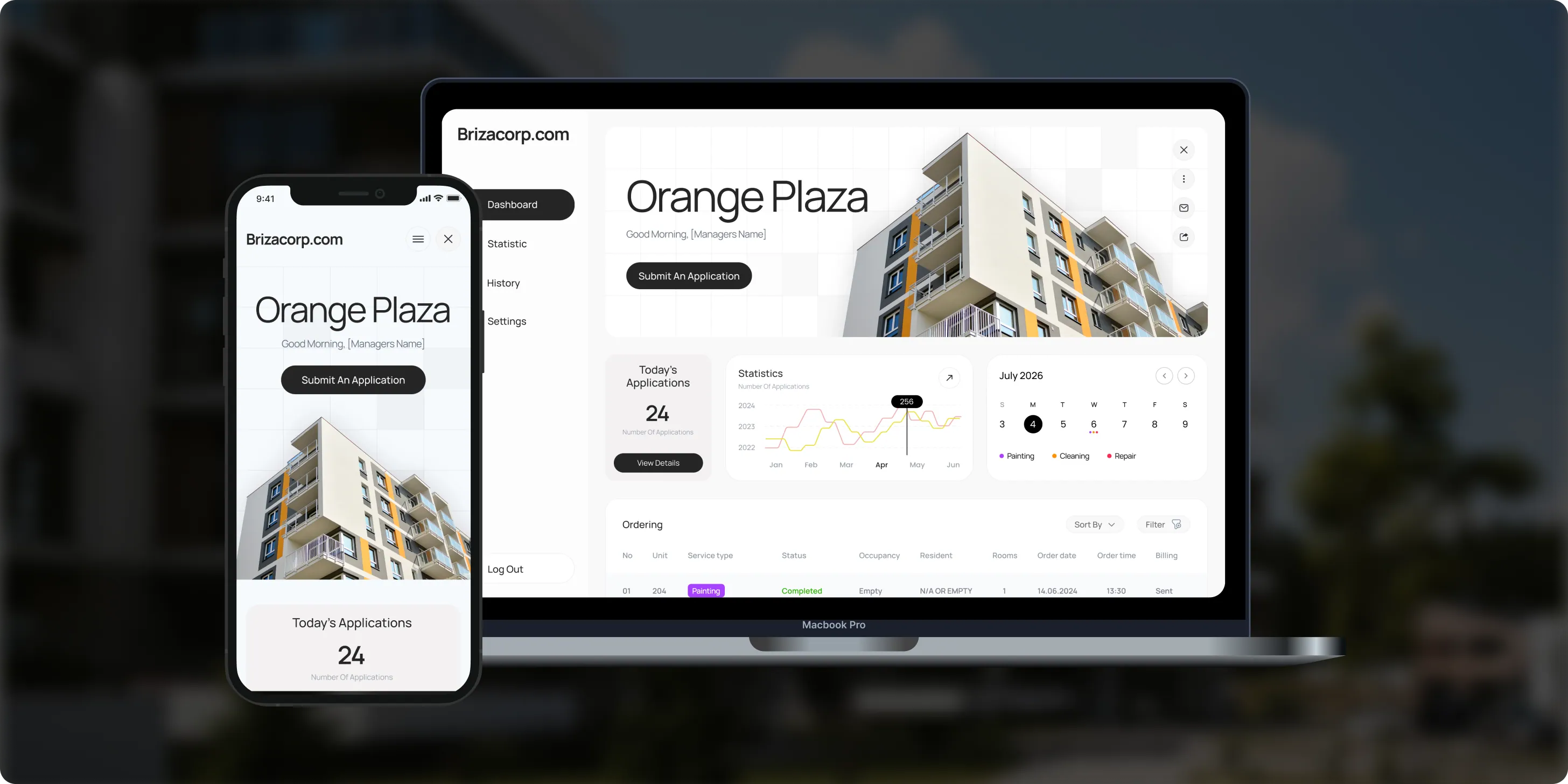
Brizacorp
Brizacorp manages residential properties and coordinates the staff who handle painting, cleaning, and repair requests. Its team tracked work across messengers, phone calls, e-mail, and paper planners, with no single place to manage requests or measure performance.- 98%Application Stability
- 95%Utilization Rate
- 30%Faster Task Completion
Risks in AI voice agents, and how we handle them
The main risks are wrong answers, callers stuck with the agent, long pauses, data exposure, manipulation and cost overrun. Each gets a control tested on scripted calls before launch.

How we keep call data safe
Call data stays on your accounts
Call audio, recordings and transcripts stay on your accounts. Each model call sends only the fields a task needs, and every call leaves a log entry. For company rules on AI use, see AI governance and compliance. Calls with patient data have their own rules: see the AI receptionist for medical practices and our guide to HIPAA-compliant AI.
Your own accounts
Phone, model and storage usage run on your own accounts, under your contracts with each vendor.
No card numbers by voice
Card numbers are never taken by voice; your billing system texts a payment link instead.
Access by role
Recordings and transcripts have access by role, an audit log and the retention you set.
Keys out of code
API keys stay in your secrets manager, never in code or in prompts.
How to choose a voice AI agent development partner
Choose a partner that builds on your accounts, tests on your own calls and puts handoff rules and per-call costs in writing. Ask these questions before you sign.
Questions to ask, and what a good answer includes
- Where will the agent's code, prompts and recordings live? On your accounts and in your repository, owned by you.
- How will you test it before customers hear it? Scripted calls and your team's own calls, with a test report you sign off.
- What happens when the agent can't help? Written handoff rules and a warm transfer with a summary.
- How will you measure speed? Wait times measured on test calls and tuned before any live traffic.
- What will each call cost to run? Minutes and model usage at cost on your accounts, with an estimate per call.
- What paperwork comes first? An NDA and a certificate of insurance before the first call.
For agents that work in text and back-office systems, see AI agent development.
Build price and running costs
One fixed build price, agreed before work starts. Phone minutes and model usage are billed at cost on your accounts: you pay the phone and model vendors directly, and we never mark up minutes.
Voice agent across several systems
Call flows, phone connection, data lookups, handoff rules
From $9,000
AI receptionist for one line
Answering, booking, intake
From $5,000
Maintenance
Monitoring and updates
From $500 a month
Call minutes and model usage
Billed at cost
About $0.10 to $0.20 a minute
Project Discovery
Credited to the build
$490
Why teams build voice agents with SoftDoes
Teams build voice agents with SoftDoes because they own every part of the agent, from call flows to recordings. As a Claude Partner Network member and an OpenAI Registered Partner, we choose the model per call type.

- 01
Built on Claude or OpenAI
We are a Claude Partner Network member and an OpenAI Registered Partner, so we pick the model per call type.
- 02
Vendor documents first
Our NDA and certificate of insurance reach your procurement team before the first call.
- 03
You own the agent
Code, prompts, call flows and recordings stay on your accounts, and all of it belongs to you.
- 04
AI in most of our work
About 80% of SoftDoes projects include AI, from document intake to filing through Medicare's API.
- 05
Rated 5.0 on Clutch
5.0 from 40 client reviews. Clutch named SoftDoes a Top Artificial Intelligence Company and Top Machine Learning Company in Kansas City for 2026.
- 06
Kansas City headquarters
Headquartered in Mission, KS, in the Kansas City metro. Call 800-909-2345 to reach the team.
AI voice agents by industry
The same voice agent, built around each industry's calls, systems and rules. Each page shows a sample call and the record it writes.
Law firms
Intake in English or Spanish, conflict checks before booking and a new matter in your case system.
Medical and dental practices
Callers verified by name and birth date, visits booked by your rules and intake written into the EHR.
HVAC, plumbing and electrical
Safety questions first, priority by your rules and jobs booked in your field service software.


Questions about AI voice agents
Cost, models, call quality and handoffs. Can't find your answer?
What is an AI voice agent?
An AI voice agent is software that holds a phone conversation. It turns speech into text, decides what to do with a language model, takes actions in your systems and speaks the reply. Unlike a phone menu, callers say what they need in their own words, and the agent can finish the task on the call.
Is there an AI agent that can make phone calls?
Yes. Voice agents can place outbound calls as well as answer them. We build outbound agents for reminders, renewals and follow-ups to customers who opted in. Each call follows your script, logs the result in your CRM and hands warm leads or complaints to a person.
How much do AI call agents cost?
A custom voice agent that works across several systems starts at $9,000 to build. Maintenance starts at $500 a month. Call minutes and model usage are billed at cost, about $0.10 to $0.20 a minute. Our voice agent pricing page shows example budgets.
What is the difference between an AI voice agent and an AI receptionist?
An AI receptionist answers one business line: questions, booking, intake and transfers. A voice agent covers wider work, such as support queues, outbound calls and multi-step tasks across several systems. Many teams start with an AI receptionist and add agent skills once the first line runs well.
Can a voice agent replace our call center?
Not fully, and we don't recommend it. Agents take the repeat calls, such as order status, booking and account updates, and pass complex or emotional calls to people with a summary. Your team handles fewer calls, and the calls they take are the ones that need judgment.
How do you keep a voice agent from saying the wrong thing?
Each agent has a written scope, tested answers and hard limits, such as refund caps and topics it must transfer. We test it with scripted calls before launch and review transcripts every week after. For higher-risk calls, we run red team tests for prompt injection and data leaks.
Is it legal to use AI voices on phone calls?
It depends on the call. In February 2024, the FCC ruled that calls with AI-generated voices are artificial voice calls under the Telephone Consumer Protection Act. Telemarketing robocalls with them need prior express written consent. We build outbound agents only for customers who opted in. Your counsel should review the script.
How can AI be used in call centers?
AI can take tier-one calls, such as order status, password resets and booking. The rest go to people with a summary on screen. It can also transcribe every call and check it against your script, so supervisors review real problems. We connect these agents to platforms like Amazon Connect, Genesys Cloud and Five9.
Can ChatGPT power a voice agent for our phone line?
OpenAI's models can hold spoken conversations, and a business phone agent uses them through OpenAI's API. OpenAI's voice agents guide describes realtime speech-to-speech sessions and chained designs with separate speech steps. We build on OpenAI or Claude models, on your own accounts, and choose per call type after testing.
Which call center software can a voice agent connect to?
Contact center platforms with an API, such as Twilio, Amazon Connect, Genesys Cloud, Five9, RingCentral and Zoom Phone. On the business side, the agent reads and writes Salesforce, HubSpot, Zendesk, ServiceNow, Shopify or your own database. We confirm access to each system in the written plan, before any build starts.
How long does it take to build an AI voice agent?
It depends on the number of call types, the systems involved and your testing process. We set the scope, price and schedule in a written plan before the build starts. Many teams begin with Project Discovery for $490, which is credited to the build. The plan also lists what we need from you, such as recorded calls and system access.
Will callers know they are talking to an AI agent?
They should, and we build it that way. The agent introduces itself as a virtual assistant at the start of each call. Callers can ask for a person at any time. The handoff includes a written summary, so nobody repeats the story to your team.
Can we keep our phone numbers and phone system?
Yes. The agent connects to your current phone system or takes calls by forwarding, so your numbers stay the same. You choose which calls it answers: one queue, after-hours calls, overflow at peak times or every call. We usually start with one call type and widen the scope as results hold.
Updated · Reviewed by Orest Andrusyshyn, Founder and CEO


