


U.S.-Based
LLM fine tuning services, measured before and after
We fine-tune your model or an open-weight base on data built for your tasks. Then we rerun the same benchmark, so you see the gain.
$6,000
Per training round, same benchmark before and after
2 weeks
For a focused evaluation, test plan to report
5.0
Clutch rating from 40 reviews
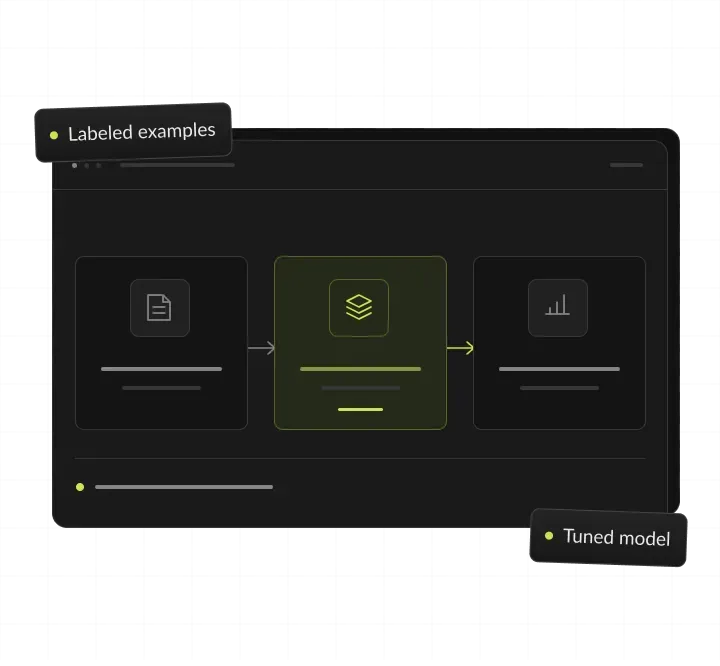























How a fine-tuning round runs
One round: a benchmark scores the model, it trains on expert data, specialists grade it on the same tasks and the tuned model ships.
A benchmark runs
Your model, scored on real tasks.
The model trains
On expert data aimed at its gaps.
Specialists grade it
Same rubric, same tasks.
The tuned model ships
To your cloud, with the report.
LLM fine tuning, in short
- Kansas City metro software and AI company
- Fine-tunes language models for product teams and companies with specialist know-how
- Your model or an open-weight base, trained on expert data, with the same benchmark rerun to show the gain
- Each training round from $6,000; you own the model and the data

Test. Train. Test again.
- 01Round priceFrom $6,000 per training round, with the same benchmark run before and after
- 02Before you tuneRAG or fine-tuning: some gaps close with better retrieval. We test that first
- 03Training dataWritten by specialists for the top failures: RLHF and training data
- 04You ownThe tuned model, the data and the reports, in your accounts
Types of fine-tuning we run
Six methods, what each one changes and where it fits. Every round starts at $6,000, with the same benchmark before and after. Training data starts at $5,000 a dataset, and an evaluation at $3,500; cloud compute is billed at cost on your accounts.

Supervised fine-tuning (SFT)
Teaches format, terms and steps from expert examples. Fits when the model knows the topic but answers the wrong way.
Reinforcement fine-tuning
Rewards answers that pass graders and rubrics. Fits when success can be checked, such as a test or a rule.
Preference tuning (RLHF)
Steers the model toward answers specialists ranked higher. Fits when quality is a judgment call, such as tone or completeness.
LoRA adapters
Trains a small add-on instead of every weight. Fits when you need several tuned versions or a smaller compute bill.
Hosted model fine-tuning
Tunes a provider's model through its fine-tuning API. Fits when the provider offers tuning for the model you use.
Open-weight model in your cloud
Tunes and serves a base model inside your account. Fits when data must never leave your cloud.
Models and platforms we tune on
Training runs in your accounts, billed at cost.
What are LLM fine-tuning services?
LLM fine-tuning services adapt a pretrained language model to one job by training it further on examples or graded tasks. The model learns your format, terms and judgment, and the same tests measure the change. A fine-tuning service runs the whole round: it finds the failures, builds data for them, trains the model and tests it again. Training runs on your model, through a provider's fine-tuning API, or on an open-weight base in your cloud.
What a fine-tuning round includes
An evaluation on real tasks
An evaluation on real tasks, with failures ranked by how often they happen.
Training data
Training data written by specialists for the top failures.
Fine-tuning in your accounts
Supervised or reinforcement fine-tuning, run in your own accounts.
The same benchmark again
The same benchmark rerun after training, scored with the same rubric.
A report by task type
A report by task type, with examples of the failures that remain.
The tuned model
The tuned model or model ID, delivered to your cloud.



Fine-tuning vs prompting vs RAG
Prompting changes the instructions, and retrieval (RAG) hands the model your documents at answer time. Fine-tuning changes the model itself, so it suits behavior, format and skill rather than facts that change often. We test the cheaper options first. Our RAG vs fine-tuning guide walks through the trade-offs in detail.
AI model training services we run
Training aimed at the failures a test found, never at a guess.
Supervised fine-tuning
Expert-written examples with the reasoning shown teach the model your format, terms and steps. For example, a support model learns your reply format and refund rules from answers your best agents wrote. See SFT data.
Reinforcement fine-tuning
Graded tasks and rubrics reward the answers your specialists would sign off on. For example, a coding model earns reward only when its fix passes the tests and a rubric approves the explanation. See RL environments.
Custom AI model training
Your tickets, documents or call notes, cleaned and labeled, become training data that stays yours. For example, approved underwriting notes become training examples, so the model drafts in the voice your reviewers already sign off on.
Open-weight models in your cloud
An open-weight base tuned and deployed in your own cloud account, so data never leaves it. For example, a Mistral base tuned on your claim notes and served from your cloud account, with no calls to an outside model API.
Hosted model fine-tuning
Tuning through a provider's fine-tuning API where one is offered, on your own account. For example, your app keeps calling the same hosted API, now pointed at the tuned model ID instead of the base model.
Before-and-after testing
The same benchmark runs before and after every round, with results by task type. For example, the report shows refund answers improved while order lookups held steady, with the failing examples to fix next.
Risks in LLM fine-tuning, and how we handle them
Fine-tuning can make a model worse at things nobody tested. Each risk below gets a control before the tuned model ships.

When LLM fine-tuning services pay off
Fine-tuning LLMs pays off when a model must behave in a new way, such as following your format or judgment. It helps most once prompts and retrieval stop closing the gap.
These are the signs we see before a team asks for a training round:
- Long prompts full of rules still produce answers in the wrong format.
- The model repeats the same domain mistakes, even with the right documents in front of it.
- You want a smaller model in your own cloud to handle a narrow task that a large model does well.
- Your data must stay in your cloud, so an open-weight model is the only option.
- You hold specialist knowledge, such as reviews or case notes, that no public model learned.
When to wait
If the model needs facts that change often, use retrieval; see RAG development. If you can't yet say where the model fails, start with an evaluation from $3,500.
What to prepare before the first call
The model you use today, or the open-weight base you prefer; access to the model or its fine-tuning API, or a cloud account for an open-weight base; real examples of failures, with what a good answer looks like; and the measure that matters: accuracy, format errors or time spent fixing answers.
What you get from each training round
Each round ends with a tuned model you control and a report that shows what changed. Both live in your accounts, and you own both.

Fine-tuning ROI: a worked example
Fine-tuning pays back when the corrections it removes cost more than the round and the data. This example uses assumed draft volumes and fix rates, not a client result, so swap in your own. At these numbers, the first round pays for itself in about a month and a half, before compute; compute is billed at cost on your own cloud account. If a tuned smaller model replaces a larger one on the task, cost per call can fall too. Estimate usage with the LLM cost calculator and savings with the AI ROI calculator. We rerun the same benchmark after each round, so the measured change sits next to this estimate.
Fine tuning LLMs, step by step
Each round starts and ends with the same test.
We test the model on real tasks and rank failures by frequency. The benchmark is fixed here and reused after training. You get a benchmark and failure report.
Specialists write examples, rubrics and practice tasks for the top failures. A second specialist checks every item. You get training data in your format.
Supervised or reinforcement fine-tuning on your model or an open base. Runs happen in your own accounts, with compute billed at cost. You get a tuned model in your account.
We rerun the same benchmark and report the change by task type. You decide on the next round with the numbers in hand. You get a before-and-after report.
AI work in production
Two live AI builds from our case studies. Our team has also worked with frontier AI labs.

- Healthcare
Prior Authorization AI
Prior Authorization AI is a healthcare automation startup building AI-powered tools to streamline prior authorization for Medicare and Medicaid medical transportation providers in New Jersey.- 16Weekly hours saved
- 63%Admin time reduced
- 43%Fewer submission errors

- Startup
- Real Estate
Our Haus AI
A finance professional turned founder built Our Haus AI, an AI-powered collaborative workspace where homeowners and contractors scope, bid, contract, and document renovation projects together. SoftDoes took her prototype and made it production-ready.- 10XMVP scope delivered
- 2+years Ongoing partnership
- 1Fully owned Platform

- Real Estate
The building buyer
The Building Buyer is a Florida-based real estate investment firm co-founded by Dylan Troiano and Charles Hanlin. They acquire single-family, multifamily, and commercial properties across South Florida and beyond, with a focus on motivated seller opportunities.- 18Weekly hours saved
- 2+Years Ongoing partnership
- 1Fully owned Platform

- Healthcare
CareInTouch
CareInTouch is a Bay Area home health agency providing skilled nursing and therapy services to patients referred from hospitals and clinics. With over 100 staff, they operate in one of the most complex and compliance-driven healthcare markets in the country.- 40% Reduction In Billing Errors
- 100+Staff Operations Managed
- 0Missed Compliance Deadlines

- Startup
Sparkle The Cleaning Service
Sparkle The Cleaning Service is a Detroit-area residential cleaning company with 10 years in business, connecting homeowners with vetted, insured independent cleaners through a subscription-based marketplace platform.- 75% Platform Transparency
- 2XPlatform Growth
- 40%Higher User Retention

- Healthcare
FMY Orthodontics
FMY Orthodontics, a multi-location practice in West Tennessee, partnered with SoftDoes to replace a spreadsheet-based financial workflow with a custom web platform. The goal was to simplify how staff present treatment financing while allowing patients and families to review and complete decisions remotely.- 60%Workflow Reduction
- 75%Remote Adoption
- 5Locations Aligned

- Real Estate
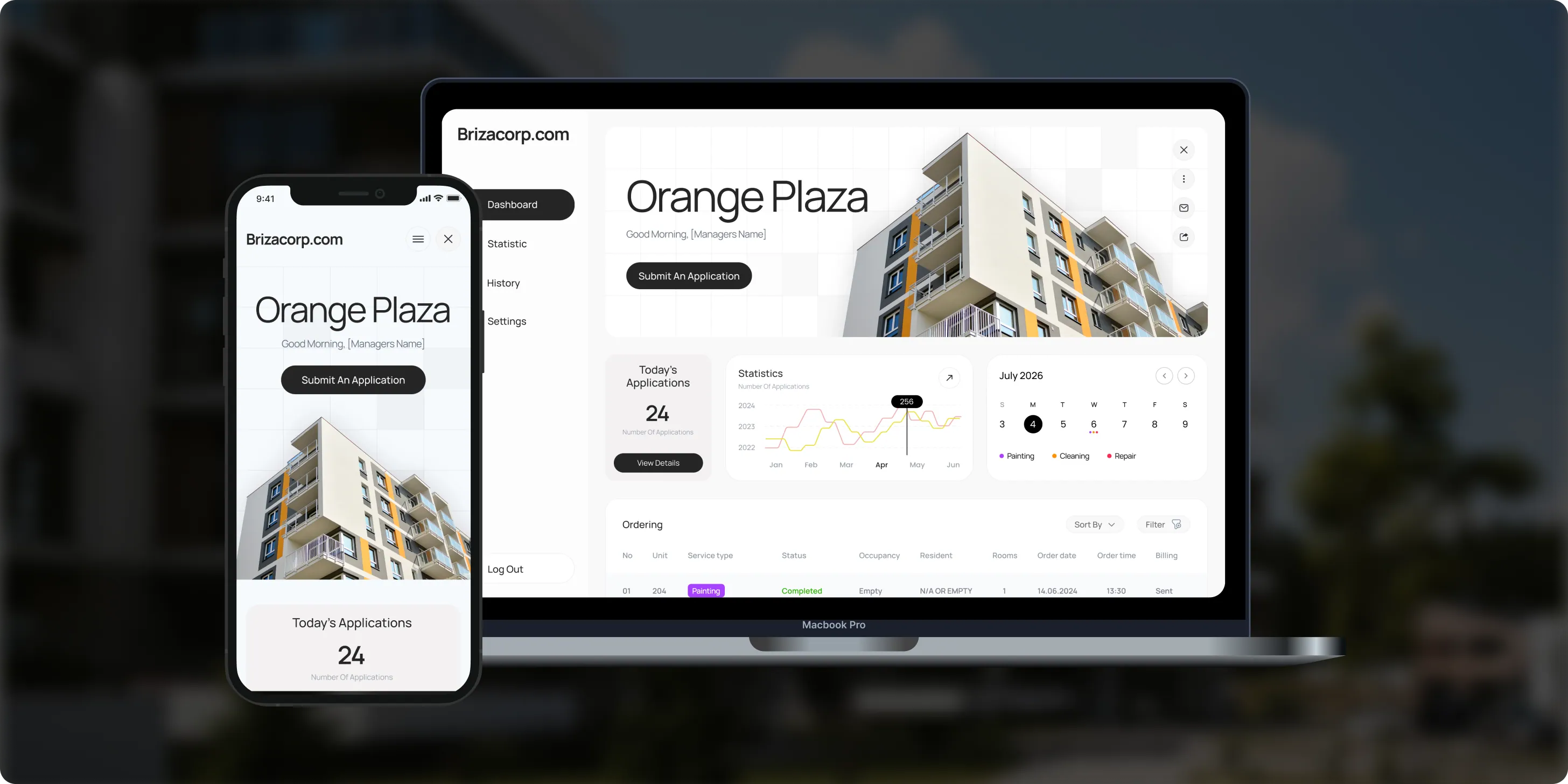
Brizacorp
Brizacorp manages residential properties and coordinates the staff who handle painting, cleaning, and repair requests. Its team tracked work across messengers, phone calls, e-mail, and paper planners, with no single place to manage requests or measure performance.- 98%Application Stability
- 95%Utilization Rate
- 30%Faster Task Completion
How we keep training data and models safe
Your data and your model stay in your accounts. We sign an NDA before you share anything, and training runs in your cloud or through your own provider account.
Insured, and in your cloud
Our certificate of insurance reaches your procurement team before the first call. For data that must stay inside your own cloud, see our private AI service.
NDA first
The NDA is signed before any data, prompt or model detail is shared.
A separate workspace
Training data stays in your cloud or in a separate workspace that only the project team can open.
Deleted at the end
We delete project data when the project ends.
Open-weight in your cloud
Open-weight models can be tuned and served inside your own cloud account, so data never leaves it.
You own everything
You own 100% of the tuned model or model ID, the data, the test sets and the reports.
Why teams choose SoftDoes for LLM training services
Teams choose SoftDoes because one team writes the data, trains the model and proves the gain, and the client owns all of it.

- 01
Data and training, one team
The specialists who write your data and the engineers who train the model share one plan.
- 02
Frontier lab experience
Our team has worked with frontier AI labs and some of the largest data providers.
- 03
You own the model
The tuned model, the data, the test sets and the reports are yours from day one.
- 04
Claude and OpenAI partner
A Claude Partner Network member and an OpenAI Registered Partner, building on both platforms.
- 05
40 AI projects since 2020
About 80% of our projects include AI, and 40 AI projects have been delivered since 2020.
- 06
Rated 5.0 on Clutch
5.0 from 40 client reviews. Clutch named SoftDoes a Top Artificial Intelligence Company and Top Machine Learning Company in Kansas City for 2026.
Fine-tuning prices
One fixed price per round, agreed before training starts. Cloud compute and model usage are billed at cost on your own accounts. You decide on each next round with the numbers in hand.
Training round
Supervised or reinforcement, tested before and after
From $6,000
Evaluation
To find the gaps
From $3,500
Expert training dataset
Written and checked by specialists
From $5,000
Maintenance and support
For the tuned model
From $500 a month
How to choose an LLM fine-tuning company
Ask these questions before you sign. A strong fine-tuning vendor answers each one in writing.
Questions to ask, and what a good answer includes
- How will you prove it worked? The same benchmark before and after, scored with the same rubric, reported by task type.
- Will you test cheaper options first? A check of prompts and retrieval before any training is proposed.
- Who writes the training data? Specialists from your field, vetted first, with a second check on every item.
- Where does training run? In your accounts, through your provider's API or in your own cloud.
- Who owns the tuned model? You do, with the data, test sets and reports, from day one.
- What does each round cost? A fixed price per round before training starts, with compute at cost.
- What paperwork comes first? An NDA and a certificate of insurance before the first call.
LLM fine-tuning by industry
Each field needs its own format, terms and judgment, written by its own specialists. The industry pages show the AI use cases and the rules for each field.
Healthcare
Models tuned to write clinical notes and summaries in your format, on data written by clinical specialists.
Legal
Models tuned on your clause positions and review notes, so drafts follow how your firm works.
Financial services
Models tuned to follow your policy wording and disclosure rules in customer replies.
Insurance
Models tuned to draft claim notes and coverage summaries the way your adjusters write them.
Accounting
Models tuned to explain reconciliations and tax positions in your firm's style.
Logistics
Models tuned to read shipment exceptions and draft carrier updates in your terms.


Questions about LLM fine-tuning
What it is, what it costs and how you know it worked. Can't find your answer?
What is fine-tuning in an LLM?
Fine-tuning is extra training that adapts a pretrained language model to one job. The model learns from examples or graded tasks, so it follows your format, uses your terms and makes fewer of the mistakes a test found. It changes how the model behaves. It is not the best way to add facts that change often.
How much does it cost to fine-tune an LLM?
A training round with SoftDoes starts at $6,000 and includes the same benchmark before and after. Cloud compute is billed at cost on your account. If you need training data, a dataset starts at $5,000, and an evaluation to find the gaps starts at $3,500. You decide on each next round with the results in hand.
Can I get LLM fine-tuning as a service?
Yes. We run the whole round for you: the evaluation, the training data, the fine-tuning and the re-test. Training runs on your model, through its provider's fine-tuning API, or on an open-weight base in your own cloud. You get the tuned model, the data and a before-and-after report.
Should we fine-tune or use RAG?
Use retrieval (RAG) when the model needs your facts, documents or data that change often. Use fine-tuning when it needs a new behavior, format or skill that prompts can't fix. Many systems use both. We test the cheaper option first, and our RAG vs fine-tuning guide explains the trade-offs.
Do you need access to our model?
For fine-tuning we need the model itself or access to its fine-tuning API. For an evaluation alone, we only need to reach your model or agent through its API or a test build. We sign an NDA before you share anything, and training data stays in your cloud or a separate workspace.
How do you prove the fine-tuning worked?
We run the same benchmark before and after each round, scored with the same rubric. The report shows the overall score, results by task type and examples of failures that remain. If a round doesn't move the numbers, you see that too, and we change the data before the next round.
Who owns the fine-tuned model?
You do. You own 100% of the tuned model or model ID, the training data, the test sets and the reports, from day one. Training runs in your own accounts, so you can keep using the model, move it or train it further with any team.
Where can I train my AI model?
You can train in a cloud account, through a model provider's fine-tuning API, or on your own GPU servers. We run training in your own accounts, such as Amazon Bedrock, Amazon SageMaker, Google Cloud or Azure. The data and the tuned model stay with you. Cloud compute is billed at cost.
Which AI models can you fine-tune?
Open-weight models such as Llama, Mistral, Qwen and Gemma can be tuned fully or with LoRA adapters. Hosted models can be tuned only where the provider offers a fine-tuning API. That list changes often, so we check it for your model at the start. Open-weight training and serving run in your cloud.
How long does fine-tuning take?
It depends on the data, the model size and how many rounds you run. We set the scope and schedule of each round in a written plan before training starts. The evaluation that comes first usually takes about two weeks, from the approved test plan to the report.
Is LoRA as good as full fine-tuning?
It depends on the task, so we test it. LoRA trains a small add-on instead of every weight, which lowers compute cost and lets several tuned versions share one base model. Full fine-tuning changes every weight. If a LoRA run meets the target on your benchmark, there is no reason to pay for more.
Will fine-tuning make the model forget other skills?
It can, which is why we test for it. The benchmark covers each task type the model handles, not only the one being trained, and results are reported by type. If a round hurts another task, you see it in the report, and we change the data before the next round.
Can you fine-tune a model on our company's writing style?
Yes. Style, format and tone are behaviors, which is what fine-tuning changes. Specialists write or select examples in your style, we train on them and score the output with a rubric your team approves. For facts inside that writing, such as prices or policies, we pair the tuned model with retrieval.
Updated · Reviewed by Orest Andrusyshyn, Founder and CEO


