The energy sector is going through one of the most significant technology shifts in decades. Utilities are modernizing legacy systems, renewable developers need smarter forecasting tools, and grid operators face growing pressure to manage distributed energy resources at scale. With the energy software market projected to exceed $50 billion by 2027, choosing the right development partner matters more than ever. This guide breaks down the top energy software development companies serving U.S. and Canadian organizations in 2026 and helps you match the right vendor to your specific needs.Key Takeaways
- GTA 6 is almost certainly built in C++ on Rockstar's proprietary RAGE game engine, not on public engines like Unreal Engine or Unity.
- Rockstar uses a multi language stack: C++ for core systems, proprietary scripting languages for gameplay logic, and Python or C# for tools and automation.
- A custom game engine like RAGE gives Rockstar fine control over performance, AI, and graphics that off the shelf engines cannot match at this scale.
- The technology stack behind GTA 6 mirrors patterns used by software partners like SoftDoes when building complex, high performance systems for enterprises and studios across the U.S. and Canada.
- Common myths that GTA 6 is coded in Python or Java alone are simply wrong. AAA games are developed using multiple languages to handle various functionalities.
What Programming Language Is GTA 6 Written In?
Here is the short answer: GTA 6's core systems are written in C++, running on Rockstar's RAGE engine, with supporting code in scripting languages, Python, and C#. Large open world games rarely rely on a single programming language. They use a stack of technologies chosen for performance, tooling, and platform needs. This article breaks down the main languages involved, why Rockstar chooses them, and what this means for teams creating complex interactive systems today.
Rockstar's Core Technology Stack for GTA 6
Rockstar has used its proprietary RAGE (Rockstar Advanced Game Engine) across titles like GTA IV, GTA V, Red Dead Redemption, and Red Dead Redemption 2. GTA 6 development relies on Rockstar's proprietary RAGE engine as well, though a former Rockstar audio designer publicly suggested the studio "probably rebuilt the entirety of the RAGE engine" because the architecture of technology has advanced significantly since GTA V.
RAGE is primarily written in C++. Its subsystems, covering rendering, physics, streaming, animation, audio, AI, and networking, are all performance critical modules optimized for current gen consoles and PCs. Rockstar also integrates middleware like Euphoria for character animation and physics, and uses libraries for collision and audio decoding, all tightly coupled through C++. Rockstar does not use Unreal Engine for GTA 6, though Unreal Engine is often referenced as an industry benchmark game engine for comparison.
Main Programming Languages Likely Used in GTA 6
Multi language stacks are common in large scale AAA game development. Here is what the evidence points to for GTA 6:
- C++ is the primary language for the game engine itself. It handles core systems like memory management, rendering, physics, networking, and platform specific optimizations. Rockstar uses C++ for high performance game development because C++ provides low level hardware control for game engines. C++ is the industry standard for game engine development and is preferred for its efficiency in game programming.
- Proprietary scripting languages are used to build missions and gameplay logic. Red Dead Redemption 2 used a C based scripting language for mission scripting, AI behavior, and in game triggers. Lua is often used for gameplay logic, UI behavior, and modding frameworks in similar titles. GTA 6 very likely continues this pattern.
- Python and C# are used for internal development tools and asset pipelines. Job listing data from Hakken shows Python appearing in roughly 7 of 11 programming roles, with C# in 2 of 11 and C++ in 4 of 11.
- Shader languages like HLSL are used for GPU rendering in the graphics pipeline.
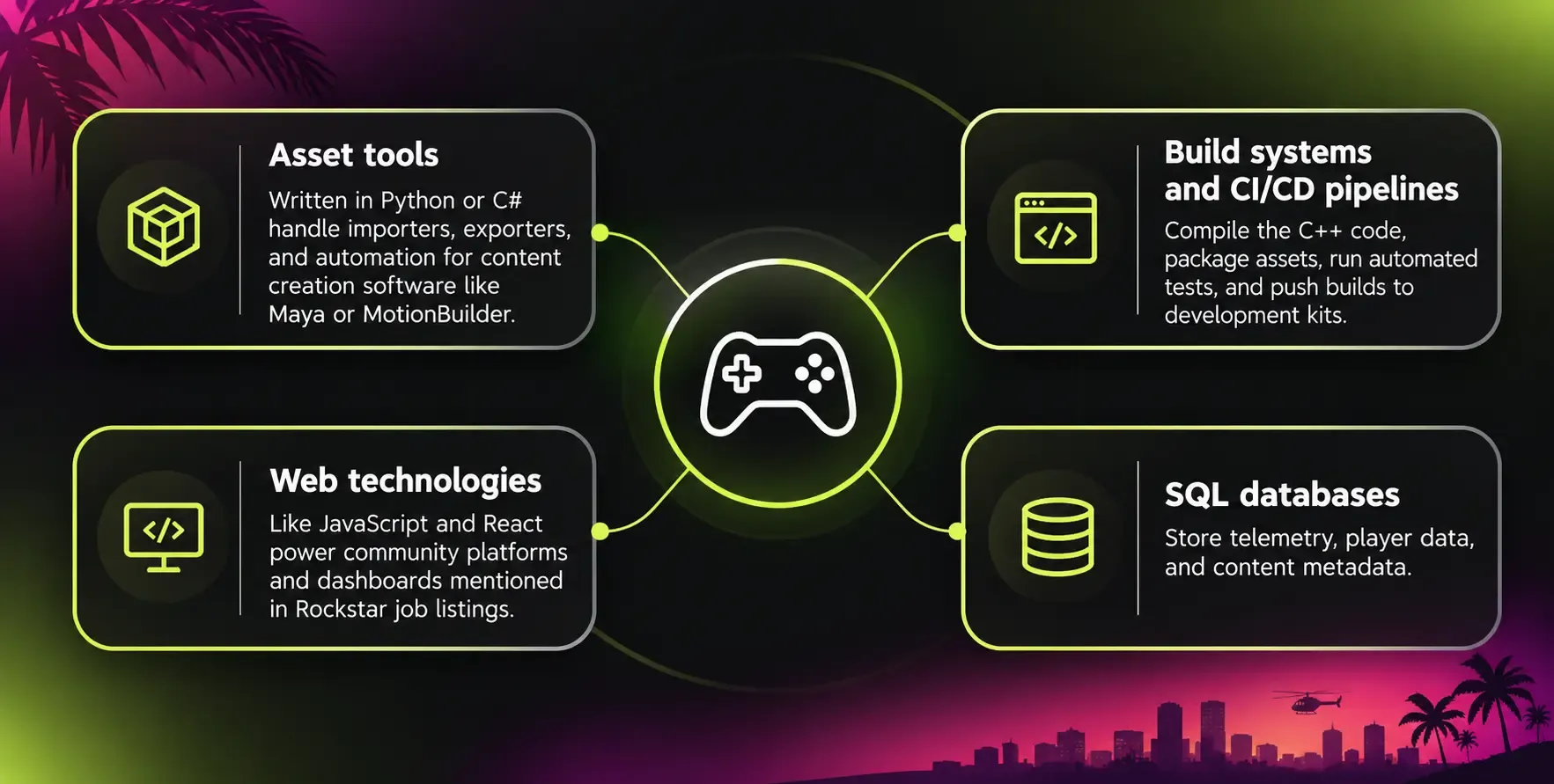
- JavaScript and React appear in web tools, community platforms, and dashboards. SQL handles data storage.
Game engines often use C++, C#, and Java for development across their various layers. Assembly is sometimes used for low level optimization in game development when every CPU cycle matters.
How Game Engines Power GTA 6's Open World
Think of a game engine as the operating system for a game. RAGE functions in that role for GTA 6, managing thousands of moving parts simultaneously. Game engines manage graphics, physics, and AI in real time, and RAGE handles all of these at a scale few engines can match.
Core RAGE subsystems include:
Subsystem |
Rendering engine | Graphics, lighting, ray tracing |
Streaming engine | Loading the massive map without visible loading screens |
Animation system | Character motion, facial animation, Euphoria physics |
Physics | Collision, vehicle dynamics, environmental destruction |
AI | NPC behavior, crowd simulation, traffic |
Networking | Multiplayer, live services |
Game engines like Unreal and CryEngine are commonly used by other studios, but Rockstar maintains its own engine for a series as demanding as GTA because it needs total control over performance and architecture at this complexity level. Unity uses C# and Unreal Engine uses C++, but neither offers the kind of bespoke optimization RAGE delivers for Rockstar's open world design.
Why C++ Remains Essential for GTA Scale Game Development
For console and high end PC titles in this era, C++ remains the dominant choice for AAA game engines. The reality is simple: hitting 30 to 60 plus FPS targets at 4K resolutions with high object counts, ray tracing, and dense urban environments demands a compiled language with direct hardware access.
C++ gives programmers fine grained control over memory layout, threading, and CPU and GPU synchronization. Higher level languages introduce overhead from garbage collection and abstraction that strictly cannot be tolerated in the frame to frame game loop. When thousands of NPCs, vehicles, and players share a scene, every millisecond of speed matters.
Common misconceptions persist. Some posts claim GTA 6 is coded in Python, Java, or PHP alone. That is honestly wrong. While those languages may appear in tooling, web components, or internal dashboards, they are not powering the core code that runs every frame. Other AAA studios using their own engines or Unreal Engine also rely heavily on C++ developers for this exact reason, reinforcing its central role in modern game engines.
Beyond the Engine: Tools, Pipelines, and Data for GTA 6
A game like GTA 6 is as much about tools and data pipelines as it is about shipped code. GTA 5's development team had approximately 1000 people, with a core team of 360. Large scale game development can involve around 7000 people when you count every contributor across the studio. Game development teams often include specialists in design and production, and game development requires expertise in various fields beyond programming.
Behind the scenes, a bunch of supporting systems keep the content pipeline moving:
These pipelines mirror the complexity that enterprises face when building and operating mission critical digital systems, where data science consulting and analytics services become essential, and that is essentially where a partner like SoftDoes adds value.
How SoftDoes Supports GTA Level Game and Simulation Projects
While SoftDoes is not Rockstar, our teams work with similar stacks to support large scale interactive systems for U.S. and Canadian clients. We help studios and enterprises build or modernize custom software platforms, including performance critical modules, API integration, and legacy code refactoring. Our AI and machine learning capabilities, delivered through custom AI and machine learning services, support NPC behavior modeling, recommendation systems, telemetry analysis, and automated testing frameworks. For live services and multiplayer backends, our cloud and data engineering teams build scalable infrastructure that processes gameplay data and powers real time dashboards.
Benefits of Working With SoftDoes
- Deep knowledge across the stack. From C++ engine work to Python automation to cloud backends, SoftDoes covers the full technology spectrum your project needs.
- AI and ML expertise. Build smarter analytics, personalization systems, and intelligent automation into your tooling and pipelines with our ML engineering team.
- Scalable cloud solutions. Launch multiplayer backends, content delivery networks, and monitoring systems that grow with your user base.
- Flexible engagement models. Dedicated teams, project based work, or consulting. We help clients choose the right programming languages, design architectures, and plan technology roadmaps, including custom LMS development services for business, without worry about long term lock in.
- North American focus. We serve companies across the U.S. and Canada with compliance awareness, timezone alignment, and a fun collaborative culture that keeps projects on the line.











Comments (0)
No comments yet.