Choosing between building a custom manufacturing ERP and selecting a commercial vendor solution is one of the most consequential technology decisions a mid-market manufacturer can make. The path you pick will shape your production scheduling, inventory management, supply chain management, and quality control workflows for the next five to ten years. This comparison breaks down where each approach wins, where it falls short, and how to decide based on your plant's actual needs rather than vendor marketing or engineering enthusiasm.
The short answer: For most U.S. and Canadian manufacturers with $50M–$500M in revenue, a vendor manufacturing ERP delivers faster time to value, lower risk, and more predictable costs. Custom development becomes the better choice only when your manufacturing processes are genuinely unique, deeply strategic, and poorly served by commercial ERP systems. In practice, the strongest outcomes often come from a hybrid model: vendor ERP for core business functions like finance, purchasing, and inventory, with custom applications layered on top for scheduling, quality, and shop floor integration.
What Is a Custom-Built Manufacturing ERP?
A custom-built manufacturing ERP is a platform developed from scratch or assembled on a modern, flexible tech stack to mirror the exact workflows of a specific plant or set of plants. Rather than configuring off-the-shelf modules to approximate how your operation works, custom development involves building software tailored to specific operational workflows, from BOM structures and routing logic to compliance documentation and production planning.
SoftDoes typically approaches these projects through domain discovery, modular architecture design, and cloud-native deployment on AWS or Azure. The goal is to create a system where each component (scheduling, quality, traceability, dashboards) can evolve independently while sharing data through well-defined APIs. This allows integration with MES, PLM, WMS, and legacy systems without the constraints of a vendor's data model.
Defining Characteristics of Custom Manufacturing ERP
- Built around your specific BOM and routing logic, not a generalized manufacturing template
- Niche quality and traceability rules encoded directly into the system, such as device history records or lot-level audit trails
- Plant-specific production scheduling that accounts for sequence-dependent setups, constrained machines, and mixed mode manufacturing
- Custom dashboards and reporting designed for operators, planners, and executives with real time visibility into the metrics that matter
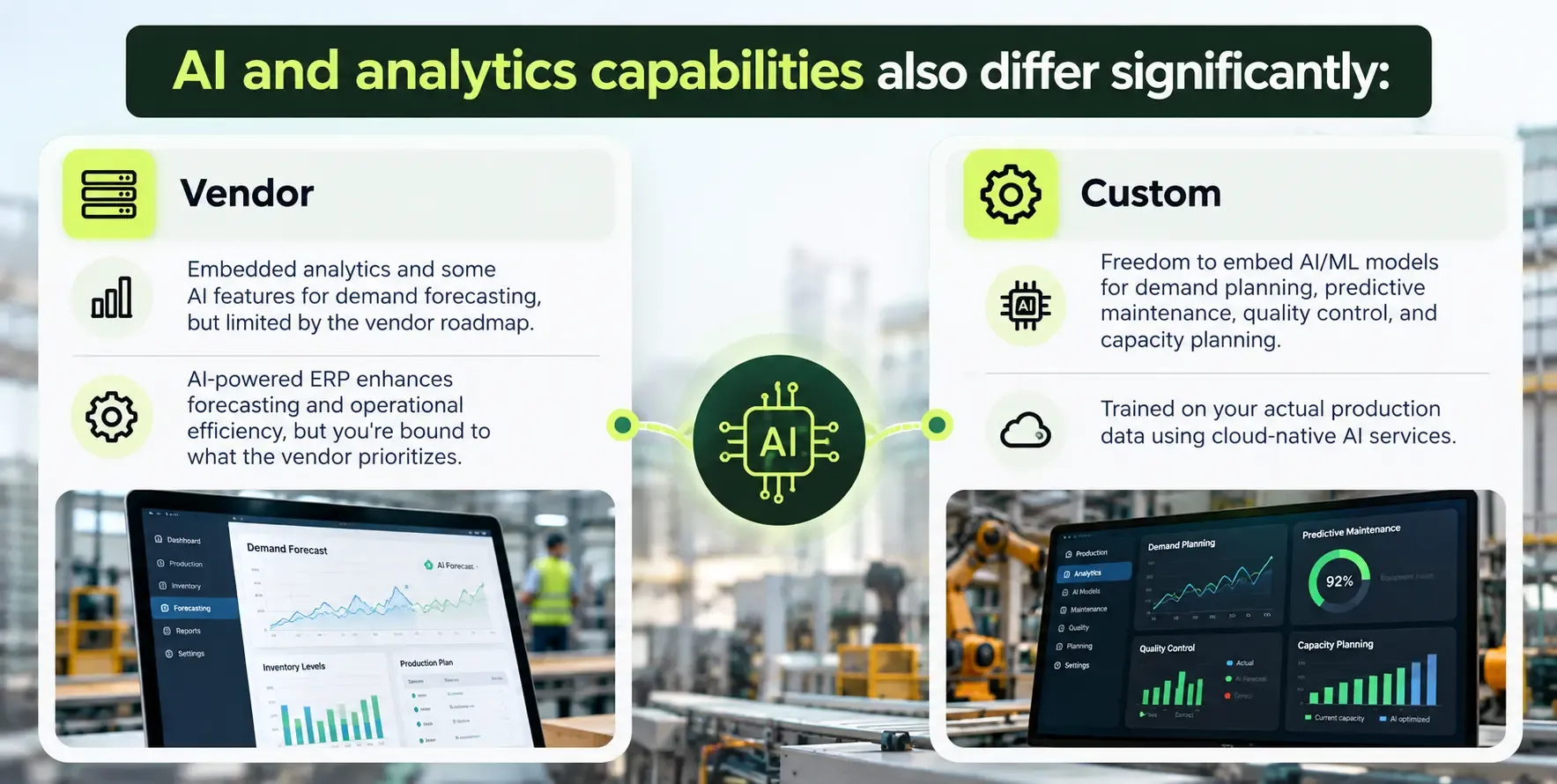
- Embedded AI models for demand forecasting, scrap prediction, or predictive maintenance, trained on your own data
- Custom solutions provide complete ownership of the source code and roadmap, eliminating dependency on a vendor's release cycle
Custom development allows for a 100% exact fit for unique proprietary processes. It typically combines core ERP functions (orders, inventory, production, costing) with purpose-built applications and integrations rather than a monolithic packaged system.
Where Custom Manufacturing ERP Excels
- Engineer-to-order environments where every job has different materials, routings, and lead times
- Mixed mode manufacturing operations that combine discrete and process manufacturing under one roof with unusual workflows
- Regulated sectors with atypical compliance needs, such as aerospace (AS9100), medical devices (FDA), or defense, where vendor ERP templates often fall short of real documentation requirements
- Complex contract manufacturing where customer-specific quality gates, packaging, and traceability rules vary by program
- Integration-heavy environments where IoT sensors, PLCs, and legacy systems need clean data flows to and from the ERP
Many mid-sized North American manufacturers already layer custom tools on top of legacy ERPs. A full custom alternative replaces the patchwork of spreadsheets, workarounds, and bolt-on tools with a coherent, purpose-built platform.
What Is a Vendor Manufacturing ERP?
A vendor manufacturing ERP is an off-the-shelf enterprise resource planning system designed for broad manufacturing needs. Products like Epicor Kinetic, Infor CloudSuite Industrial, Oracle NetSuite, SAP S/4HANA Cloud, and Microsoft Dynamics 365 offer predefined modules covering production, inventory management, financial management, purchasing, and customer relationship management. Vendor selection involves purchasing and configuring a pre-built ERP solution from a provider, then adapting it to your operation through configuration, limited customization, and add-on applications.
Most U.S. and Canadian manufacturing companies start here. Over 70% of manufacturers see ERP as vital for operations, and pre-built modules in vendor solutions often come with industry best practices built in. The vendor handles maintenance, security updates, and system upgrades, shifting that burden away from your internal team.
Core Traits of Vendor Manufacturing ERP
- Predefined modules for production, inventory, purchasing, finance, human resources, and CRM on a single platform
- Best practice workflows for standard manufacturing modes: make-to-stock, make-to-order, repetitive, batch, and process manufacturing
- Vendor roadmap and regular upgrades with new features, compliance updates, and security patches
- Standard APIs and partner ecosystems with prebuilt connectors for common business systems
- Cloud ERP, on-premise, and hosted deployment options, though most vendors now push SaaS with subscription pricing
Cloud ERP systems are updated frequently at no cost, and cloud ERP offers faster deployment with lower upfront costs. On-premise ERP provides greater control over data and customization but requires significant investments in hardware.
Where Vendor Manufacturing ERP Excels
- Predictable implementation patterns with well-documented processes, templates, and certified implementation partners
- Embedded manufacturing templates covering standard MTS, MTO, and repetitive workflows that serve the majority of manufacturing operations
- Built-in compliance and audit features for common standards and financial management requirements
- Ecosystem of integrators, consultants, and community resources that reduce dependency on any single partner
- Faster time to value: vendor selection can lead to faster deployment than custom development
SoftDoes often helps clients get more from existing ERP systems through integration, data pipelines, and UX layers rather than ripping and replacing what already works.
Custom vs Vendor ERP for Manufacturing: How They Compare at a Glance
The decision between custom development and vendor ERP comes down to a handful of factors that genuinely differ between the two approaches. Cost comparisons for ERP systems should consider a five-year total cost of ownership, not just licensing fees or initial build costs. The table below focuses on what actually drives the decision for mid-market manufacturers in the U.S. and Canada.
Side-by-Side Comparison Table
Factor |
Best for | Manufacturers with highly unique, strategic workflows that don't fit standard ERP models | Manufacturers whose processes align 70–90% with standard best practices |
Typical 5-year TCO (mid-market, 150–300 users) | $600K–$3M+, depending on scope, integrations, and ongoing feature development | $500K–$3M for licensing, maintenance, customization, upgrades, and vendor support |
Implementation timeline (single plant) | 9–24 months for full platform breadth; narrow scope phases can go live in 3–6 months | 6–12 months for standard scope; 9–18 months for multi-site or complex modules |
Process fit | Excellent for unique workflows: advanced scheduling, quality gates, lot traceability, custom routing logic | Good for standard workflows; covers MTS, MTO, repetitive; may struggle with edge cases |
Integration flexibility (MES, PLM, WMS, eCommerce, IoT) | Built API-first with full control over data model; freedom to integrate novel data sources and AI services | Standard APIs and vendor partner ecosystems; prebuilt connectors; upgrades may break custom code |
Upgrade and maintenance model | Full control of roadmap and priorities; responsible for support, technical debt, security, documentation | Vendor issues updates; predictable support and maintenance fees; forced upgrades may break customizations |
Risk profile | Higher risk from underestimating domain complexity, delayed time to value, personnel dependency | Lower baseline risk; main risks from scope creep, customization bloat, and user adoption |
Decisive Factor 1: Process Fit and Competitive Differentiation
Process fit is the single most important factor in this decision. In manufacturing, production scheduling around constrained machines, sequence-dependent setups, industry-specific quality steps, and customer compliance requirements define how well any ERP will serve the business. A poor fit means manual processes, workarounds, and spreadsheets fill the gaps, which is exactly what an ERP is supposed to eliminate.
Vendor manufacturing ERP software typically covers 70–90% of requirements through configuration and industry editions. For a standard metal fabrication shop running make-to-stock, a vendor ERP handles production planning, inventory levels, raw materials tracking, and financial management well. But the remaining edge cases matter. A job shop with highly variable routings and sequence-dependent setups will often find that vendor ERPs force flattened routings or inappropriate batching logic. A medical device manufacturer needing device history records, lot and serial traceability, detailed audit trails, and regulatory approvals at multiple steps will likely exceed core vendor ERP capabilities without custom extensions.
Custom development encodes those unique workflows directly. Proprietary scheduling logic, custom quality gates, AI-based scrap prediction, and real time shop floor feedback loops become native features rather than convoluted workarounds. ERP improves production efficiency by aligning planning and execution, and this alignment is far tighter when the software mirrors your actual core processes.
The trade-off is real: over-customizing a vendor ERP creates maintenance headaches during every erp upgrade cycle, while maintaining a large custom codebase over five to ten years demands disciplined engineering. If more than 30–40% of your workflows are unique, vendor ERP with heavy customization may cost nearly as much as custom, with more risk of misfit.
Decisive Factor 2: Time-to-Value and Implementation Risk
Most U.S. and Canadian manufacturers can't afford two to three years of disruption with no ROI. They need measurable improvements in lead times, order visibility, or inventory costs within 6–18 months. ERP implementation can boost efficiency by up to 30%, and 75% of companies see a drop in inventory costs after ERP implementation, but only if the system actually goes live and gets adopted.
Realistic timelines:
- Vendor manufacturing ERP: 6–12 months for a single plant with phased rollout, 9–18 months for multi-site. ERP implementation timelines typically range from 4 to 12 weeks for initial configuration phases, with full deployment following.
- Custom ERP platform: 9–24 months to reach parity with standard ERP breadth, faster if starting with a narrow scope such as production plus inventory only.
Risk patterns differ sharply between the two approaches:
- Vendor: scope creep in customizations, user adoption issues, integration surprises with existing systems, and underestimated data migration effort.
- Custom: underestimating complexity, re-implementing commodity functions like GL, AP/AR, or payroll instead of reusing proven components, and custom development carries high project failure risk and dependency on specific personnel.
The statistics are sobering regardless of path: 40% to 90% of ERP implementations fail due to poor planning. Successful ERP implementations require careful planning and clear goals, whether you build or buy.
SoftDoes mitigates risk in custom projects using incremental releases, pilot lines, and reuse of accounting and HR SaaS instead of rebuilding everything. By keeping the initial scope narrow and delivering working software early, manufacturers can reduce manual work while the broader platform matures.
Winner: Vendor ERP - commercial solutions usually deliver faster, more predictable time to value for most manufacturers. Custom approaches are viable when scope is tightly controlled and phased, but carry higher schedule risk.
Decisive Factor 3: Total Cost of Ownership (TCO) Over 5–7 Years
License sticker price is a misleading number. The total cost of ownership includes internal IT staff, integration capabilities, erp upgrades, professional services, data migration, training, and change management. For a successful implementation, all of these costs must be planned from the start.
Vendor ERP costs for a typical 150–300 user manufacturer:
- Subscription licenses: often $150–$250 per user per month for cloud based ERP systems, with annual increases
- Implementation partner services: configuration, data migration, training, typically $300K–$1.5M for year one
- Additional customizations and integrations in years 2–5, plus ongoing licensing fees and maintenance fees (often 15–20% of license cost annually)
- 5-year TCO: roughly $500K–$3M for mid-market manufacturing companies
Vendor selection may involve ongoing subscription fees and licensing costs after implementation. Cloud ERP reduces overall costs by 56% for manufacturers compared to on-premise alternatives, which require significant investments in hardware.
Custom development costs:
- Initial build: discovery, design, development, QA, rollout for core modules (production, inventory, BOM, routing) ranges from $80K–$400K for limited scope; broader scope with MES-adjacent features and advanced AI pushes costs higher
- Cloud hosting on AWS or Azure plus observability costs
- Ongoing enhancements, bug fixes, and feature requests as the manufacturing business evolves
- Custom development typically requires a higher upfront financial investment than vendor solutions, but custom development can lead to high total cost of ownership over time if not managed carefully
In practice, vendor ERP might be cheaper for 50 users, while custom can deliver similar or better economics with 300+ users where vendor customization fees and per-user licensing compound. The hidden costs differ too: paying for unused ERP modules on the vendor side versus carrying technical debt in a custom codebase.
Winner: It depends, with a tilt toward vendor ERP - for most small to mid-sized manufacturers, vendor ERP is cheaper and easier to budget. Custom may win when user counts are high, vendor customization and maintenance costs are extreme, or when you factor in the improved operational efficiency that comes from a perfectly fitted system.
Decisive Factor 4: Integration, Data, and Technology Flexibility
Modern manufacturing operations demand clean data flows between IoT sensors, PLCs, MES, PLM, WMS, quality management systems, transportation, and customer portals. ERP integrates production, inventory, and supply chain management, but the depth and flexibility of those integrations varies dramatically between vendor and custom approaches.
Vendor ERP: standard APIs, prebuilt connectors, and partner ecosystems cover many common integration scenarios. But legacy shop floor systems, custom machinery, and older PLCs often need custom interfaces. Vendor data models can be rigid, making it difficult to incorporate streaming data, event-driven workflows, or advanced analytics. Upgrades may break custom connectors, creating ongoing maintenance costs. Vendor lock-in can occur when using commercial ERP systems, complicating migration away from the system.
Custom ERP platform: can be built API-first with event streaming and modern data architectures designed from day one. Data lakes, real-time analytics, and automated data integration become natural extensions rather than afterthoughts. This eliminates data silos and creates a foundation for real time visibility across the entire operation.
Real-time data access reduces lead times by up to 95%, and ERP enhances supply chain resilience by improving visibility. The question is whether vendor-provided integrations are sufficient for your industrial IoT and shop floor environment or whether you need deeper control.
Winner: Custom development - it wins for integration-heavy, data-driven manufacturers investing in modern architectures. Vendor ERP still works well when its ecosystem already covers most of your tools and you don't need to push beyond standard integration patterns.
Decisive Factor 5: Support, Skills, and Long-Term Ownership
Who will run and evolve the system in years three through ten is a decision driver that many manufacturers underestimate. The right ERP system must be sustainable, not just functional at go-live.
Vendor ERP:
- Benefits: vendor support contracts, partner ecosystem, user communities, regular upgrades, documentation, and a proven track record across thousands of implementations
- Risks: dependency on vendor roadmap, possible price changes, forced upgrades that break customizations, and ongoing support that may not prioritize your specific needs
Vendor solutions shift the burden of maintenance, security updates, and system upgrades to the vendor. This is a major advantage for manufacturing companies that don't want to build or manage a software product team.
Custom ERP:
- Benefits: full control of the roadmap, ability to respond quickly to new customer demand or regulatory requirements, no forced upgrades, no vendor lock-in
- Risks: dependence on internal team or external partner; need for disciplined documentation, DevOps, and QA practices; difficulty hiring and retaining engineers in the U.S. and Canada
The talent aspect is significant. Engineering talent for custom development is expensive in North America, and finding developers who understand manufacturing domain requirements is harder still. This is why long-term partnerships with firms like SoftDoes, which combine custom ERP development expertise and dedicated product management services with manufacturing domain knowledge, often make more practical sense than building an internal team.
Winner: Vendor ERP - for most manufacturers that don't want to run a software product team, vendor ERP with ongoing support is more sustainable. Custom wins only when you are ready to treat software as a strategic asset with ongoing investment and a committed engineering partner.
Custom Development vs Vendor ERP for Manufacturing: Which Should You Choose?
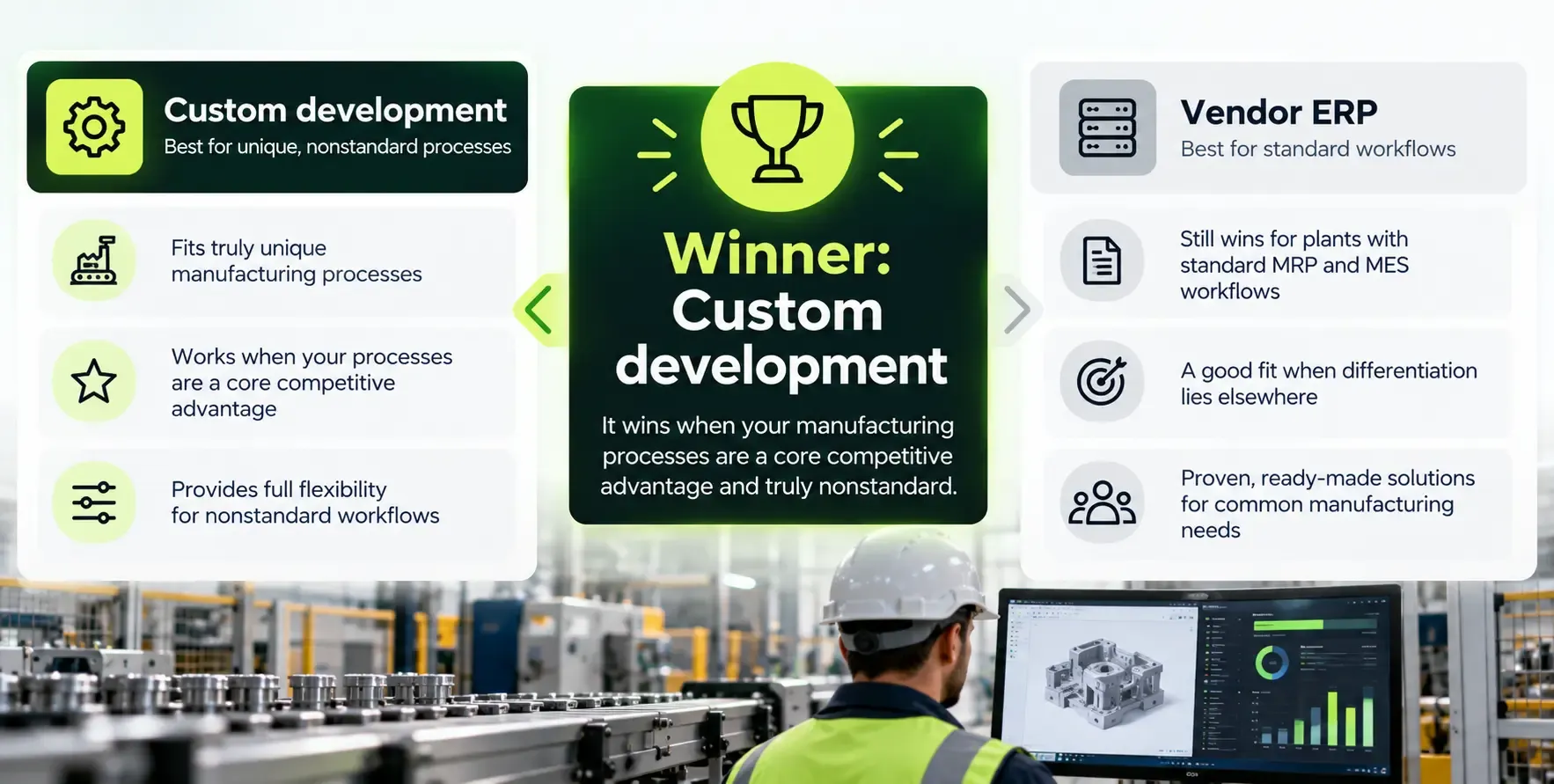
The five factors above point to a clear pattern. Vendor ERP wins on speed, cost predictability, support infrastructure, and lower implementation risk. Custom development wins on process fit, integration flexibility, and long-term control. Selecting an ERP should align with the organization's operational complexity and budget. Manufacturers should list must-haves before selecting an ERP system.
- Choose vendor manufacturing ERP if:
- Your production processes are 70–80% standard (MTS, MTO, repetitive) and can adapt to best practices
- You want measurable improvements within 12 months and predictable erp implementation patterns
- You prefer not to staff or manage a long-term product engineering team
- Your core business processes around financial management, inventory management, and purchasing don't require unusual logic
- Choose a custom-built ERP platform if:
- Your manufacturing workflows are a key competitive advantage and don't fit standard ERP models
- You require deep integration with IoT, legacy plant systems, or advanced AI/ML in production scheduling and quality control
- You are prepared to invest in a long-term partnership with a firm like SoftDoes to evolve the platform as your plants grow
- Custom development carries high project failure risk, so you must be ready for disciplined scoping and phased delivery
- Consider a hybrid approach:
- Use a vendor ERP for finance, purchasing, and basic inventory
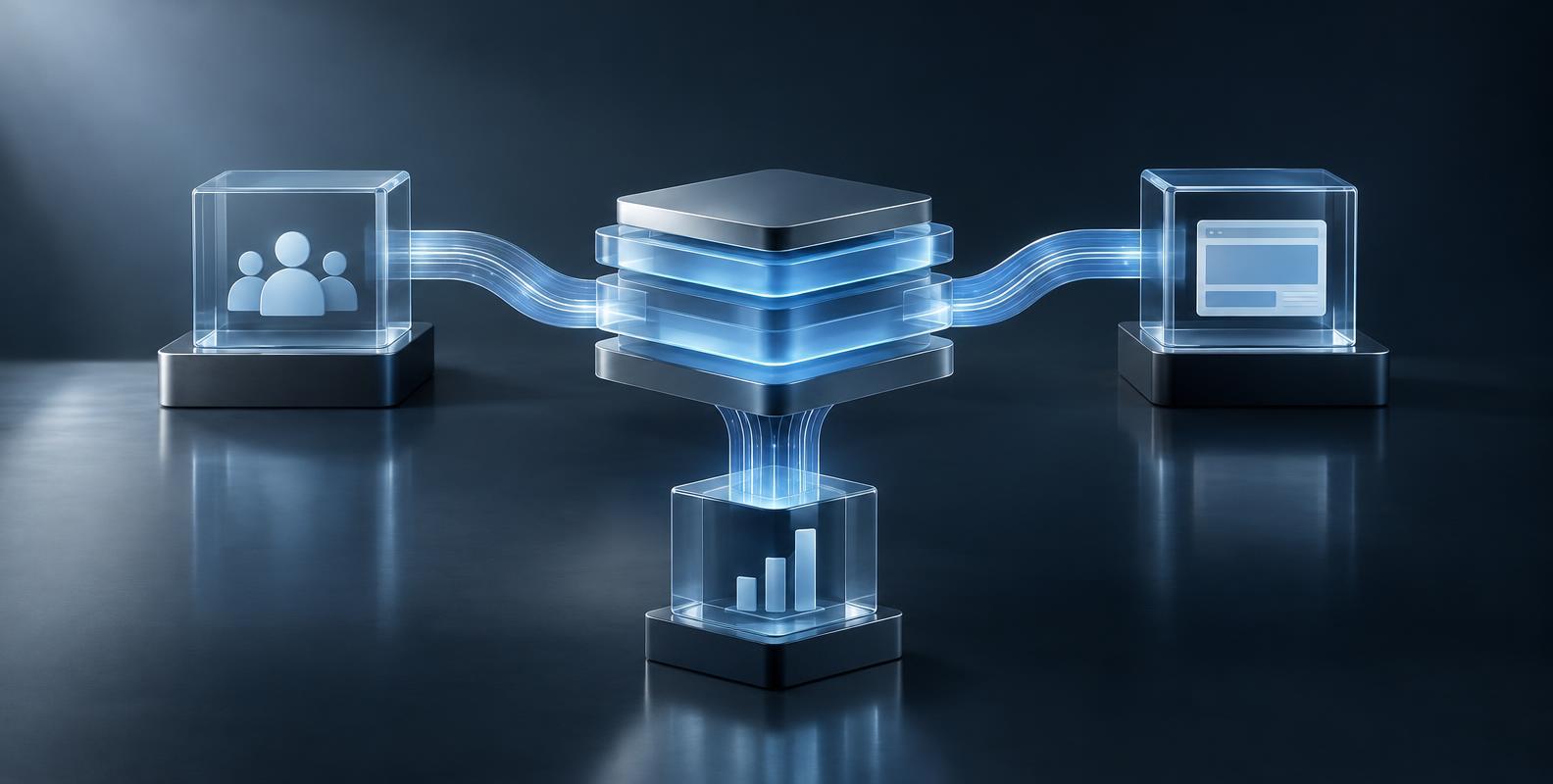
- Build custom manufacturing apps (scheduling, quality, configurators, portals) that integrate via APIs
- Hybrid models combine core vendor ERP for standard operations with custom applications for specialized needs
SoftDoes often recommends and implements this hybrid model for North American manufacturers. A U.S. glass manufacturer, for example, kept Microsoft Dynamics for core ERP but built a custom layer around it: a customer portal with real time order tracking, a vendor portal for supplier document submission, custom configurator logic, and delivery route planning. The custom layer handled the unique workflows while preserving standard ERP functionality for finance, inventory, and order management.
The right answer is tied to business strategy, not just IT preference. A structured assessment of your core processes, integration needs, and long-term investment appetite, ideally as part of a broader digital transformation strategy, will reveal which path fits.
How SoftDoes Helps Manufacturers Decide and Implement
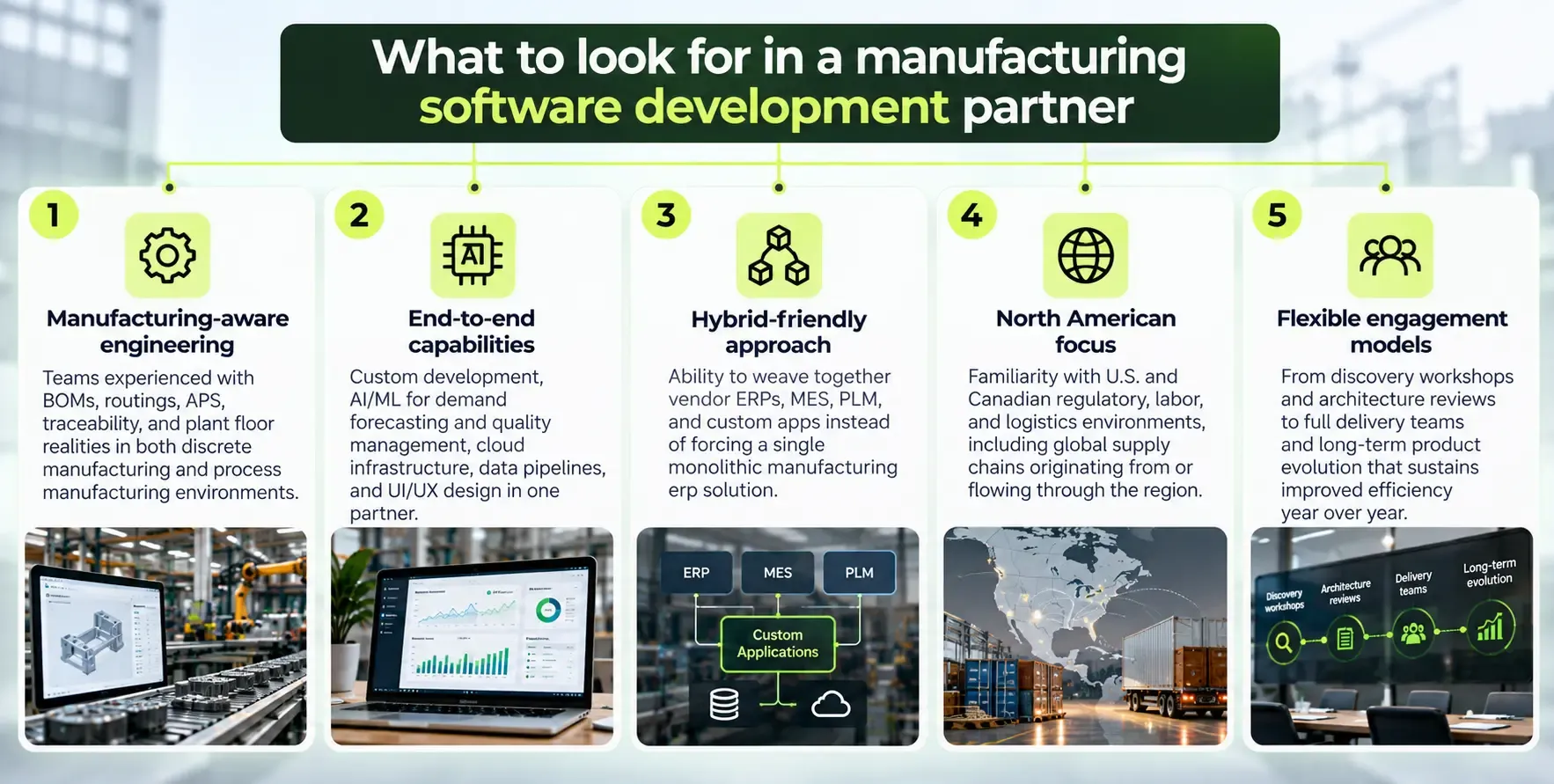
SoftDoes is a software engineering partner for manufacturers in the U.S. and Canada, specializing in custom development, cloud and data engineering, AI/ML, and integration consulting. Rather than pushing a single approach, SoftDoes helps manufacturing companies evaluate both vendor and custom options based on evidence, then delivers the solution that fits.
A typical engagement follows this flow:
- Short diagnostic to map current business systems, pain points, and constraints (2–4 weeks)
- Side-by-side evaluation of vendor options versus custom or hybrid architecture, including TCO and risk analysis
- Roadmap design with phased implementation, pilot plants, and integration sequence
- Execution covering custom development, ERP integration, data and cloud engineering, and UX/UI design for operators and planners
SoftDoes is vendor-agnostic and can:
- Extend existing erp solutions like NetSuite, Dynamics 365, SAP, and Epicor with custom modules and AI capabilities
- Build greenfield manufacturing platforms when vendor solutions can't support the strategy
- Help eliminate manual data entry and connect data silos across your manufacturing operations
Benefits of Working With SoftDoes on Your Manufacturing ERP Strategy
Rather than a hard sales pitch, here is what a partnership with SoftDoes brings to the table for manufacturers weighing this decision:
ERP systems can increase operational productivity significantly, and ERP systems automate production scheduling and inventory management. The key benefits depend entirely on whether your implementation approach matches the realities of your manufacturing business. Manufacturing ERP supports multiple production types like discrete and process, but only when the right ERP solution is chosen for your specific situation.









Comments (0)
No comments yet.