Core banking software automates essential banking operations, from deposits and transaction posting to lending, reporting, and account management. It is the system of record that powers everything a financial institution does, day and night. For banks and credit unions in the US and Canada, the core banking decision made in 2026 will shape technology, compliance, and competitiveness for the next decade.The pressure to modernize is real. Legacy systems often use monolithic architecture that requires extensive customization for even minor updates. Meanwhile, cloud migration trends are shifting banking from rigid on premises systems to scalable SaaS solutions. Customer expectations around mobile banking, real time payments, and digital banking services keep rising. Regulatory demands from the OCC, FDIC, NCUA, FFIEC, and OSFI in Canada add further urgency.
There is no single best core banking software for every institution. The right core banking solution depends on your size, charter type (bank, credit union, fintech), product mix, and modernization goals. A community bank with $500M in assets has different priorities than a $50B regional bank or a neobank launching embedded finance products. This guide covers platforms relevant to community banks, regional banks, credit unions, neobanks, and fintechs operating in North America.
We ranked these platforms based on 2026 capabilities: cloud readiness, API depth, regulatory fit, AI readiness, and implementation track record in the US and Canada. The article names the top core banking providers first, then goes deeper on how to choose and how a partner like SoftDoes can help with integration and modernization.
How We Chose the Best Core Banking Platforms for 2026
We focused on platforms with a proven or fast growing footprint in the US and Canada by 2026. Banks prioritize rapid deployment and flexible product configuration in core systems, so we weighted those capabilities heavily.
Core Evaluation Criteria
- Performance and reliability. 24/7 uptime targets, real time vs batch processing capabilities, and SLAs suitable for regulated financial institutions. Real time transaction processing enhances customer experience and is now a baseline expectation.
- Architecture and cloud strategy. Cloud native vs cloud hosted, microservices design, multi tenant SaaS vs private cloud, and support for major US and Canadian cloud regions. Modern cores utilize cloud native, microservices architecture that scales without heavy infrastructure investment.
- Regulatory and market fit. Support for US and Canadian compliance including BSA/AML, sanctions screening, FFIEC guidance, OSFI requirements, and open banking APIs. Core banking systems support regulatory compliance through automated reporting.
- API and integration capabilities. API coverage of core objects, event streaming, webhook support, SDKs, and ease of integrating digital banking, payments, fraud detection, and data platforms. You should evaluate integration capabilities before selecting a core banking provider.
- Product coverage and flexibility. Deposits, lending, cards, treasury, cash management, SME banking, and multi currency operations where relevant.
- AI and data readiness. Availability of real time data access, event logs, AI toolkits, and support for connecting to a bank's own AI/ML models without vendor lock in. AI readiness is a key selection criterion for core banking systems in 2026.
- Implementation model and time to value. Typical timelines for US and Canadian clients, partner ecosystem strength, and support for phased vs big bang migrations.
- Total cost and commercial model. SaaS vs license, implementation costs, and all in TCO over 5 to 10 years for mid market institutions.
- Vendor stability and roadmap. Financial health, ownership clarity, M&A activity, and a transparent 3 to 5 year roadmap. Assess vendor support and service level agreements before commitment.
Define outcomes before features when choosing a provider. Consider regulatory compliance features in your selection process alongside architecture and cost.
Best Core Banking Software in 2026: Top Platforms for US & Canada
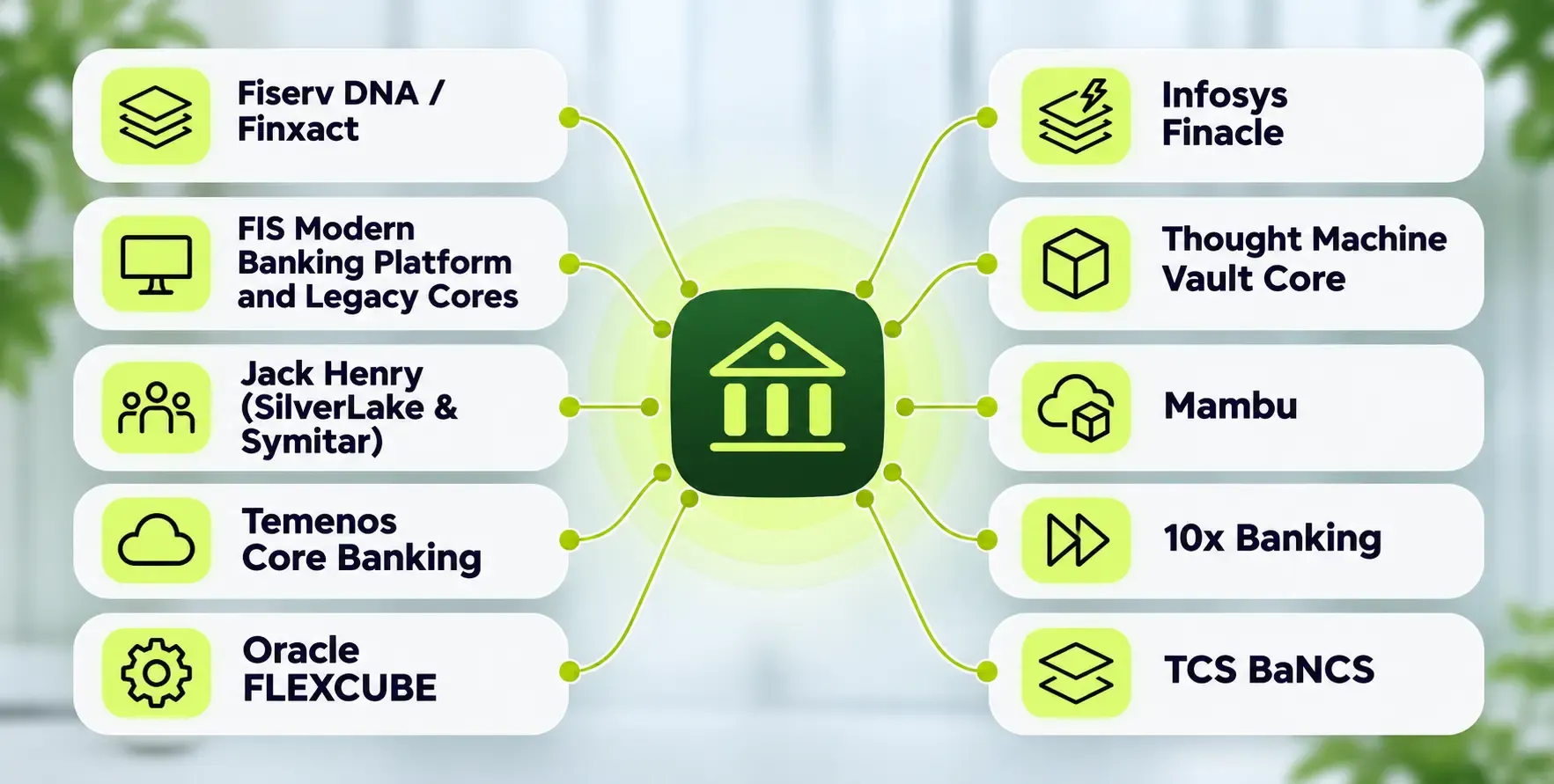
The core banking market is broad and segmented. Rather than declaring a single winner, we grouped the top core banking software by best fit. The list includes 10 platforms, a mix of global incumbents and newer cloud native cores, all with relevance to US and Canadian institutions.
Each profile covers why it stands out, who it is best for, key strengths, and limitations worth knowing. Multi channel support including online, mobile, and branch services is a baseline expectation across all of them.
1. Fiserv DNA / Finxact
Fiserv is one of the dominant core banking software providers in the US, with DNA serving community banks and credit unions and Finxact representing its cloud native future.
Why It Stands Out
Fiserv's massive US footprint means deep integration with cards, payments, and merchant services. By 2026, the push toward open APIs and cloud native deployments via Finxact gives existing Fiserv clients a modernization path without a full rip and replace. Cloud based solutions like Finxact reduce the need for in house IT infrastructure.
Best For
US community banks, credit unions, and regional banks wanting a core platform tightly coupled with digital banking, payments, and merchant services from a single ecosystem.
Key Strengths
- Broad US regulatory support and compliance tooling
- Rich product catalog covering retail and corporate banking
- Extensive partner ecosystem and prebuilt integrations
- Strong data and analytics options via Fiserv's broader platform
Possible Limitations
- Product portfolio complexity can slow decision making
- API maturity differs significantly between DNA and Finxact
- Longer implementation timelines for full core conversions
2. FIS Modern Banking Platform and Legacy Cores
FIS holds a large share of the North American banking systems market. The Modern Banking Platform (MBP) is its strategic modernization path for institutions moving away from legacy cores.
Why It Stands Out
FIS Modern Banking Platform is designed for incremental modernization, letting institutions migrate domain by domain rather than all at once.
Best For
Institutions wanting continuity within the FIS ecosystem and large scale, multi segment banking operations covering retail, commercial, and wealth management.
Key Strengths
- Integrated payments and card processing
- Enterprise wide coverage across banking services
- Support for real time transaction processing
- Existing client base makes migration from FIS legacy systems smoother
Possible Limitations
- Emerging MBP track record at Tier 1 scale
- Migration from legacy FIS cores remains complex
- Potential for vendor lock in within the FIS ecosystem
3. Jack Henry (SilverLake & Symitar)
Jack Henry is a dominant core vendor for US community banks and credit unions. SilverLake serves banks; Symitar serves credit unions.
Why It Stands Out
Jack Henry's reputation rests on service quality, US specific compliance depth, and a robust ecosystem of add ons for smaller and mid size institutions. Their continuous delivery model for updates keeps clients current without major upgrade projects.
Best For
SilverLake suits community banks typically under $50B in assets. Symitar is purpose built for credit unions. Both work well for institutions that value strong vendor support and prebuilt integrations over raw customization power.
Key Strengths
- Proven US deployments across thousands of institutions
- Strong integrations with digital banking software vendors
- Solid support models and regulatory reporting
- Roadmap toward API enablement and open banking APIs
Possible Limitations
- Legacy architecture in some deployments limits flexibility
- Slower pace of change compared to born in the cloud challengers
- Integration reliance on the Jack Henry ecosystem
4. Temenos Core Banking
Temenos is a global core banking platform with growing US and Canadian presence. It offers both cloud and SaaS delivery options through Temenos Banking Cloud.
Why It Stands Out
Model bank accelerators speed deployment. In Q3 2026, a leading US regional bank selected Temenos SaaS on Azure to modernize a specialized corporate banking line, signaling growing North American traction. Temenos offers broad functional coverage across retail and corporate banking.
Best For
Regional banks, digital banks, and cross border institutions operating in North America. Particularly strong for banks needing lifecycle management across multiple product lines.
Key Strengths
- Deep banking functionality across retail, corporate, and wealth management
- Multi country capability for US/Canada plus other regions
- Strong ecosystem of partners and system integrators
- AI and analytics offerings integrated into the banking platform
Possible Limitations
- Configuration complexity requires strong SI or consulting support
- Wide range of possible architectures (cloud native vs hosted) can create confusion
- North American reference base still growing compared to incumbents
5. Oracle FLEXCUBE
Oracle FLEXCUBE is an enterprise grade core banking system often used by larger and more complex banks. Oracle FLEXCUBE is widely deployed in Asia, the Middle East, and Africa, with selective presence in North America.
Why It Stands Out
Deep retail and corporate banking support combined with Oracle ecosystem integration (database, middleware, analytics) and strong risk management tooling. The Oracle Banking Digital Experience layer extends the core into digital channels.
Best For
Banks already invested in Oracle technology and institutions needing robust universal banking coverage, including private bank and corporate banking capabilities.
Key Strengths
- Module breadth covering deposits, lending, trade finance, and treasury
- High configurability for complex product sets
- Interoperability with Oracle Banking Digital Experience for digital account opening
- Strong risk management and compliance tooling
Possible Limitations
- Heavier cloud infrastructure footprint than pure SaaS alternatives
- More traditional architecture for some deployments
- Long transformation timelines for full implementations
6. Infosys Finacle
Infosys Finacle is a mature core banking platform with stability and breadth. Infosys Finacle is deployed at over 100 financial institutions globally, with growing relevance in North America.
Why It Stands Out
Strong regulatory features, open APIs via Finacle Connect, and an expanding cloud offering by 2026. Finacle supports digital banking applications alongside traditional banking operations.
Best For
Regional banks and digital players aiming for a single platform covering retail, SME banking, and corporate segments, especially those that value a global delivery model.
Key Strengths
- Proven migration frameworks and analytics modules
- Omnichannel support across mobile apps and digital channels
- Broad product functionality covering retail banking and corporate banking
- Scalable architecture for modern data needs
Possible Limitations
- Architecture history predates full real time event driven models
- Large scale programs required for major transformations
- North American market share smaller than domestic incumbents
7. Thought Machine Vault Core
Thought Machine Vault Core is a fourth generation, cloud native and event driven core banking platform used by large banks and digital challengers. Modern cores support real time data processing without batch dependencies, and Vault Core exemplifies this.
Why It Stands Out
The smart contract based product engine lets institutions define banking products in code, enabling rapid product launches through composable architecture. In 2026, Pathward selected Vault Core for fintech partner enablement, and USSFCU (a credit union with over $1B in assets) adopted it for millisecond level transaction processing. Thought Machine has crossed $100M in annual recurring revenue with roughly 20 banks and fintechs in the Americas.
Best For
US and Canadian digital banks, fintechs, sponsor banks, and progressive incumbents that want high control and rapid product experimentation. Institutions pursuing an API first architecture will find Vault Core especially compelling.
Key Strengths
- Flexibility in product design via smart contracts and business logic configuration
- Strong API model with event streaming (Kafka) and RESTful APIs
- Modern DevOps alignment and continuous delivery model
- Fit for AI and real time analytics overlays
- Cloud agnostic: deployable on AWS, Azure, or GCP
Possible Limitations
- Requires specialized engineering skills and governance
- Evolving migration tooling for complex legacy back books
- Heavier demands on in house technology leadership than turnkey cores
8. Mambu
Mambu is a cloud native composable core banking solution popular with neobanks, credit unions, and fintech lenders in North America. Mambu popularized the composable banking model for digital banks.
Why It Stands Out
API first design, SaaS delivery, and strong time to market for new lending and deposit products. League Data migrated 37 member credit unions (320,000 members) across Atlantic Canada to Mambu on AWS, with some cutovers completed in roughly 48 hours. Mambu guarantees 99.99% availability.
Best For
Greenfield digital banks, credit unions looking to modernize from legacy cores, and fintechs embedding banking products. Embedded finance capabilities enable non financial brands to offer banking services through platforms like Mambu.
Key Strengths
- Fast configuration and product launches
- Strong partner marketplace for front ends, payments, fraud detection, and digital channels
- Multi tenant SaaS economics lower total cost
- Focus on US and Canadian fintech and credit union use cases
Possible Limitations
- Limited suitability for very complex universal banking or large banks
- Reliance on partner components for some core banking capabilities
- Process orchestration features still maturing in some areas
9. 10x Banking
10x Banking is a fourth generation, cloud native core platform with an event sourced ledger designed for the AI era.
Why It Stands Out
A polyglot runtime for product logic, native support for AI assisted configuration, and robust migration tooling make it compelling. 10x Banking processes over 10,000 transactions per second, supporting real time operating models at scale.
Best For
Larger banks and ambitious digital banks in the US and Canada planning multi year transformation toward real time operating models and batch processing elimination.
Key Strengths
- Event driven architecture with strong performance SLAs
- Focus on migration from legacy books with purpose built tooling
- AI tooling to speed product launches and reduce manual configuration
- Modern cores enable faster product launches through composable architecture
Possible Limitations
- Relatively smaller installed base in North America compared to incumbents
- Requires sophisticated internal engineering and governance
- Early stage for some US specific regulatory integrations
10. TCS BaNCS
TCS BaNCS is a broad banking software platform used in North America for complex modernization programs by several large banks and payment institutions.
Why It Stands Out
A global delivery model, multi domain coverage (retail, corporate, capital markets), and the ability to support multi entity operations make it a fit for complex institutions. TCS brings strong implementation expertise from global banks.
Best For
Large institutions planning multi country or multi line transformations that include US and Canada as core markets, including those needing multi currency operations.
Key Strengths
- Strong implementation expertise and configurable modules
- Proven track record with large banks and global banks
- Flexible hosting models including cloud and on premises
- Coverage across retail banking, corporate banking, and capital markets
Possible Limitations
- Transformation scale and cost can be significant
- Not a simple plug and play SaaS core system
- Longer, governance heavy programs typical of large enterprise engagements
Quick Comparison of the Best Core Banking Software in 2026
- Fiserv DNA / Finxact – Best for US community banks and credit unions wanting bundled digital and payments solutions
- FIS Modern Banking Platform – Best for large banks and existing FIS clients pursuing incremental modernization
- Jack Henry (SilverLake & Symitar) – Best for US community banks and credit unions valuing service quality and ecosystem depth
- Temenos Core Banking – Best for regional banks and cross border institutions with broad product needs
- Oracle FLEXCUBE – Best for complex institutions invested in Oracle technology needing universal banking
- Infosys Finacle – Best for regional banks seeking a single platform across retail, SME, and corporate segments
- Thought Machine Vault Core – Best for digital banks, fintechs, and progressive incumbents wanting API first, event driven architecture
- Mambu – Best for neobanks, credit unions, and fintechs needing fast SaaS deployment and composable design
- 10x Banking – Best for larger banks planning multi year real time transformation with AI native tooling
- TCS BaNCS – Best for large, multi entity institutions running complex modernization programs
How to Choose the Right Core Banking Platform in 2026
Selecting the right core banking solution depends more on fit and execution than on any single feature checklist. Before shortlisting core banking vendors, define the outcomes you want: faster product launches, lower operational efficiency costs, AI ready data pipelines, or regulator comfort with your existing systems. Run a meaningful proof of concept to evaluate platforms against your real workloads.
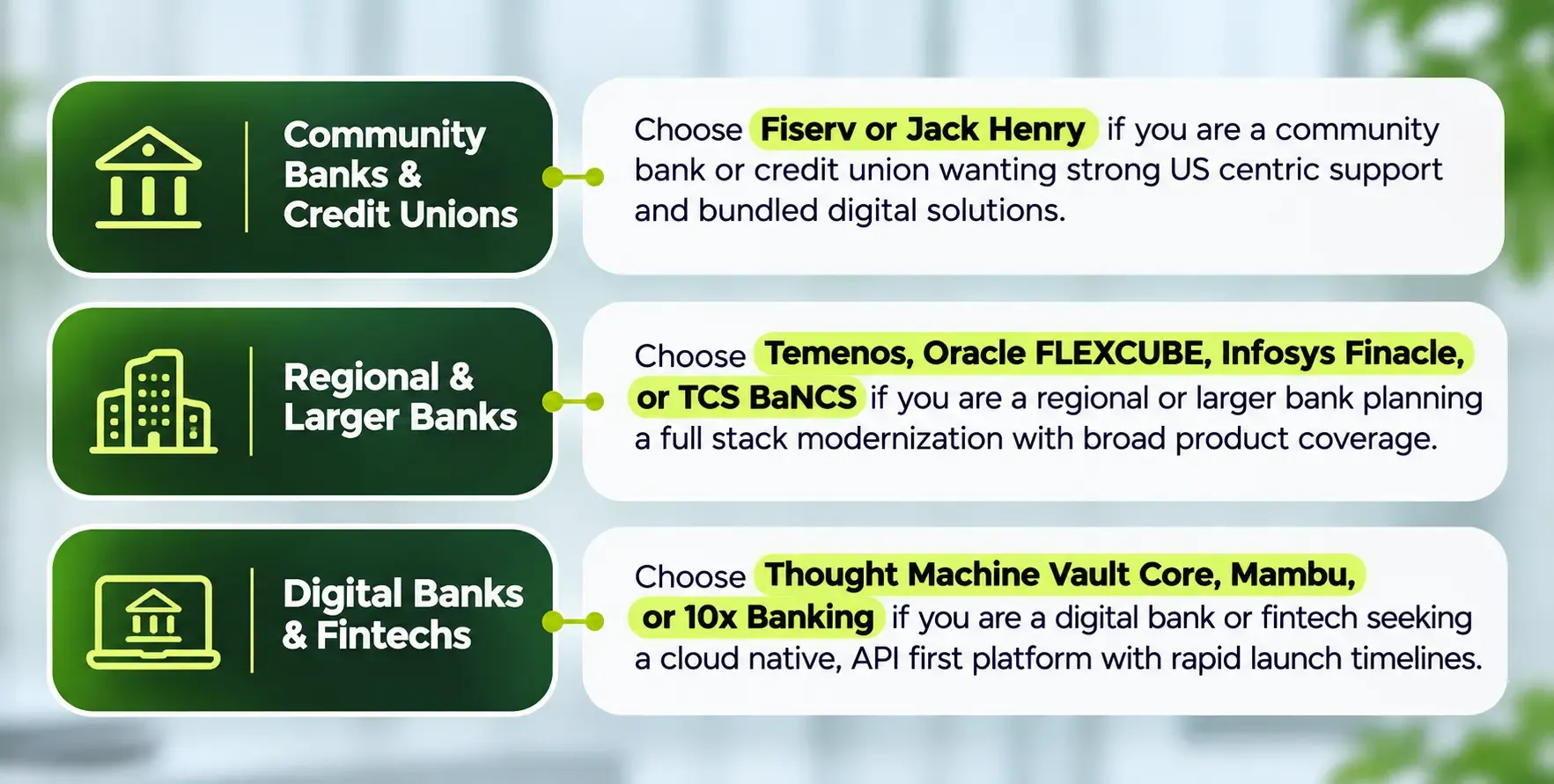
Choose Based on Institution Type and Scale
Needs differ sharply across institution types. Community banks may prioritize vendor support, prebuilt integrations, and operational efficiency over raw flexibility. Credit unions often care most about member experience and keeping total cost manageable. Regional banks typically need broad coverage across retail and corporate banking plus strong risk management.
Fintechs and digital banks tend to prioritize developer experience, API coverage, and speed to market. Map your asset size and product complexity to an appropriate vendor tier. A $300M credit union evaluating Mambu faces different trade offs than a $30B regional bank looking at Temenos or TCS BaNCS.
Choose Based on Architecture and Integration Strategy
Aligning your new core with a target architecture matters. Decide whether you need cloud native, event driven, microservices design or whether a modular monolith is acceptable for your operating model. Evaluate real API docs, sandbox environments, and event streaming support before committing.
Consider how the core will integrate with your existing core, CRM, AML and fraud systems, data warehouse, and AI/ML platforms. Third party integrations are where many banks spend the most effort post selection. Review how each vendor handles data migration tooling and validation before signing.
Choose Based on Migration Risk, Timeline, and Budget
There are real trade offs between greenfield builds, phased migrations, and full conversions. Greenfield digital banks can launch in 3 to 6 months on platforms like Mambu or Vault Core. Full legacy system replacements for many banks typically take 12 to 24 months, sometimes longer for complex institutions. Legacy systems typically require extensive customization for updates, which extends timelines further, making legacy system modernization and replacement of spreadsheet driven processes an important parallel initiative.
Ask core banking software vendors concrete questions about migration tooling, parallel run strategies, and validation frameworks. Build a 5 to 10 year TCO model that includes licensing, cloud costs, integration build, ongoing change, and internal staffing. The total cost of a core platform extends well beyond the initial contract.
Benefits of Working with a Core Banking Engineering Partner Like SoftDoes
SoftDoes is a vendor neutral software engineering and integration partner. We help US and Canadian banks, credit unions, and fintechs select, integrate, and extend the chosen core banking platform while maintaining compliance and reliability.
Independent Core Selection and Architecture Advisory
SoftDoes helps define requirements, shortlist core banking software companies, run RFPs, and evaluate proofs of concept with a focus on architecture and long term fit. Our experience spans custom software development, digital channels, and data platforms around major cores. We bring an outside perspective free from any single vendor's sales incentive.
Custom Integration, Data, and AI Enablement
We build API integrations, middleware, real time data pipelines, and event streaming between core systems, digital banking applications, and analytics platforms. AI integration enhances real time decision making in banking operations, and our AI/ML and data engineering teams make core data usable for fraud detection models, credit scoring, personalization, and operations dashboards.
Using generative AI helps enhance banking operations and mitigate financial crimes. AI tools automate legacy data mapping during migrations, reducing manual effort and error rates, and similar AI and cybersecurity capabilities underpin mission critical defense technology software built for high assurance environments. AI powered solutions improve customer experience through personalization, while AI assists in fraud detection and compliance monitoring across the regulatory environment.
Legacy Modernization and Incremental Migration Support
SoftDoes designs progressive modernization roadmaps: domain by domain migration, parallel runs, and validation tooling. We emphasize risk controlled cutovers and automation for reconciliation, reporting, and regulatory evidence during transitions. Whether you are replacing batch processing with real time flows or wrapping an existing core with modern digital transformation layers, our digital transformation services help structure the roadmap while our teams manage the complexity so banking professionals can focus on strategy.
Which Core Banking Platform Is Best for You?
There is no single best core banking software for all US and Canadian institutions. The answer depends on your starting point and where you need to be in 3 to 5 years.
Align your choice with your product roadmap, risk appetite, and technology strategy. The best platform is the one that fits your operating model and can grow with your ambitions in the US and Canadian regulatory environment.
If you need help evaluating options, contact SoftDoes for a tailored assessment and architecture workshop.
Final Thoughts
In 2026, the financial institutions that pull ahead are the ones choosing cores that are AI ready, API rich, and aligned with their operating model. The gap between legacy holdouts and modern core banking systems is widening. Customer experience expectations, regulatory demands, and competitive pressure from fintechs are not slowing down.
Implementation quality and integration strategy often matter more than minor feature differences between core banking software vendors. A well chosen platform paired with weak integration work will underperform a modestly featured core backed by excellent engineering.
US and Canadian banks can use modern cores plus strong engineering partners to compete with big tech and fintech challengers. The decision you make about banking infrastructure this year will determine how fast you move for the rest of the decade.












Comments (0)
No comments yet.