







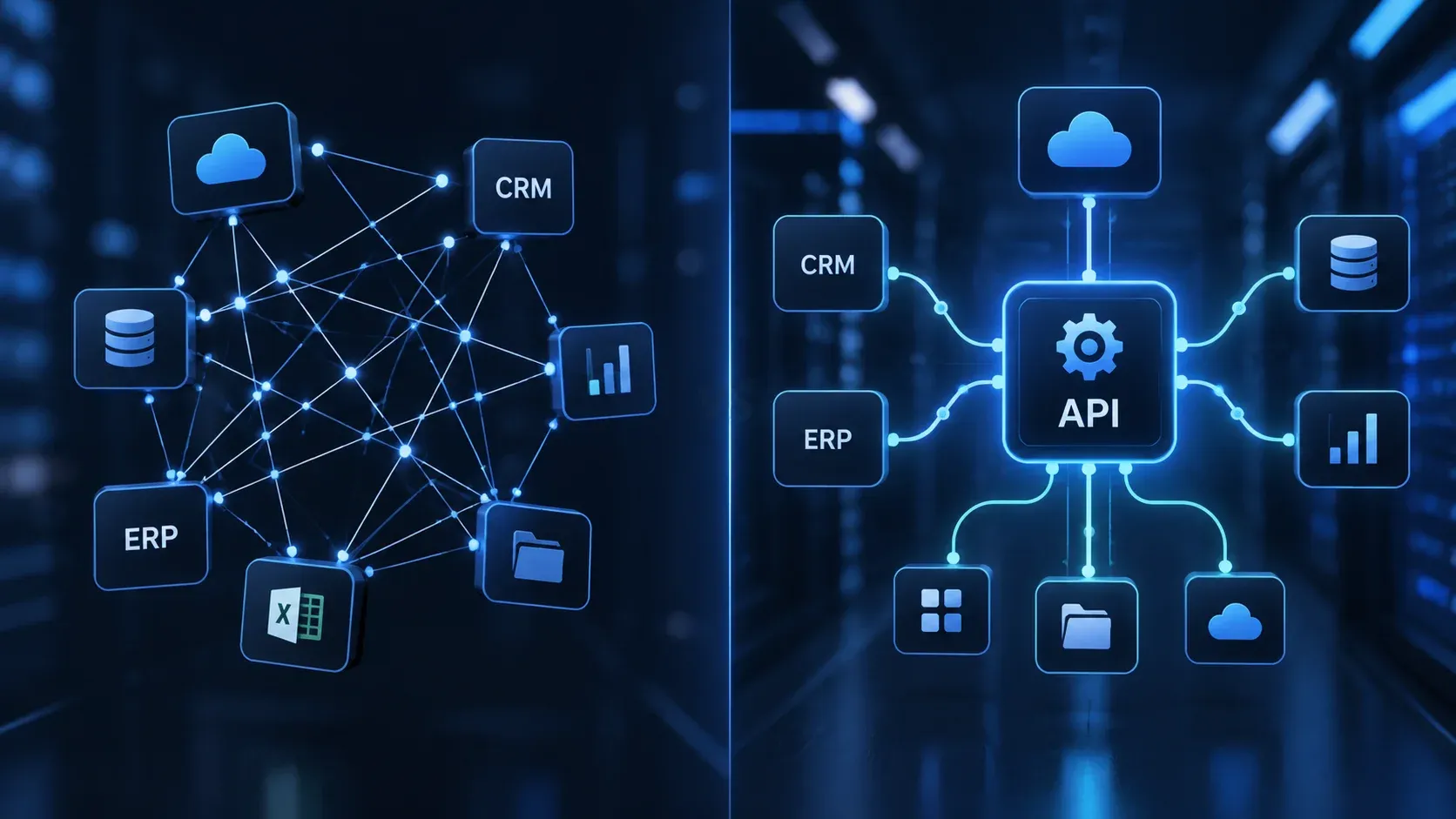
Point-to-point creates direct connections between systems, while API-led architecture uses a three-layer strategy with reusable application programming interfaces for system connectivity. This decision impacts scalability, maintenance costs, and long-term business agility, so getting it right matters.
The short answer: API-led architecture wins for most enterprises seeking scalable, maintainable data integration. While point to point integration offers faster initial implementation for simple connections between two systems, API-led architecture provides superior scalability, governance, security, and reusability once your environment grows beyond a handful of connected systems. Given that over 112 SaaS applications are used on average by organizations today, most mid-size and large enterprises will benefit from the API-led approach.
What Is Point-to-Point Integration?
Point to point integration connects two systems directly without intermediaries. Each pair of software systems is linked by a dedicated connection, typically using APIs, custom code, or file transfers to exchange data between applications. When only a few systems are involved, this integration approach is the simplest and fastest path to getting data from one place to another.
P2P integration suits limited application landscapes, making it effective for early stage startups, temporary and short-term projects, or unique custom systems requiring direct connections. It is also ideal for real-time data exchange needs between a small number of applications. The core appeal is speed: you build a direct communication channel, test it, and move on without setting up middleware or governance layers.
What Is API-Led Architecture?
API-led architecture structures integration into layers for better reuse and governance. It organizes connectivity through three tiers of reusable APIs:
- System APIs expose data and services from backend systems such as enterprise resource planning or CRM platforms in a stable, consistent way.
- Process APIs orchestrate and combine system APIs into business logic workflows that support core business processes.
- Experience APIs tailor outputs for specific consumers like mobile apps, partner systems, or web portals.
The core principles are reusability, modularity, standardization, and centralized management. Rather than building one-off connectors, IT teams create API assets that can be consumed across multiple integrations. This integration platform foundation enables centralized governance and positions organizations for digital transformation, partner ecosystem connectivity, and emerging demands such as AI agent support.
Point-to-Point Integration vs API-Led Architecture: How They Compare at a Glance
Factor | Point-to-Point Integration | API-Led Architecture |
|---|---|---|
Best for | Small scale, 2–3 stable systems | Complex environments with 5+ systems |
Initial cost | Low; no platform licensing | Higher; platform and design investment |
Scalability | Poor; connections grow exponentially | Strong; scales linearly via reuse |
Maintenance | High as systems grow | Lower long-term (~55% cost reduction) |
Development speed | Fast for isolated connections | Slower upfront, faster over time |
Security approach | Per-connection, inconsistent | Centralized access controls and policies |
Governance | Minimal or absent | Full lifecycle management |
Future readiness | Limited | Strong; supports AI, partners, growth |
The fundamental trade-off: point to point gives you speed now at the cost of scalability later, while API-led architecture asks for more investment upfront but pays back in maintainability, cost savings, and agility as your landscape grows.
Scalability and Maintenance
This is the factor that most often tips the decision. Point to point integration limits scalability as businesses grow because the number of connections increases exponentially. In a point to point architecture, the number of required connections grows approximately as n(n−1)/2 where n equals the number of systems involved. With 10 systems, that means up to 45 multiple direct connections to build, test, document, and maintain. Point-to-point integration creates a tangled web of connections, often called "spaghetti architecture," which makes troubleshooting and updates time consuming.
Managing multiple point-to-point integrations increases complexity and maintenance significantly. Each maintained integration might consume roughly 20% of one engineer's time, amounting to around $35,000 per year per link in some organizations. Data mappings get duplicated. Documentation gaps grow. Tribal knowledge replaces clear ownership. The result is data inconsistencies, failed data flows that go undetected, and a growing pile of technical debt that drains internal resources.
API-led architecture scales more linearly. You build system APIs once, then reuse them through process and experience layers. Mature API portfolios commonly reach 60–70% reuse rates within 18 months, meaning new integration effort drops dramatically as assets accumulate. When a backend system changes, only its system API needs updating. Downstream layers often remain untouched. Firms migrating from point to point to API-led report an average 55% reduction in integration maintenance costs within 18 months.
Winner: API-Led Architecture
Superior scalability through modular, reusable API design makes this the clear winner for any environment beyond a handful of integrated systems. Point to point still has a trade-off advantage: faster initial setup when only a few systems are connected and change frequency is low.
Development Speed and Implementation Complexity
For a single, straightforward integration project connecting two systems with simple data transfer requirements, point to point integration is hard to beat. There is no platform to configure, no layered API design to plan, no governance framework to establish. You write the connector, test it, and deploy. This makes p2p integration the right call for proof of concept work, one-off data exchanges, or early stage companies where speed outweighs long-term architectural concerns.
API-led architecture requires more upfront investment and design compared to point-to-point. You need to plan the API layers, set up an integration platform, define security and versioning policies, and align teams on standards. Developer skill requirements are higher, and IT teams may need upskilling in API design, lifecycle management, and platform tooling. Research from Boomi found that 48% of organizations using API-led approaches experienced cost overruns or underestimated the initial effort.
However, the calculus flips once the foundation is in place. Each new integration becomes significantly faster because existing system APIs can be reused rather than rebuilt from scratch. Organizations with mature API programs report that adding new consumers or integration points takes a fraction of the time compared to writing each new connection from zero.
Winner: Point-to-Point Integration
Faster initial implementation for simple, isolated integration needs. The API-led trade-off is a longer setup period that yields greater long-term efficiency and faster delivery on subsequent projects. Organizational maturity is important for successful implementation of API-led architecture, so teams should be realistic about readiness.
Governance, Security, and Compliance
For enterprises in finance, healthcare, and other regulated industries, this factor can be decisive.
Point-to-point integration increases the attack surface for security breaches. Each connection requires individual security management, meaning encryption, authentication, access controls, and logging are implemented separately in every integration point. This distributed responsibility leads to inconsistent enforcement and gaps. Point-to-point integration lacks a unified compliance framework for security, and direct connections can lead to unauthorized access risks when credentials are managed across dozens of separate links. Security concerns multiply as the number of point integrations grows.
API-led architecture supports centralized governance through API gateways, consistent security policies, rate limiting, audit trails, and version control. Experience APIs or system APIs can enforce authorization scopes, and centralized visibility makes compliance audits far simpler. The Salesforce Connectivity Benchmark (2026) found that 94% of enterprise IT leaders believe AI agents' success depends on IT architecture being more API-driven, largely because governance and secure integration are central to enabling safe automated workflows. Robust security measures like encryption are essential for data protection across any approach, but API-led makes consistent enforcement achievable.

Let’s Turn Your Idea into Scalable Software
Book a call with the representative to get answers to all the questions you may have.
Winner: API-Led Architecture
Comprehensive governance framework with centralized security controls, consistent policies, and auditable access management. Point to point offers individual connection control but with severely limited oversight, which becomes a liability in regulated environments.
Cost Considerations
Cost is never a single number. It depends on scale, timeline, and what you count.
Initial investment: Point to point integration is a cost effective solution upfront. There is no middleware licensing, no platform fees, no architecture planning overhead. For only one integration or a handful of connections, total cost is low and predictable.
Ongoing expenses: Each new integration in a point to point environment requires significant effort and resources to manage. As the number of connections grows, so does the cost of maintenance, troubleshooting, and updating each dedicated connection when systems change. A single backend schema change can break multiple connectors, creating cascading rework.
API-led total cost of ownership: The upfront investment in platform licensing, API design, and governance setup is real. But over a 3–5 year timeframe, organizations consistently see the returns. One telecom case study documented over $33 million in annual savings after modernizing its API gateway platform and eliminating legacy licensing and operations costs, along with performance improvements (70,000 transactions per second, latency reduced to approximately 50 milliseconds). API-led architecture improves reusability by allowing APIs to be reused across projects, which compounds the savings.
Developer resources: Point to point approaches often require less specialized technical expertise initially but consume more developer time over the long run. API-led requires investment in internal skill development but reduces reliance on specialized knowledge for individual connections.
Winner: Depends on Scale
Point to point wins for small-scale, short-term projects where future expansion is not planned. API-led architecture provides better ROI for complex, growing environments and is the stronger long-term investment for organizations managing multiple systems.
Future-Proofing and Business Agility
The pace of technology change makes this dimension increasingly important. Over 112 SaaS applications are used on average by businesses today, and that number continues to grow. Every new system added to a point to point landscape multiplies the connections needed and the risk of breakage.
API-led architecture is designed for adaptability. Adding a new system or consumer means connecting it to the existing API layers rather than building connections to every other system. Partner ecosystem integrations, external connectivity, and cloud services become straightforward because the architecture already provides standardized entry points. API-led architecture reduces the risk of cascading failures compared to point-to-point integration because changes are isolated within layers.
Digital transformation initiatives, AI agent deployments, and end-to-end workflow automation all demand seamless data exchange across internal systems and partner systems. The 2026 Salesforce Connectivity Report found that 96% of enterprise IT leaders believe seamless data integration across systems is essential for business success. An integration strategy built on reusable APIs positions organizations to respond to changing business requirements without rebuilding infrastructure. For organizations looking to connect ERP, CRM, and internal tools at scale, this flexibility is indispensable.
Winner: API-Led Architecture
Superior flexibility and adaptability for evolving business needs, emerging technologies, and growing partner ecosystems. Point to point offers current simplicity but creates constraints on future expansion that become increasingly expensive to overcome.
Alternatives and Hybrid Approaches
Point to point and API-led are not the only integration methods available. Many enterprises adopt hybrid or alternative architectures, selecting the right pattern for each use case.
Hub and Spoke Integration / Enterprise Service Bus (ESB): An enterprise service bus provides centralized routing, protocol translation, and message transformation through a single hub. Every system connects to the hub rather than to every other system, providing centralized control and visibility. This hub and spoke model is especially useful in environments with many legacy systems and heterogeneous protocols. The risk: the central bus can become a bottleneck and accumulate hidden business logic that reduces agility.
Event-Driven Architecture (EDA): Instead of synchronous request-response calls, event-driven architecture uses message brokers like Apache Kafka, AWS EventBridge, or RabbitMQ to decouple systems. Systems publish events to topics and other systems subscribe and react. This pattern excels for high-volume, near real-time data transfer, asynchronous processing, and analytics pipelines. Key challenges include schema governance, ensuring idempotency, and observability across async data flows.
Integration Platform as a Service (iPaaS): Integration Platform as a Service offers low-code solutions for integrating systems, combining connectors, visual tools, monitoring, and API management in a cloud-hosted package. Platforms such as MuleSoft, Boomi, and Workato lower the barrier to entry and accelerate deployment. The trade-offs are reduced fine-grained control and potential vendor lock-in.
Integration-led automation platforms enable quick app connections at scale. These platforms provide low-code/no-code interfaces for users and offer customizable dashboards for full visibility. They allow for end-to-end workflow automation across applications and reduce reliance on technical staff, making them a practical choice for business units that need to manage data flows without deep engineering support.
Hybrid models: In practice, a hybrid approach combines multiple integration patterns for flexibility and efficiency. Many enterprises use point to point for trivial or stable legacy system connections, API-led for front-to-back and external partner integrations, and event-driven for asynchronous or pub/sub style flows. The right integration architecture depends on the number of systems involved, change frequency, synchronous versus asynchronous needs, and regulatory requirements. When connecting industrial systems like ERP, MES, IoT, and legacy platforms, a mix of patterns is often the most realistic path.
Data integration platforms focus specifically on moving and transforming data for analytics and reporting. These are complementary to API-led or event-driven approaches and are particularly relevant for organizations managing data silos or building centralized warehouses. For heavily data-driven initiatives, partnering with Databricks consulting experts can further accelerate architecture design and implementation, and working with experienced ETL consulting partners can accelerate this work.
Benefits of Working with SoftDoes for Integration Architecture
Navigating the choice between point to point, API-led, and hybrid architectures requires both strategic clarity and hands-on technical expertise. SoftDoes brings both to the table for enterprises in the U.S. and Canada as a partner for custom software and digital transformation:
- Expert consultation on choosing the right integration approach for your specific business requirements, system landscape, and growth trajectory.
- Custom API-led architecture design and implementation through dedicated API integration services, covering system, process, and experience API layers with built-in governance.
- Legacy system modernization and phased migration from point to point to scalable architectures, including replacing spreadsheet-based processes with custom systems and wrapping hard-to-integrate backend systems in modern APIs.
- Ongoing support and maintenance for integration platforms, custom solutions, and complex integration platforms, ensuring operational efficiency and system interoperability over time.
- Compliance-focused integration solutions for regulated industries like finance and healthcare, with audit trails, access controls, data lineage, and security measures embedded from the start.
Point-to-Point Integration vs API-Led Architecture: Which Should You Choose?
- Choose point to point integration if you need rapid connection of 2–3 systems with simple data flows and limited future expansion plans. It works well for early stage startups, temporary projects, and unique systems requiring a direct connection where the landscape is unlikely to grow. Point-to-point integration is suitable for unique or custom systems requiring direct connections with minimal overhead.
- Choose API-led architecture if you manage multiple systems, expect growth, require strong governance, or need enterprise-scale integration capabilities. If your organization handles critical data across business units, integrates with partner systems, or must meet compliance obligations, the layered API approach provides the structure and centralized visibility needed to manage data flows at scale.
API-led architecture emerges as the stronger choice for most enterprises prioritizing scalability, security, and long-term business agility. The upfront cost is real, but for any organization beyond a handful of connected systems, the total cost of ownership is lower and the risk profile is dramatically better. A phased implementation, starting with high-value connections and expanding over time, makes the transition manageable without requiring a full rewrite.



Comments (0)
No comments yet.