Key Takeaways
- GTA 6 pushes open world game design forward with a dense, living version of modern Vice City, targeting release on PlayStation 5 and Xbox Series X|S. Rockstar Games revealed the first trailer in December 2023 and has since generated over $1.5 billion in pre-orders.
- Rockstar uses human psychology, game UX, and behavioral design to create Grand Theft Auto experiences that stick in memory. A positive UX can increase player retention significantly across any digital product.
- GTA 6's world building, systems design, and narrative structure offer practical lessons for UX designers, product teams, and engineers across the broader games industry and other industries.
- Studios with limited time and budget can apply GTA 6 inspired principles using lean tools, AI, and rapid UX design validation without needing Rockstar scale resources.
- SoftDoes helps North American studios and entertainment companies turn these principles into production ready, scalable software and game adjacent platforms.
Why GTA 6 Matters for Modern Game Design
GTA 6 is Rockstar's long awaited return to Vice City, officially revealed in 2023 after years of leaks, speculation, and fan made concepts. With a November 2026 release confirmed, the game has already become a case study in how anticipation, design philosophy, and world building converge to shape what millions of players expect from a modern video game.
This article is not about cheats or basic gameplay tips. Instead, it examines what GTA 6's design direction implies for game UX, world building, systems thinking, and cross industry applications in the U.S. and Canada market. SoftDoes writes from a software and UX engineering perspective, drawing lessons relevant to AAA studios, mid-size developers, and non-gaming enterprises inspired by Grand Theft Auto.
From GTA 1 to GTA 6: Evolution of Grand Theft Auto Game Design
The Grand Theft Auto franchise has reinvented itself with nearly every major release. The original GTA in 1997 was a top-down, chaotic driving game. GTA III brought the series into 3D and introduced open world exploration as a core loop. GTA: Vice City layered stylized 1980s Miami flavor on top of that foundation. GTA IV shifted the tone toward gritty realism, while GTA V introduced multiple protagonists and built the most commercially successful entertainment product in history.
Each entry expanded the design toolset available to the development process. Mission structures grew more complex. AI systems became more reactive. Game UX elements like mini maps, cellphones, and mission replays were introduced or refined. Concept and ideation in each generation generated ideas for game mechanics and storyline that pushed the series forward. Game engines evolved from simple sprite renderers to complex simulation platforms.
GTA Online changed Rockstar's priorities further, bringing live ops, long term retention, and community driven content into focus. That shift laid the groundwork for GTA 6's approach.
The lesson for the games industry is clear: successful franchises continuously iterate on core game design loops while rethinking UX patterns and systems to fit new hardware and new player expectations.
Vice City Reimagined: World Building in GTA 6
GTA 6 returns to a modernized Vice City inspired by Florida's geography and culture. Based on official trailers and developer interviews, the world includes swamps, highways, neon lit nightlife, crowded beaches, and social media culture woven directly into the environment.
Environmental storytelling is central. Every building, from opulent mansions to rundown motels, is designed to reflect its fictional owner's personality. Rockstar's art team treated each space as if someone actually lives or works there. Design and production in this context develop the game's interface and graphics at a level of detail that sets a new standard. Over 600,000 unique animations power the characters and world, compared to roughly 55,000 in GTA V.
The map is denser and more vertically varied than any previous GTA. Roads are narrower, which forced teams to add more buildings and tighter city blocks. NPCs dress differently depending on whether they are in an urban core, a rural backroad, or an affluent neighborhood.
From a UX angle, world layout subtly guides navigation through recognizable landmarks, sightlines, and lighting. Players explore freely, but the environment reduces cognitive load by offering clear visual cues instead of cluttering the screen with markers.
Human Psychology at the Core of GTA 6 Experience Design
Rockstar's deep use of human psychology starts long before anyone presses play. The marketing strategy around GTA 6 leveraged scarcity, mystery, and controlled information flow. The first trailer reached roughly 300 million YouTube views. The second trailer hit 475 million cross platform views in a single day. That level of excitement does not happen by accident.
The trailers hint at psychological hooks that drive engagement: freedom, rebellion, risk, status, humor, and nostalgia for classic Vice City. Each scene is carefully constructed to trigger emotional resonance in a fan base that spans decades.
User testing is critical in game design because it validates whether those psychological triggers actually land with real players. Key principles at work include intrinsic versus extrinsic motivation, cognitive load management, flow states, and memory formation through high emotion moments.
These principles help teams build games and digital products designed not just for attention spikes but for long term emotional connection. That is what separates a forgettable app from one players talk about for years.
Core Game Design Pillars in GTA 6
Based on Rockstar's history and revealed footage, GTA 6's high level design pillars appear to be: living world simulation, narrative driven sandbox, meaningful chaos, and social media flavored storytelling.
These pillars translate into concrete systems. Law enforcement response adapts to context and severity. Traffic and crowd AI create emergent situations. Mission types range from heists to small side jobs. Research and planning in the early phases of game design identifies user needs and game objectives, ensuring every system supports the overall vision.
Prototyping allows designers to experiment with ideas early in the development process. Early prototyping can save time and resources by catching problems before they become expensive. Rob Nelson, Rockstar's Head of Development, confirmed that missions like the tower block escape offer multiple paths, allowing improvisation without breaking the story skeleton.
Any serious studio or product team in the games industry should maintain design pillars as a north star for decision making. They prevent scope creep and ensure coherence across features.
Game UX and Interface Design Lessons from GTA 6
Rockstar historically keeps HUD and UI minimal, relying on environmental cues and animation to communicate state. GTA 6 pushes this further with diegetic UI elements. For example, in world livestreaming shows a chat overlay and viewer count without pausing the game or breaking immersion.
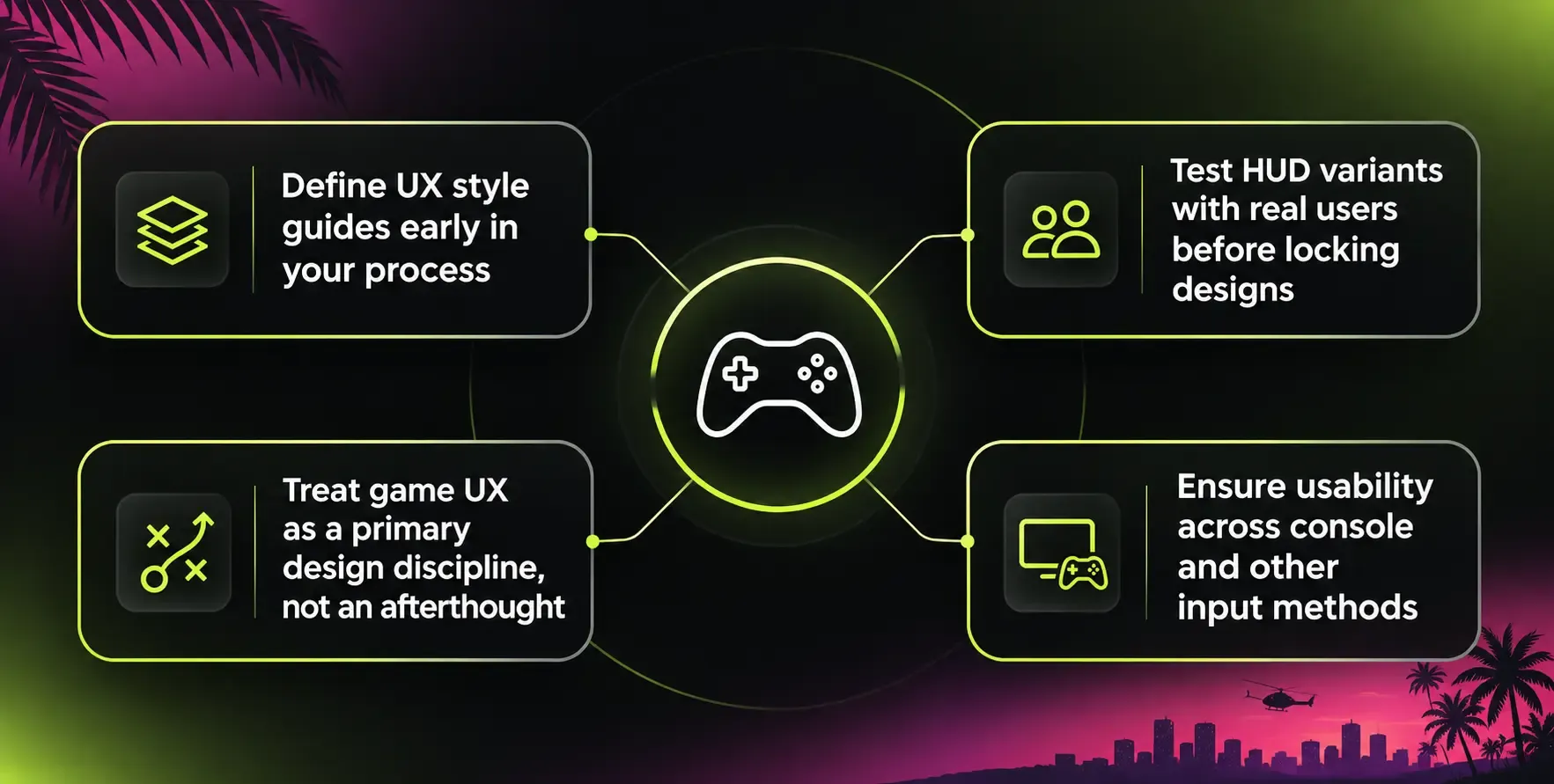
UI/UX design is essential for improving user experience in digital systems, and GTA 6 demonstrates this at scale. Games with intuitive controls are more engaging for players. Games require intuitive controls and clear feedback for players to feel confident in their actions. Poor UX can lead to player frustration and abandonment, which is why user interface design deserves dedicated attention.
Effective onboarding reduces frustration for new players. GTA 6 improves mission onboarding with better clarity of objectives, more forgiving failure states, and more frequent checkpoints. UX designers create immersive experiences for players in games by working closely with developers and artists to ensure consistency between visual design and interaction logic.
Iterative testing improves overall user experience in games. Modern game UX patterns such as adaptive tutorials, input agnostic prompts, and accessibility toggles can coexist with gritty Grand Theft Auto aesthetics without breaking immersion.
Guidance for studios:
Systems Design: Emergent Chaos with Clear Rules
GTA games rely on systemic design rather than purely scripted moments. Physics, AI behaviors, wanted levels, traffic rules, and pedestrian routines combine into emergent stories that feel unique to each player.
GTA 6 deepens this with more reactive crowds, social media mechanics, and environmental interactions. Testing and iteration involve playtesting prototypes with real users to find where systems break or feel unfair. Playtests provide valuable feedback from real users that no amount of internal review can replicate.
Effective feedback enhances player engagement and enjoyment. Games should provide clear feedback to enhance player enjoyment. Sirens, on screen indicators, and NPC barks all serve as an essential component of the feedback loop that helps players understand consequences. Positive feedback reinforces good play, while escalation signals communicate rising danger.
The wanted system encourages hit and run crime playstyles rather than over escalation. NPC priority logic decides which crimes police respond to first.
For designers building systemic products:
- Start from simple rule sets
- Prototype quickly
- Use playtests to see if emergent behavior feels fun, fair, and understandable
- Layer complexity only after the foundation works
Narrative, Characters, and Mission Structure
GTA 6 introduces dual protagonists: Lucia Caminos and Jason Duval. This revisits the multi character storytelling approach from GTA V but with more emotional focus on the relationship between the two leads.
Modern mission design mixes linear, cinematic sequences with open ended objectives that support different play styles. Want to go stealth? Go ahead. Prefer full chaos? The systems support that too. Even after a mission is complete, locations remain reusable. Fence missions, vehicle theft flows, and robbery activities persist beyond story progression.
Story beats are paced with quieter interactions: social media feeds, random encounters, and small side jobs that build empathy and texture. Effective onboarding reduces frustration for new game players by easing them into mechanics before the stakes climb.
User testing is critical for improving player engagement because it reveals where pacing drags or where objectives feel unclear.
Align mission UX (checkpoints, fail states, clear objectives) with narrative goals. Never forget that players bought a game that sells freedom, so avoid over constraining them.
Designing for Limited Time Players and Long Term Engagement
Many players in the U.S. and Canada now have limited time to play. They expect clear progress and meaningful sessions even in 20 to 30 minute bursts. Games must be accessible to players of all skill levels and session lengths.
GTA 6 responds with flexible mission length, fast travel, instant replays, and quick hit activities that still feel connected to the broader world. Short session UX (clean menus, fast load, quick rewards) coexists with long session UX (deep systems, complex heists, layered side stories) within a single save file.
Studios should instrument telemetry, measure session patterns, and iterate systems to respect players' time. A course correction based on real data is always better than guessing what players want.
The goal is to make every session, whether it lasts 20 minutes or 4 hours, feel like it mattered.
Staying Up to Date with Tools, AI, and Cross Industry Skills
The skills behind GTA 6 now power simulations, training environments, digital twins, and other industries far beyond gaming. Large scale world building, AI driven crowds, and real time rendering have direct applications in defense, healthcare, and education.
AI and machine learning are increasingly adopted in enterprise applications, from behavior modeling to QA automation to personalized content delivery. Machine learning model development supports everything from NPC behavior prediction to streaming asset optimization. Launch and post launch support includes updates based on user feedback, a practice that applies equally to games and enterprise software.
Teams need to stay up to date with game engines, tooling, and UX research. Follow conferences, dev diaries, technical breakdowns, and reliable industry news sources. The creativity required to build something at GTA 6 scale comes from continuous learning.
Benefits of Working with SoftDoes on GTA Scale Experiences
SoftDoes is a software engineering and UX design partner for enterprises and ambitious game or media teams in the U.S. and Canada that want polished, scalable digital experiences.
What SoftDoes brings to your projects:
- Custom backends for large scale worlds: Custom software development helps enterprises build and adapt mission critical systems. Software development agencies deliver custom solutions across sectors including gaming, finance, and education.
- AI and ML for behavior modeling: Custom AI solutions help teams build smarter NPC logic, QA automation, and personalization engines. UX designers work closely with developers and artists to ensure AI integrations serve the user.
- Cloud infrastructure for live games: Cloud migration is a common objective for businesses seeking modern IT infrastructure. SoftDoes engineers build scalable, reliable backends that handle millions of concurrent users.
- UX design and user research: Apply GTA 6 style game UX principles (signals, feedback, onboarding, accessibility, iterative playtesting) to both games and non-game applications.
- IT consulting and strategy: Software agencies offer IT consulting to guide businesses in technology adoption strategies, from choosing the right tools to building a portfolio of reusable components.
- Flexible collaboration models: Embedded feature teams, end to end web app and platform development, or targeted consulting to fix specific UX or scalability issues. Scale your engagement up or down based on what you need.
Whether you need to create a companion app, a player hub, or a simulation platform, SoftDoes brings the engineering and design skills to achieve production quality results.
How Non Gaming Products Can Learn from GTA 6 Game Design
GTA 6 design ideas translate directly into broader digital products: map based apps, training simulations, virtual campuses, and customer engagement platforms.
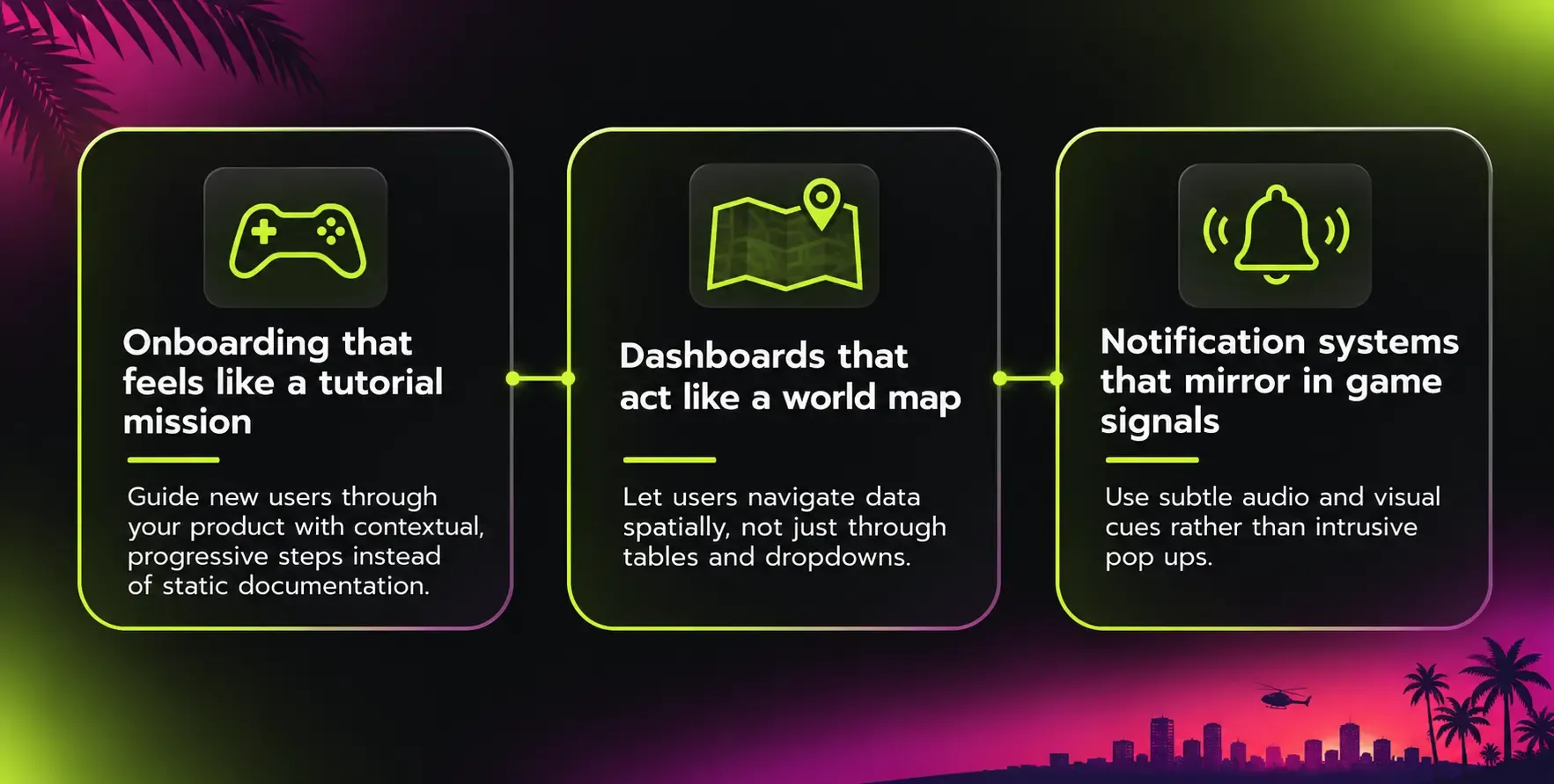
Consider these analogies:
Product teams should view their systems as "worlds" with rules, roles, and rewards.
Digital transformation initiatives often involve the integration of AI and data solutions. API integration is a foundational element of modern software architectures. Compliance is a critical consideration in software development for regulated industries like finance, healthcare, and education. SoftDoes helps non-gaming enterprises bring this mindset into regulated domains without compromising clarity.
Practical Checklist: Applying GTA 6 Game Design Principles to Your Next Project
Use this checklist before your next sprint or design review:
- Define design pillars that every feature must support. If a feature does not serve a pillar, cut it.
- Map psychological drivers for your target user. What motivates them? Freedom? Status? Mastery?
- Simplify HUD and flows. Remove every element that does not serve the user in the current context.
- Build systemic rules that create emergent, discoverable behavior. Start simple.
- Test with real users early. User testing is critical for improving game UX design and any other digital product.
- Document player (or user) journeys from first launch through long term engagement.
- Design for limited time sessions. Ensure progress is meaningful in 20 minutes.
- Bake in accessibility from the start. Do not treat it as a patch.
- Create one small experiment inspired by GTA 6, like a better onboarding flow or a more "alive" hub screen, before overhauling your entire product.
If your team wants help translating these principles into concrete roadmaps, prototypes, and production systems, consider a discovery call with SoftDoes.











Comments (0)
No comments yet.