


U.S.-Based
A private LLM on your data, in your cloud
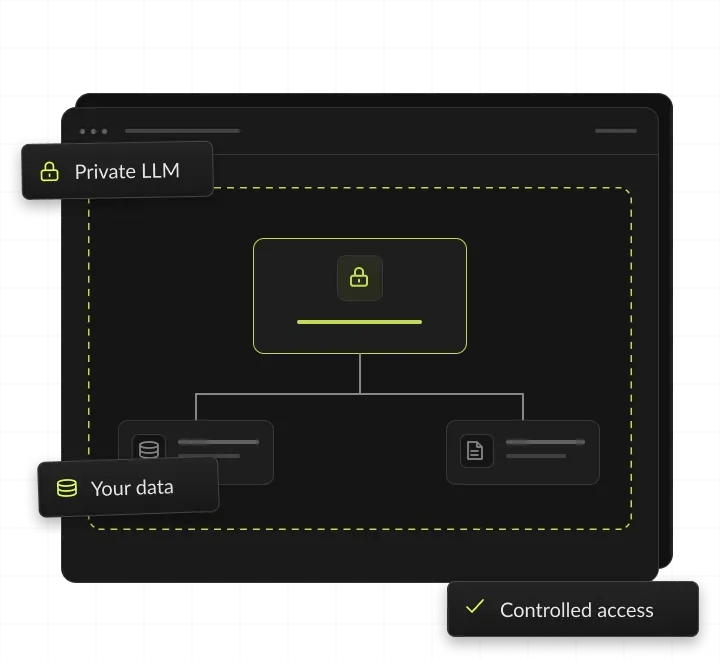
We deploy a large language model in your own cloud account or on your servers, connected to your documents and locked to your access rules.
$15,000
Starting price of a private LLM build
40
AI projects delivered since 2020
5.0
Clutch rating from 40 reviews

















How a private LLM answers inside your network
One legal question, answered without leaving your cloud: the model reads your contracts, counsel checks the citations, and the list is saved to the matter.
Legal asks a question
Which contracts have a change-of-control clause?
The model reads them
It searches contracts in your own cloud account.
Counsel reviews
Each answer cites the contract and page.
Saved to the matter
The checked list goes to the document system.
Private AI for business, in short
- Kansas City metro software and AI company
- Private AI for mid-market companies
- A private LLM in your own cloud account or on your servers, for data that can't go into a public AI tool
- Builds from $15,000, hosting billed at cost, and you own the code

Your data. Your cloud.
- 01Build priceFrom $15,000: model deployment, document connections, single sign-on and audit logs
- 02HostingBilled at cost on your own cloud account
- 03Private ChatGPTA ChatGPT-style assistant for staff that keeps data in-house
- 04You ownThe code, the admin keys and the logs
What is a private LLM?
A private LLM is a language model deployed inside an environment your company controls, such as your cloud account, your own servers or a closed network. Your team decides who can use it and keeps the logs.
Private vs public AI apps
Public AI apps send each prompt to the vendor's own service. With a private LLM, the model, the search index and the logs all sit on infrastructure you control.
Three ways to run a private LLM
A commercial model in your cloud account, through Amazon Bedrock, Azure or Google Cloud, under your cloud contract. An open model, such as Google's Gemma, on GPU servers in your cloud account or data center. Or an on-premise LLM in a closed network, where the model, the search index and the logs run with no internet link at all.
Private LLM vs RAG
A private LLM is about where the model runs. Retrieval-augmented generation, or RAG, is how it reads your documents: it finds the right passages and cites them. Most private AI projects use both, and our RAG development service builds the search side.
Private LLM vs a business AI plan
Business plans of ChatGPT, Claude and Copilot run on each vendor's own service, under that vendor's business data terms. A private LLM goes further, because the model itself runs in your environment.



Private LLM deployment options compared
Four common setups, from the quickest to start to the most isolated. Hosting, GPUs and model usage are billed by your cloud provider at cost, with no markup.

Commercial model in your cloud
Amazon Bedrock, Azure or Google Cloud, in your account. Outside access to prompts is set by your cloud contract; AWS and Microsoft state that model makers cannot access them. Fits when you want top model quality under your cloud contract.
Open model in your cloud
GPU servers in your own cloud account. No model maker involved, and your cloud contract applies. Fits when you want to pick, tune and pin the model yourself.
Open model on your servers
GPU servers in your data center, with no outside access to prompts. Fits when data must stay in your building.
Closed network
Servers with no internet link, so nothing outside can reach the prompts. Fits plants, labs or secure sites with no outside connection.
Systems a private LLM connects to
It reads from the systems you already use, under the permissions they already have.
When a private LLM pays off
A private LLM pays off when your data cannot go into a public AI service. It also fits when your security review requires the model to run inside your own environment.
Signs we see before a company asks for private AI:
- Client contracts, health records or financial data cannot leave your control.
- Your security team blocked public AI tools, and staff use them anyway.
- Customers or regulators ask where AI processes their data.
- Sites or networks have no internet link, but staff still need AI answers.
- You want to choose and pin the model yourself, on your own schedule.
When to wait
If a business plan of ChatGPT, Claude or Copilot passes your security review, a workspace rollout from $5,000 is faster and cheaper. If you only need answers from documents, permission-aware company search starts at $11,000.
What to prepare before the first call
Where the data must stay (a cloud account, a region or your own building), the documents and systems the model should read, how many people will use it and for which tasks, your security team’s requirements such as single sign-on and audit logs, and twenty real questions with good answers for the first test set.
Secure AI for business: what we build
Five ways to run a large language model where your data already lives.
Private ChatGPT for your staff
A chat assistant on your own model deployment, with single sign-on, roles and an audit log of every prompt. For example, staff ask policy and contract questions in a chat window, and every prompt is logged under their own sign-in.
A private LLM in your cloud account
Models from Amazon Bedrock, Azure OpenAI or Google Vertex AI, deployed in the cloud account you already pay for. For example, a Claude model through Amazon Bedrock in your AWS account, billed on the cloud invoice you already pay.
A self-hosted LLM on your servers
Open models such as Google's Gemma, running on GPU servers you own and control. For example, Gemma running on GPU servers in your own data center, sized to your number of users.
An on-premise LLM for closed networks
For sites with no internet link, the model, search index and logs all stay on your premises. For example, a plant network with no internet link runs the model, index and logs on local servers.
Answers from your documents
Search over SharePoint, drives and databases that respects each person's file permissions. For example, legal asks which contracts have a change-of-control clause, and each answer cites the file and page.
What you get from a private LLM build
You get a private model running in your environment and connected to your documents, with single sign-on, roles, audit logs, test results and runbooks your IT team can use.




Private LLM ROI: a worked example
A private LLM pays back when the hours it saves cover the build and the hosting. This example uses assumed numbers for a legal and compliance team, not a client result: at these numbers, the build pays back in under two months after hosting. Your real hosting cost comes from the planning step, where we price cloud and on-premise side by side. Test your own question volumes and hosting costs in the AI ROI calculator.
How a private LLM goes live
Four steps from the first call to a model your staff use every day.
We map your data, security rules and tasks, then pick cloud, self-hosted or on-premise. You see hosting costs for each option and a fixed build price before any spend. You get a deployment plan with hosting costs.
We deploy the model, connect your documents and add single sign-on, roles and logs. Keys, prompts and settings stay in your accounts and your repository. You get a private model on your data.
We test answers on your real questions and try to break the access rules. It must reach the agreed pass mark before launch. You get a test report for your security team.
We roll it out to the first teams, train them and hand over runbooks. Usage and cost alerts are switched on from the first day. You get runbooks and admin access for IT.
Sensitive data, handled in production
An AI build and a HIPAA platform from our case studies, and the record behind them.

- Healthcare
Prior Authorization AI
Prior Authorization AI is a healthcare automation startup building AI-powered tools to streamline prior authorization for Medicare and Medicaid medical transportation providers in New Jersey.- 16Weekly hours saved
- 63%Admin time reduced
- 43%Fewer submission errors

- Startup
- Real Estate
Our Haus AI
A finance professional turned founder built Our Haus AI, an AI-powered collaborative workspace where homeowners and contractors scope, bid, contract, and document renovation projects together. SoftDoes took her prototype and made it production-ready.- 10XMVP scope delivered
- 2+years Ongoing partnership
- 1Fully owned Platform

- Real Estate
The building buyer
The Building Buyer is a Florida-based real estate investment firm co-founded by Dylan Troiano and Charles Hanlin. They acquire single-family, multifamily, and commercial properties across South Florida and beyond, with a focus on motivated seller opportunities.- 18Weekly hours saved
- 2+Years Ongoing partnership
- 1Fully owned Platform

- Healthcare
CareInTouch
CareInTouch is a Bay Area home health agency providing skilled nursing and therapy services to patients referred from hospitals and clinics. With over 100 staff, they operate in one of the most complex and compliance-driven healthcare markets in the country.- 40% Reduction In Billing Errors
- 100+Staff Operations Managed
- 0Missed Compliance Deadlines

- Startup
Sparkle The Cleaning Service
Sparkle The Cleaning Service is a Detroit-area residential cleaning company with 10 years in business, connecting homeowners with vetted, insured independent cleaners through a subscription-based marketplace platform.- 75% Platform Transparency
- 2XPlatform Growth
- 40%Higher User Retention

- Healthcare
FMY Orthodontics
FMY Orthodontics, a multi-location practice in West Tennessee, partnered with SoftDoes to replace a spreadsheet-based financial workflow with a custom web platform. The goal was to simplify how staff present treatment financing while allowing patients and families to review and complete decisions remotely.- 60%Workflow Reduction
- 75%Remote Adoption
- 5Locations Aligned

- Real Estate
Brizacorp
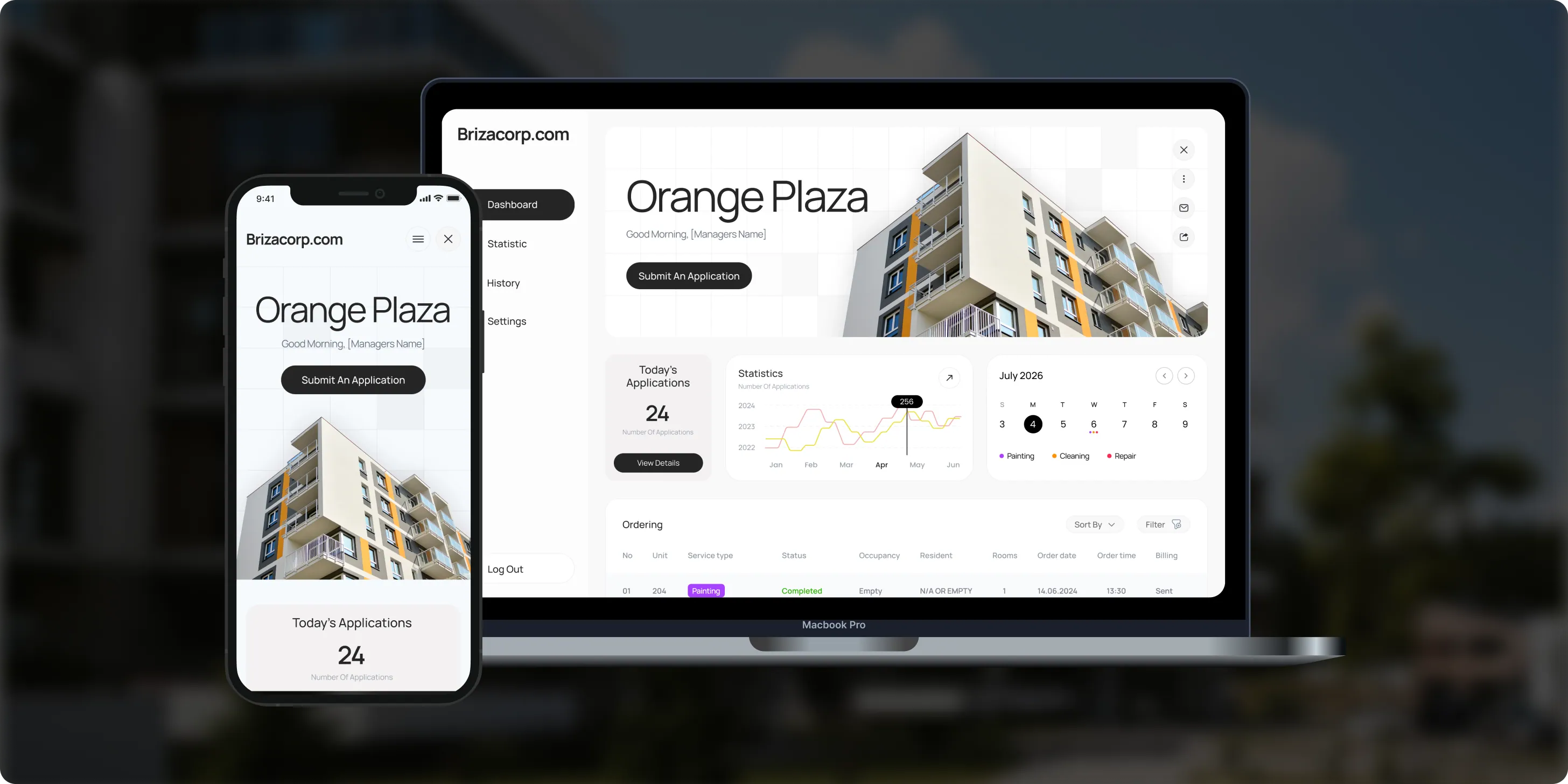
Brizacorp manages residential properties and coordinates the staff who handle painting, cleaning, and repair requests. Its team tracked work across messengers, phone calls, e-mail, and paper planners, with no single place to manage requests or measure performance.- 98%Application Stability
- 95%Utilization Rate
- 30%Faster Task Completion
Risks in a private LLM, and how we handle them
Each risk gets a control in the build and a test before launch, not a promise on a slide.

How we keep a private LLM secure
Under your accounts and keys
Each request carries the user's identity, reaches only documents that person can open and leaves a log entry your security team can review. Health and legal data have their own rules: see our guide to HIPAA-compliant AI and our AI governance and compliance service. For a full attack test before launch, see AI red teaming.
Your environment
The model, index and logs live in your cloud account or data center, and your team holds the admin keys.
Your sign-in and roles
Single sign-on and roles that follow the groups you already manage.
An audit log
Every prompt, answer and source is logged, for reviews and incident response.
Keys out of code
API keys stay in your secrets manager, never in code or prompts.
Amazon Bedrock
AWS states that model providers have no access to customer prompts and completions.
Azure and Google Cloud
Microsoft states that prompts and outputs for models sold by Azure are not available to OpenAI or used for training without your permission. Google Cloud states the same for training and fine-tuning.
Self-hosted and on-premise LLMs: models, hardware and running costs
Which models can be self-hosted
A self-hosted LLM runs an open model on hardware you control. Its cost depends on model size, the number of users and document length, so we size servers and price cloud hosting before you buy anything.
Open-weight models can run on your own servers. Google's Gemma family, for example, is built from the same research as Gemini. Google built it to run on your own hardware, mobile devices or hosted services, and says it can be tuned for specific tasks.
We test two or three candidates on your real questions and pick the smallest one that answers them well. Smaller models need less hardware and respond faster.
Can it run on one computer? Small open models can run on a single workstation for testing. A model that serves a whole team needs GPU servers sized to the model and the number of users.
Cloud hosting is usually cheaper to start, so we price cloud and on-premise side by side before you buy hardware. Model usage and hosting are billed at cost on your own account. Estimate token costs for your volume with the LLM cost calculator.
What drives hosting cost
Model size, which sets how much GPU memory each server needs
How many people ask questions at the same time
How long the documents and answers are, measured in tokens
Whether servers run around the clock or only during working hours

How to choose a private LLM company
Ask any private LLM company these questions before you sign, and expect each answer in writing.
Questions to ask, and what a good answer includes
- Where will the model and data live? In your cloud account or data center, with your team holding the keys.
- How will you choose the model? A test of two or three models on your real questions, with accuracy and cost.
- How will access rules be enforced? Search that follows each person's permissions, tested by trying to break it.
- What will hosting cost each month? An estimate for cloud and on-premise, billed at cost on your account.
- What happens when a better model ships? Pinned versions, a rerun of the test set and a planned switch.
- Who owns the code? You do, from the first commit, with runbooks for your IT team.
- What paperwork comes first? An NDA and a certificate of insurance before the first call.
What a private LLM costs
One fixed price for the build, agreed before work starts. Hosting and GPUs are billed by your cloud provider on your account, with no markup.
Private AI on your data
Deployment, documents, SSO, audit log
From $15,000
Cloud hosting and model usage
On your own cloud account
At cost
Permission-aware company search
Answers from your documents (RAG)
From $11,000
LLM fine-tuning
Per round, with before-and-after tests
From $6,000
Maintenance and support
After launch
From $500 a month
Project Discovery
Credited to the build
$490
Why companies build private AI with SoftDoes
Companies build private AI with SoftDoes because the model, index and logs stay in their cloud, under their admin keys. We are a Claude Partner Network member and an OpenAI Registered Partner, and we deploy open models too.

- 01
Your accounts, your keys
The model, index and logs live in your cloud account or data center. Your team holds the admin keys.
- 02
Vendor documents first
Our NDA and certificate of insurance reach procurement and security before the first call.
- 03
We know the model makers
SoftDoes is a Claude Partner Network member and an OpenAI Registered Partner. We deploy open models too.
- 04
40 AI projects since 2020
AI work in production since 2020, from document extraction to filing through Medicare's API.
- 05
Rated 5.0 on Clutch
5.0 from 40 client reviews. More than half of the reviewers are founders, executives or department heads.
- 06
Kansas City headquarters
Headquartered in Mission, KS, in the Kansas City metro. Call 800-909-2345 to reach the team.
Private AI for business by industry
Private models fit industries where data rules come first. Each industry page covers its private AI use cases and compliance rules in detail.
Healthcare
Answers from clinical policies and patient documents, inside your own cloud account.
Legal
Contract and matter search with citations, limited to the people on each matter.
Financial services
Policy and document questions answered without client data leaving your environment.
Insurance
Claims files and policy wording searched in your own account, with a person approving decisions.
Government
Models that run inside your own cloud or a closed network, with a full audit log.
Accounting
Client documents and engagement files searched under each client team's permissions.


Questions about private LLMs
Privacy, models, hosting and cost. Can't find your answer?
What is a private LLM?
A private LLM is a large language model that runs where your company controls the data. It can be an open model on your own servers, or a commercial model deployed in your cloud account. Prompts, documents and answers stay inside your environment, under your access rules and logs, instead of going through a public AI app.
Is there any AI that is private?
Yes, if you control where it runs. Microsoft states that prompts sent to Azure OpenAI models are not available to OpenAI. AWS states that model providers on Amazon Bedrock can't access customer prompts and completions. For data that must never leave your building, an open model can run on your own servers instead.
What is the best private LLM?
The best private LLM is the smallest one that answers your real questions well. We test two or three candidates on your own documents before choosing. Commercial models in your cloud account usually win on quality. Open models such as Google's Gemma suit closed networks and fixed budgets, because they run on your hardware.
Can you run an on-premise LLM?
Yes. For sites without an internet link, we install the model, the search index and the logs on servers you own. You need GPU servers sized to the model and your number of users, and we size them in the planning step. Cloud hosting is usually cheaper to start, so we price both before you buy hardware.
How much does a private LLM cost?
Builds start at $15,000, covering the model deployment, connections to your documents, single sign-on, roles and an audit log. Cloud hosting is billed at cost on your own account, and maintenance starts at $500 a month. If you only need answers from documents, permission-aware company search starts at $11,000.
Can a private LLM learn from our documents?
Yes, in two ways. Most companies connect the model to their documents, so it finds and cites the right passage for each question. Fine-tuning goes further and trains the model on your examples, from $6,000 per training round with before-and-after testing. Our RAG vs fine-tuning guide explains which one fits.
How much does it cost to host your own LLM?
Hosting cost depends on the model size, how many people use it at once and how long the documents are. Cloud GPUs are billed by your provider at cost, on your account. On-premise means buying GPU servers up front. We price both in the planning step, and builds start at $15,000 plus hosting.
Can I run an LLM on my own computer?
Yes, for testing. Small open models, such as Google's Gemma, are made to run on your own hardware and even on mobile devices. A model that serves a whole team needs GPU servers sized to the model and the number of users, plus single sign-on, roles and logs. We size that setup and price cloud and on-premise options side by side.
Do we need a private LLM if we already have ChatGPT Enterprise or Copilot?
Often not. ChatGPT Enterprise and Microsoft 365 Copilot keep data under each vendor's business terms, and neither trains on it by default. A private LLM fits when data must not reach any outside service or sites have no internet link. It also fits when you must choose and pin the model yourself. We review both options against your security rules.
Which cloud should we use for a private LLM?
Usually the cloud you already run. Amazon Bedrock, Azure and Google Cloud all offer commercial models inside your account, and each states limits on how your prompts can be used. We compare model quality and hosting costs on the clouds you use, then build where your contracts, keys and logs already live.
Who owns a private LLM you build?
You do. The model runs in your cloud account or on your servers, your team holds the admin keys, and the code lives in your repository. Prompts, documents and logs stay in your environment. Nothing depends on a SoftDoes account, and maintenance from $500 a month is optional if you want us to run it.
How long does a private LLM project take?
It depends on the setup, the number of document sources and your security review. We set the scope, price and schedule in a written plan before any build. Many companies start with Project Discovery for $490, credited to the build. The plan also lists what we need from you, such as cloud access and sample questions.
Updated · Reviewed by Orest Andrusyshyn, Founder and CEO


