


U.S.-Based
AI code modernization for legacy systems
We use AI to map, test and rewrite old code. Our engineers prove the new system matches the old one before anything switches over.
$4,500
Fixed price of a code assessment
$25,000
Starting price of a modernization project
5.0
Clutch rating from 40 reviews




















How one module moves to new code
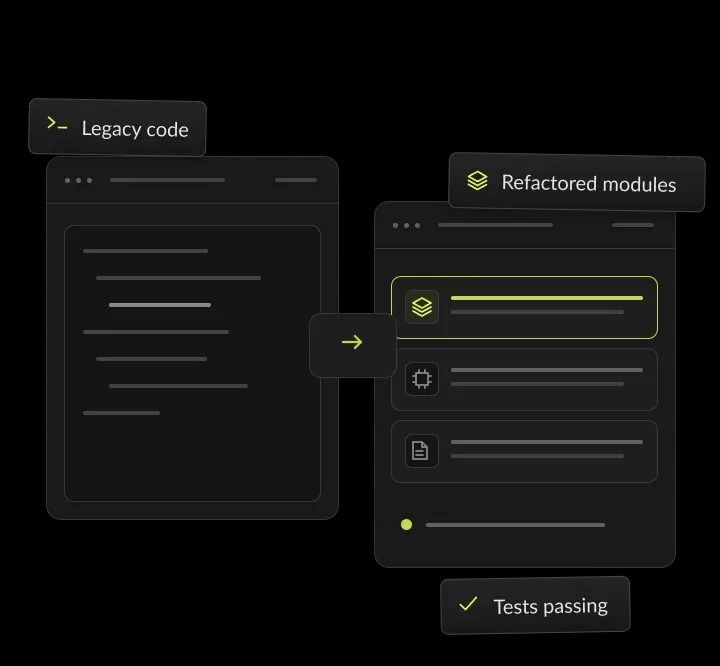
One payroll batch job, from COBOL to Java: AI drafts the new code and its tests, engineers compare the outputs, and the old version waits on standby.
A COBOL module is picked
A payroll batch job, chosen in the assessment.
AI drafts the Java version
It also drafts tests from today's outputs.
Engineers compare outputs
Old and new code run on the same data.
The module goes live
The old version stays on standby until proven.
AI legacy code migration, in short
- Kansas City metro software and AI company
- AI legacy code migration for mid-market companies
- COBOL, old Java and .NET code moved to a modern stack
- Code assessment $4,500 fixed, modernization from $25,000, and you own all code and IP

Assess first. Then move.
- 01Start here$4,500 fixed: a map of the code, its risks and a priced plan for COBOL migration or any other move
- 02Modernization projectFrom $25,000, priced from your assessment
- 03Full rebuildsFor rewrites that go beyond the code, see our legacy software modernization service
- 04You ownCode, tests, documentation and migration scripts
What is AI code modernization?
AI code modernization uses AI models to read, document, test and rewrite old code, while engineers check every change. The goal is a supported codebase that behaves exactly like the old system.
Why AI helps
Most legacy systems still work, but few people can change them safely, and every change needs long rounds of manual testing. AI shortens the slowest part: understanding what the code actually does.
Understanding the code first
Anthropic, the company behind Claude, calls understanding the code the most expensive step in COBOL modernization. Its Claude Code tool maps dependencies across thousands of lines and drafts documentation that engineers then check.
What counts as legacy code
Code a business still depends on but can no longer change cheaply or safely. Common causes are an old language, an unsupported framework version, missing tests or missing documentation.
What an AI code modernization includes
A map of modules, data flows and dependencies, reviewed by engineers. Business rules pulled from the code into plain English, confirmed by your experts. Tests that record what the old system does today, odd cases included. New code written module by module, with an engineer reviewing every change. Old and new code run side by side on the same data before each cutover. Documentation and migration scripts land in your own repositories.
AI code modernization vs a manual rewrite
A manual rewrite starts with people reading old code line by line before anything moves. With AI, the reading, mapping and first drafts go faster, so engineers spend their time on decisions and checks. Both routes need the same proof at the end: the new code must give the same results as the old code. For full platform rebuilds with new screens, data models or hosting, see our legacy software modernization service.



Types of legacy code modernization, and where AI helps
Anthropic groups modernization into four approaches. The code assessment compares them for your system before you commit to one.

Rehost
The code moves unchanged to new infrastructure. Fits when you need to leave old hardware quickly. AI maps dependencies so nothing breaks in the move.
Refactor
The code is restructured, and its behavior stays the same. Fits when the language is fine, but the code is hard to change. AI finds dead code, duplicated logic and risky modules.
Rewrite
The code is converted to a modern language, such as Java or C#. Fits when the language itself limits staffing, tools or hosting. AI drafts new code and tests, one module at a time.
Replace
A commercial product takes over the job. Fits when a standard product already fits the process. AI pulls the business rules out, so you can check the product against them.
Legacy code migration: from and to
The languages we move code out of, and the stacks we move it to.
When AI code modernization pays off
AI code modernization pays off when an old system still runs the business, but every change is slow and risky. It pays off fastest when only one or two people still know the code.
Signs we look for in a code assessment:
- The people who understand the code are retiring or have already left.
- Small changes need weeks of manual testing before anyone dares to release them.
- The framework or language version no longer gets security updates.
- New products need data or APIs that the old system can't provide.
- Auditors or buyers ask for documentation that doesn't exist.
When to wait
If the system rarely changes and the team that runs it is stable, modernizing may not pay off yet. If a commercial product already does the job, replacing the system can beat rewriting it. The code assessment shows which case you are in, and if you are still deciding where AI fits at all, start with an AI readiness assessment.
What to prepare before the first call
Read access to the repository or a copy of the source code, a list of the systems, files and jobs that depend on it, sample inputs and outputs such as one month of batch runs, the names of the people who know the business rules, and any fixed dates, such as a hardware lease or a license renewal.
COBOL migration services and other legacy code work
Six jobs AI speeds up, each checked by an engineer before it reaches production.
COBOL to Java migration
Batch jobs and business rules moved from COBOL to Java or C#, checked against the old system's outputs. For example, a nightly payroll batch job rewritten in Java, then run beside the COBOL version on the same month of inputs.
Old .NET and Java upgrades
Applications on old .NET Framework or Java versions moved to current, supported releases. For example, an internal claims app moved from an old .NET Framework release to current .NET, one screen at a time.
Business rules pulled from old code
AI reads the code and drafts plain-English rules that your experts confirm before anything moves. For example, AI drafts the rule behind a late-payment fee from three programs, and your finance lead confirms it.
Tests before any change
We write tests that record today's behavior, so the new code has to match it. For example, a test suite that replays last quarter's inputs and checks every output field against the old system.
Maps of code nobody remembers
AI-drafted maps of modules, data flows and dependencies, reviewed by our engineers. For example, a dependency graph that shows which jobs write to a shared file, before anyone touches it.
APIs around code that stays
Stable old modules get an API wrapper, so new systems can call them while other modules move. For example, a new customer portal reads account balances through an API that calls the old COBOL program.
What you get from AI code modernization
You get a modern codebase that passes the same tests as the old one. The maps, rules and scripts that explain it sit in your own repositories.




AI code modernization ROI: a worked example
Code modernization pays back when the engineering hours it saves on future changes cost more than the project. This example uses assumed numbers, not a client result: at these numbers, a project at the starting price pays back in about seven months. Larger codebases cost more, so use the fixed price from your own assessment. The math leaves out gains that vary too much to assume, such as lower hosting costs or fewer outages. Run your own numbers in the AI ROI calculator. You can run this math with real numbers before you commit to the project.
How AI-powered code modernization works
Four steps from the first call to the last module switched over.
We map the code, its data and every system that depends on it. AI drafts the map, and our engineers check it against how the system really runs. You get a risk map and a priced plan.
We write tests that capture what the old code does today, odd cases included. Where old behavior looks like a bug, your team decides whether to keep it. You get a test suite for the old system.
AI drafts each module in the new language, and engineers review every change. Each module must pass the recorded tests before the next one starts. You get new code that passes the old tests.
Old and new code run side by side on real data until the outputs match. We switch one module at a time, so any problem stays small. You get a cutover with the old system on standby.
Rebuilds we have shipped
Two rebuilds from our case studies, and the record behind them.

- Healthcare
Prior Authorization AI
Prior Authorization AI is a healthcare automation startup building AI-powered tools to streamline prior authorization for Medicare and Medicaid medical transportation providers in New Jersey.- 16Weekly hours saved
- 63%Admin time reduced
- 43%Fewer submission errors

- Startup
- Real Estate
Our Haus AI
A finance professional turned founder built Our Haus AI, an AI-powered collaborative workspace where homeowners and contractors scope, bid, contract, and document renovation projects together. SoftDoes took her prototype and made it production-ready.- 10XMVP scope delivered
- 2+years Ongoing partnership
- 1Fully owned Platform

- Real Estate
The building buyer
The Building Buyer is a Florida-based real estate investment firm co-founded by Dylan Troiano and Charles Hanlin. They acquire single-family, multifamily, and commercial properties across South Florida and beyond, with a focus on motivated seller opportunities.- 18Weekly hours saved
- 2+Years Ongoing partnership
- 1Fully owned Platform

- Healthcare
CareInTouch
CareInTouch is a Bay Area home health agency providing skilled nursing and therapy services to patients referred from hospitals and clinics. With over 100 staff, they operate in one of the most complex and compliance-driven healthcare markets in the country.- 40% Reduction In Billing Errors
- 100+Staff Operations Managed
- 0Missed Compliance Deadlines

- Startup
Sparkle The Cleaning Service
Sparkle The Cleaning Service is a Detroit-area residential cleaning company with 10 years in business, connecting homeowners with vetted, insured independent cleaners through a subscription-based marketplace platform.- 75% Platform Transparency
- 2XPlatform Growth
- 40%Higher User Retention

- Healthcare
FMY Orthodontics
FMY Orthodontics, a multi-location practice in West Tennessee, partnered with SoftDoes to replace a spreadsheet-based financial workflow with a custom web platform. The goal was to simplify how staff present treatment financing while allowing patients and families to review and complete decisions remotely.- 60%Workflow Reduction
- 75%Remote Adoption
- 5Locations Aligned

- Real Estate
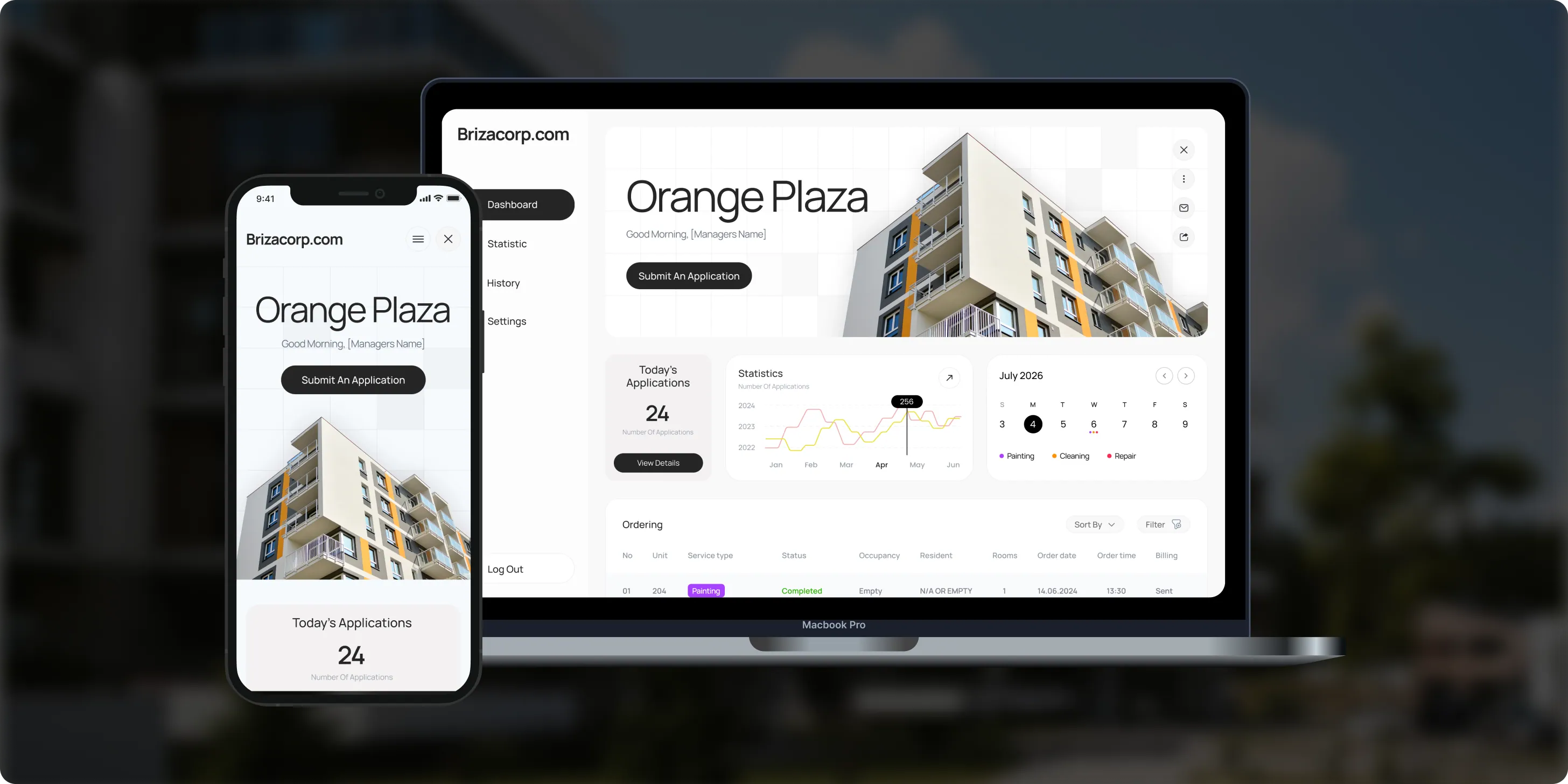
Brizacorp
Brizacorp manages residential properties and coordinates the staff who handle painting, cleaning, and repair requests. Its team tracked work across messengers, phone calls, e-mail, and paper planners, with no single place to manage requests or measure performance.- 98%Application Stability
- 95%Utilization Rate
- 30%Faster Task Completion
Risks in AI code modernization, and how we handle them
Each risk gets a control before cutover, not a promise in a slide.

How we keep your code and data safe
Only what the task needs reaches a model
Your code stays in your repositories, and AI tools run under accounts and terms your company approves. Our NDA and certificate of insurance reach your procurement team before the first call. For company rules on AI use, see AI governance and compliance. If code or data must never leave your own cloud, see our private AI service.
Your repositories
Work happens on branches in your repositories and goes through your normal code review.
Approved AI accounts
AI tools run on your own accounts or ones you approve, under commercial terms.
No training on your code
Anthropic states that inputs and outputs from its commercial products, including its API, are not used to train its models by default.
Zero data retention
Anthropic offers zero data retention by arrangement, and it covers Claude Code used with API keys from a commercial organization.
Masked sample data
Sensitive values in sample data are masked where the task allows it.
Secrets stay secret
Keys and credentials stay in your secrets manager, never in code or prompts.
How to choose an AI code modernization company
Ask these questions before you sign. A strong partner answers each one in writing, and be careful with any offer of a fully automatic conversion that skips recorded tests and side-by-side runs.
Questions to ask, and what a good answer includes
- How will you prove the new code works like the old? Tests recorded from today's behavior, and side-by-side runs on real data.
- Who reviews the code AI writes? Senior engineers review every change before it merges.
- Where will the code, tests and scripts live? In your repositories from the first day.
- Can we stop after the assessment? Yes, with a fixed-price plan you keep either way.
- What happens if a module fails after cutover? The old version stays on standby until the new one is proven.
- How do you find rules nobody wrote down? AI drafts them from the code, and your experts confirm each one.
- What paperwork comes first? An NDA and a certificate of insurance before the first call.
What AI code modernization costs
Fixed prices, agreed before work starts. The assessment ends with a fixed price for the migration, so you can stop there if it doesn't pay off.
Code assessment
Code map, risks and a priced plan
$4,500 fixed
Modernization project
Module by module, tested
From $25,000
Cloud hosting
On your own cloud account
At cost
Maintenance and support
After cutover
From $500 a month
Why companies modernize code with SoftDoes
Companies modernize code with SoftDoes because tests, documentation and migration scripts land in their own repositories from the first day. On Clutch, a law firm reports large case files opening in under 6 seconds after our modernization, down from about 20.

- 01
You own all code and IP
Tests, documentation and migration scripts live in your repositories from the first day.
- 02
Vendor documents first
Our NDA and certificate of insurance reach your procurement team before the first call.
- 03
Claude Partner Network member
We build on Claude as a member of Anthropic's partner network, and train engineering teams on Claude Code.
- 04
40 AI projects since 2020
AI work in production since 2020, from document extraction to filing through Medicare's API.
- 05
Rated 5.0 on Clutch
5.0 from 40 client reviews. Clutch named SoftDoes a Top Artificial Intelligence Company and Top Machine Learning Company in Kansas City for 2026.
- 06
App modernization on Clutch
A law firm's Clutch review reports large case files opening in under 6 seconds after an app modernization, down from about 20.
AI code modernization by industry
Anthropic notes that COBOL still powers critical systems in finance, airlines and government. Each industry page shows the systems, rules and use cases in detail.
Financial services
Batch jobs, statements and reports moved to supported code, with every change traced in your repository.
Insurance
Policy, billing and claims rules pulled from old code and confirmed by your claims and underwriting leads.
Government
Case and benefits systems documented and modernized module by module, with the old system on standby.
Healthcare
Billing and records code modernized under your HIPAA controls, with sensitive values masked in test data.
Logistics
Shipment and warehouse logic moved off old platforms, with APIs that newer carrier systems can call.
Manufacturing
Planning and inventory code moved to supported stacks while the old jobs keep running until each part is proven.


Questions about AI code modernization
COBOL, cost, timing, risk and ownership. Can't find your answer?
What is AI code modernization?
AI code modernization uses AI models to read, explain and rewrite old code, with engineers checking every step. The AI drafts documentation, business rules, tests and translated code. Our engineers review each change and prove the new system matches the old one. That lets a rewrite ship in small, tested releases instead of one big switch.
Can AI convert COBOL to Java?
AI can draft most of the translation, but it shouldn't be trusted alone. COBOL programs carry decades of business rules, packed data formats and batch schedules. For COBOL migration we have AI translate one module at a time. Then we run the old and new code on the same inputs and compare outputs before any module goes live.
How much does AI code modernization cost?
Every project starts with a code assessment at $4,500 fixed, covering a map of the code, the risks and a priced migration plan. Modernization projects start at $25,000 and grow with the size of the codebase and the systems connected to it. Hosting for the new system is billed at cost on your own cloud account.
How long does a code modernization take?
It depends on the size of the codebase and how many systems depend on it. The assessment gives you a module-by-module plan with a schedule for each release before you commit to the full project. We move one module at a time, so the old system keeps running until each part is proven.
Will the new code work the way the old system did?
Yes, because we prove it before cutover. We first write tests that record how the old system behaves today, including its odd cases. The new code has to pass the same tests and produce the same outputs on real data. Where the old behavior was a bug, your team decides whether to keep it or fix it.
Do we own the modernized code?
Yes. You own all the code and IP we write, including tests, documentation and migration scripts. Everything lives in your own repositories and cloud accounts from the first day, so your team can keep working without us. If you want support afterwards, maintenance starts at $500 a month.
Can AI be used to migrate legacy code?
Yes, with engineers in control. AI reads old code, maps dependencies, drafts business rules and writes first versions of new code and tests. It still makes mistakes, so every change needs review and proof. AI drafts one module at a time, and engineers review it. Old and new code then run on the same data before cutover.
Is COBOL still used in 2026?
Yes. Anthropic, the company behind Claude, estimates that COBOL handles about 95% of ATM transactions in the US. It also says hundreds of billions of lines of COBOL run in production every day, in finance, airlines and government. Anthropic adds that fewer people can read COBOL each year, which is why many companies now plan a migration.
What does legacy code mean?
Legacy code is code a business still relies on but can no longer change cheaply or safely. It is often written in an older language, such as COBOL or Visual Basic 6, or on an unsupported framework version. Missing tests and missing documentation make code legacy too, even when the language itself is modern.
What is legacy code migration?
Legacy code migration moves a system's code to a newer language, framework or platform while keeping what it does. It can mean moving COBOL to Java, an old .NET Framework app to current .NET, or a server app to the cloud. The hard part is proving that the new version gives the same results as the old one.
Should we rewrite, refactor or rehost?
It depends on what blocks you. Rehosting moves code unchanged to new infrastructure. Refactoring restructures it without changing behavior. Rewriting converts it to a modern language, and replacing swaps in a commercial product. The code assessment compares these routes for your system and prices the one that pays off.
Which AI tools are used in code modernization?
Agentic coding tools such as Claude Code, Anthropic's coding tool, do most of the reading, mapping and drafting. Anthropic positions it for dependency mapping, documenting legacy code and writing regression tests. As a Claude Partner Network member, we run these tools under accounts you approve, and engineers review every result.
Can the old system keep running during the migration?
Yes. We move one module at a time, and the old system keeps running until each new module is proven. Old and new code run side by side on the same data before each cutover. After cutover, the old version stays on standby, so it can take over again while a problem is fixed.
Do you need access to our production data?
Only what the task needs. We start with the source code and sample inputs and outputs, such as one month of batch runs. Side-by-side runs need real data, so they follow the access rules you set, with sensitive values masked where the task allows it. Everything stays under the NDA signed before the first call.
Will our team be able to maintain the new code?
Yes. The new code uses current languages and frameworks that are easier to staff, such as Java, C# or TypeScript. It comes with tests, documentation and migration scripts, all in your repositories. A handover session walks your engineers through it, and maintenance from $500 a month is there if you want it.
Updated · Reviewed by Orest Andrusyshyn, Founder and CEO


