


U.S.-Based
AI data entry for forms, emails and PDFs
It types data from documents and emails into your systems, and your team checks only uncertain fields.
$5,000
Starting price of a data entry flow
40
AI projects delivered since 2020
5.0
Clutch rating from 40 reviews
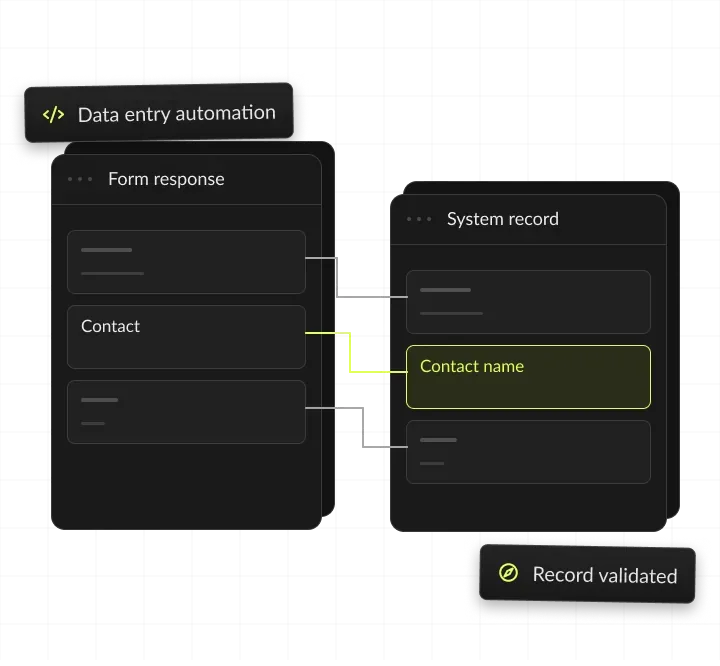
























How the agent enters a record
One signed application: the agent fills the CRM fields, a reviewer confirms the highlighted ones, and the record is saved with the PDF attached.
A form arrives
A signed application, as a PDF.
The agent fills the fields
Each value mapped to your CRM.
A reviewer confirms
Uncertain fields are highlighted.
The record is saved
With the PDF attached.
AI data entry, in short
- Kansas City metro software and AI company
- AI data entry automation for operations teams
- Types data from forms, emails and PDFs into your CRM, ERP or EHR for review
- Builds from $5,000, maintenance from $500 a month

AI types. People check.
- 01Build priceFrom $5,000: one data entry flow with a review screen
- 02Who it's forOperations teams retyping the same data into two or more systems
- 03People approveUncertain fields, changes to existing data, payment details and merges
- 04You ownThe field rules, prompts and code
What is AI data entry?
AI data entry uses AI models to read forms, emails, PDFs and scans, then type each value into the right field. A person checks only the values the model is unsure of.
It replaces retyping, not your systems
Records still land in your CRM, ERP, EHR or spreadsheet, with the source document attached. A data entry agent is one kind of AI agent, with one narrow job and a person checking its uncertain work.
How AI data entry works
It collects new items from an inbox, portal, upload folder or scanner, reads each document and finds the value for every field. Then it checks values against your records and rules, such as a known account or a valid date.
Review, write and log
Uncertain fields are highlighted on a review screen for a person to confirm. The record is written through the system's API, or through its screens when no API exists, and the source, the values and the reviewer are logged.
AI data entry vs OCR and RPA
OCR turns an image of text into text. It does not know which value belongs in which field. AI data entry reads meaning, maps values to fields and checks them. RPA repeats fixed clicks and keystrokes, so it stops when a form or screen changes. AI data entry reads new layouts and free text. Unclear values still need a person, so a review step stays.
Data entry and document processing
Data entry is often the last step of document processing. Document processing covers reading documents at scale, and this service covers getting the values into your systems.


Types of data entry automation we build
Six common builds, from document to record to app-to-app workflows. Prices for each data entry build are starting points from our price list. Model usage is billed at cost on your account, maintenance starts at $500 a month, and three or more extra systems add $9,000.

Document to record
Reads forms, PDFs and scans and fills the record. Fits when staff retype documents into one system.
Email to CRM
Logs contacts, requests and orders from emails to the right account. Fits when reps copy emails into the CRM by hand.
Portal and spreadsheet updates
Copies data between portals, spreadsheets and systems without an API. Fits when a portal or legacy screen has no API.
One source, several systems
Writes the same record to the CRM, ERP or billing system. Fits when the same data is typed twice.
Invoices into your ERP
Reads invoices, matches POs and drafts bills for approval. Fits when the data entry is accounts payable.
App-to-app workflow
Moves clean data between apps in n8n, Make or Zapier. Fits when the data is already structured.
Systems it types into
When AI data entry pays off
AI data entry pays off when your team retypes the same kinds of documents every day. The values should follow rules a person can explain.
Signs we see before an operations team asks for an agent:
- Staff copy data from PDFs or emails into a system every day.
- The same record is typed into two or more systems.
- Typos and duplicates cause rework later in the process.
- Backlogs build up at month end or in busy seasons.
- A portal with no API forces someone to copy data by hand.
When to wait
If a document type arrives a few times a month, manual entry is usually cheaper. If the data already arrives as clean fields from another app, a workflow automation from $2,500 may be enough. For a first check of your operations team, the free AI readiness quiz scores your data, processes, people and security in 12 questions.
What to prepare before the first call
Samples of each document type with the records your team created from them, the list of target fields and the rules for each one, access to the target system’s API or a test account, time with the people who type the data today, and the measures that matter: hours, error rate or backlog.
Data entry automation software we build
Six things the agent does for operations teams, with a person approving any change to existing data.
Forms and PDFs into records
Applications, order forms and intake packets entered into the right fields. For example, a signed application arrives as a PDF, and the agent fills every CRM field and highlights two it could not read.
Emails into your CRM
Contacts, requests and orders pulled from emails and logged to the right account. For example, a customer emails a new delivery address, and the agent drafts the update for a person to approve.
Portal and spreadsheet updates
Data copied between portals, spreadsheets and systems, even without an API. For example, each morning the agent copies new orders from a supplier portal with no API into your ERP.
Checks before saving
Values checked against your records, so duplicates and typos are caught first. For example, a new lead matches an existing contact by email, so the agent flags the duplicate instead of creating a second record.
One record into several systems
Enters the same data into every system that needs it, from one source. For example, a signed order creates the customer in the CRM and the account in billing, both linked to the PDF.
Review screen and error log
Shows reviewers only the highlighted fields, and records every correction to tune the agent. For example, a reviewer fixes a misread policy number, and the correction joins the test set for the next release.
What you get at launch
You get a working data entry agent and everything needed to run it. Field rules, prompts, tests, the review screen and the error log all sit in your accounts.




AI data entry ROI: a worked example
AI data entry pays back when the typing hours it saves cost more than the build, maintenance and model usage. This example uses assumed document volumes and typing hours, not a client result: at these numbers, the agent pays for itself in under two months, after maintenance and before model usage. Fewer typos and duplicates downstream are a second gain this math leaves out. Run your own document volumes in the AI ROI calculator, and estimate model usage per document with the LLM cost calculator.
How we automate data entry for your team
Four steps from your field list to a live agent, with code and field rules in your accounts.
We list every source, field and rule with the people who type them today. Each field gets a format and a check. You get a field map and a fixed price.
We build extraction, checks and the write, tested on last month's records. Field accuracy is measured against what your team typed. You get field accuracy on real records.
Your team reviews uncertain fields, and we tune on every correction. Fields that stay accurate move to spot checks, one document type at a time. You get a review screen and an error log.
We document the field rules and train your team to add a field or a document type. The daily report shows what to widen next. You get runbooks, reports and admin access.
Data extraction and AI in production
Builds from our case studies, and our record.

- Healthcare
Prior Authorization AI
Prior Authorization AI is a healthcare automation startup building AI-powered tools to streamline prior authorization for Medicare and Medicaid medical transportation providers in New Jersey.- 16Weekly hours saved
- 63%Admin time reduced
- 43%Fewer submission errors

- Startup
- Real Estate
Our Haus AI
A finance professional turned founder built Our Haus AI, an AI-powered collaborative workspace where homeowners and contractors scope, bid, contract, and document renovation projects together. SoftDoes took her prototype and made it production-ready.- 10XMVP scope delivered
- 2+years Ongoing partnership
- 1Fully owned Platform

- Real Estate
The building buyer
The Building Buyer is a Florida-based real estate investment firm co-founded by Dylan Troiano and Charles Hanlin. They acquire single-family, multifamily, and commercial properties across South Florida and beyond, with a focus on motivated seller opportunities.- 18Weekly hours saved
- 2+Years Ongoing partnership
- 1Fully owned Platform

- Healthcare
CareInTouch
CareInTouch is a Bay Area home health agency providing skilled nursing and therapy services to patients referred from hospitals and clinics. With over 100 staff, they operate in one of the most complex and compliance-driven healthcare markets in the country.- 40% Reduction In Billing Errors
- 100+Staff Operations Managed
- 0Missed Compliance Deadlines

- Startup
Sparkle The Cleaning Service
Sparkle The Cleaning Service is a Detroit-area residential cleaning company with 10 years in business, connecting homeowners with vetted, insured independent cleaners through a subscription-based marketplace platform.- 75% Platform Transparency
- 2XPlatform Growth
- 40%Higher User Retention

- Healthcare
FMY Orthodontics
FMY Orthodontics, a multi-location practice in West Tennessee, partnered with SoftDoes to replace a spreadsheet-based financial workflow with a custom web platform. The goal was to simplify how staff present treatment financing while allowing patients and families to review and complete decisions remotely.- 60%Workflow Reduction
- 75%Remote Adoption
- 5Locations Aligned

- Real Estate
Brizacorp
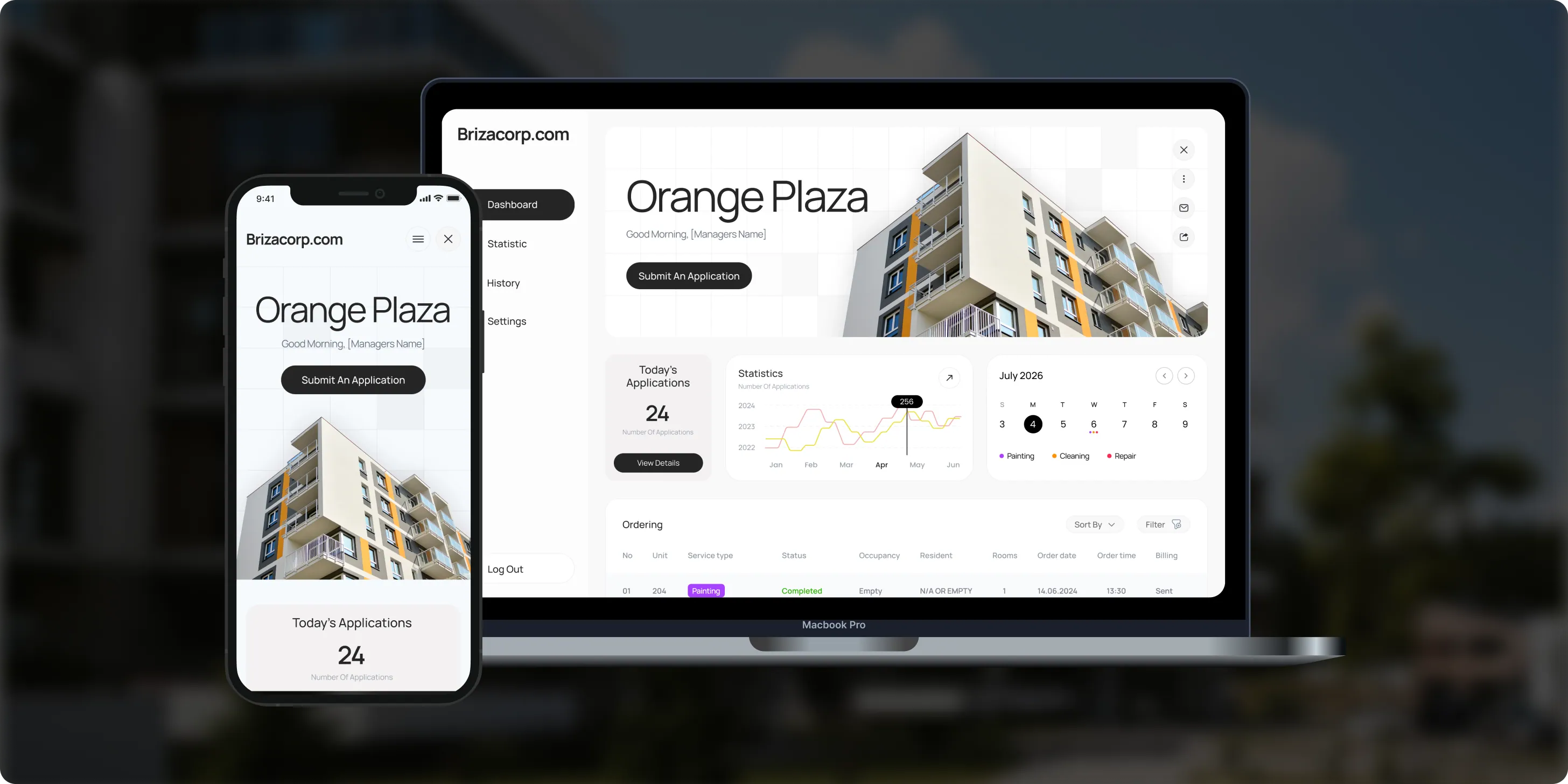
Brizacorp manages residential properties and coordinates the staff who handle painting, cleaning, and repair requests. Its team tracked work across messengers, phone calls, e-mail, and paper planners, with no single place to manage requests or measure performance.- 98%Application Stability
- 95%Utilization Rate
- 30%Faster Task Completion
A day with the data entry agent

7 AM · Agent
What the agent does alone, and where people sign off. Drafts records from overnight forms and emails.
8 AM · Agent
Checks values and flags a likely duplicate.
9 AM · Person approves
A reviewer confirms highlighted fields and merges the duplicate.
2 PM · Person approves
A manager approves a billing address change.
5 PM · Agent
Sends the daily report: entered, corrected and waiting.
Risks in AI data entry, and how we handle them
Each risk gets a control in the agent before launch, tested on your past records.

How we keep your data safe
Every value traced to its source
Data stays in your systems and your own vendor accounts. The agent reads only the fields each record needs, never deletes records and logs every value it writes. Before launch, our AI red teaming service tests the agent with tricky documents, and our AI governance service documents its limits for your compliance team. Health records have their own rules: our guide to HIPAA-compliant AI explains what changes for patient data.
Your vendor accounts
Model calls for each document run on your own Anthropic, OpenAI or cloud accounts, under your terms with each vendor.
Only the fields it needs
Each request sends only the fields the record needs, and sensitive values are masked where the task allows it.
Access follows your roles
Access follows the roles in each target system, so the agent writes only where a clerk could. Payment details and deletions always wait for a named person.
Keys out of code
Target system API keys stay in your secrets manager, never in code or prompts.
Every value logged
Every value written is logged with its source document and reviewer.
Insured
SoftDoes carries general liability, professional liability (errors and omissions) and cyber liability insurance. A certificate of insurance is available on request.
Guardrails: what the data entry agent never does alone
We test each limit through AI red teaming and document it with our AI governance service.
> No overwriting good data <
> No guessing <
> No payment detail changes <
> No deletions <
How to choose data entry automation software
Ask these questions of any data entry product or builder before you sign. A strong data entry vendor answers each one in writing.
Questions to ask, and what a good answer includes
- Will it work on our real documents? A test on your own samples, with field accuracy per document type.
- How does it handle unclear values? A review screen with uncertain fields highlighted, never a guess.
- What happens when a form or portal changes? The AI reads new layouts, and failed writes wait in a queue for a person.
- Can it write to systems without an API? Yes, through screen automation, with the same checks and logs.
- What can it never do alone? Overwrite existing values, change payment details or delete records.
- What does each record cost to run? Model usage at cost on your account, with an estimate per document.
- Who owns the field rules, prompts and code? You do, in your own repository and systems.
- What paperwork comes first? An NDA and a certificate of insurance before the first call.
What AI data entry costs to run
The build, maintenance and model usage, each set out in writing before work starts. Simple app-to-app copying with no documents to read can run as a workflow automation, from $2,500; monitoring and cost control is optional: setup $3,500, then from $500 a month. See AI agent development cost.
Build: one data entry flow
Extraction, checks, review screen, one system
From $5,000
1 or 2 extra systems
The same record in more systems
Add $3,000
3 or more extra systems
CRM, ERP, billing and more
Add $9,000
Maintenance and support
After launch
From $500 a month
AI model usage
On your own account, no markup
At cost
Project Discovery
Credited to the build
$490
Why operations teams build with SoftDoes
SoftDoes is a Claude Partner Network member and an OpenAI Registered Partner, rated 5.0 on Clutch. Your code and field rules stay in your own accounts.

- 01
Claude and OpenAI partners
A Claude Partner Network member and an OpenAI Registered Partner, with 40 AI projects delivered since 2020.
- 02
Vendor documents first
Our NDA and certificate of insurance reach your procurement team before the first call.
- 03
You own the agent and data
Field rules, prompts and code live in your accounts, and you own all of it.
- 04
Rated 5.0 on Clutch
5.0 from 40 client reviews, 36 verified by Clutch. More than half of the reviewers are founders, executives or department heads.
- 05
Top AI Company in Kansas City
Clutch named SoftDoes a Top AI Company and a Top Machine Learning Company in Kansas City for 2026.
- 06
Kansas City headquarters
Headquartered in Mission, KS, in the Kansas City metro. Call 800-909-2345 to reach the team.
AI data entry by industry
The same data entry agent, built around each industry's documents, systems and rules. Each industry page shows the use cases in detail.
Healthcare
Intake forms and faxed records entered into your EHR, with staff confirming uncertain fields.
Insurance
Claim forms and policy documents entered into your claims system for an adjuster to confirm.
Financial services
Applications and statements entered into your systems, with an audit log for every value.
Real estate
Listings, leases and market data entered into your database and kept current.
Logistics
Bills of lading and delivery paperwork entered into your TMS, with exceptions sent to a person.
Legal
Intake forms and documents entered into your case management system for review.


Questions about AI data entry
Accuracy, tools, Excel, RPA and cost.
Can AI do data entry work?
Yes. AI reads forms, emails, PDFs and scans, works out which value belongs in which field and types it into your system. It also checks values against your records, catching duplicates and typos. A person reviews fields the model is unsure of, which keeps accuracy high without retyping everything.
How do you automate data entry?
List each source and the fields it feeds, then decide which values need checks. Connect the sources, such as an inbox or portal, to an AI step that extracts the fields. Then write the results to your system through its API, and keep a review screen for uncertain values. Our guide on reducing manual data entry with APIs covers the API side.
How does AI reduce manual data entry for sales teams?
It logs emails, meeting notes and contact details into the CRM automatically, so reps stop copying them by hand. It also fills new leads from web forms and adds company data. Reps confirm anything uncertain in one review step. Our AI SDR goes further and qualifies the leads too.
What is the difference between AI data entry and RPA?
RPA copies data by following fixed clicks and rules, so it breaks when a form or screen changes. AI data entry reads documents and messages the way a person does, handling new layouts and free text. We often combine them: AI extracts and checks the data, and automation types it into systems without an API.
How much does AI data entry automation cost?
A data entry flow starts at $5,000, including extraction, checks, a review screen and a write to one system. Writing to one or two more systems adds $3,000. Maintenance starts at $500 a month, and AI model usage is billed at cost on your own account.
What AI tool can I use to automate data entry?
It depends on the source. Forms, PDFs and emails need an AI step that reads documents, such as a Claude or OpenAI model with checks around it. For clean data moving between apps, a workflow tool like n8n, Make or Zapier is enough. For systems without an API, screen automation finishes the job. We combine the three when a process needs it.
How can I automate data entry in Excel?
When data arrives as PDFs, emails or scans, an AI step reads each one and writes the values as new rows in your workbook. Uncertain cells are flagged for review before anyone relies on them. If the workbook only feeds another system, writing to that system directly is usually better. To work with Claude inside Excel itself, see Claude for Excel.
What is the best software for automating data entry tasks?
The best fit depends on your documents and systems. Off-the-shelf tools suit standard documents and popular apps. A custom agent suits teams with their own forms, several target systems or portals without an API. It starts at $5,000 and writes into the systems you already use, with a review screen your team controls.
How accurate is AI data entry?
It depends on your documents, so we measure accuracy before launch. We run last month's records through the agent and compare every field with what your team typed. You see the results by document type and field. Fields the model is unsure of always go to a reviewer, and each correction is used to tune the agent.
Can AI enter data into systems without an API?
Yes. When a portal or legacy system has no API, the agent types into its screens the way a person would, using screen automation. The same checks, review screen and logs apply. If the screens change, failed items wait in a queue with the source attached, and a person is alerted.
Can it read handwriting and poor scans?
Current AI models can read clear handwriting and many scans, but quality varies, so we test your own samples early. Values the model cannot read with confidence are left blank and highlighted for a reviewer. The agent never guesses to fill a field. If a source is often unreadable, the daily report shows it.
Is our data safe with AI data entry?
Yes, when the controls come first. Model calls run on your own vendor accounts, and each request sends only the fields a record needs. Access follows your system roles, keys stay in your secrets manager and every value written is logged. Payment details and deletions always wait for a named person.
How long does it take to automate data entry?
It depends on the number of document types, fields and systems. We set the scope, price and schedule in a written data entry plan before the build starts. Many teams begin with Project Discovery for $490, which is credited to the build. The plan lists what we need from you, such as sample documents and system access.
Who owns the agent and the data?
You do. Your records stay in your systems and your own vendor accounts. The code, prompts, field rules and test sets live in your repository, documented for your team. Your staff can run the agent without us, or we maintain it from $500 a month.
Updated · Reviewed by Orest Andrusyshyn, Founder and CEO


