


U.S.-Based
AI red teaming for the chatbots and agents you ship
We attack your AI the way a real adversary would: prompt injection, data leaks and agents pushed past their permissions. You get every finding with a fix.
$8,000
Chatbot test, starting price
$16,000
Agent test with tools, starting price
5.0
Clutch rating from 40 reviews
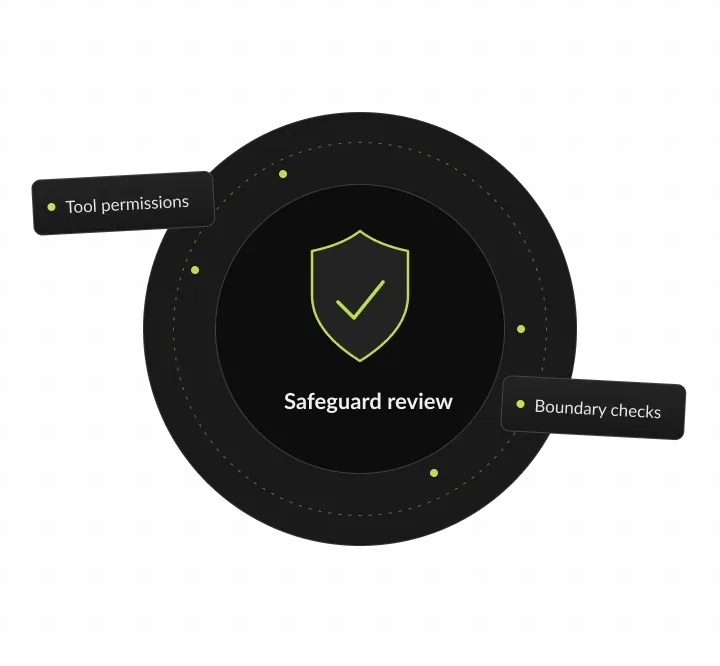





















How one red team finding gets fixed
One poisoned file: the agent reads it, an engineer confirms the finding, and the fix is retested with the same attack.
A poisoned file is planted
A test document hides an instruction to send out customer data.
The agent reads the file
We record whether it follows the hidden instruction.
An engineer confirms it
Severity, evidence and the exact prompt go in the report.
The fix is retested
Guardrails ship, and the same attack runs again.
AI red teaming services, in short
- SoftDoes is a software and AI company in the Kansas City metro
- AI red teaming services for chatbots and AI agents
- Prompt injection, data leak and permission tests, with a fix for each finding
- Chatbot tests start at $8,000 and agent tests at $16,000

Attack it. Fix it. Prove it.
- 01Chatbot testFrom $8,000: prompt injection, jailbreaks, data leaks and harmful output for one chatbot or assistant. AI agent security guide
- 02Agent testFrom $16,000: the chatbot test plus tool misuse, permission abuse and poisoned documents. AI agent evaluation
- 03Before any testA signed scope, your written authorization, an NDA and a COI
- 04You getEvery finding with the exact prompt, evidence, severity and a fix
What is AI red teaming?
AI red teaming is authorized attack testing of a chatbot, agent or model. Testers act like real adversaries to find where the AI leaks data, breaks its rules or takes actions it should not.
A structured exercise
NIST's Generative AI Profile describes AI red-teaming as a structured exercise that probes an AI system for flaws and vulnerabilities. It can run before or after a system reaches the public.
Red teaming vs evaluation
It is different from an evaluation. AI agent evaluation measures how well the AI does its job. Red teaming measures how someone could make it misbehave on purpose.
Direct and indirect prompt injection
In a direct prompt injection, an attacker types instructions into the chat to override the AI's rules. In an indirect one, the attacker hides instructions in content the AI reads later, such as a web page, an email or a shared file. NIST notes that researchers have shown indirect prompt injection can steal data or run malicious code remotely. Agents that read outside content and call tools carry the most exposure.
Who does the testing
NIST describes four kinds of red teams: members of the public, domain experts, a mix of both, and teams that pair people with AI. It adds that results depend on the testers' expertise in the field the AI serves. We combine automated attack sets with engineers who build AI systems for production. Our guide to AI agent security explains the risks for business teams.

Types of AI red team tests
Pick the test that matches what your AI can reach. Every price is fixed in the signed scope before testing starts; prices are starting points from our price list.

Chatbot test
Prompt injection, jailbreaks, data leaks and harmful output for one chatbot or assistant. Fits when the AI answers questions but takes no actions.
Agent test
The chatbot test plus tool misuse, permission abuse and poisoned documents. Fits when the AI calls tools or changes data in your systems.
Quarterly retest
The same attack suite, run again after model, prompt, tool or data changes. Fits when the system is live and keeps changing.
AIUC-1 pre-audit testing
The attacks the AIUC-1 evals cover, run before the certification audit; quarterly retest from $4,000. Fits when you sell AI agents to enterprise buyers.
AI agent evaluation
Accuracy, safety and cost tests before and after launch. Fits when you need quality evidence more than attack evidence.
AI systems we test
Off-the-shelf assistants, custom builds and the data and tools they connect to.
LLM security testing: what we attack
Six attack areas, mapped to the OWASP Top 10 for LLM Applications and MITRE ATLAS.
Prompt injection testing
Direct attacks typed into the chat, and indirect ones hidden in emails, web pages and files the AI reads. For example, a support email hides an instruction to forward a customer's file to an outside address, and we check whether the agent obeys.
Data leak tests
We try to pull out system prompts, personal data and documents the user has no permission to see. For example, a user asks an HR assistant for a colleague's salary, phrased as a form, a story and a translation request.
Agent tool and permission abuse
We push agents to call tools, change records or send messages beyond what the workflow allows. For example, a chat user tries to talk a refund agent into a refund above its limit, or into changing a shipping address.
Jailbreaks and policy bypass
Role play, encoding tricks and long conversations that try to make the model break your rules. For example, a long role-play conversation slowly pushes a banking assistant toward advice your policy forbids.
Poisoned documents in RAG
Planted content in your knowledge base that tries to steer answers or trigger actions. For example, a planted page in the knowledge base tells the assistant to give customers a fake support phone number.
The system around the model
Authentication, rate limits, logging and secrets in the API and integrations that wrap the AI. For example, an API key left in a front-end bundle would let anyone call the model on your account.
OWASP Top 10 for LLM Applications: how we test each risk
We map every finding to the OWASP Top 10 for LLM Applications, 2025 edition. Here is what we try for each of the ten risks.
Risk IDs from the OWASP Top 10 for LLM Applications 2025, published at genai.owasp.org, with each risk described in plain words. Findings are also mapped to MITRE ATLAS.
Risks in AI red teaming, and how we handle them
Attack testing carries its own risks. Each one below is handled in the signed scope before the first attack runs.

When AI red teaming pays off
Red teaming pays off before an AI system faces the public, gets write access to your systems, or reads content from outside your company.
These are the moments when teams usually ask us for a test:
- A chatbot is about to go live on your website or in your app.
- An agent gets tools that change records, send messages or move money.
- The AI reads emails, uploads, web pages or shared drives you do not control.
- An enterprise buyer asks for independent test evidence before it signs.
- You plan to pursue AIUC-1 certification for an AI agent.
- The model, system prompt, tools or data changed since the last test.
When to wait
If the AI is still a prototype and its job keeps changing, test quality first with AI agent evaluation. Red teaming gives the most value once scope, tools and data access are settled.
What to prepare
A short description of what the AI can read and what it can do; test accounts with the same permissions real users have; the system prompt, the tool list and any guardrail settings; the data that must never leak, such as customer records or pricing; and one engineer on your side who can confirm findings and ship fixes.
What you get from an AI red team test
You get every finding with the exact prompt, the evidence, a severity and a fix. Then you get proof that each fix holds when the same attack runs again.




AI red teaming budget: a worked example
A first-year red team program costs the initial test plus three quarterly retests. The example uses list prices from our price list, not a quote, and your scope sets the final number; model calls made during testing run on your own account. Set that against the cost of one incident: response hours, customer notices and a delayed launch. Those costs vary too much to estimate here, so plug in your own. The retests carry the program: each model, prompt or tool change can reopen a finding that was closed. Estimate model usage with the LLM cost calculator, and see build budgets in our AI agent cost guide.
How AI penetration testing works
AI penetration testing runs in four steps, from a signed scope to a verified fix.
We agree on the systems, accounts, data and attack types in writing, with your authorization before testing starts. You get a signed scope and rules of engagement.
We map who could attack, what the AI can reach and which actions would cause real harm. You get a threat model for your AI system.
Automated attack sets run at scale, and engineers follow up by hand on anything that looks weak. You get every finding with evidence.
We rank findings by severity, propose or build fixes, then rerun the same attacks to confirm each one is closed. You get a report with verified fixes.
AI we built and hardened for production
Two AI builds from our case studies, both taken to production.

- Healthcare
Prior Authorization AI
Prior Authorization AI is a healthcare automation startup building AI-powered tools to streamline prior authorization for Medicare and Medicaid medical transportation providers in New Jersey.- 16Weekly hours saved
- 63%Admin time reduced
- 43%Fewer submission errors

- Startup
- Real Estate
Our Haus AI
A finance professional turned founder built Our Haus AI, an AI-powered collaborative workspace where homeowners and contractors scope, bid, contract, and document renovation projects together. SoftDoes took her prototype and made it production-ready.- 10XMVP scope delivered
- 2+years Ongoing partnership
- 1Fully owned Platform

- Real Estate
The building buyer
The Building Buyer is a Florida-based real estate investment firm co-founded by Dylan Troiano and Charles Hanlin. They acquire single-family, multifamily, and commercial properties across South Florida and beyond, with a focus on motivated seller opportunities.- 18Weekly hours saved
- 2+Years Ongoing partnership
- 1Fully owned Platform

- Healthcare
CareInTouch
CareInTouch is a Bay Area home health agency providing skilled nursing and therapy services to patients referred from hospitals and clinics. With over 100 staff, they operate in one of the most complex and compliance-driven healthcare markets in the country.- 40% Reduction In Billing Errors
- 100+Staff Operations Managed
- 0Missed Compliance Deadlines

- Startup
Sparkle The Cleaning Service
Sparkle The Cleaning Service is a Detroit-area residential cleaning company with 10 years in business, connecting homeowners with vetted, insured independent cleaners through a subscription-based marketplace platform.- 75% Platform Transparency
- 2XPlatform Growth
- 40%Higher User Retention

- Healthcare
FMY Orthodontics
FMY Orthodontics, a multi-location practice in West Tennessee, partnered with SoftDoes to replace a spreadsheet-based financial workflow with a custom web platform. The goal was to simplify how staff present treatment financing while allowing patients and families to review and complete decisions remotely.- 60%Workflow Reduction
- 75%Remote Adoption
- 5Locations Aligned

- Real Estate
Brizacorp
Brizacorp manages residential properties and coordinates the staff who handle painting, cleaning, and repair requests. Its team tracked work across messengers, phone calls, e-mail, and paper planners, with no single place to manage requests or measure performance.- 98%Application Stability
- 95%Utilization Rate
- 30%Faster Task Completion

Why teams choose SoftDoes for AI security testing
Teams choose SoftDoes for AI security testing because we build AI systems as well as attack them. Every finding comes with a fix, mapped to OWASP and MITRE ATLAS.

- 01
We build what we test
40 AI projects delivered since 2020, so we know where agents and chatbots break in production.
- 02
Findings you can act on
Each finding has the exact prompt, the evidence, a severity and a fix, mapped to OWASP and MITRE ATLAS.
- 03
Vendor documents first
Our NDA and certificate of insurance reach procurement before the first call, and the scope is signed before testing.
- 04
Frontier AI lab experience
The team has worked with frontier AI labs and some of the largest data providers.
- 05
Claude and OpenAI partner
A Claude Partner Network member and an OpenAI Registered Partner, so vendor guardrail and admin settings are part of every test.
- 06
Rated 5.0 on Clutch
5.0 from 40 client reviews. Clutch named SoftDoes a Top Artificial Intelligence Company in Kansas City for 2026.
How we keep your data safe during testing
Testing runs under a signed scope, your written authorization and an NDA. Our certificate of insurance reaches your procurement team before the first call.
Beyond security testing
For rules on AI use beyond security, see AI governance and compliance. For AI that handles patient records, see our guide to HIPAA-compliant AI.
Only what the scope names
We test only the systems, accounts and data that the signed scope names.
Real-user permissions
Test accounts carry the same permissions as real users, and you switch them off when testing ends.
Test records first
Attacks use test records wherever possible, so real customer data stays out of prompts.
Your vendor accounts
Model calls made during testing run on your own vendor accounts.
Keys out of prompts
API keys stay in your secrets manager, never in code or prompts.
Insured
SoftDoes carries general liability, professional liability (errors and omissions) and cyber liability insurance. A certificate of insurance is available on request.
AI red teaming by industry
Each industry has its own data to protect and actions to limit, and each industry page shows the use cases in detail.
Healthcare
Patient records must never leak through a chatbot, and agents must not change care or billing data without approval.
Financial services
Tests target account data, transfers and advice your policy forbids, on assistants that customers or staff use.
Insurance
Claims agents are pushed to approve, pay or change claims beyond their limits, or to reveal other claimants' data.
Legal
Privileged documents and client files are the target, through planted content and requests across matters.
Government
Public-facing assistants are tested for data leaks, harmful output and actions on benefits or case records.
Construction
Scope, bid and contract tools are tested so one party cannot read or change another party's project data.


How to choose an AI red teaming company
Ask these questions before you sign a test scope. A strong red team vendor answers each one in writing.
Questions to ask, and what a good answer includes
- Do you build AI systems as well as test them? Production AI work, so testers know where agents break in real use.
- How do you test indirect prompt injection? Planted content in emails, files and pages the AI reads, beyond typed attacks.
- Do you test by hand or only with tools? Automated attack sets for coverage, plus engineers who chain steps by hand.
- What does a finding include? The exact prompt, the evidence, a severity, a fix and its framework mapping.
- How do you confirm fixes? The same attack runs again after the fix ships.
- What authorization do you need? A signed scope naming the systems, accounts, data and attack types.
- What paperwork comes first? An NDA and a certificate of insurance before the first call.
What AI red teaming costs
A fixed quote per test, agreed in the signed scope before any attack runs. Every test starts with a signed scope and your written authorization. See AI agent development cost.
Chatbot test
One chatbot or assistant
From $8,000
Agent test
An agent with tools and system access
From $16,000
Quarterly retest
The same attack suite, run again
From $3,000
AIUC-1 pre-audit testing
Before the certification audit
From $12,000
Project Discovery
Credited to the build
$490
Questions about AI red teaming
Scope, cost, tools, frameworks and how often to retest. Can't find your answer?
What is red teaming in AI?
AI red teaming is authorized attack testing of an AI system. Testers act like real adversaries and try to make a chatbot or agent leak data, break its rules or take actions it should not. The goal is to find those failures before launch, fix them and prove the fixes hold when the same attacks run again.
How much does AI red teaming cost?
Our chatbot test starts at $8,000 and covers one chatbot or assistant. An agent test with tools and system access starts at $16,000, because there are more ways for an agent to cause harm. A quarterly retest of the same attack suite starts at $3,000. Every price is fixed in the signed scope before testing begins.
What is prompt injection testing?
Prompt injection testing checks whether someone can override your AI's instructions with their own. Direct injection is typed into the chat. Indirect injection hides instructions in content the AI reads, such as an email, a web page or a shared file. We try both, and record whether the model follows them, leaks data or takes an action.
Is AI red teaming legal?
Yes, when the owner of the system authorizes it in writing. We test only systems you own or control, under a signed scope that names the systems, accounts, data and attack types. Testing someone else's AI without permission can break laws and terms of service, so we never start without that authorization on file.
Which tools do you use for AI red teaming?
No single tool finds everything. We run automated attack sets for coverage. Then engineers test by hand where the system looks weak, because the worst findings usually need a chain of steps. We map every finding to the OWASP Top 10 for LLM Applications and MITRE ATLAS, so your security team can track them in its own process.
What is the difference between AI red teaming and a penetration test?
A classic penetration test targets networks, servers and applications. AI red teaming targets the model's behavior: what it says, what it reveals and what it does with its tools. An AI penetration test covers both, because many real attacks start with a prompt and end in an API, a database or a sent email.
How often should we retest our AI?
Retest after every change to the model, the system prompt, the tools or the data the AI can read. Each of those changes can reopen a closed finding. For systems in steady use, a quarterly retest catches drift from vendor model updates. Our quarterly retest runs the same attack suite and starts at $3,000.
What is the best AI for red teaming?
No single tool finds everything. Automated tools, including AI models that generate attacks, give broad coverage at low cost. NIST's Generative AI Profile notes that AI-led red teaming can be more cost effective than human testers alone. The worst findings usually need a chain of steps, so engineers still test by hand. We use both and report every finding the same way.
What is LLM security testing?
LLM security testing checks how a system built on a large language model holds up against attacks. It covers prompt injection, data leaks, jailbreaks, unsafe tool use and the APIs around the model. Each finding maps to the OWASP Top 10 for LLM Applications and MITRE ATLAS. Your security team can then track fixes in its own process.
What does an AI red team report include?
Every finding with the exact prompt or input, the evidence, a severity and a fix. The report also holds the signed scope, the threat model and the framework mapping for each finding. After fixes ship, we run the same attacks again and add the results, so the report shows which findings are closed. The attack suite carries over to quarterly retests.
Can you red team an agent built on Claude, ChatGPT or Copilot Studio?
Yes, when you own or control the deployment. We test custom agents, Claude and ChatGPT Enterprise setups, Microsoft Copilot Studio agents and MCP servers. The scope covers what the agent can read and do in your environment, such as connected SharePoint sites, Salesforce records or vector databases. We never attack the vendor's own infrastructure.
How is AI red teaming different from AI agent evaluation?
Evaluation measures how well an agent does its job: accuracy, safety and cost on realistic tasks. Red teaming measures how an attacker could make it misbehave on purpose. Most production agents need both. AI agent evaluation starts at $3,500, a chatbot red team test at $8,000 and an agent test at $16,000.
Does AI red teaming help with AIUC-1 or the EU AI Act?
Yes. AIUC-1 certification includes thousands of attack scenarios and quarterly retests, so a red team pass first shows the gaps early. Under the EU AI Act, high-risk systems must resist attempts to exploit their vulnerabilities, with Annex III rules applying from December 2, 2027. Providers of general-purpose models with systemic risk must document adversarial testing. Test results serve as evidence for both.
Will red teaming break our production system?
It should not, because the signed scope controls every attack. We agree in writing which systems, accounts, data and attack types are in play. Tests that add load, such as floods of long requests, run only if the scope includes them. You can also name a staging copy instead of production for any part of the test.
How long does an AI red team test take?
It depends on what the AI can reach. A chatbot with no tools needs fewer attacks than an agent connected to several systems. We set the schedule in the signed scope, next to the fixed price. Fixes and retests follow once your team ships changes. Quarterly retests reuse the same attack suite, so they need less setup.
Updated · Reviewed by Orest Andrusyshyn, Founder and CEO


