Custom energy software development helps U.S. and Canadian utilities, IPPs, ESCOs, and retail energy providers cut operating costs, improve grid reliability, and accelerate the shift to clean power. Whether you run a regional electric cooperative or a national renewable energy portfolio, the right software turns fragmented data into operational clarity and gives your teams the tools to act in real time.- Grid analytics platforms that unify SCADA, AMI, and DER telemetry into a single operational view
- Energy management systems for generation, transmission, and distribution optimization
- DER and EV charging platforms for monitoring, dispatch, and customer programs
- Trading, billing, and regulatory compliance tools built for North American markets
We understand the challenges you're facing
These are the problems we hear most often from energy leaders across the U.S. and Canada, from utility executives and grid operators to renewable energy companies launching new programs.
"We have data from meters, inverters, and SCADA, but no single source of truth."
Most utilities collect massive volumes of energy data from smart meters, SCADA systems, inverter telemetry, and weather feeds, but that data lives in separate silos with different formats, refresh rates, and quality standards. A Siemens and Oxford Economics survey of 100 electric utilities in the U.S. and Canada found that utilities estimate visibility into only about 36% of DER assets through DERMS or similar platforms. Custom energy software solves this by building a unified data layer that ingests, cleans, and normalizes readings from AMI head ends, SCADA historians, and IoT sensors into a single store. Data quality and accuracy are fundamental for reliable energy management decisions. The result is one consistent picture for operations, planning, and regulatory teams, so nobody is working from a different version of the truth.
"Our grid teams can't see real time conditions across distributed energy resources."
With 92% of North American utilities now reporting DERs on their systems, the grid is no longer one directional. Yet only 14% of utility leaders surveyed had access to all behind the meter DER locations, and just 20% could see all behind the meter generation and load data. Custom software development addresses this by building real time monitoring dashboards that pull inverter status, battery state of charge, and EV charger load alongside traditional SCADA feeds. Smart grids rely on IoT connectivity for real time monitoring and automation. These platforms give distribution operators and reliability engineers the visibility they need to prevent voltage issues, manage congestion, and dispatch distributed energy resources effectively.
"Regulatory reporting and compliance for FERC, NERC, and local regulators is eating our time."
Utilities in the U.S. must comply with NERC reliability standards, NERC CIP cybersecurity requirements, FERC orders like Order 2222 for DER market participation, and NAESB data exchange standards, while Canadian utilities face provincial regulators and data residency rules. Compliance software automates regulatory processes for renewable energy businesses by pulling reliability indices, outage statistics, and interconnection data directly from operational systems. Energy management solutions need to comply with sustainability and regulatory requirements, including ISO 14001 and ISO 50001 frameworks for establishing energy management systems. Custom software replaces manual spreadsheet driven reporting with automated pipelines that format submissions, maintain audit trails, and flag gaps before deadlines, freeing your regulatory team for higher value work.
"We're rolling out EV charging and solar programs but our legacy systems can't keep up."
Legacy CIS, billing, and OMS platforms were designed for one way power delivery and flat rate structures, not for managing dynamic pricing, net metering, community solar enrollment, or EV charger networks, which is why many utilities turn to custom software development for energy and utilities to bridge the gap without disrupting core operations. Energy software development faces challenges related to legacy infrastructure integration, and rip and replace projects carry enormous risk. The better path is custom software solutions that wrap modern APIs around existing systems, enabling new program management, customer portals, and data analytics without destabilizing core operations. This approach lets you launch renewable energy projects and EV programs on a modern stack while your legacy platforms continue to handle what they do well.
"We worry about cybersecurity when connecting OT assets, cloud platforms, and field apps."
The convergence of operational technology and IT opens serious risk vectors. Older SCADA protocols often lack encryption, field devices may be unpatched, and connecting OT networks to cloud analytics or mobile field apps creates new attack surfaces. Role based access control is essential for securing energy management platforms, and software tools are being developed for dynamic security protocols in energy systems. Custom energy software built for the energy sector embeds security from the ground up: encrypted communications, identity and access management across OT and IT boundaries, intrusion detection aligned with NERC CIP, and regular penetration testing, so your digital transformation does not become a liability.
You power the grid. We engineer the software behind it.
SoftDoes works as an energy software development partner for organizations across generation, transmission, distribution, trading, and customer programs. We build software systems that integrate with your existing physical infrastructure and operational workflows, not generic tools that need months of configuration.
Operational & Grid Intelligence Platforms
These platforms unify AMI, SCADA, IoT sensors, and weather feeds into a single operational view so control centers, grid planners, and reliability engineers can make faster and better decisions. Energy Management Systems optimize energy production and distribution while enhancing operational efficiency and reducing costs.
- Real time dashboards combining SCADA, smart meter, and DER telemetry for operators, with high frequency telemetry ingestion for effective performance monitoring
- Grid analytics for load forecasting, congestion analysis, and outage prediction built on cloud data platforms using big data analytics
- Integration adapters for common OT and IT systems (DMS, OMS, EMS, GIS) without disrupting existing workflows or requiring risky changes to core infrastructure
Customer & Program Management Solutions
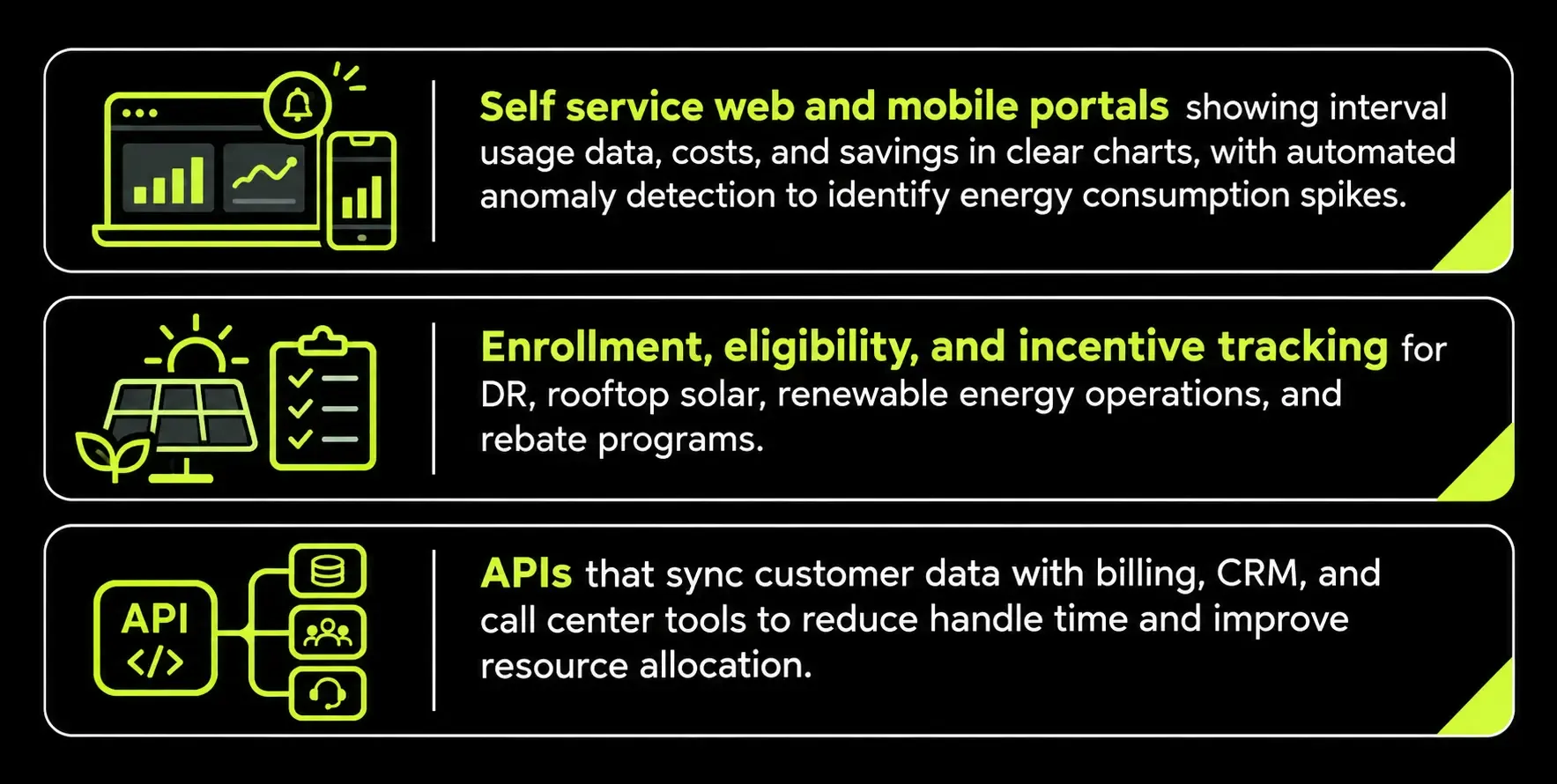
Modern portals and management software for residential, commercial, and industrial customers support demand response, community solar, EV charging, energy efficiency programs, and rebate tracking. These tools connect to existing CIS and CRM systems but deliver modern UX and near real time usage insights.
Energy Analytics, Optimization & AI
AI and machine learning are increasingly integrated into energy software for predictive analytics, dispatch optimization, and asset performance management across renewables, energy storage, and conventional fleets. Advanced forecasting tools improve grid reliability and energy dispatch, and machine learning models can improve energy forecasts and operational decisions.
- Forecasting models for load, solar farms, and wind production using historical, weather, and energy market data to optimize energy production
- Optimization engines for battery, microgrid, and demand response control based on tariffs, constraints, and ISO/RTO market signals
- Predictive maintenance models for turbines, inverters, and transformers using sensor streams, because predictive maintenance reduces operational downtime significantly and AI technologies predict equipment failures before they occur
Case studies in energy software that actually ships
These are representative examples of the types of renewable energy software and energy platforms SoftDoes designs and engineers for North American energy companies.
- U.S. solar plus storage provider - Custom platform integrating inverter telemetry, battery performance data, and ISO market signals for asset monitoring, dispatch optimization, and energy trading. Digital twins are used to model physical energy assets for performance simulations across the renewable energy portfolio.
- Canadian electric utility - Analytics layer built on top of AMI interval data for outage detection and load forecasting at the feeder and transformer level, combining usage data with weather and census data to guide infrastructure upgrades and optimize operations.
- North American EV charging network - Backend system and mobile app for charger management, dynamic pricing, driver experience, and integration with retail billing and demand response programs.
- Fuel and LNG operator - Modernization of a legacy reporting and scheduling system into a secure cloud based portal with automated compliance reporting, asset tracking, and operational dashboards, drawing on our experience building data driven oil and gas software for complex midstream and downstream operations.
Why they choose SoftDoes
Energy leaders partner with SoftDoes instead of generic development shops because the energy sector demands domain knowledge, security discipline, and respect for operational constraints that most software teams simply do not have.
SENIOR ENGINEERS, NOT LAYERS
Energy projects at SoftDoes are staffed with small teams of senior engineers who have direct experience with OT and IT integration, real time data engineering, and security requirements for critical infrastructure. Our engineers understand SCADA protocols, AMI platforms, field device communication, cloud data lakes, and streaming pipelines. Fewer handoffs mean real decision makers are on every call, which accelerates progress and reduces miscommunication. We work alongside utility engineering teams, grid operators, and program managers, not just IT departments. SoftDoes invests in domain knowledge across regulation, grid operations, and renewable energy technology so our teams speak the same language as yours.
PREDICTABLE DELIVERY
SoftDoes breaks complex energy software development work into clear phases: discovery, architecture, MVP, iterations, and rollout, following a broader digital transformation services approach that ties technology modernization to measurable business outcomes. We run short sprints with risk logs focused on OT integration challenges, data volume concerns, and data quality issues, plus early proof of concept work using real meter or device data. Shared roadmaps, regular demo cadence, and stable release plans are aligned with utility change windows and planned outages. Coordination with field teams, NERC CIP maintenance windows, and seasonal load cycles is built into every project plan. Our estimates include regulatory reviews, security testing, and performance tuning, not just feature coding.
BUILT TO LAST PAST LAUNCH
SoftDoes designs software systems for 5 to 10+ year lifespans in environments where physical assets and grid equipment last decades. We use modular services, well documented APIs, and cloud native designs that can adapt as you add new meters, distributed energy resources, tariff structures, or renewable energy sources. Logging, monitoring, alerting, and test automation are built for high availability operations. Code quality, thorough documentation, and knowledge transfer ensure that in house teams can own and evolve the system over time. We plan for maintenance budgets and version upgrades tied to vendor and regulator timelines.
NO BABYSITTING REQUIRED
SoftDoes works with minimal supervision because our teams understand energy business goals, not just tickets. We flag integration risks proactively, suggest simpler workflows where possible, and spot data issues early rather than waiting for someone to file a bug. Our product managers and tech leads coordinate with client stakeholders to reduce meeting burden for busy operations staff. We have proven expertise working in regulated and safety conscious environments where process and documentation are not optional. SoftDoes plugs into existing vendor ecosystems and internal teams without heavy handholding, supporting your digital transformation without adding management overhead.
What you can count on
This section covers how SoftDoes partners with you day to day, from the first workshop through long term support. Each phase is designed for the realities of building renewable energy software and energy platforms in regulated North American markets.
Energy focused discovery and roadmapping
Discovery workshops bring together operations, IT, regulatory, and program teams to map current systems, constraints, and priorities. We review SCADA and AMI architecture, data flows, compliance requirements, and existing vendor platforms. Outputs include a prioritized backlog, system map, risk register, and a phased delivery plan aligned with grid and budget cycles. Software development for renewable energy requires extensive market research, and our discovery process ensures nothing is overlooked.
Experience led UX and system design
We design for the people who will actually use the software: control room operators handling outage events, field technicians managing physical assets, traders watching the energy market, and customers checking their energy usage. Low friction UIs for high pressure tasks like dispatch, alarm management, and outage handling are paired with clear dashboards for executives. Clickable prototypes are tested with real users before heavy engineering begins, so you are not writing code for features nobody wants.
Robust engineering and integrations
SoftDoes builds cloud native and on prem components that integrate with EMS, DMS, OMS, CIS, GIS, and market interfaces including ISO/RTO systems across North America. Energy software should support multiple protocols for interoperability with various devices, and our architecture handles ingesting and processing high volume time series data from meters, inverters, and sensors. Cloud platforms are utilized for unified energy management and data accessibility. Secure development practices, role based access, and alignment with utility cybersecurity standards are standard on every project.
Support, evolution, and training after launch
After launch, SoftDoes provides continuous support: monitoring, bug fixes, enhancements, and adapting to regulatory or tariff changes as the renewable energy industry evolves. We deliver training sessions for operators, analysts, and support staff, along with documentation and runbooks. Collaborative roadmapping ensures the platform grows with you, whether you are adding DER programs, entering new markets, or expanding to new geographies.
Benefits of working with SoftDoes on energy software
U.S. and Canadian energy companies partner with SoftDoes because we combine deep energy sector knowledge with modern software engineering discipline. Here is what that means in practice:
- Faster time to production for EMS add ons, DER platforms, and advanced analytics tools without sacrificing safety or regulatory compliance. Building renewable energy software can cost between $30,000 and $200,000, and our phased approach keeps your cost line predictable.
- Real business impact such as reduced truck rolls, fewer outage minutes, more accurate load and renewable forecasting, and optimized maintenance schedules and costs through predictive maintenance and advanced analytics.
- Modernize around existing systems instead of risky rip and replace programs. We build custom software that wraps modern capabilities around your current OT and IT stack, preserving stability while enabling digital tools for the future.
- One partner for everything from custom development and AI/ML models to data engineering and UX for energy specific workflows. The global energy software market is projected to exceed $50 billion by 2027, and the renewable energy software market will reach $2.06 trillion by 2032. You need a partner who can keep pace.
- Long term ownership and clarity with complete knowledge transfer, documentation, and support, so your internal teams are never left with mystery code or vendor lock in. As the renewable energy sector grows, the software you invest in today needs to scale.









Comments (0)
No comments yet.