If you are building or expanding an EV charging network in the United States or Canada, the software behind your chargers will shape everything from uptime and revenue to driver satisfaction. But what does it actually cost to build that software in 2026 and 2027? This guide breaks down realistic numbers by component, compares build vs buy options, and offers practical tips for keeping your development budget under control.Key Takeaways
- EV charging software development costs range from $40,000 to $250,000 or more depending on scope, with MVPs starting around $40,000 to $90,000 and enterprise platforms reaching $350,000 and beyond.
- The biggest cost drivers are backend and OCPP integration, billing and payment processing, load management, and driver facing apps. Each can be phased to spread investment over time.
- SaaS per port fees of $10 to $50 per port per month are often more economical for networks under about 150 ports, while custom builds start paying off around 300 or more ports.
- Ongoing operating costs for cloud hosting, third party APIs, and maintenance typically add 15 to 25 percent per year on top of the initial build cost.
- Smart decisions around tech stack and feature scope can cut EV charging app development cost by 20 to 30 percent without sacrificing reliability. SoftDoes helps charging network operators and fleets navigate these tradeoffs through phased roadmaps and build vs buy analysis, backed by custom EV charging software development services.
What Is EV Charging Software and Why Its Cost Matters
EV charging software is the management software that connects physical chargers, EV drivers, and back office systems across EV charging networks. An EV charging ecosystem usually comprises three main software layers: a driver facing mobile app, an operator dashboard, and a backend platform that handles communication, billing, and business logic.
This software governs how network operators earn revenue, manage uptime, handle load management, and deliver a seamless user experience. Underinvesting in architecture or integration quality usually raises operating costs later through higher support volume, lost sessions, and hardware workarounds.
Each layer of the platform impacts the total budget differently. The driver facing EV charging app handles station search, payment integration, and session tracking. The operator dashboard provides real time monitoring and tariff setup. The backend manages charging sessions, tariffs, and connectivity with electric vehicle supply equipment through protocols like the open charge point protocol. This article focuses on EV charging software development cost for businesses in the U.S. and Canada planning new platforms in 2026 and 2027.
Quick Cost Summary: What You Can Expect to Pay in 2027
A comprehensive breakdown outlines the estimated costs by project tier. Here is what custom EV charging software development typically costs in North America right now.
An MVP or basic platform runs about $40,000 to $90,000 and takes roughly 3 to 5 months. This gets you basic OCPP integration, a single driver app on one mobile platform, simple billing, and a minimal operator dashboard. It is a solid starting point if you need to validate your business model or launch a small charging network.
A mid range build runs $90,000 to $200,000 over 5 to 9 months. This tier adds both iOS and Android apps with shared code, richer analytics, support for different charger brands, roaming capabilities, and moderate UI/UX polish. Most operators launching a regional EV charging platform land here.
An enterprise platform starts at $200,000 to $350,000 and can exceed $500,000 depending on scope, with timelines of 9 to 14 months. This includes multi tenant architecture, fleet integrations, advanced load management, ISO 15118 support, white label apps, and deep analytics. Understanding how much it costs to build an MVP can help you decide which tier makes sense as a starting point.
As an alternative, SaaS EV charging management software charges roughly $10 to $50 per port per month in the U.S. and Canada. For operators with fewer than about 150 ports, this model often costs less than building a custom platform, at least in the short term.
Core Cost Components of EV Charging Software
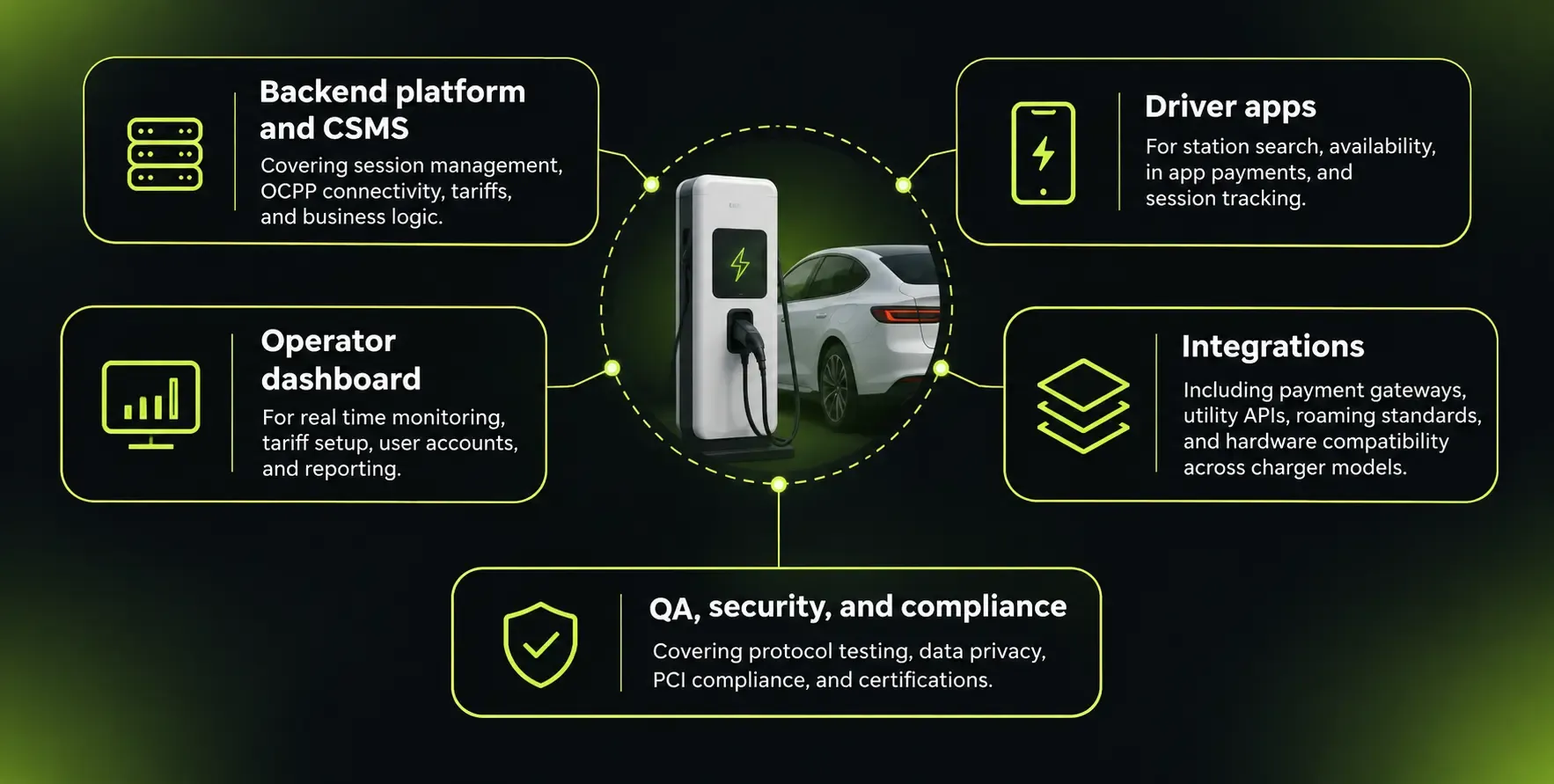
Building a complete EV charging management platform involves significant architectural complexity. The total EV charging software development cost breaks into five main workstreams.
Effective testing is critical due to the interaction of software with hardware and financial transactions. Each workstream can be phased. For example, you might start with a web dashboard and basic backend, then add native mobile apps and advanced features in later releases. This is how SoftDoes typically structures custom software development estimates so energy teams can cut or postpone features without derailing the project.
Backend Platform and OCPP Integration Costs
The backend is the largest line item in most EV charging software projects. Backend development for 20 to 50 chargers costs $40,000 to $80,000. For larger networks with more complex tariffs and multi vendor support, this can climb past $150,000. Backend infrastructure is essential for managing communication between chargers and the cloud.
OCPP, the open charge point protocol, enables interoperability between different charging station manufacturers. Without it, you are locked into one vendor's ecosystem. OCPP 1.6 is widely used across installed chargers in North America, with OCPP 2.0.1 gaining traction for its improved security hooks, reservation features, and smart charging capabilities. Planning for 2.0.1 now is wise if your EV charging infrastructure needs enterprise grade security or Plug and Charge support, though it adds implementation effort.
Supporting multiple charger manufacturers and firmware variants usually adds 15 to 30 percent to backend cost compared with a single vendor setup. Each brand has its own firmware quirks, error code implementations, and behavior differences. Certifying two common brands is significantly cheaper than five, so pick your initial hardware compatibility targets carefully.
Driver Apps and EV Charging App Development Cost
The estimated cost for a basic electric vehicle charging mobile app ranges from $30,000 to $50,000 for a single platform. Driver facing applications cost between $50,000 and $100,000 when building for both iOS and Android with a polished experience.
Driver mobile apps provide features like charger locator maps and real time status updates. The key features that push app development cost higher include real time availability filters, in app payments with secure tokenization, charging session tracking that shows energy consumed and estimated session cost, push notifications, and overstay or idle fees logic. Driver facing apps must provide accurate real time station status to reduce frustration and support calls.
When choosing between native development in Swift and Kotlin versus cross platform frameworks like React Native or Flutter, the tradeoff is performance and platform access versus speed and lower cost, which is why many teams lean on specialized mobile app development services for cross-platform apps. Cross platform development can save 25 to 35 percent on initial build, making it attractive for most mobile app development projects. Native apps tend to perform better for complex features like ISO 15118 certificate handling.
Custom branding and rich UI/UX design requirements can increase software development efforts, but investing in clear design and accessibility up front reduces support tickets and improves user engagement across EV charging networks over time.
Operator Dashboards and Management Software Cost
Web based management tools give network operators visibility into their entire charging network. Admin dashboards help operators monitor charger status and usage across sites. Real time monitoring detects charger status within seconds, enabling fast response to faults and outages.
Operator dashboard development costs between $35,000 and $80,000 depending on reporting depth, multi site support, and role based access control. Basic station management views showing faults, session summaries, and revenue are the priority for a first release. More advanced analytics covering utilization rates, failure patterns, and revenue by site add noticeable development hours and require dedicated data pipelines.
For the first phase, prioritize a clean, data rich dashboard over visualization extras. Exportable reports for finance or ESG teams are valuable but can be added in a later release to keep EV charging software development cost under control. The goal is to give EV fleet managers and site operators the essential features they need without overbuilding management systems too early.
Billing, Payments, and Revenue Management
Robust billing is one of the hardest and most expensive areas of EV charging software. Payment processing integration costs range from $30,000 to $65,000, and a full featured revenue management module with settlement logic and reconciliation can push toward $80,000.
Real world billing needs in the U.S. and Canada include tiered tariffs, time of day pricing, idle fees, per kWh or per minute rates where local regulations allow, coupons, and tax handling across states and provinces. Billing systems should support multiple pricing models like dynamic pricing, which adjusts rates based on real time demand and session duration. Charging session tracking that shows energy consumed and estimated costs is table stakes for electric vehicle users.
EV charging software integrates with payment gateways for seamless transactions. Common integrations include Stripe, Braintree, and Adyen. Security measures for EV charging software must comply with PCI-DSS and data privacy laws. The software must allow for handling sensitive user data securely with high level encryption, and you need to protect user data across every transaction.
Accurate reconciliation reports for accounting and partners save operating costs long term but require careful design. Operators must also meet regulatory reporting requirements for utility rebate programs, which vary by state and province.
Load Management and Energy Optimization Features
Load management in EV charging means balancing site power draw to avoid panel upgrades, demand charges from utilities, and grid penalties. For a fleet depot or multi tenant garage with dozens of ports, this feature directly affects energy costs and infrastructure investment.
Adding smart energy management logic to your EV charging platform typically costs $20,000 to $60,000 for dynamic load balancing, scheduled charging, and demand response hooks. Advanced features like smart charging and dynamic pricing significantly increase development costs, but they can dramatically lower electricity bills and defer expensive electrical upgrades.
The strongest use cases for load management include depots where multiple vehicles charge overnight, commercial garages with constrained power capacity, and sites participating in utility demand response programs. Integrating with utility APIs or local energy management systems adds custom work but can materially reduce long term operating costs. The ability to track energy usage and optimize energy consumption across a site is what separates a basic app from a serious EV charging management platform.
Key Factors That Drive EV Charging Software Development Cost
Several factors combine to determine your overall cost. Feature set and complexity sit at the top. Each additional capability layer, whether roaming, ISO 15118, fleet operations, or AI driven analytics, adds cost in a nonlinear way. Key cost drivers include hardware diversity and compliance with security standards.
EV charging networks can be impacted by geographic distribution and concurrent usage requirements. Supporting many charger brands, locations, user types, and tariff structures increases the test matrix, monitoring needs, and operational complexity. State utility rebate programs have varying reporting requirements, and the federal NEVI program requires specific uptime standards that may affect how you build your monitoring and reporting modules.
Regulatory compliance can result in increased costs during the development of EV charging software. App platform choice across iOS, Android, and web, plus team composition and project governance, often matter as much as raw engineering hours. The best approach is to prioritize must have features for launch and defer nice to have items to later phases using iterative development. SoftDoes uses phased roadmaps with costed milestones to give network operators clear tradeoffs between scope and spend.
Impact of Tech Stack and Architecture on Cost
Your tech stack directly affects both upfront development cost and long term maintenance cost. Common choices include Node.js with TypeScript or Java with Spring Boot for the backend, React or Angular for web dashboards, and React Native or Flutter for mobile platforms.
Cloud native architecture on AWS, Azure, or Google Cloud adds scalability and reliability but also introduces recurring infrastructure and DevOps costs. Real time monitoring requires event driven architecture for effective fault detection, which means investing in message queues like Kafka or RabbitMQ and designing pipelines for session events and meter values. When budgets are tighter, a simpler design with polling based updates can work for smaller networks. Understanding the tradeoffs between point to point and API led architecture helps you make smarter decisions here.
Selecting widely used technologies reduces hiring difficulty and maintenance costs over the life of the EV charging infrastructure platform. Niche frameworks or proprietary stacks might solve a narrow problem but create long term risk when you need to scale or replace team members.
Regional Development Rates and Team Structure in U.S. & Canada
Geographic location of development teams significantly affects hourly rates. In the U.S. and Canada in 2026 and 2027, senior backend or protocol engineers typically charge $120 to $180 per hour. Mid level engineers fall in the $80 to $120 range. Using blended remote or nearshore teams can reduce rates by 20 to 50 percent depending on the quality and oversight model.
A typical mid range build requires 3 to 7 core roles on the development team: product owner, UI/UX designer, backend engineers, mobile developers, QA engineer, and DevOps support. Common engagement models include a small dedicated team, an extended team with nearshore developers, or a blended arrangement with in house staff plus a software partner.
SoftDoes often uses mixed North American and global teams to keep quality high while optimizing app development cost. This blended approach works especially well for EV charging projects where domain expertise in OCPP and energy protocols can be concentrated on senior leads while development velocity comes from a broader team.
Ongoing Operating and Maintenance Costs
After launch, your EV charging platform has recurring costs that need their own line in the budget. These include cloud hosting, data storage, log aggregation and monitoring, payment API fees, map APIs, SMS and notification services, security patches, and support staff time.
For a growing network of 100 to 500 ports, infrastructure and third party tools typically cost $1,500 to $6,000 per month, scaling with usage volume and the number of active charging sessions. Managed cloud services can help control these costs with predictable pricing and proactive monitoring.
Annual maintenance and operational overhead can be 15 to 25 percent of the initial build cost for actively evolving EV charging networks. This covers bug fixes, performance tuning, protocol updates, and incremental feature work. Budget separately for compliance updates like new payment rules, utility program changes, or charger firmware patches, as these can arrive mid year and require fast implementation.
SaaS vs White-Label vs Custom Build: Cost Comparison
SaaS EV charging management software with per port subscription fees makes economic sense when you have fewer than about 150 ports or are running a pilot project. You get lower upfront cost, faster deployment, and ongoing support from the vendor. The tradeoff is limited flexibility in pricing models, branding, and integrations.
White label platforms sit in the middle. They offer faster deployment than a full custom build with branded apps and dashboards, but you accept constraints on customization and typically pay ongoing licensing or revenue share fees. Comparing these models to a custom AI SaaS build can help clarify where the cost crossover happens for your specific situation.
A custom EV charging platform is the best financial choice when you have a unique business model, a large or fast growing port count, or need deep integrations with fleet management systems, utility programs, or third party systems. Over a 3 to 5 year horizon, custom builds often deliver a lower total cost per port at scale while giving you full ownership and the ability to support business growth without vendor constraints. Run a total cost of ownership comparison across all three models before committing, using realistic assumptions about port growth and feature needs.
How EV Charging Software Reduces Operating Costs and Increases ROI
Real time monitoring and remote diagnostics can reduce field service visits by 40 percent, cutting truck rolls and labor expenses for network operators and fleets. Real time monitoring can also recover undetected downtime revenue by catching faults that would otherwise leave chargers offline for hours or days.
Charging apps improve customer experience by simplifying payments and delivering a seamless charging experience that keeps EV drivers coming back. Accurate billing with fewer payment failures directly increases captured revenue from charging sessions. EV charging apps can also generate new revenue streams through advertising, premium memberships, or fleet services.
Smart load management and demand response participation lower electricity bills and help operators avoid costly infrastructure upgrades. Data insights help businesses optimize pricing and capacity, turning raw usage data into actionable decisions about where to add ports, how to adjust tariffs, and when to schedule maintenance. Better driver experiences and reliable EV charging services raise utilization per port, improving payback on both hardware and software together.
Benefits of Working With SoftDoes on EV Charging Software
SoftDoes is a software engineering partner with experience in custom energy and utilities software development for enterprises and scale ups across the U.S. and Canada. As an app development company focused on mission critical systems, SoftDoes brings capabilities directly relevant to EV charging and broader renewables, including custom renewable energy software development services, data engineering for analytics and reporting, AI and ML for load forecasting, and cloud native architectures built for scale.
The SoftDoes process starts with cost modeling and build vs buy analysis, then moves into phased roadmaps with itemized cost ranges for each release. This consultative approach gives EV charging operators and fleet managers clear visibility into tradeoffs between scope, timeline, and development budget before a single line of code is written.
Engagement models are flexible. You can bring in a dedicated team, run a co delivery model with your in house IT group, or start with advisory plus implementation. Whether you need a single platform MVP or a multi site central management system with remote monitoring and fleet integrations, SoftDoes structures the work to match your maturity and budget.
Practical Budget Planning Tips for 2027 Projects
Start with a 2 to 4 week discovery phase to capture your hardware list, charger brands, target users, pricing rules, and integration requirements. Budget roughly $15,000 to $25,000 for this phase. The clarity it provides prevents scope creep and misestimated integrations that inflate costs later.
Create a feature priority matrix organized into must have, should have, and could have categories. This lets you phase investment over 12 to 24 months using iterative development instead of overbuilding your first release. For example, you might defer roaming, vehicle availability tracking for multiple vehicles, or advanced analytics to a second phase while launching with core charging and billing functionality.
Add a 15 to 20 percent contingency buffer for surprises. Charger firmware quirks, new utility requirements, or expanded reporting needs have a way of appearing mid project. Use the app development cost calculator to get an early sense of where your project might land, then have a conversation with a partner like SoftDoes to validate assumptions around scope, timeline, and EV charging software cost before locking anything in.











Comments (0)
No comments yet.