Development costs for oil and gas software can range from $30,000 to several million dollars, depending on scope, integrations, and regulatory burden. This guide breaks down every major cost factor so U.S. and Canadian operators can budget accurately, compare vendor proposals, and avoid the overruns that plague projects built without clear data.
Table of contents1. Key Takeaways2. Quick Answer: What Does Oil and Gas Software Development Cost in 2026?3. What Makes Oil and Gas Software Development Different (and More Expensive)?4. Typical Oil and Gas Software Use Cases and Their Cost Profiles5. Cost Breakdown by Segment: Upstream, Midstream, and Downstream6. Core Cost Drivers in Oil and Gas Software Development7. Impact of SCADA, OT, and Historian Systems on Cost8. Cloud Infrastructure, Data Architecture, and Ongoing Platform Costs9. Security, Compliance, and Regulatory-Driven Costs10. Custom Software vs Off-the-Shelf Gas Software: Cost Tradeoffs11. Pricing Models Used by Oil and Gas Software Development Companies12. Discovery and Architecture: The First 10 to 20% of Your Budget13. How Remote Sites, Offline Work, and Harsh Conditions Affect Cost14. Team Composition and Location: How Talent Mix Changes Cost15. Hidden and Ongoing Costs: Maintenance, Support, and Enhancements16. Strategies to Reduce Oil and Gas Software Development Costs Without Cutting Quality17. How SoftDoes Approaches Oil and Gas Software Projects (Cost-Aware Delivery)18. Benefits of Working With SoftDoes19. Estimating Your Own Oil and Gas Software Budget: A Step-by-Step Checklist Key Takeaways
Oil and gas software development cost differs from generic custom software because of operational technology (OT) systems, safety critical environments, and the regulatory landscape across the U.S. and Canada. A standard back-office app does not need to pull real-time sensor data from a compressor station in northern Alberta or produce audit trails for PHMSA inspectors. Oil and gas software does.
- An MVP (basic production dashboard or single mobile field app) runs $80,000 to $150,000 and takes 3 to 5 months.
- Mid-range systems (production accounting, HSE tracking, field service management with historian integration) cost $200,000 to $600,000 over 6 to 14 months.
- A full digital oilfield platform costs $1 million or more and takes 12 to 24 months when connecting SCADA, historians, ERP systems, and multiple asset types.
- Annual maintenance typically runs about 15 to 20% of the build cost, covering bug fixes, security patches, small enhancements, and cloud monitoring. Budget this from day one.
- The biggest cost multipliers are SCADA integration, data volume from field sensors, compliance reporting requirements, and the number of remote sites with limited connectivity.
SoftDoes helps operators structure scope, choose the right architecture, and phase delivery to control total cost of ownership across the full lifecycle.
Quick Answer: What Does Oil and Gas Software Development Cost in 2026?
Custom oil and gas software costs between $60,000 and several million, depending on whether you are building a single workflow app or a multi-asset enterprise platform. Basic internal tools for oil and gas software range from $8,000 to $22,000. Mid-level custom software for oil and gas typically costs between $22,000 and $70,000. Enterprise-grade platforms in the oil and gas sector can exceed $275,000.
For U.S. and Canadian operators planning 2026 or 2027 budgets, here are the ranges that match real project data:
- $80,000 to $150,000 for a narrow MVP: one SCADA or historian feed, one production monitoring dashboard, limited user roles. Delivery in 3 to 5 months.
- $200,000 to $600,000 for core gas software like production accounting, HSE incident tracking, or field service management integrated with historian systems. Timeline: 6 to 14 months.
- $700,000 to $1.5M+ for full digital field or multi-asset platforms with SCADA integration, historian systems, ERP connectors, predictive analytics, and compliance reporting. Timeline: 12 to 24 months.
Cost depends more on integrations (SCADA protocols, historian data quality, cloud infrastructure design) and compliance scope than on the visible number of screens or reports. The project timeline and scalability affect the overall budget; phasing work across budget cycles lets you validate assumptions at each stage before committing more capital.
The rest of this article breaks down every major cost driver so you can sanity-check quotes from any oil and gas software development services provider.
What Makes Oil and Gas Software Development Different (and More Expensive)?
Gas software development must work across wells, pipelines, terminals, and refineries, often at remote sites with unstable cellular or satellite connections. That operating reality separates it from a typical SaaS or back-office build.
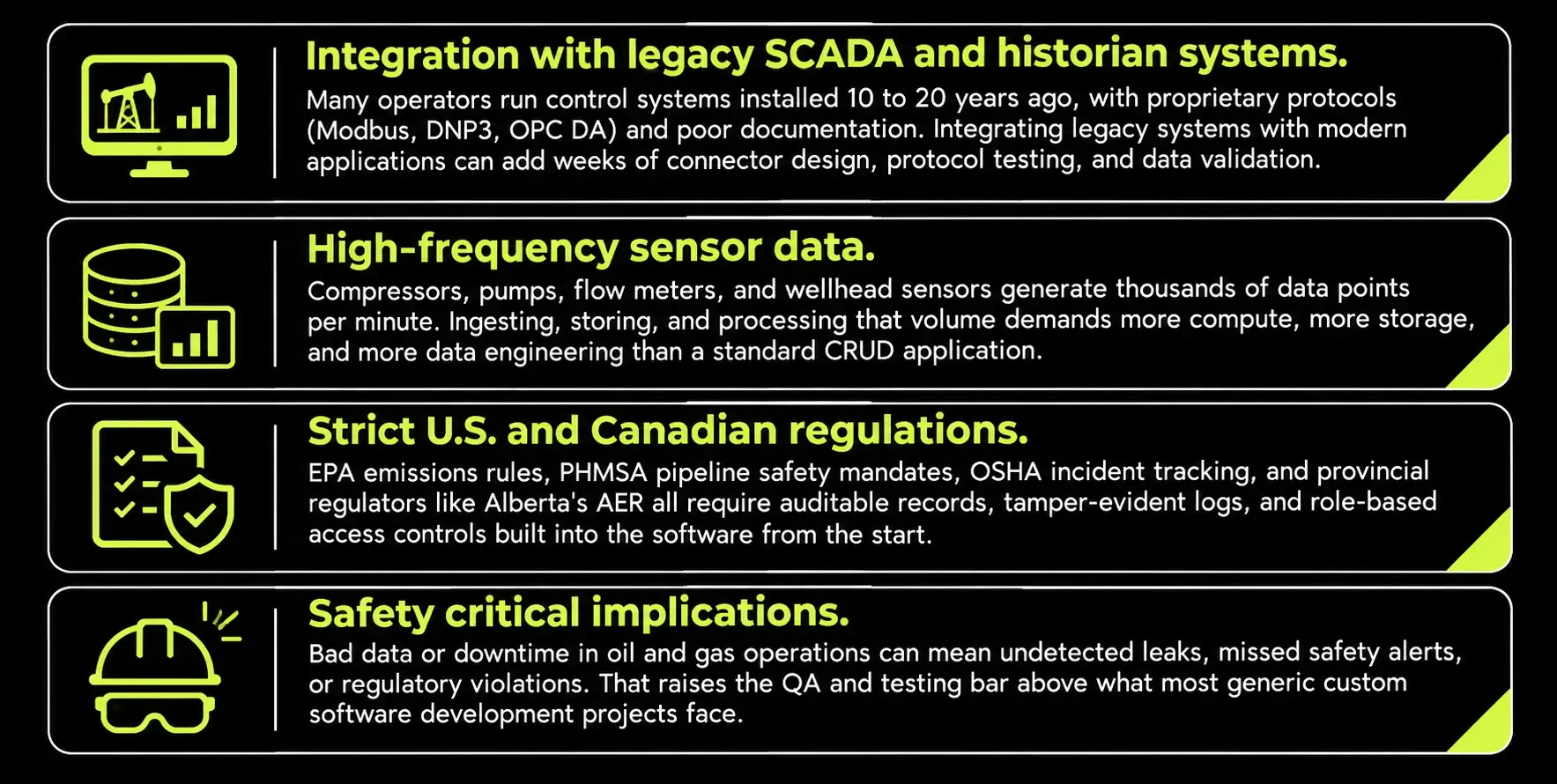
Four factors push oil and gas software development cost above typical custom software:
Compare this to a CRM or internal task tracker. A CRM never needs to survive a satellite outage, translate OPC UA tags, or produce an emissions report for a provincial regulator. Oil and gas applications often need to support remote operations with limited connectivity, and that alone adds layers of architecture, testing, and domain expertise that standard web apps never encounter.
SoftDoes structures projects to account for these risks during discovery, not after they surface as budget overruns, drawing on broader energy and utilities software development experience.
Typical Oil and Gas Software Use Cases and Their Cost Profiles
Oil and gas software development cost depends on the type of solution. A production monitoring dashboard pulling from one historian costs a fraction of a multi-module digital oilfield platform. Here are the most common application types with high-level cost bands:
Production monitoring dashboards pull operational data from SCADA systems and historian systems, displaying real-time and historical data for control room operators. Oil and gas software includes SCADA and production monitoring systems. Expect $80,000 to $150,000 for a basic version with one or two data feeds.
Field operations and work order apps coordinate remote crews and capture field data at well sites, compressor stations, or pipeline right-of-ways. Field service management software coordinates remote crews in oil and gas. These apps need offline capability and rugged UX. Cost: $40,000 to $90,000 for a single workflow; $90,000 to $220,000 with SCADA and ERP integration.
HSE and incident reporting software with compliance reporting workflows for EPA, PHMSA, OSHA, or provincial bodies. These platforms require audit trails, role-based access, and regulator-formatted exports. Cost: $150,000 to $300,000.
Asset management and predictive maintenance systems use IoT sensor data to forecast equipment failures. Predictive maintenance software reduces unplanned downtime by 30 to 40% according to published case studies. These systems require data engineering, ML model training, and edge or cloud deployment. Cost: $250,000 to $800,000.
ERP and production accounting bridges handle joint interest billing, allocations, and volumetric reporting. ERP systems manage finance, procurement, and supply chain in oil and gas. These bridges must reconcile production data with financial records. Cost: $150,000 to $300,000.
Digital twins model assets for performance monitoring in oil and gas, creating virtual representations of wells, pipelines, or facilities for scenario analysis. These are typically part of larger platform builds at $400,000 and up.
Each use case has different data volume, reliability, and compliance requirements that affect both initial build and ongoing costs, especially when designing data-driven oil and gas software architectures. The sections below detail cost drivers for each category.
Cost Breakdown by Segment: Upstream, Midstream, and Downstream
Upstream, midstream, and downstream gas operations have distinct software cost patterns because of differences in data intensity, safety requirements, and integration complexity.
Upstream projects cover E&P analytics, drilling optimization tools, well surveillance, artificial lift optimization, and production reporting. Data intensity is the primary cost driver. Hundreds or thousands of wells generate continuous sensor data that must flow from historian systems into dashboards, analytics engines, and regulatory reports. Drilling data alone can produce terabytes per well. Cloud infrastructure costs scale with the number of assets monitored.
Midstream software handles pipeline monitoring, leak detection, custody transfer calculations, and compressor station oversight. Real-time constraints are the differentiator. PHMSA regulations in the U.S. impose strict requirements on pipeline safety software; fines for violations reach $84,425 per day. That raises QA, security testing, and operational technology security costs above what upstream projects typically require. Data integration is essential for analytics and reporting across custody transfer points.
Downstream projects include refinery operations dashboards, terminal management, and fuel distribution support. High availability (24/7 uptime) and integration with business systems (ERP, trading platforms, retail networks) define the cost structure. These systems must comply with strict regulatory requirements for emissions monitoring, spill control, and environmental reporting.
Midstream safety requirements and downstream availability demands often produce the highest QA and security budgets. Upstream projects, by contrast, push infrastructure cost highest because of sheer data scale across many producing assets.
Core Cost Drivers in Oil and Gas Software Development
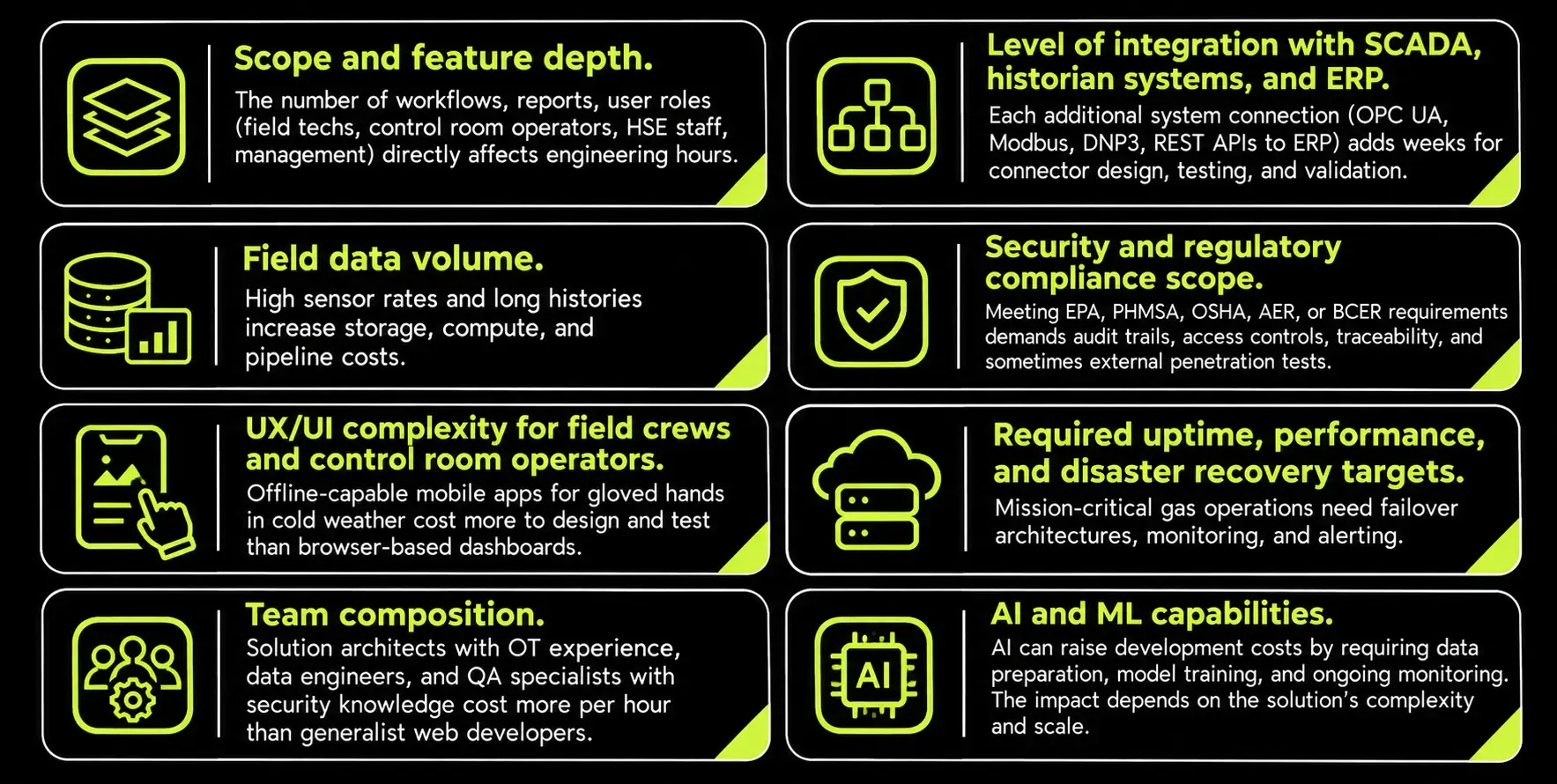
These are the levers that move your gas software development cost up or down, regardless of which vendor you choose.
Impact of SCADA, OT, and Historian Systems on Cost
Gas software must connect to OT systems like SCADA, RTUs, PLCs, and historians that may date back 10 to 20 years. Integration with SCADA systems is critical for oil and gas software. Many of these systems use proprietary protocols, lack documentation, or store production data in formats that do not map cleanly to modern databases.
Typical engineering work includes:
- Assessing protocols and data quality. Identifying which SCADA systems use OPC UA versus Modbus versus proprietary vendor formats, and cataloging how clean (or messy) the historical data is.
- Designing safe read/write boundaries to protect control systems. You do not want a dashboard bug to send a bad command to a wellhead controller. Oil and gas software must comply with IEC 62443 standards, and IEC 62443 is essential for securing industrial control systems in this context.
- Building adapters to move historian data into modern cloud infrastructure. This often means creating extract jobs, tag mapping tables, and validation rules for decades of operational data.
Even "simple" dashboards become expensive once historian systems and real-time telemetry are involved. You need engineers who understand both IT and OT protocols, staging environments that mirror field conditions, and test plans that cover reconnection after outages.
Multi-vendor SCADA integration can add $40,000 to $150,000 and several weeks of schedule, depending on the number of sites and protocols. New software must connect to existing ERP systems as well, which adds another layer of connector work. Integration challenges arise from legacy systems in oil and gas at every stage.
SoftDoes has OT-aware architects who design integrations to be reusable across fields and assets, lowering cost on follow-on projects. When you solve the OPC UA connector problem once, deploying it to 50 wells should not require re-engineering.
Cloud Infrastructure, Data Architecture, and Ongoing Platform Costs
Cloud infrastructure and data engineering form a large, recurring portion of total cost of ownership for gas software. The initial build gets the headlines, but monthly cloud spend runs for years.
Key components that drive cost:
- Cloud provider selection (AWS, Azure, Google Cloud) and the mix of managed services versus self-managed infrastructure. Each provider has different pricing for time-series storage, streaming ingestion, and compute.
- Storage and compute for time-series data coming from historian systems and IoT devices. A single compressor station can generate millions of data points per day. Real-time data processing and analytics are essential features of modern oil and gas software systems, and oil and gas software often requires real-time data ingestion and processing capabilities.
- Data pipelines (batch and streaming), ETL jobs, data lakes, and monitoring for pipeline failures. Poor data quality in historical data can add 20 to 30% to data engineering timelines.
- High availability and disaster recovery setups for mission-critical gas operations, including multi-region failover and automated alerting.
A robust data architecture often costs more than the UI layer but is essential for predictive maintenance, predictive analytics, big data analytics, business intelligence, and reliable regulatory reporting; many operators lean on specialized business analytics and data engineering partners to design and operate these platforms.
Monthly cloud spend brackets (indicative):
Deployment Size |
Small (few assets, low telemetry) | $2,000 to $8,000 | Single field, limited sensor count |
Medium (multiple fields, moderate data) | $8,000 to $20,000 | Production monitoring across 50+ wells |
Large (multi-asset, heavy sensor data) | $10,000 to $40,000+ | Full digital oilfield with streaming analytics |
SoftDoes designs architectures to right-size cloud infrastructure and avoid "over-provision now, optimize later" waste that inflates monthly bills.
Security, Compliance, and Regulatory-Driven Costs
U.S. and Canadian oil and gas operations face layered regulatory requirements that directly add to software development costs. Compliance with HSE standards is mandatory in oil and gas, and cybersecurity controls are crucial due to the sensitivity of operational data flowing between field devices and business systems.
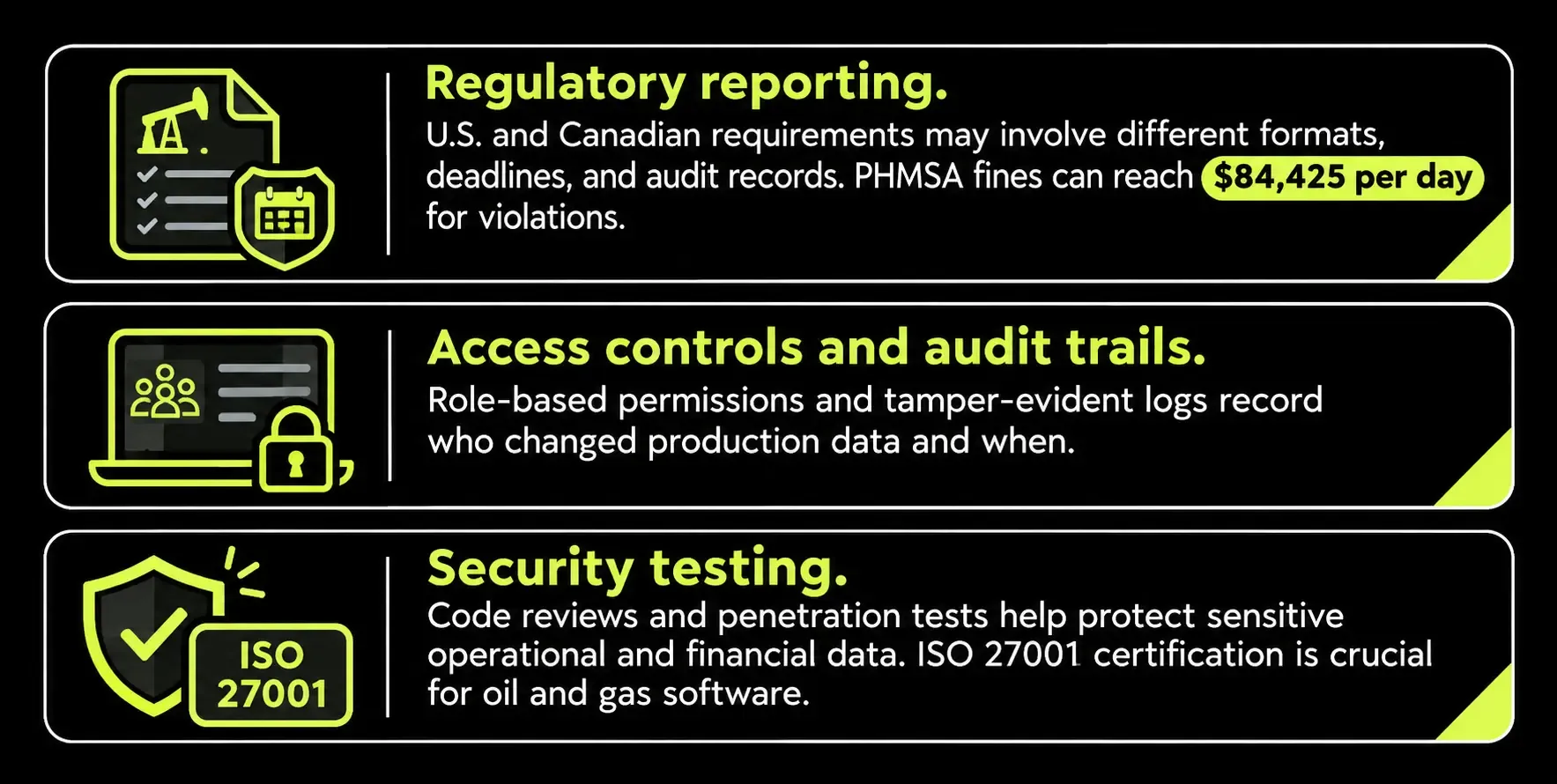
Concrete compliance and security factors that add work:
Security and compliance requirements add complexity to oil and gas software development. Building compliance in from the first sprint is cheaper than retrofitting later, but it still adds analysis and QA effort.
Cost impact:
- End-to-end audit logging and compliance reporting engines typically add 10 to 20% to initial build.
- Formal third-party security testing can range from $15,000 to $75,000+, depending on system scope and the number of components under review.
SoftDoes aligns designs with client-specific regulatory obligations rather than generic checklists, so effort is focused where auditors actually look.
Custom Software vs Off-the-Shelf Gas Software: Cost Tradeoffs
Oil and gas companies often choose between licensing off-the-shelf gas software solutions (like AspenTech, Enertia, or P2) and commissioning custom software development. The same build-or-buy decision applies here as in other industrial sectors, but with higher integration stakes.
Off-the-shelf:
- Lower upfront implementation cost and faster time to first value.
- Ongoing license or subscription fees and limits on workflow customization.
- You may need to adapt your gas operations to vendor-defined processes.
Custom software:
- Higher initial investment but exact fit to oil and gas operations and local regulations.
- Deeper integration with existing SCADA, historian systems, and ERP.
- Better long-term unit economics when scaled across many assets or subsidiaries.
Evaluate how software fits existing workflows before choosing a vendor. Check the vendor's integration capabilities with existing systems. Many operators adopt a hybrid approach: license core platforms for standard production accounting or simulation, then build custom modules for unique workflows, emissions monitoring at remote sites, or compliance gaps that off-the-shelf tools do not cover.
SoftDoes helps assess when custom development is warranted and where existing platforms can save money, so you are not rebuilding what already works.
Pricing Models Used by Oil and Gas Software Development Companies
The same scope can cost very different amounts depending on how you pay. Here are the common models:
Fixed-price works for tightly defined, smaller scopes with clear acceptance criteria and limited change. It requires a detailed discovery phase upfront, and vendors typically pad contingency into the price to cover unknowns. Best for: single-workflow apps, well-documented integrations.
Time-and-materials (T&M) suits evolving requirements and multi-phase gas software programs. It needs strong governance (weekly scope reviews, burn reports) but reduces rework on complex integration projects where legacy systems create surprises.
Dedicated team scaling provides a long-term engineering squad working as an extension of your internal team. Long-term partnerships average four years in oil and gas software projects, making dedicated teams a practical option.
Hourly rates range from $25 to $149 among development companies, depending on seniority, specialization, and location. North American-based OT specialists and cloud architects sit at the higher end. Nearshore teams can reduce cost, but communication overhead and gas domain knowledge gaps must be factored in. Minimum project sizes start at $10,000 with firms like Chetu and Azati for small engagements.
SoftDoes typically blends models: fixed scope for discovery, then T&M or a dedicated team for build and evolution.
Discovery and Architecture: The First 10 to 20% of Your Budget
Structured discovery and architecture typically consume 10 to 20% of total cost but prevent expensive redesigns later. Skipping this phase is the single most common cause of budget overruns in gas software projects.
What happens in this phase:
- Stakeholder and workflow interviews across field crews, HSE, accounting, and IT.
- System and data inventory: SCADA, historian, ERP, spreadsheets, manual reporting processes, cloud apps.
- Initial UX flows, data model sketches, and integration maps.
- High-level backlog and phased roadmap with budget ranges per phase.
Skipping discovery leads to underestimating integration effort, data cleanup scope, and change management costs, especially for gas operations with legacy systems and undocumented sensor tag mappings.
Choose a partner with proven oil and gas project experience. Verify vendor claims with three named oil and gas projects before signing a discovery contract. That filters out generalist shops that have never dealt with OPC protocols or historian data migration.
SoftDoes runs short, time-boxed discovery engagements (typically 3 to 6 weeks) to give gas companies a grounded cost and timeline before any major spend commitment.
How Remote Sites, Offline Work, and Harsh Conditions Affect Cost
Many oil and gas operations in the U.S. and Canada take place at remote sites with limited connectivity and harsh weather: the Rockies, northern Alberta, the Permian Basin, offshore Gulf of Mexico.
Cost-impact factors:
- Offline-capable mobile apps that capture field data and sync with gas software when networks return. Conflict resolution logic (what happens when two techs edit the same record offline?) adds architecture and testing work.
- Extra testing across satellite, cellular, and radio links, plus simulation of outages and reconnection scenarios. You cannot just test on office Wi-Fi and ship it.
- Rugged UX design for harsh field environments: glove-friendly touch targets, readable displays in bright sunlight or low light, large buttons for spotty signal conditions.
These requirements increase QA effort and sometimes dictate technology stack choices (local-first databases, edge computing components), which impacts overall budget.
Well-designed offline-first architectures reduce on-site revisits and manual data cleanup, offsetting initial cost with operational savings over time. SoftDoes has patterns for remote site data capture and sync that can be reused across multiple gas fields to control costs.
Team Composition and Location: How Talent Mix Changes Cost
Cost is not just "hourly rate." Which seniority levels and specialized roles are on the project matters more than the raw number of developers.
Typical roles in gas software development:
- Solution architect with OT/IT integration experience
- Backend and frontend developers familiar with gas software patterns
- Data engineers for historian, IoT sensor data, and analytics pipelines
- QA engineers and test automation specialists
- DevOps/cloud engineers for secure, monitored deployments
A senior-heavy team costs more per week but reduces rework and time-to-production. Access to nearshore or blended teams can deliver savings without sacrificing communication for U.S. and Canada time zones.
Team Size |
Small (3 to 4 people) | $40,000 to $80,000/month | MVP or single-module build |
Medium (6 to 8 people) | $80,000 to $160,000/month | Multi-module platform with integrations |
Actual numbers depend on rate cards, seniority mix, and scope. SoftDoes tailors team shape over project phases: architecture-heavy early, data-heavy mid-build, support-focused post go-live.
Hidden and Ongoing Costs: Maintenance, Support, and Enhancements
Initial build is only part of total software spend over a 5 to 10 year lifecycle in the oil and gas industry. Operators who budget only for the build phase face surprises in year two.
Common ongoing costs:
- Maintenance and minor enhancements: Maintenance and ongoing support typically cost between 15% and 20% of the initial development cost annually. For a $500,000 platform, that is $75,000 to $100,000 per year.
- Cloud infrastructure, observability tools, logging, and backups. These costs grow as you add assets, users, and data sources.
- Security patches, library upgrades, and periodic penetration tests. Operational software touching production or safety data needs continuous security attention.
- Support for new regulations, report templates, or acquisition-related integrations. When you buy a new field or a regulator updates a reporting format, the software must follow.
Ask vendors how post-launch support is structured: SLA response times, pricing tiers, and what is included versus billed separately. SoftDoes promotes long-term engineering ownership, offering roadmaps and predictable support models so gas operators can budget over multiple years without surprise invoices.
Strategies to Reduce Oil and Gas Software Development Costs Without Cutting Quality
Cost optimization is about smarter scope and architecture.
Practical strategies:
- Prioritize a narrow, high-ROI workflow first. Build one critical production allocation flow or one emissions monitoring dashboard before committing to a broad platform.
- Reuse existing systems where possible. Modernizing legacy systems does not mean replacing everything at once. Keep what works and build connectors.
- Standardize data models and integration patterns across fields and business units so you do not solve the same connector problem ten times.
- Avoid "nice-to-have" features in v1. Add them after confirming adoption and ROI on core workflows.
- Use cloud-native services and managed databases instead of self-managed infrastructure when appropriate.
Phased delivery (MVP, pilot field, regional rollout, enterprise rollout) validates assumptions at each stage. If the pilot field reveals that sensor data quality is worse than expected, you adjust before spending the next $300,000.
SoftDoes runs architecture and cost reviews to identify where existing or open-source components can replace custom code safely, keeping your operational efficiency gains without unnecessary spend.
How SoftDoes Approaches Oil and Gas Software Projects (Cost-Aware Delivery)
SoftDoes is a North American-focused custom software development partner with experience in energy, cloud, data engineering, and AI/ML, as well as operational software for construction and manufacturing. We work with oil and gas operators and service companies across the U.S. and Canada.
Our typical engagement phases in cost-conscious terms:
- Discovery and architecture focused on clarifying integrations, compliance, and remote site needs.
- Incremental delivery with working releases at 4 to 8 week intervals. Each release is testable in the field.
- Ongoing optimization based on field feedback and actual cloud usage metrics, so you do not overpay for infrastructure you are not using.
Engineering strengths relevant to cost:
- Combining data engineering, AI/ML, and gas software development under one roof to avoid managing multiple vendors.
- Reusable modules and templates for common gas operations patterns: offline sync, audit logging, historian connectors, emissions reporting tools.
- Strong DevOps practices to keep deployments stable and reduce unplanned downtime costs.
Share your current system map, integration list, and budget window with SoftDoes. We will prepare a grounded estimate tied to your specific assets, regulations, and data reality.
Benefits of Working With SoftDoes
For oil and gas operators and service companies in the U.S. and Canada, here is what working with SoftDoes delivers:
- Domain-aware engineering. Experience with gas operations, historian systems, and OT/IT boundaries. We design with field realities in mind.
- Cost transparency. Up-front breakdowns of build vs. maintenance vs. cloud, with clear tradeoffs per feature and integration.
- End-to-end capabilities. Custom software development, AI/ML (for example, predictive maintenance analytics), cloud infrastructure, and data engineering from one partner.
- Security and compliance focus. Architectures aligned with North American regulatory expectations and internal audit standards.
- Flexible engagement models. From focused project teams to long-term dedicated squads that act as an extension of your engineering group.
- Long-term ownership. Emphasis on documentation, knowledge transfer, and stable teams to avoid expensive relearning when you extend enterprise systems.
Estimating Your Own Oil and Gas Software Budget: A Step-by-Step Checklist
Before approaching vendors, use this checklist internally to compress discovery time and get more accurate proposals.
- Document top 3 to 5 pain points. Examples: manual production allocation in spreadsheets, missing emissions audit trails, delayed field tickets, unreliable data acquisition from aging SCADA.
- Map current systems touching those problems. SCADA systems, historian systems, ERP systems, spreadsheets, mobile apps, manual reporting processes.
- Identify which workflows must work offline for remote sites and which users (field techs, operators, HSE staff) are involved.
- Decide your tolerance for change. Can you adapt to an off-the-shelf process, or do you need custom software that fits your existing gas operations?
- Set a rough budget band and timeline so vendors can propose realistic options instead of one-size-fits-all estimates.
- Collect existing diagrams, sample reports, and regulator requests to share during discovery. The more context a vendor has, the tighter their estimate will be.
- Identify who will own the system post-launch. Will your internal team maintain it, or do you need a long-term support model?
Bring these outputs to a consultation with SoftDoes. They compress discovery time and reduce cost by giving us a head start on understanding your modern software needs.









Comments (0)
No comments yet.