Table of contents1. Key Takeaways2. What Makes Utility Billing Software Hard to Build?3. Clarifying Your Scope: CIS vs. Utility Billing Engine4. Requirements and Domain Modeling for Utility Billing5. Designing the Core Data Model and Architecture6. Building Meter Reading and Validation Pipelines7. Designing the Tariff and Rating Engine8. Invoice Generation, Bill Presentation, and Tax Handling9. Payments, Collections, Debt, and Installment Plans10. Customer Self Service, Portals, and Mobile Experiences11. Integrating Utility Billing with ERP, CIS, and Field Systems12. Ensuring Security, Compliance, and Auditability13. Modernizing Legacy Utility Billing and CIS Systems14. Benefits of Working with SoftDoes on Utility Billing Projects Key Takeaways
- Modern utility billing software must handle complex tariffs, meter reading pipelines, CIS utility billing workflows, and seamless integration with ERP and payment systems.
- The core build path follows a clear sequence: define requirements, design the data model, implement meter reading and validation, build the tariff engine, implement invoicing and payments, then add self service and reporting tools.
- Billing accuracy, auditability, and regulatory compliance in the U.S. and Canada are design goals you must lock in from day one, not features you bolt on later.
- Energy retailers, municipalities, and co-ops should decide early whether they are replacing a full CIS or building a focused utility billing layer that plugs into existing systems, especially when they already rely on energy management software to monitor and optimize consumption.
- SoftDoes specializes in building custom utility billing platforms, including AI driven meter validation and cloud native architectures, for North American utilities.
What Makes Utility Billing Software Hard to Build?
Utility billing is not standard SaaS invoicing. It sits at the intersection of regulated rate structures, physical metering infrastructure, multi-service premises, and customer protection rules that vary by state, province, and municipality. Today, 68% of utility providers rely on software-based billing platforms, yet many of those platforms are aging systems that struggle with modern demands like time-of-use pricing, solar net metering, or real-time customer portals.
Utility billing systems must handle complex pricing rules and diverse metering inputs across services like water, sewer, electric, gas, and waste management. A single residential customer might receive a consolidated bill covering four services, each governed by different rate ordinances. Manual processes lead to billing disputes and errors, while traditional systems often involve lengthy billing cycles that frustrate customers and delay revenue collection.
This article is a step by step blueprint for building custom utility billing software rather than a roundup of the best utility billing software vendors. We will walk through data modeling, meter reading pipelines, tariff engines, invoice generation, payments, self service portals, integrations, security, and modernization strategies, all grounded in real North American utility operations.
You will see references to well known systems like Black Mountain Software, Oracle Energy and Water, and CIS Utility Billing along the way. These are mentioned only as context for what existing platforms do and what they cost, not as recommendations.
Clarifying Your Scope: CIS vs. Utility Billing Engine
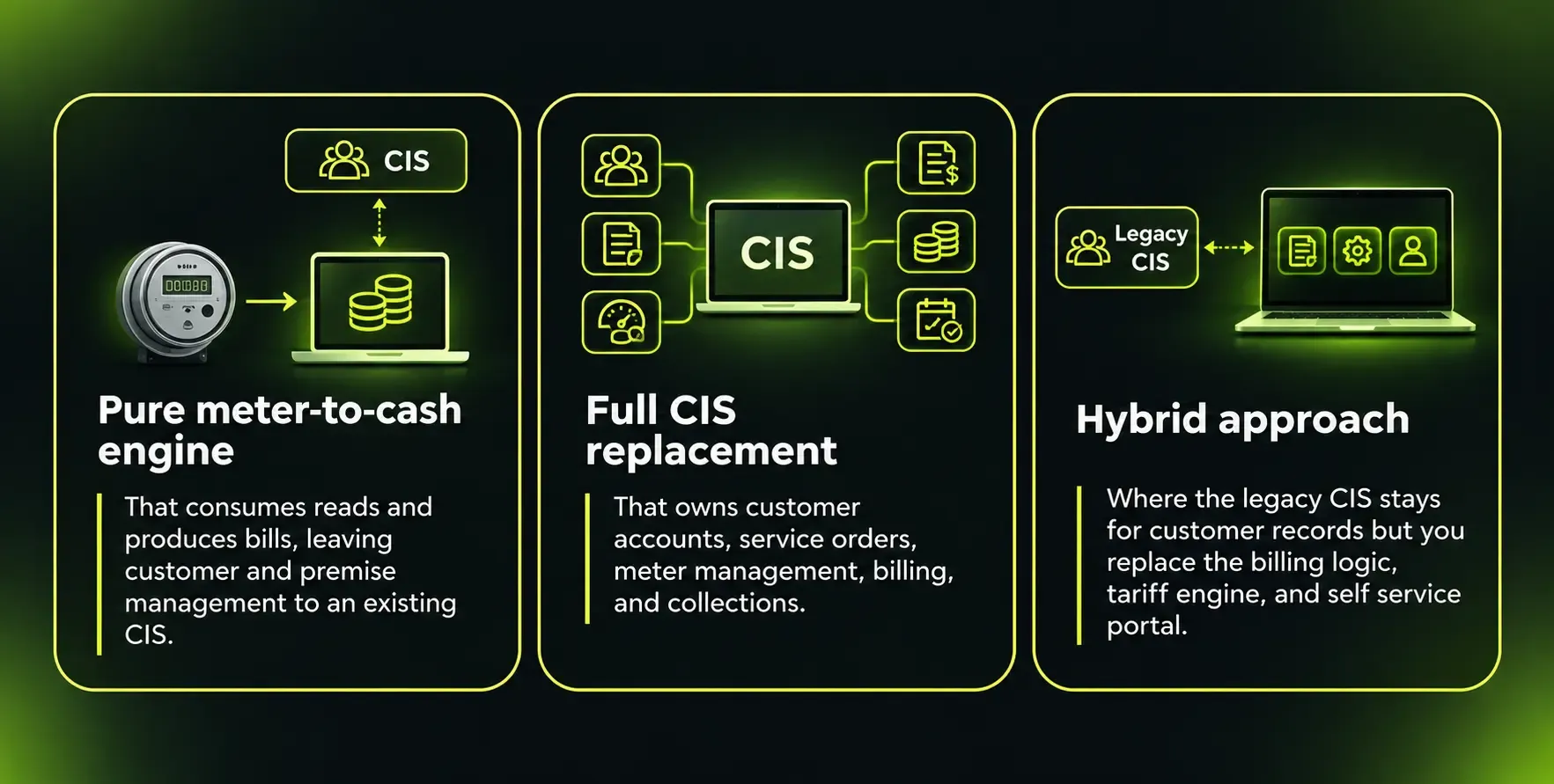
A full CIS utility billing platform covers the entire customer lifecycle: account creation, premise and meter management, service orders, billing, payments, collections, and customer relationship management. A narrower billing engine focuses on the meter-to-cash workflow: ingesting usage data, applying tariffs, generating invoices, and processing payments. The right billing software choice depends on what your utility already has in place and where the pain is worst.
Before writing a single line of code, map your scope with concrete options:
For context on existing pricing, CIS Utility Billing starts at 35 cents per meter monthly, EnergyCAP pricing starts at $24 per meter annually, Bynry pricing ranges from $1.29 to $0.99 per customer, Visual Utility Billing is priced at $0.15 to $0.089 per customer monthly, and Oracle Energy and Water is suited for larger utility companies. These numbers help you benchmark build vs. buy economics.
Create a scope matrix that maps features like meter reading, service orders, and invoice generation to "build," "integrate," or "defer." This keeps your billing team, finance team, and engineering group aligned on what the new solution will own versus what stays in ERP, CRM, or work management.
Requirements and Domain Modeling for Utility Billing
Utility billing software requires a structured software development lifecycle that starts with deep domain modeling. Before you design screens or APIs, you need to understand the business entities that drive every bill.
Core entities to model include:
- Customer and account: name, contact info, billing address versus service address, classification (residential, commercial, industrial), credit status, deposit history.
- Premise and service location: physical location where service is delivered, potentially with GIS coordinates. One customer may have multiple premises.
- Meter and meter register: meters can have multiple registers (volume, demand, import, export for solar). Track commissioning dates, calibration, replacements.
- Service agreement: which services are active at a premise, contract terms, special conditions like irrigation or temporary construction meters.
- Tariff and rate version: effective dated rate schedules including fixed charges, volumetric tiers, demand charges, minimum bills, and surcharges.
Customer Information Management systems track account hierarchies and service addresses, so define early whether your new platform owns this data or syncs it from another system. Stakeholders should create a roadmap outlining goals and timelines before development begins.
A tariff and rate engine manages complex municipal rate structures. In the U.S., state utility commissions or municipal boards set rates. In Canada, provincial utility boards and municipal bylaws govern. Run workshops with billing clerks, field operations, finance, and call center teams to capture edge cases like seasonal services and temporary meters, particularly if you also operate renewable energy assets that require specialized portfolio monitoring and dispatch. A small utility company with 1,200 connections has very different workflow needs than a metro authority serving 1.4 million residents.
Designing the Core Data Model and Architecture
A resilient utility billing system must be modular and auditable. The canonical data model includes accounts, premises, meters, meter registers, meter reads, tariffs, charge components, invoices, invoice lines, payments, adjustments, and service orders.
Design for auditability from day one:
- Immutable invoice records that cannot be silently modified after generation.
- Versioned tariffs so you can reconstruct why a charge was calculated a certain way.
- Event logs recording who changed what, when, and why.
Cloud scalability is essential for modern utility billing software architecture. Use a modular, service-oriented design where rating, invoicing, payments, and customer portals are loosely coupled. This lets you update the tariff engine without touching the payment module, or scale the meter ingestion pipeline independently during peak AMI load windows.
For U.S. and Canadian deployments, select cloud regions that satisfy data residency requirements. In Canada, government-owned utilities may need data stored on Canadian soil under PIPEDA and provincial privacy laws. Use encryption at rest and in transit, and enforce role-based access control across all environments.
Building Meter Reading and Validation Pipelines
Meter readings are the foundation of every utility billing system and the top driver of billing accuracy. If a read is wrong, every downstream charge is wrong. Smart meters enable real-time consumption insights for accurate billing, and integration with Advanced Metering Infrastructure is vital for any modern billing platform. Today, 51% of billing platforms support integration with smart meters and real-time consumption tracking.
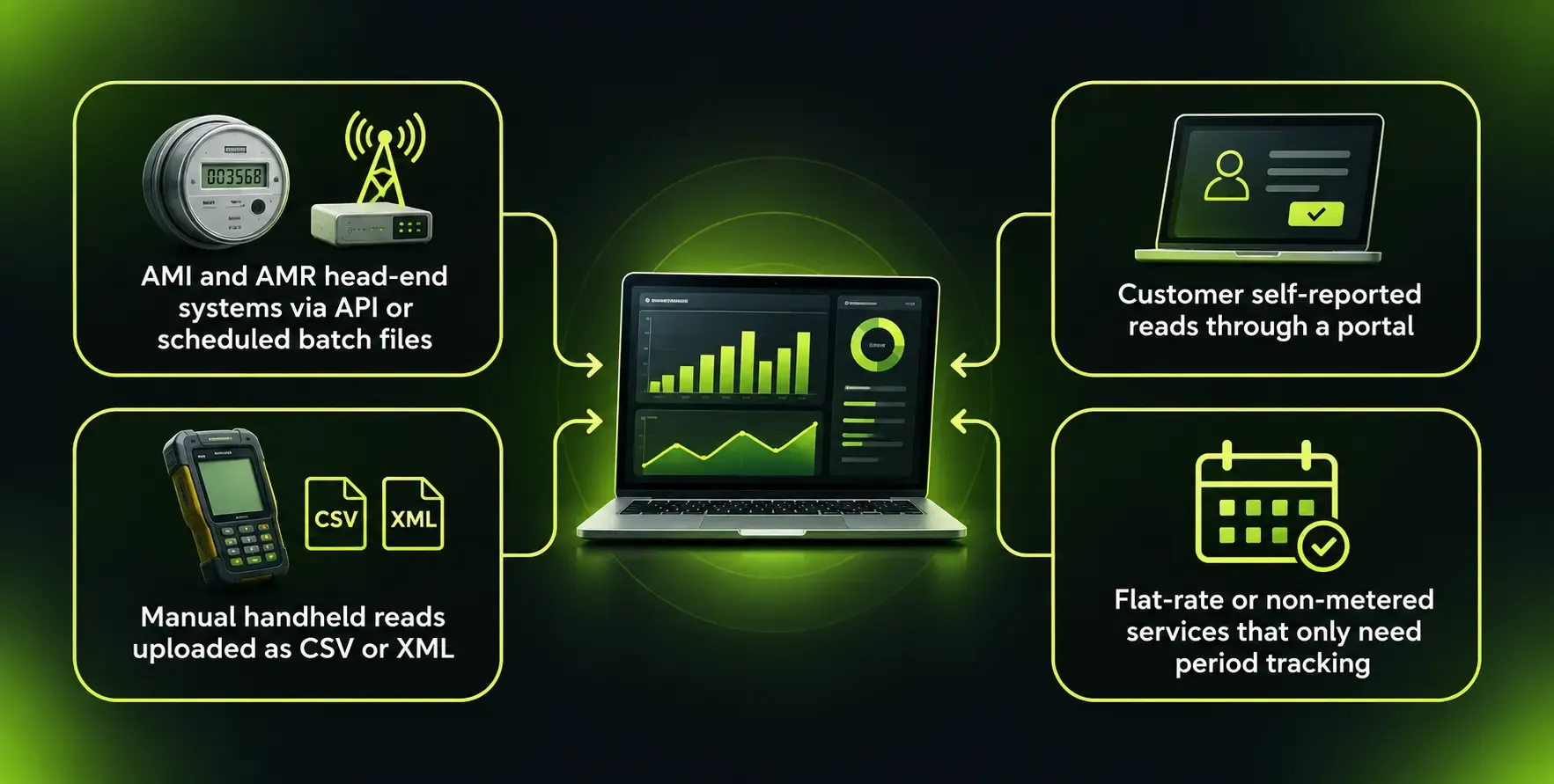
Design your ingestion layer to accept reads from multiple sources:
Automated meter data management enhances efficiency, but raw reads need validation before they reach the rating engine. Implement rules for high and low checks against historical patterns, zero-usage flags, negative consumption, impossible spikes, and overlapping read dates. When a read fails validation, route it to an exception queue for review rather than blocking the entire billing cycle.
Estimation logic is necessary for missed or failed reads. Common approaches include using the average usage for the same period last year, weather-adjusted models, or machine learning forecasts when you have enough historical data. Kraken, for example, uses AI to automate energy supply chains including predictive metering. Mark every estimated read clearly so it can be replaced when an actual read arrives, triggering a re-rate if needed.
Santee Cooper, a state-owned power and water provider in South Carolina, reduced its nightly billing batch from roughly 13 hours to 6.5 hours after modernizing its meter data and billing platform. That kind of performance gain matters when you are processing millions of reads on a tight overnight window.
Designing the Tariff and Rating Engine
The tariff engine is the brain that turns usage data into money. A flexible rate engine supports tiered pricing, time-of-use rates, demand charges, seasonal adjustments, and net metering credits. Dynamic pricing models are becoming increasingly popular as utilities adopt more granular rate structures to encourage energy efficiency and manage peak demand.
Key features of a modern rating engine include:
- Configurable tariffs with effective dating so rate changes apply correctly across billing periods.
- Support for multiple charge types: fixed customer charges, volumetric block tiers, demand charges (based on peak kW), minimum bills, surcharges, and riders.
- Complex scenario handling: seasonal rates, time-of-use windows, net metering for solar customers, demand ratchets, and low-income rebates.
- Rule configuration over hard-coded logic: business analysts should maintain tariff definitions through a UI or rules language, not by filing code change requests.
The automated billing lifecycle includes meter-read ingestion and bill generation, with the tariff engine sitting between those two steps. Performance matters: you may need to rate millions of interval reads overnight, support incremental re-rating for backdated corrections, and test new tariff versions against historical bills before going live.
For reference, the median fixed charge across U.S. rate schedules with a fixed component is about $12.52 per month, but the real complexity lives in how volumetric and demand charges stack on top.
Invoice Generation, Bill Presentation, and Tax Handling
Invoices are both financial records and communication tools. Auditable data helps maintain accuracy and reliability in billing systems, and each invoice line should trace back to the tariff version, meter reading, and tax rule that produced it.
Invoice composition should group charges by service type, include usage graphs for the billing period, itemize fees, and show prior balance with payments and adjustments applied. In the U.S. and Canada, tax handling is location-aware: franchise fees, state sales taxes, GST/HST, PST, and municipal surcharges may all apply depending on the service address jurisdiction.
Generate bills as structured data first (JSON or XML), then transform into PDFs for print, email-ready formats, and portal-viewable pages. Cloud-based systems can process thousands of invoices in minutes, a dramatic improvement over legacy batch processing. This approach also supports dispute resolution: when a customer questions a charge, your billing team can trace every line back to its source data.
Payments, Collections, Debt, and Installment Plans
The meter-to-cash lifecycle extends from invoice generation through payment processing, collections, and write-offs. Automated billing can cut billing cycle times by 50%, and clean payment workflows are essential for healthy cash flow and revenue streams.
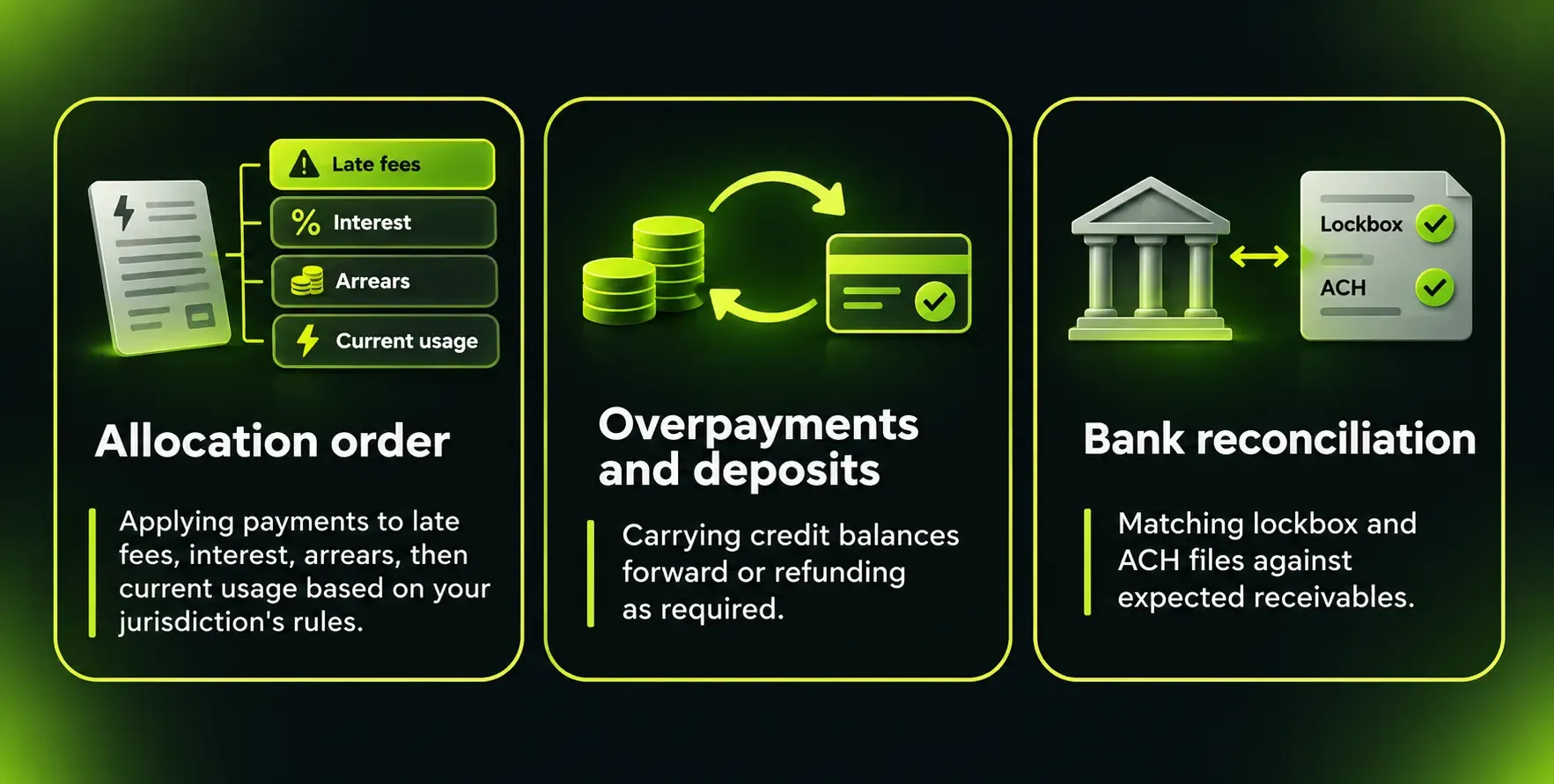
Payment channels to support include ACH, credit and debit cards, cash, check, bank lockbox, kiosk, IVR, and online payments through self service portals. Payment Card Industry Data Security Standard compliance is crucial for billing software handling card transactions, so integrate with tokenized payment gateways rather than storing card data directly.
Design your payment application logic to handle:
Collection workflows need dunning notices, shutoff warnings, reconnect fees, and hardship programs. Many U.S. states and Canadian provinces have specific rules about when you can disconnect service and what notice you must provide. Installment plans link past-due balances to scheduled payments while you continue billing for ongoing usage. The data model must track plan terms, expected versus actual payments, and plan status independently from regular billing data.
Customer Self Service, Portals, and Mobile Experiences
Customer self-service portals are essential for modern utility billing. Consumer-facing features improve user experience and engagement, and cloud solutions enhance customer satisfaction through real-time data access. Oklahoma City saw an 850% increase in digital registrations after launching a modern self service platform, with app ratings jumping from roughly 3.2 to above 4.7.
Concrete portal features to build:
- Usage history charts with period-over-period comparison
- Bill download and payment history
- Multiple payment methods and autopay setup
- Move-in and move-out service requests
- Service orders submission and tracking
- High-usage alerts and payment reminders via push notifications
The portal must read from the same data source as the billing engine. If your customer sees a different balance than your call center agent, you will generate billing disputes and erode trust. UI/UX design for both operators and end users is important, so invest in usability testing with real customers. Design for responsive web first, with optional native mobile apps for push alerts.
In the U.S., follow WCAG and ADA accessibility guidelines. In Canada, provincial accessibility standards apply. Offer multi-language support where your service territory demands it. A well-built portal can track usage patterns and surface actionable insights that help customers manage their energy usage.
Integrating Utility Billing with ERP, CIS, and Field Systems
Integration is often the most difficult part of building utility billing software for established utility companies. Today, 59% of modern platforms include compliance monitoring tools, but those tools are only useful when they have access to clean, synchronized data across systems.
Upstream integrations include:
- AMI and AMR meter systems for automated read ingestion
- Work management for service orders and field dispatch
- GIS for meter and premise location mapping
- Outage management for electric utilities
Downstream integrations include:
- ERP and general ledger for financial posting and revenue collection reporting
- Payment gateways for card and ACH processing
- Document composition and print vendors for mailed bills
- Collection agencies for delinquent accounts
Integration requires mapping data flows and ensuring compatibility between systems. Use APIs and message queues for near-real-time synchronization, and design a canonical billing events stream that various utilities and finance systems can consume. Clear ownership of customer master data is essential. If both your billing platform and your ERP think they own the customer record, you will end up with double-billing or mismatched GL postings.
Ensuring Security, Compliance, and Auditability
Regulatory compliance is essential in utility billing software development. Utilities serve U.S. and Canadian residents under overlapping federal, state, and provincial rules that govern everything from rate filing procedures to customer disconnect notices.
Core security practices include:
- Role-based permissions and multi-factor authentication
- Encryption at rest and in transit for all billing data and customer records
- Secure coding standards and regular penetration tests
- Audit logs capturing every change to tariffs, customer data, adjustments, and service orders
Testing utility billing software involves unit, integration, and security testing. Automated test suites should validate tariff calculations against known historical bills, verify payment allocation logic, and confirm that access controls prevent unauthorized data changes.
Applicable frameworks include SOC 2 for cloud platforms, NERC-informed practices for some energy providers handling critical infrastructure, state-level privacy rules, and PIPEDA in Canada. Build reporting and export capabilities so your finance team can support rate cases, board reviews, and regulator inquiries with detailed, auditable billing data. Utility billing systems should provide real-time dashboards for reporting and analytics so that operational issues surface before they become revenue problems.
Modernizing Legacy Utility Billing and CIS Systems
Many North American utilities run legacy CIS or billing systems from the 1990s or early 2000s, including on-premises solutions like Black Mountain Software and other platforms that predate cloud computing. These systems often suffer from hard-coded tariff logic, limited self service capabilities, and manual data entry workarounds that slow down operational workflows.
Common modernization paths include:
Path |
Full replacement | High | 18-24+ months | Large utilities needing complete overhaul |
Phased module replacement | Medium | 9-15 months per phase | Mid-size utilities wanting incremental improvement |
New layer wrapping legacy core | Lower | 6-12 months | Utilities that need a modern tariff or analytics layer fast |
Cloud solutions can reduce operational costs by up to 30%, which makes the business case for modernization compelling. But the transition carries real risk. Use shadow billing, running the new system in parallel for several cycles and comparing outputs to legacy bills. Training sessions should be tailored to different user roles: billing clerks need different instruction than field operators or finance analysts. Create a clear cutover plan with freeze windows, a rollback strategy, and intensive support during the first two to three billing cycles.
The City of Wilmington, Delaware moved from an aging CIS to a cloud-based platform supporting water, wastewater, and stormwater, adopting daily billing enabled by modern meter data. Macungie Borough in Pennsylvania, with roughly 1,200 service connections, now has bills ready two days after the quarter closes. These examples show that improving operational efficiency through modernization is achievable at any scale.
Benefits of Working with SoftDoes on Utility Billing Projects
SoftDoes is a North American software engineering partner that specializes in complex, regulated systems including utility billing software for energy and water providers. Advanced analytics and AI are enhancing decision-making in utility billing, and SoftDoes brings deep experience building the systems that make that possible.
Key engineering strengths include:
- Custom billing engine design with highly customizable tariff logic, demand charges, time-of-use pricing, and net metering support.
- AI and ML models for meter reading validation, anomaly detection, and revenue protection.
- Scalable cloud architectures on AWS, Azure, or GCP with regional data residency for U.S. and Canadian deployments.
- Integration expertise connecting billing platforms to ERPs, payment gateways, AMI systems, and field management tools.
SoftDoes offers flexible engagement models: end-to-end product delivery, extension of in-house teams, or targeted modernization of specific modules like tariff engines or service orders. The team has a proven track record working with various utilities, energy retailers, renewable energy providers, oil and gas operators needing modern field and pipeline software, and municipal enterprises across the U.S. and Canada, with a focus on reliability, regulatory compliance, and long-term maintainability. Whether you are a small utility looking to escape spreadsheets or a large provider streamlining operations across multiple jurisdictions, SoftDoes provides ongoing support through every phase of the build.










Comments (0)
No comments yet.