


U.S.-Based
RLHF services and expert AI training data
Specialists in your field write, rank and grade the data your model learns from. Then we test the model to show the data moved the score.
$5,000
Per dataset, written and checked by specialists
2
Specialists on every item: one writes, one checks
5.0
Clutch rating from 40 reviews


















How an RLHF dataset is made
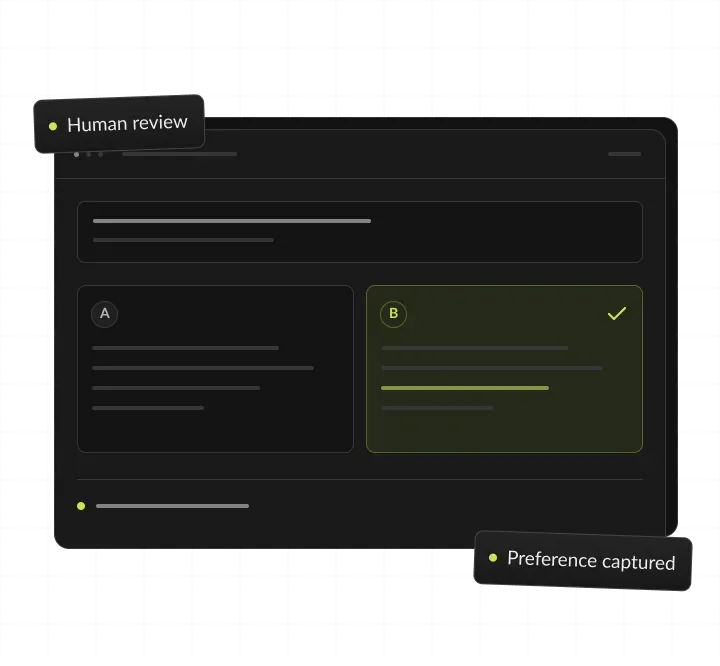
One item: a specialist writes a prompt, your model answers, specialists rank the answers and the data ships in your format.
A specialist writes a prompt
A hard task from real work.
Your model answers
Two or more responses to compare.
Specialists rank them
Against a rubric, then checked twice.
Data ships in your format
Ready for your training pipeline.
AI training data services, in short
- Kansas City metro software and AI company
- RLHF and training data for teams training and tuning models
- Specialists in your field write fine-tuning sets, rank model answers and write grading rubrics; a second specialist checks every item
- Datasets from $5,000, and you own the data from day one

Written. Ranked. Checked twice.
- 01Dataset priceFrom $5,000 per dataset, written and checked by specialists, in your training format. Training on it: LLM fine-tuning
- 02Who writes itSpecialists: nurses, paralegals, accountants or senior engineers, each vetted first
- 03QualityA second specialist checks every item against a written rubric
- 04You ownThe data, test sets and reports, from day one
Types of AI training data we deliver
Seven data types, what specialists produce for each and what it trains. Prices for each data type are starting points from our price list. Every dataset is written by vetted specialists and checked by a second specialist; fine-tuning rounds start at $6,000.
SFT data
Prompts with expert answers and the reasoning written out. Used for teaching format, terms and steps.
Preference (RLHF) data
Ranked pairs of model answers, each with a reason. Used for reward models and preference tuning.
RL tasks with rubrics
Hard tasks with grading criteria. Used for reinforcement learning pipelines.
Computer use trajectories
Step-by-step recordings of people using software. Used for agents that operate browsers and desktop apps.
Audio and voice data
Labeled speech with verified transcripts. Used for speech recognition and voice agents.
Evaluation sets
Test cases scored with a rubric. Used for finding where a model or agent breaks.
RL environments
App replicas with 50 tasks and graders. Used for training agents on multi-step work.
Formats and pipelines we deliver to
Data arrives in the format your team already trains on.
What are RLHF services?
RLHF services supply the human feedback a model learns from: people compare its answers, rank them and explain why. A reward model learns those preferences, and training steers the model toward them. RLHF stands for reinforcement learning from human feedback. It usually follows supervised fine-tuning, which teaches the format. RLHF teaches judgment: which answer a careful expert would choose.
What RLHF services include
Prompts from your field
Prompts written by specialists from your field, drawn from hard, real tasks.
Ranked answer pairs
Ranked answer pairs, each with a written reason for the choice.
Rubrics
Rubrics that define a good answer, so raters agree with each other.
A second check
A second specialist check on every item.
Your format
Delivery in the format your training pipeline reads.
Before-and-after test
A before-and-after test on the same benchmark, to show the data moved the score.


How RLHF works, in four steps
1. Specialists write prompts drawn from real work in your field. 2. Your model produces two or more answers to each prompt. 3. Specialists rank the answers against a written rubric and note why; a second specialist checks each ranking. 4. A reward model learns the rankings, and the language model is trained to score well on it.
RLHF vs SFT vs data labeling
SFT data shows the model the right answer to copy. RLHF data shows which of two answers is better, and why. Data labeling tags records with categories or fields, which suits classifiers and extraction more than chat models. Most projects mix them. A team might start with an SFT set, add ranked pairs where answers still miss, and keep a labeled test set to measure both.
AI data annotation services we deliver
Data that shows how specialists make decisions and how the work really gets done.
SFT data
Expert-written prompt and answer sets with the reasoning shown, so models learn the path to the answer. For example, a nurse writes the triage note a model should produce from a patient message, with each reasoning step shown.
RLHF data services
Specialists rank pairs of model answers and say why, which gives your reward model a grounded signal. For example, a paralegal compares two summaries of a contract clause, picks the one that flags the renewal risk and says why.
RL tasks with rubrics
Hard tasks with grading criteria written by domain experts, for reinforcement learning pipelines. For example, a senior engineer writes a debugging task, with a rubric that scores the fix, the test and the explanation. See RL environments.
Computer use trajectories
People complete tasks in browsers and desktop apps, captured step by step. For example, a specialist sets up a new vendor in an ERP while every click, field and screen is recorded.
Audio and voice data
Accented, multilingual and noisy speech with speaker labels and verified transcripts. For example, bilingual intake calls with background noise, where each speaker turn is labeled for a voice agent's training set.
Data labeling services
Classification and extraction labels on your own records, checked against a written guide. For example, support tickets tagged by intent and urgency against a written guide, with each label checked by a second specialist. To add people to your team, see data annotators.
Risks in RLHF and training data, and how we handle them
Most data problems start with the people who write it. Each risk below has a control in the process before delivery.

When expert training data pays off
Expert training data pays off when your model fails on judgment in a specialist field. It helps most after better prompts and retrieval stop closing the gap.
These are the signs we see before a team asks for a dataset:
- Reviewers in your field reject the same kinds of answers again and again.
- The model follows instructions but skips steps an expert would never skip.
- Generic raters agree with each other but not with your specialists.
- You tune your own model or an open-weight base and need data in its format.
- Leadership wants proof that data moved a score before it funds more rounds.
When to wait
If the model needs facts that change often, retrieval is usually cheaper than training; see RAG development. If you don't know where the model fails, start with an evaluation from $3,500.
What to prepare before the first call
A handful of real failures, with what the right answer should have been; the format your training pipeline reads, such as JSONL or Parquet; the person on your side who signs off on the rubric and the acceptance rules; and where the data must live: your cloud or a separate workspace.
What you get with each dataset
You get a dataset your team can train on the day it arrives. The items, rubrics, spec and test results come in your format, and you own all of them.



Training data ROI: a worked example
Training data pays back when the errors it removes cost more than the evaluation, the data and the training round. This example uses assumed review volumes and rework rates, not a client result, so swap in your own. At these numbers, the work pays for itself in about two months, before compute; compute for training runs is billed at cost on your own cloud account. Run your own review volumes and rework rates in the AI ROI calculator. We run the same tests before and after training, so you see the measured change next to this estimate.
How an expert data annotation project runs
Every item is written by one specialist and checked by another.
We agree the skill gap, the data type, the format and the acceptance rules. You see the data spec and a fixed price before anyone writes an item. You get a data spec and a fixed price.
Each specialist passes a paid test task in your field first. Only specialists who pass it work on your project. You get a vetted specialist team.
Specialists write, rank or grade items; a second one checks each. Every item must meet the acceptance rules agreed in the spec. You get a reviewed dataset.
We run the same tests before and after training on the data. You see the change by task type, not a claim. You get a before-and-after report.
The team behind the data
Our team has worked with frontier AI labs and some of the largest data providers in the industry.

- Healthcare
Prior Authorization AI
Prior Authorization AI is a healthcare automation startup building AI-powered tools to streamline prior authorization for Medicare and Medicaid medical transportation providers in New Jersey.- 16Weekly hours saved
- 63%Admin time reduced
- 43%Fewer submission errors

- Startup
- Real Estate
Our Haus AI
A finance professional turned founder built Our Haus AI, an AI-powered collaborative workspace where homeowners and contractors scope, bid, contract, and document renovation projects together. SoftDoes took her prototype and made it production-ready.- 10XMVP scope delivered
- 2+years Ongoing partnership
- 1Fully owned Platform

- Real Estate
The building buyer
The Building Buyer is a Florida-based real estate investment firm co-founded by Dylan Troiano and Charles Hanlin. They acquire single-family, multifamily, and commercial properties across South Florida and beyond, with a focus on motivated seller opportunities.- 18Weekly hours saved
- 2+Years Ongoing partnership
- 1Fully owned Platform

- Healthcare
CareInTouch
CareInTouch is a Bay Area home health agency providing skilled nursing and therapy services to patients referred from hospitals and clinics. With over 100 staff, they operate in one of the most complex and compliance-driven healthcare markets in the country.- 40% Reduction In Billing Errors
- 100+Staff Operations Managed
- 0Missed Compliance Deadlines

- Startup
Sparkle The Cleaning Service
Sparkle The Cleaning Service is a Detroit-area residential cleaning company with 10 years in business, connecting homeowners with vetted, insured independent cleaners through a subscription-based marketplace platform.- 75% Platform Transparency
- 2XPlatform Growth
- 40%Higher User Retention

- Healthcare
FMY Orthodontics
FMY Orthodontics, a multi-location practice in West Tennessee, partnered with SoftDoes to replace a spreadsheet-based financial workflow with a custom web platform. The goal was to simplify how staff present treatment financing while allowing patients and families to review and complete decisions remotely.- 60%Workflow Reduction
- 75%Remote Adoption
- 5Locations Aligned

- Real Estate
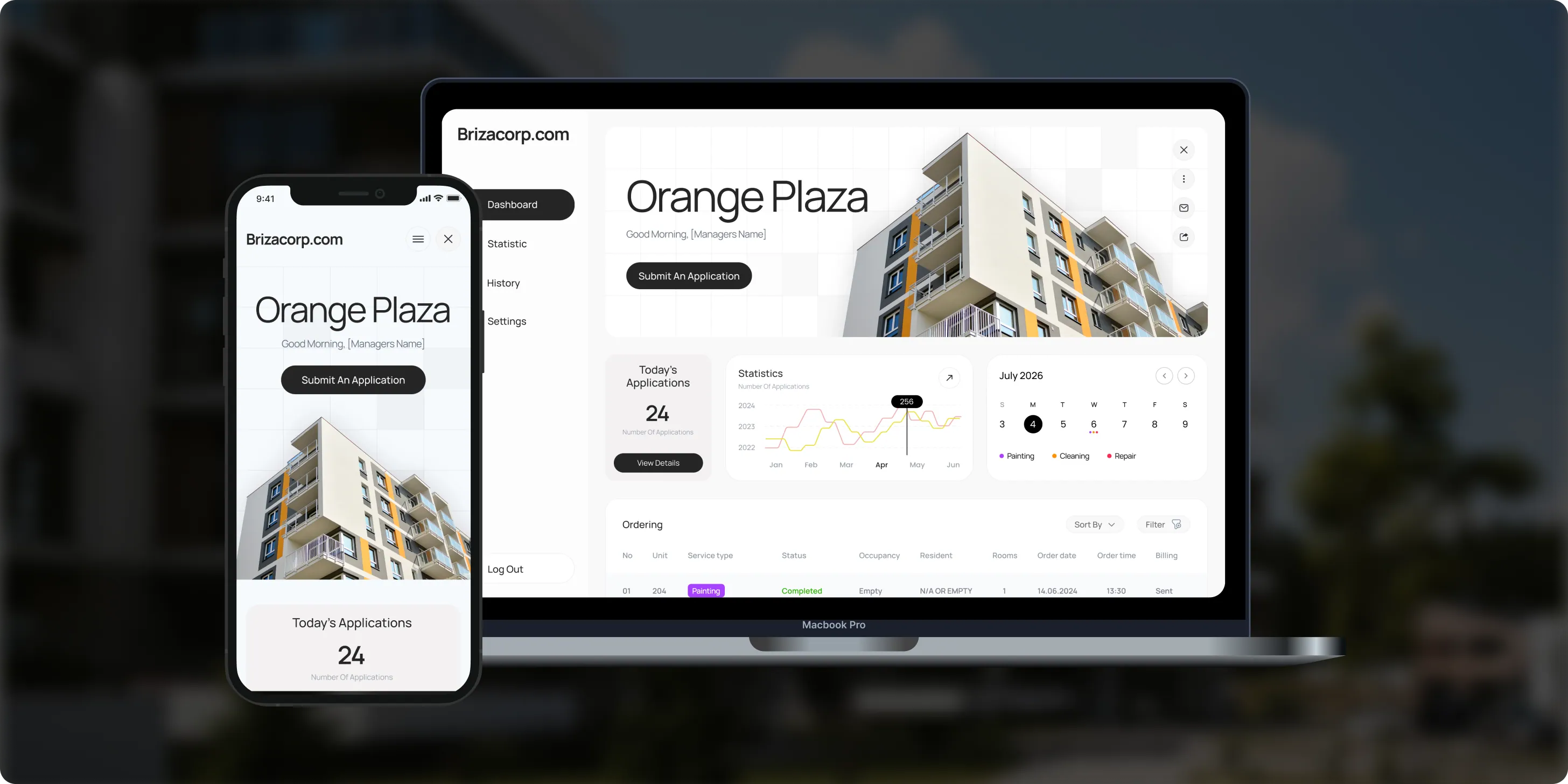
Brizacorp
Brizacorp manages residential properties and coordinates the staff who handle painting, cleaning, and repair requests. Its team tracked work across messengers, phone calls, e-mail, and paper planners, with no single place to manage requests or measure performance.- 98%Application Stability
- 95%Utilization Rate
- 30%Faster Task Completion
How we keep your training data safe
Your data stays under your control from the first file. We sign an NDA before you share anything, keep data in your cloud or a locked workspace, and delete it at the end.
Insured, with extra care for health data
Our certificate of insurance reaches your procurement team before the first call. Health records carry extra rules: our guide to HIPAA-compliant AI explains what changes for patient data.
NDA first
The NDA is signed before any prompt, record or model detail is shared.
A separate workspace
Data stays in your cloud or in a separate workspace that only the project team can open.
Deleted at the end
We delete your data when the project ends.
Vetted specialists
Each specialist passes a paid test task before joining your project.
You own everything
You own 100% of the data, test sets and reports we create, from day one.
Why teams choose SoftDoes as their AI training data company
Teams choose SoftDoes for frontier lab experience, specialists who are vetted and checked twice, and data that stays theirs.

- 01
Frontier lab experience
Our team has worked with frontier AI labs, so we know what strong training data looks like.
- 02
Vetted and checked twice
Specialists pass a paid test task, and a second specialist checks every item.
- 03
Your data stays yours
NDA before you share anything. Data stays in your cloud or a locked workspace.
- 04
Claude and OpenAI partner
A Claude Partner Network member and an OpenAI Registered Partner, building on both platforms.
- 05
40 AI projects since 2020
About 80% of our projects include AI, and 40 AI projects have been delivered since 2020.
- 06
Rated 5.0 on Clutch
5.0 from 40 client reviews. Clutch named SoftDoes a Top Artificial Intelligence Company and Top Machine Learning Company in Kansas City for 2026.
How to choose an RLHF or training data company
Ask these questions before you sign. A strong training data vendor answers each one in writing.
Questions to ask, and what a good answer includes
- Who writes the data? Specialists from your field, such as nurses or accountants, not generic raters.
- How are they vetted? A paid test task in your field before any project work.
- How is quality checked? A second specialist checks every item against a written rubric.
- How will we know the data worked? The same tests before and after training, reported by task type.
- Where does our data live? In your cloud or a separate workspace, deleted when the project ends.
- Who owns the result? You do: the data, test sets and reports, from day one.
- What paperwork comes first? An NDA and a certificate of insurance before the first call.
RLHF and training data pricing
A fixed price per dataset, set by item count, field and review depth. Start with an evaluation, so the data targets the failures that matter.
Training dataset
SFT, preference or rubric data, checked twice
From $5,000
Evaluation
To find the gaps first
From $3,500
Fine-tuning round
With before-and-after testing
From $6,000
RL environment
App replica, 50 tasks, graders
From $20,000
Project Discovery
Credited to the build
$490
Training data by industry
The specialists change with the field, and so do the rubrics, with each industry page showing the AI use cases and the rules in detail.
Healthcare
Clinical specialists such as nurses write and rank answers against a rubric your team approves.
Legal
Paralegals write summaries and rank model answers on clauses, deadlines and intake notes.
Financial services
Specialists grade answers on account servicing, lending documents and policy wording.
Accounting
Accountants write reconciliation and tax preparation reasoning step by step, for SFT sets and rubrics.
Insurance
Claims specialists rank answers on coverage questions and grade document review.
Software engineering
Senior engineers write coding tasks, code reviews and rubrics for code models and agents.


Questions about RLHF and training data
RLHF basics, who writes the data, security and price. Can't find your answer?
What does RLHF stand for?
RLHF stands for reinforcement learning from human feedback. People compare a model's answers and mark the better one, often with a reason. A reward model learns those preferences, and the language model is then trained to score well on it. The result is a model that follows instructions and policies the way your reviewers would.
What are the limitations of RLHF?
RLHF is only as good as the people giving feedback. Untrained raters disagree, reward length over accuracy and miss errors outside their field. Models can also learn to please the reward model instead of solving the task. We reduce this with specialists from your field, written rubrics, a second check on every item and tests after training.
Is RLHF used in chatbots?
Yes. RLHF is a common step in tuning chat models after pretraining, so answers follow instructions, stay on policy and match a tone. Companies also use human feedback to tune a support or domain chatbot on their own standards. That data comes from people who know the work, such as your best agents or outside specialists.
What is SFT data?
SFT data is the set of examples used for supervised fine-tuning: a prompt and the answer an expert would give, often with the reasoning written out. The model learns your format, terms and steps by copying those examples. Our SFT sets are written by specialists in your field and checked by a second specialist.
Who writes the training data?
Specialists in your field write it, for example nurses, paralegals, accountants or senior engineers. Each one passes a paid test task before starting, and a second specialist checks every item. The same vetting and second check apply to every data type, from SFT sets to computer use trajectories and voice recordings.
How is our data protected?
We sign an NDA before you share anything. Your data stays in your cloud or in a separate workspace that only the project team can open, and we delete it when the project ends. You own 100% of the data, test sets and reports we create for you, from day one.
How much do RLHF services cost?
A training dataset starts at $5,000, priced by the number of items, the field and the depth of review. Many teams start with an evaluation from $3,500, so the data targets the failures that matter. A fine-tuning round with before-and-after testing starts at $6,000 if you want us to train the model too.
What does an AI data annotator do?
On a training data project, an annotator writes, ranks or grades the examples a model learns from. Simple labeling tags records with categories. Expert annotation goes further: writing the reasoning behind an answer, ranking two answers or grading a multi-step task. To add annotators to your own team, see our data annotators page.
Is data labeling still needed?
Yes, though the hardest work has moved from simple tags to expert judgment: ranking answers, writing reasoning and grading multi-step tasks. Classification and extraction labels on your own records still matter for narrow models and test sets. For chat models and agents, specialist feedback is what moves the scores that matter.
How many examples does a training dataset need?
It depends on the skill and the training method. We size each dataset in the data spec, from the failures an evaluation found, and fix the price before work starts. Datasets start at $5,000. The before-and-after test then shows whether buying more data is worth it for your model.
Can you work with our own data and guidelines?
Yes. Specialists can label your own records, such as tickets or documents, against your written guide, or write new examples in your style. Your data stays in your cloud or a separate workspace, and we delete it when the project ends. The guide and rubric become part of what you own.
Which models can you train with this data?
Your own model, an open-weight base or a hosted model through its provider's fine-tuning API. Data ships in the format your pipeline reads, such as JSONL or Parquet. If you want us to run the training too, a fine-tuning round with before-and-after testing starts at $6,000.
Do you provide computer use and voice data?
Yes. Specialists complete tasks in browsers and desktop apps while every step is captured, for agents that operate software. For voice, we deliver accented, multilingual and noisy speech with speaker labels and verified transcripts. Both go through the same vetting and second check as text data.
How long does a training data project take?
It depends on the number of items, the field and the depth of review. We agree the scope, schedule and price in a written data spec before writing starts. Many teams begin with an evaluation, which usually takes about two weeks from the approved test plan to the report.
Updated · Reviewed by Orest Andrusyshyn, Founder and CEO


