
U.S.-Based
AI MVP development for founders and product teams
We build the smallest AI product real users can try, on web or mobile. It starts with a proof of concept on your data and ends with code you own.
$11,000
Web AI MVPs from
$24,000
iOS and Android AI MVPs from
5.0
Clutch rating from 40 reviews




How the MVP proves your idea
One user, one job: the AI does it, the user reviews it, and the usage data decides the next release.
A user signs up
They bring the real task your product promises to solve.
The AI does the core job
It drafts, extracts or recommends, using your model and rules.
The user reviews the result
They accept, edit or reject it, and every choice is logged.
Usage data comes back
You see what people use before you fund the next release.
AI MVP development, in short
- Software and AI company in the Kansas City metro
- AI MVPs for founders and product teams
- A proof of concept on your real data, then a web or mobile MVP users can try
- Web MVPs from $11,000, iOS and Android MVPs from $24,000

Test it. Ship it. Learn.
- 01Web MVPFrom $11,000: the core AI workflow, sign-in and the screens users need, on your own cloud account. AI development cost
- 02Prototype already built$1,500 review: a fixed-price production review of an AI-built or no-code app, in 5 business days
- 03Who it's forFounders and product teams with one user and one job in mind
- 04You ownThe code, prompts and tests, in your own accounts from day one
What is an AI MVP?
An AI MVP is the first working version of an AI product, cut down to one job users can try. It proves two things before you fund a full build: people use it, and the AI works on real data.
What an AI MVP includes
The core AI workflow
MVP stands for minimum viable product. In AI, viable has a second meaning: the model must perform on real inputs, at a cost per request the business can carry. The MVP does one job well, such as drafting, extracting or recommending.
Sign-in and the few screens users need
A regular MVP tests whether people want the product. An AI MVP also tests whether the AI step holds up when inputs get messy, so it ships only the screens users need to finish that job.
A review step
Users accept, edit or reject each AI result.
Usage tracking
Every choice users make is logged.
Cost tracking per request
Model cost is tracked per request, with limits and alerts.
An admin view
Manage users and watch quality in one place.


AI MVP vs a regular MVP
A regular MVP proves people want the product; an AI MVP proves they want it, and the AI works on real data. The biggest risk of a regular MVP is that nobody signs up; for an AI MVP it is that the AI fails on messy, real inputs. A regular MVP mostly costs fixed hosting to run; an AI MVP adds a model cost for every request. A regular MVP starts with discovery and design; an AI MVP adds a proof of concept on your data after discovery.
Types of AI MVPs we build
Six starting points, what each includes and when it fits. The iOS and Android price is the app from $20,000 plus the AI feature from $4,000. Model usage and hosting are billed at cost on your accounts.

Web AI MVP
A web app with sign-in, the core AI workflow and an admin view. Fits when your users work at a desk, or you sell to businesses.
iOS and Android AI MVP
Apps in both stores with the AI feature built in. Fits when your users work on phones or in the field.
AI feature in your product
One AI feature tested with a pilot group inside software you sell. Fits when you already have users to test with.
Chatbot on your documents
Answers customers or staff from your own content. Fits when the MVP is a question-and-answer tool.
AI agent, 1 or 2 systems
Takes actions, such as updating a record, with approval steps. Fits when the MVP must act, not only answer.
Production review of a prototype
Security, data model, payments and hosting checked in 5 business days. Fits when you built a first version in Lovable, Bolt, Replit or no-code.
Models and stack we build MVPs on
Proven models and common frameworks, so your future team can take over the code.
When to build an AI MVP
Build an AI MVP when you know the user and the job the AI must do. What you still lack is proof that people will use it and pay for it.
These signs usually mean an AI MVP is the right next step:
- You have a clear user and one job the AI should do for them.
- Early users or buyers have asked for the product, but nobody has paid yet.
- Investors want to see real usage, not slides.
- A demo works on sample data, and you need to know how it handles real inputs.
- You built a prototype yourself and need it ready for real users.
When to wait
If you cannot yet name the user and the job, start with discovery, not code. If your own company is the only user, a custom AI solution or an AI integration may fit better.
What to prepare before the first call
A one-line description of the user and the job the AI does; 20 to 50 real examples of the input, such as documents, messages or photos; what a good result looks like, in the words of a target user; and any rules on the data, such as health or financial records.
AI prototype development, POCs and MVPs
Three ways to prove an AI idea, from a test on your data to a product users pay for.
AI POC development (proof of concept)
AI POC development builds a working test of the riskiest AI step on your real data, with a pass or fail measure agreed up front. For example, the POC tests whether the model reads dates and amounts on 200 real invoices at the agreed accuracy.
AI prototype development
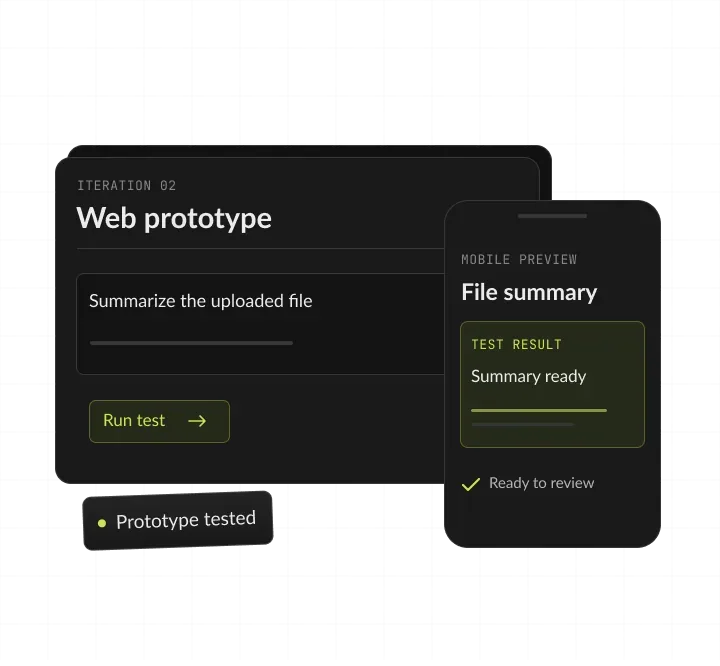
Clickable screens around a working AI core, so users, buyers and investors can try the idea. For example, a sales demo where investors upload their own document and watch the AI draft a summary.
Web AI MVP
A web app with the core AI workflow, user accounts and an admin view, from $11,000. For example, a web app where property managers upload leases and approve AI-drafted renewal notices.
Mobile AI MVP
iOS and Android apps with the AI feature built in, from $24,000, published to both stores. For example, a field app where technicians photograph a unit and get a suggested repair checklist.
Prototype to production
A first version built in Lovable, Bolt, Replit or a no-code tool, hardened for launch. For example, a Lovable prototype gets a production review, then fixes to sign-in, payments and hosting before launch.
AI feature MVP in your product
One AI feature tested with a pilot group inside software you already sell, from $4,000. For example, a project tool adds AI status summaries for 20 pilot accounts before every customer gets them. See AI integration.
AI proof of concept (POC) vs prototype vs MVP
Each stage answers a different question, so the right starting point depends on what you already know.
Not every product needs every stage. Discovery decides where yours starts.
What you get with an AI MVP
You get a live product, the evidence from your proof of concept and everything needed to keep building. Code, prompts, tests and documentation all sit in your own accounts.




AI MVP ROI: a worked example
An AI MVP pays off when early customers earn back its cost, or when it stops a weak idea early. This example uses assumed numbers for 10 paying pilots, not a client result, so swap in your own. At these numbers, the MVP earns back its build cost in about three months of pilot revenue. Compare that with building the full product first, from $25,000, before any customer pays: the MVP puts less money at risk, and its code extends into the full product once demand is proven. Pilots that do not convert are a result too: they tell you to change course after a small build, not a large one. Price the pilot's model calls in the LLM cost calculator; if the MVP saves its users time, the AI ROI calculator puts a value on those hours.
Risks in AI MVP development, and how we handle them
Each risk below gets a control before launch, so problems show up early, while they are cheap to fix.

How we keep data safe in an AI MVP
An AI MVP runs on real data from day one, so it gets the same basics as a full product. That means your own accounts, minimal data sent to models and a log of every request.
Health and financial data
For health or financial data, we plan the controls in discovery. For an MVP that handles patient records, our guide to HIPAA-compliant AI explains what changes.
NDA first
An NDA is signed before you share your idea or any data.
Your vendor accounts
Model calls run on your own Anthropic, OpenAI or Google accounts, under your terms with each vendor.
Only the fields needed
Each request sends only the fields the task needs, and sensitive values are masked where possible.
Security from the first release
Sign-in, roles and encrypted storage are part of the MVP, not a later phase.
Keys in a secrets manager
API keys stay in a secrets manager, never in code or prompts.
Every request logged
Every request, answer and model version is logged.
How AI MVP development works, from proof of concept to launch
Four steps from the first call to a live product. Our MVP development page covers MVPs without AI.
We pin down the one workflow the MVP must prove, who uses it and the data it needs. You get a scope, price and timeline in writing.
We test the riskiest AI step on your real inputs before any screens are built. We also measure the cost per request. You get a pass or fail result on real data.
We build the app, the AI workflow, accounts and an admin view, with a demo at each milestone. You get a working product your users can try.
We launch on your cloud account, watch usage and plan the next release with you. You get a live product and a ranked backlog.
AI products we took to launch
AI products from our case studies, built with founders, and the record behind them.

- Healthcare
Prior Authorization AI
Prior Authorization AI is a healthcare automation startup building AI-powered tools to streamline prior authorization for Medicare and Medicaid medical transportation providers in New Jersey.- 16Weekly hours saved
- 63%Admin time reduced
- 43%Fewer submission errors

- Startup
- Real Estate
Our Haus AI
A finance professional turned founder built Our Haus AI, an AI-powered collaborative workspace where homeowners and contractors scope, bid, contract, and document renovation projects together. SoftDoes took her prototype and made it production-ready.- 10XMVP scope delivered
- 2+years Ongoing partnership
- 1Fully owned Platform

- Real Estate
The building buyer
The Building Buyer is a Florida-based real estate investment firm co-founded by Dylan Troiano and Charles Hanlin. They acquire single-family, multifamily, and commercial properties across South Florida and beyond, with a focus on motivated seller opportunities.- 18Weekly hours saved
- 2+Years Ongoing partnership
- 1Fully owned Platform

- Healthcare
CareInTouch
CareInTouch is a Bay Area home health agency providing skilled nursing and therapy services to patients referred from hospitals and clinics. With over 100 staff, they operate in one of the most complex and compliance-driven healthcare markets in the country.- 40% Reduction In Billing Errors
- 100+Staff Operations Managed
- 0Missed Compliance Deadlines

- Startup
Sparkle The Cleaning Service
Sparkle The Cleaning Service is a Detroit-area residential cleaning company with 10 years in business, connecting homeowners with vetted, insured independent cleaners through a subscription-based marketplace platform.- 75% Platform Transparency
- 2XPlatform Growth
- 40%Higher User Retention

- Healthcare
FMY Orthodontics
FMY Orthodontics, a multi-location practice in West Tennessee, partnered with SoftDoes to replace a spreadsheet-based financial workflow with a custom web platform. The goal was to simplify how staff present treatment financing while allowing patients and families to review and complete decisions remotely.- 60%Workflow Reduction
- 75%Remote Adoption
- 5Locations Aligned

- Real Estate
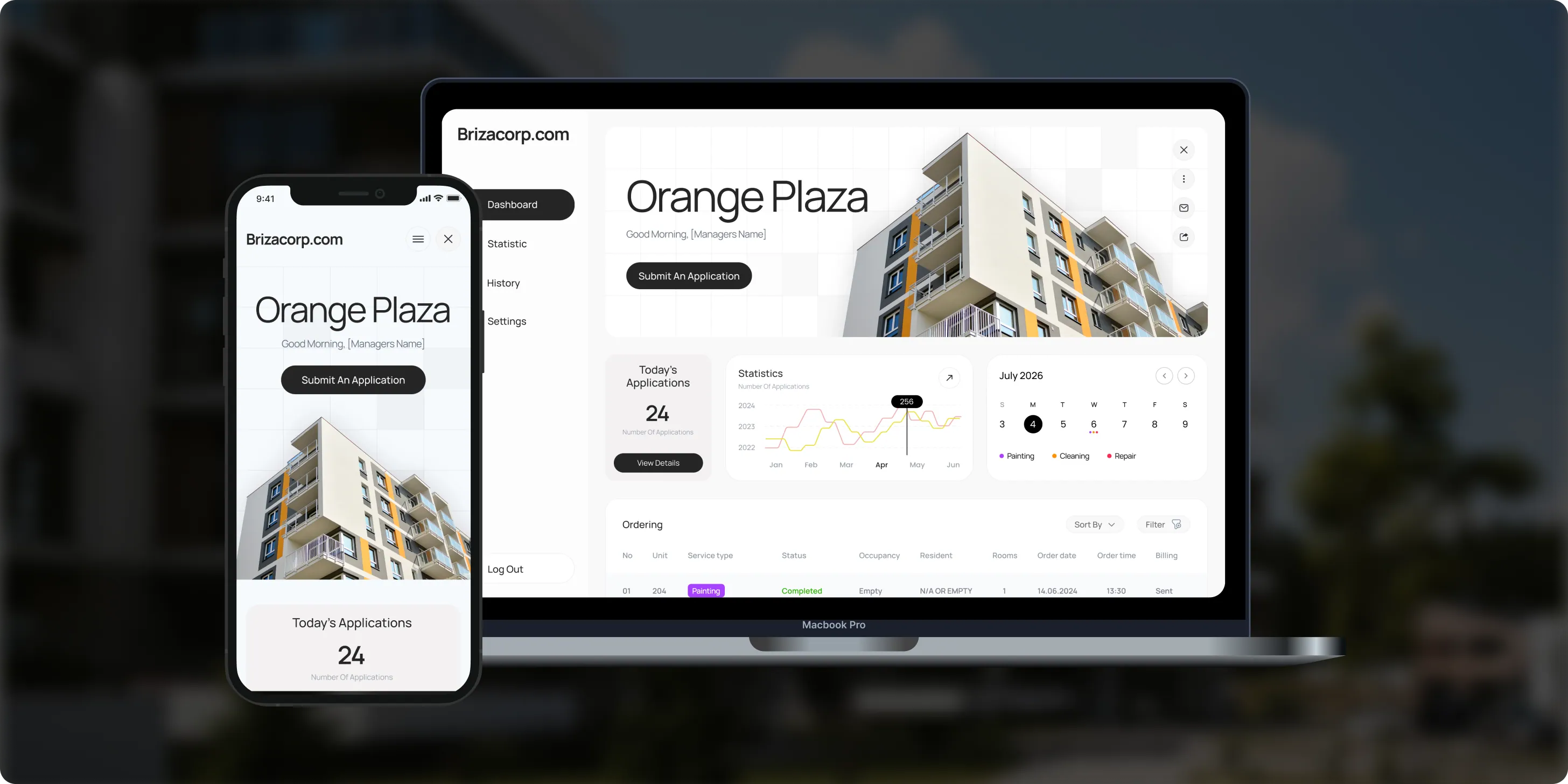
Brizacorp
Brizacorp manages residential properties and coordinates the staff who handle painting, cleaning, and repair requests. Its team tracked work across messengers, phone calls, e-mail, and paper planners, with no single place to manage requests or measure performance.- 98%Application Stability
- 95%Utilization Rate
- 30%Faster Task Completion
Why founders build AI MVPs with SoftDoes
Founders build AI MVPs with SoftDoes because the model is tested on their data before any screens, and the code is theirs from day one. The team is rated 5.0 on Clutch.

- 01
Reviewed by founders and executives
Over half of our Clutch reviewers are founders, executives or department heads.
- 02
Built on proven models
As a Claude Partner Network member and OpenAI Registered Partner, we pick the model that tests best on your data.
- 03
Code you own
The code, repository and IP are yours from day one, so investors see an asset you control.
- 04
40 AI projects since 2020
About 80% of our projects include AI, in work that runs from document reading to filing through Medicare's API.
- 05
Rated 5.0 on Clutch
5.0 from 40 client reviews, and named a Clutch 2026 Top AI Company in Kansas City.
- 06
Kansas City headquarters
Headquartered in Mission, KS, in the Kansas City metro. Call 800-909-2345 to reach the team.
AI MVPs by industry
The same MVP steps, shaped around each industry's users, records and rules. Each industry page covers that market's use cases and systems.
Healthcare
Prior authorization, intake and billing tools, with HIPAA controls planned from discovery.
Construction
Scoping, bidding and contract tools for homeowners and contractors.
Real estate
Lead, listing and transaction tools, on data the client owns.
Insurance
Claims intake and document review, with a person approving every payout.
Logistics
Shipment updates and freight documents read into carrier and warehouse systems.
Legal
Intake, document review and drafting tools that write into case management systems.


How to choose an AI MVP development company
Ask these questions before you sign. A strong MVP partner answers each one in writing.
Questions to ask, and what a good answer includes
- Will you test the AI on our data before building screens? Yes: a proof of concept with a pass mark agreed up front.
- What exactly is in the first release? One workflow, written down, with a list of what waits.
- Who owns the code? You do, in your repository from day one.
- What will it cost to run each month? An estimate of model usage and hosting, billed at cost on your accounts.
- Can the MVP grow into the full product? Yes: code built to be extended, with documentation.
- Can we see AI products you took to launch? Case studies of launched products, not only demos.
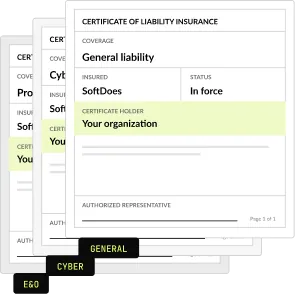
- What paperwork comes first? An NDA and a certificate of insurance before the first call.
What an AI MVP costs
A fixed price agreed before the build starts. Model usage and hosting go on your own accounts, at cost. You own the code, the repository and the IP from day one. See AI development cost.
Web AI MVP
Core AI workflow, sign-in, admin view
From $11,000
iOS and Android AI MVP
Published to both stores
From $24,000
Production review of a prototype
AI-built or no-code, 5 business days
$1,500 fixed
Project Discovery
Credited to the build
$490
Maintenance, hosting and updates
After launch
From $500 a month
Questions about AI MVP development
Cost, models, prototypes and ownership. Can't find your answer?
What is AI MVP development?
AI MVP development is building the smallest version of an AI product that real users can try. It includes the core AI workflow, sign-in, the screens users need and usage tracking, and little else. The goal is proof that people use it and that the AI performs on real data, before you fund a full build.
What is an AI proof of concept?
An AI proof of concept is a focused test of the riskiest AI step, run on your real data. You agree a pass mark first, such as the share of fields read correctly. The result is a clear pass or fail, plus the cost per request, before you fund screens or a full MVP.
How much does it cost to develop an AI MVP?
A web AI MVP starts at $11,000, and an AI MVP for iOS and Android starts at $24,000. The price grows with the number of screens, user roles and connected systems. Model usage and hosting are billed at cost on your accounts. Many teams begin with Project Discovery for $490, which is credited to the build.
What is the difference between an AI POC, a prototype and an MVP?
A proof of concept tests whether the AI step works on your real data, with no product around it. A prototype adds screens so people can try the idea. An MVP is a working product real users sign up for, with accounts, data storage and usage tracking. You can run all three in order, and each step lowers the risk of the next.
Which AI is best for an MVP?
Most MVPs call a proven model, such as Claude or GPT, rather than training their own. The best choice depends on the task, accuracy on your data and the cost per request. We test the leading models on your real inputs during the proof of concept, then build so you can switch models later.
Can you turn our no-code or AI-built prototype into an MVP?
Yes. We start with a production review, $1,500 fixed over 5 business days, covering security, data model, payments and hosting. Then we fix and launch it, from $4,500, or rebuild it in code you own, from $15,000. One founder came to us with a no-code prototype and launched a production platform about 10 times the scope of an MVP.
Who owns the MVP code?
You do. The code, the repository and the intellectual property are yours from day one, and the app runs on your own cloud and model accounts. That matters when you raise money, because investors see an asset you control. If you later build an in-house team, it takes over a documented codebase.
How long does AI MVP development take?
It depends on the screens, user roles and connected systems. On our general MVP development service, most core MVPs launch in 6 to 8 weeks. An AI MVP adds a proof of concept on your data first. We set its schedule in the written plan before the build starts.
Do we need our own data to build an AI MVP?
You need real examples, not a big dataset. Most AI MVPs call a proven model, so the first test set can start with 20 to 50 real inputs. Training a custom model needs far more labeled data. We suggest it only when proven models fail the proof of concept.
Should our AI MVP be web or mobile?
Start with web when users work at a desk or you sell to businesses: a web AI MVP starts at $11,000. Choose iOS and Android, from $24,000, when users work on phones or in the field. You can also launch on web first and add the apps once usage is proven.
How do we know if our AI MVP worked?
Two sets of numbers tell you. For the AI: the share of results users accept without edits, and the cost per request. For the product: how many users come back each week, and how many pay or sign a pilot. We agree these measures at discovery, so the result is clear at launch.
What happens after the MVP launches?
We watch usage and costs with you, then rank the next release by what users actually do. When demand is proven, the MVP code is extended into a full product with tenants and billing, from $25,000. If you prefer to run it yourself, your team takes over the documented code. Maintenance from us starts at $500 a month.
Updated · Reviewed by Orest Andrusyshyn, Founder and CEO