
U.S.-Based
AI SaaS development, from first release to scale
We build subscription products where AI does the core work, with tenants, usage-based billing and model cost controls built in from day one.
$25,000
AI SaaS products from
40
AI projects delivered since 2020
5.0
Clutch rating from 40 reviews
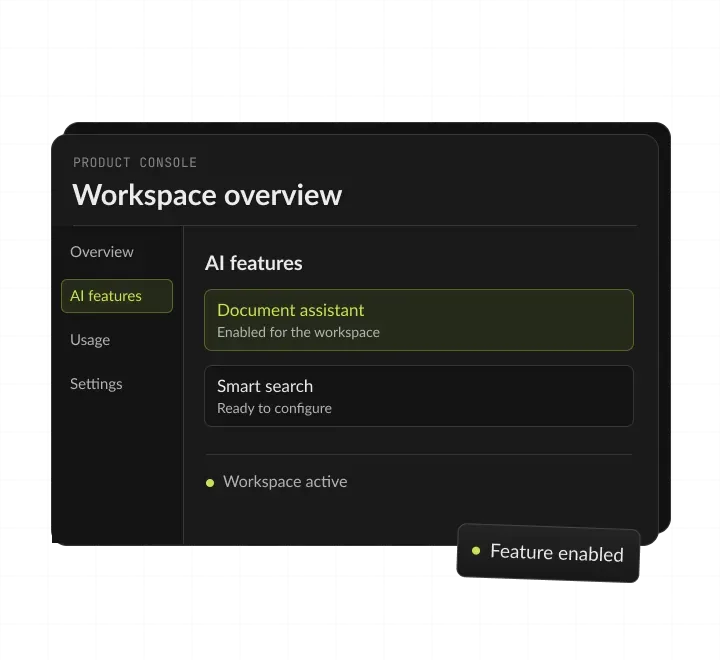























How one request runs in an AI SaaS product
One contract review: the AI flags risky clauses, the user approves the edits, and the request is metered against the plan.
A customer uploads a contract
A user at one of your client companies starts a review.
The AI reviews it
It flags risky clauses using that customer's own playbook.
The user approves the edits
They accept or change each suggestion before it is saved.
Usage is metered and billed
The request counts toward that customer's plan and limits.
AI SaaS development company, in short
- Software and AI company in the Kansas City metro
- AI SaaS products for founders and product teams
- The AI workflow, multi-tenant architecture, usage-based billing and evaluation, and you own all the code
- AI SaaS products start at $25,000

Build it. Bill it. Keep the margin.
- 01Full productFrom $25,000: tenants, the AI workflow, billing and an admin console, on your own cloud. AI development cost
- 02Test the market firstFrom $11,000: a web AI MVP that proves demand before you fund the full product. AI MVP development
- 03Who it's forFounders and product teams selling AI as a subscription
- 04You ownThe code, prompts, tests and billing setup, in your own accounts
What is AI SaaS development?
AI SaaS development is building subscription software where an AI model does the core job for each customer. Around the model sit accounts, tenant separation, usage-based billing, cost controls and quality tests.
What an AI SaaS build includes
The AI workflow
A standard SaaS product stores records and runs fixed rules. An AI SaaS product also reads, writes or decides, so every request carries a model cost and a quality risk. Prompts, model calls, retries and fallbacks are kept in your codebase.
Accounts, teams and roles
That changes the build. Each customer's data has to stay out of every other customer's answers, so each customer's data is kept in its own tenant.
Plans, credits and metered usage
Billing has to follow usage, not only seats: plans, credits and metered AI usage through Stripe or another billing provider.
Cost controls for each customer
Caching, model routing and usage limits for each customer.
Test sets and quality scores
Every release has to pass a test set before it reaches paying users: test sets, quality scores and alerts that run before every release.
An admin console
Accounts, plans, usage and support in one console.


AI SaaS vs adding AI to software you already sell
If you already sell software, one AI feature inside it is often the faster route. AI integration adds AI to the product you have, from $4,000. A new AI SaaS product, from $25,000, fits when the AI is the product itself. SaaS products without AI sit with our SaaS development team.
Types of AI SaaS products we build
Six common starting points, what each covers and when it fits. The prices are where each product starts on our price list. Model usage and hosting are billed at cost on your own accounts. Maintenance starts at $500 a month.

Web AI MVP
Sign-in, the core AI workflow and the screens needed to test demand. Fits when you still need proof that users will pay.
iOS and Android AI MVP
The same core workflow in apps for both stores. Fits when your users work on phones.
Full AI SaaS product
Tenants, the AI workflow, usage billing and an admin console. Fits when you have paying users or a signed pilot.
AI feature in a product you sell
Drafting, summaries or sorting added to your current screens. Fits when customers already use your software daily.
AI search on customer data
Answers from each customer's documents, filtered by permissions. Fits when customers ask questions of their own files.
AI agent inside the product
Actions in 1 or 2 connected systems, with approval steps. Fits when the product must update records, not only answer.
Models and stack we build on
Proven models and common frameworks, so your own team can take over the product.
When to build AI SaaS, and when to wait
Build AI SaaS when many companies share one costly task that AI does well, and will pay monthly for it. Get proof of that demand before the full build.
These signs usually come before a strong AI SaaS build:
- The same manual task shows up across many companies, not only one.
- Pilot users already rely on an MVP, a prototype or a manual service you run.
- The AI step works on real examples, with a pass rate you have measured.
- Buyers have named a price, or signed a paid pilot.
- The task needs data or rules that a general chatbot does not have.
When to wait
If no user has tried the AI on real work, start with a web AI MVP, from $11,000. If only your own company needs the tool, a single-company build costs less than a multi-tenant product. Our custom AI solutions page covers that route.
What to prepare before the first call
Who the customer is, and the one job the AI must do for them; 20 to 50 real examples of that job, such as documents, tickets or forms; how you plan to charge: per seat, per use or both; and rules your buyers expect, such as HIPAA or a SOC 2 report request.
AI product development, built for a SaaS business
Everything an AI product needs to earn money, beyond the model call.
AI product development
From the first AI feature to a full product: discovery, design, build and launch on your cloud. For example, a contract review idea scoped to one job, flagging risky clauses, and shipped before any second feature.
Multi-tenant architecture
Each customer's data kept separate, with per-tenant settings, roles and audit logs. For example, a recruiting platform where each client firm sees only its own candidates, settings and audit log.
Usage-based billing
Plans, credits and metered AI usage through Stripe, so revenue tracks your model costs. For example, a Pro plan that includes 1,000 AI reviews a month, with metered overage billed through Stripe.
Model cost controls
Caching, model routing and per-customer limits, so heavy users don't erase your margin. For example, simple tagging runs on a small, low-cost model, and only hard cases go to the largest one.
Evaluation and monitoring
Test sets, quality scores and alerts on every release, so a model change doesn't break answers. For example, before a model upgrade ships, 300 saved customer cases run again and the scores are compared. See AI agent evaluation.
AI search on each customer's data
Answers from each customer's own documents, filtered to that customer and to each user's role. For example, a support product where each client's assistant answers only from that client's help articles.
What you get with an AI SaaS build
You get a working product and everything needed to run it without us. Code, prompts, tests, billing setup and documentation all sit in your own accounts.




AI SaaS margins: a worked example
An AI SaaS product earns money when each customer's plan price covers that customer's model usage, hosting and support. This example uses assumed numbers for one $300 plan, not a client result, so swap in your own. At these numbers, 50 paying customers bring about $12,000 a month in margin, and the build pays back in just over two months. Watch the heavy users: one customer sending ten times the average volume would cost $450 a month in model usage, more than the $300 plan, so per-customer limits and metered overage keep that account profitable. Vendor discounts help too: Anthropic's pricing page and OpenAI's Batch API guide both list 50 percent off for batch requests, and on Anthropic's pricing page a cached prompt read costs at most 10 percent of the standard input price (both read in November 2026). Estimate each customer's model usage in the LLM cost calculator and the hours your product saves in the AI ROI calculator. After launch we track model cost per customer next to revenue.
How we build AI SaaS products, step by step
Four steps from the idea to paying customers. Our AI SaaS build guide covers the architecture.
We define the users, the AI job, the pricing model and the first release. We also model the cost per customer, so plan prices cover model usage. You get a scope, architecture and price in writing.
Accounts, tenants, the AI workflow, billing and an admin console, with a demo at each milestone. You get a working product on your cloud.
We test quality, security and cost per customer before launch. You get an evaluation report and a launch checklist.
We launch, watch usage and margins, and ship the next releases with you. You get a live product and a ranked roadmap.
AI products in production
AI products from our case studies, built with their founders, and the record behind them.

- Healthcare
Prior Authorization AI
Prior Authorization AI is a healthcare automation startup building AI-powered tools to streamline prior authorization for Medicare and Medicaid medical transportation providers in New Jersey.- 16Weekly hours saved
- 63%Admin time reduced
- 43%Fewer submission errors

- Startup
- Real Estate
Our Haus AI
A finance professional turned founder built Our Haus AI, an AI-powered collaborative workspace where homeowners and contractors scope, bid, contract, and document renovation projects together. SoftDoes took her prototype and made it production-ready.- 10XMVP scope delivered
- 2+years Ongoing partnership
- 1Fully owned Platform

- Real Estate
The building buyer
The Building Buyer is a Florida-based real estate investment firm co-founded by Dylan Troiano and Charles Hanlin. They acquire single-family, multifamily, and commercial properties across South Florida and beyond, with a focus on motivated seller opportunities.- 18Weekly hours saved
- 2+Years Ongoing partnership
- 1Fully owned Platform

- Healthcare
CareInTouch
CareInTouch is a Bay Area home health agency providing skilled nursing and therapy services to patients referred from hospitals and clinics. With over 100 staff, they operate in one of the most complex and compliance-driven healthcare markets in the country.- 40% Reduction In Billing Errors
- 100+Staff Operations Managed
- 0Missed Compliance Deadlines

- Startup
Sparkle The Cleaning Service
Sparkle The Cleaning Service is a Detroit-area residential cleaning company with 10 years in business, connecting homeowners with vetted, insured independent cleaners through a subscription-based marketplace platform.- 75% Platform Transparency
- 2XPlatform Growth
- 40%Higher User Retention

- Healthcare
FMY Orthodontics
FMY Orthodontics, a multi-location practice in West Tennessee, partnered with SoftDoes to replace a spreadsheet-based financial workflow with a custom web platform. The goal was to simplify how staff present treatment financing while allowing patients and families to review and complete decisions remotely.- 60%Workflow Reduction
- 75%Remote Adoption
- 5Locations Aligned

- Real Estate
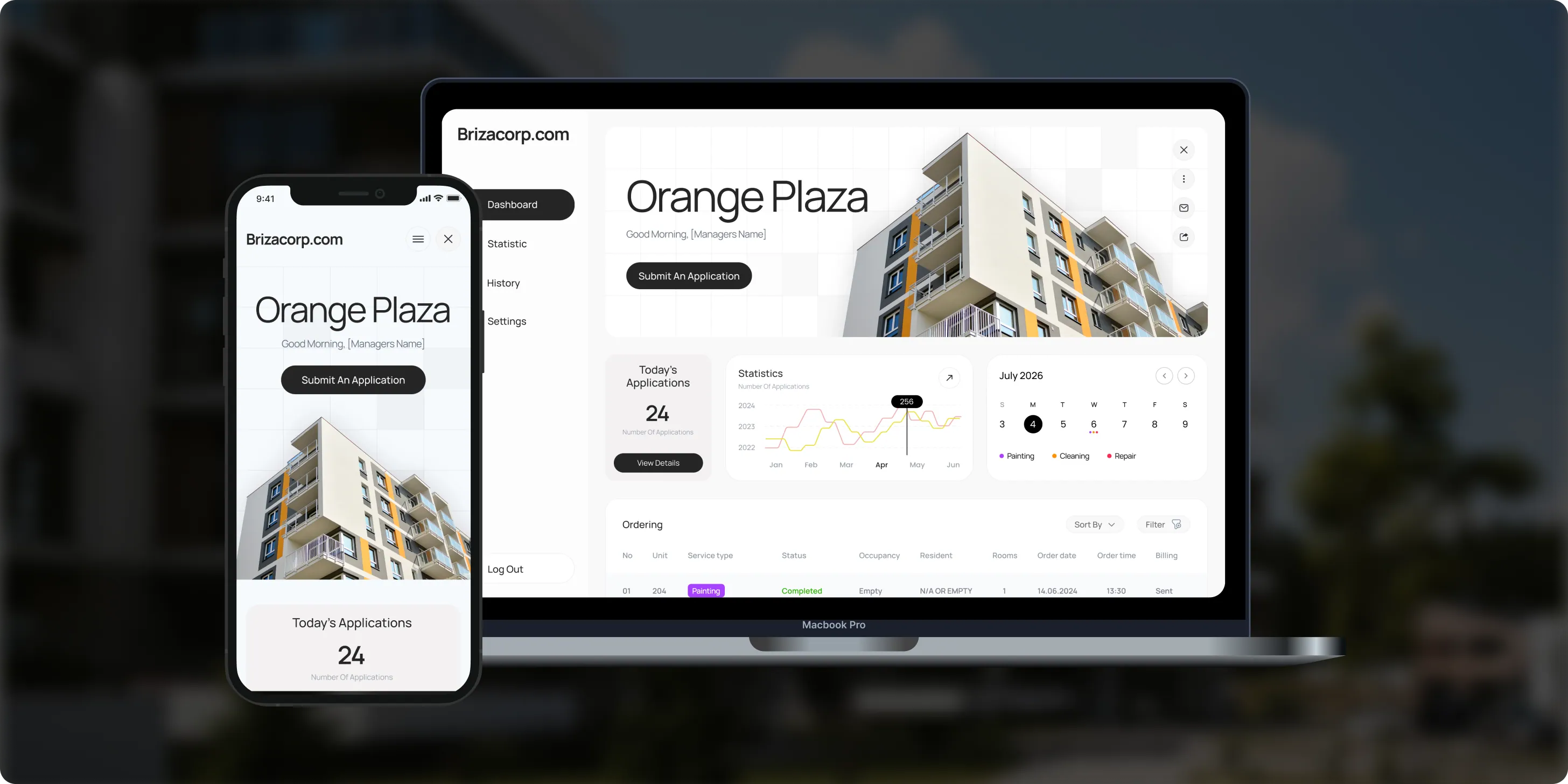
Brizacorp
Brizacorp manages residential properties and coordinates the staff who handle painting, cleaning, and repair requests. Its team tracked work across messengers, phone calls, e-mail, and paper planners, with no single place to manage requests or measure performance.- 98%Application Stability
- 95%Utilization Rate
- 30%Faster Task Completion
Risks in AI SaaS development, and how we handle them
Each risk gets a control in the product before launch, and a test that shows it works.

How we keep customer data safe in an AI SaaS product
Each customer's data stays in its own tenant, and every model call runs on your own vendor accounts. Every request leaves a log entry, and these controls ship with the first release.
SOC 2 controls from the first release
From the first release, we build the controls SOC 2 auditors look for: access control, activity logs, encryption and backups. Enterprise buyers often ask about them in security reviews. If customer data must stay inside your own cloud, see private AI. For products that handle patient records, our guide to HIPAA-compliant AI explains what changes. Our AI governance page covers company rules on AI use.
Tenant checks everywhere
Tenant checks run in every database query and every AI search, with tests that try to cross them.
Your vendor accounts
Model calls run on your own Anthropic, OpenAI, Google or cloud accounts, under your terms with each vendor.
Only the fields needed
Each request sends only the fields the task needs, and sensitive values are masked where the task allows.
Role-based access
Access follows the roles in your product, so the AI never shows a record a user cannot open.
Keys in a secrets manager
API keys for each model vendor stay in a secrets manager, never in code or prompts.
Every request logged
Every request, answer and model version is logged for audits and incident review.
What AI SaaS development costs
A fixed price agreed before the build starts. Model usage and hosting are billed at cost on your own accounts. Each extra system your product connects to adds $3,000 for 1 or 2 systems, or $9,000 for 3 or more. Our AI SaaS development cost guide breaks down token, RAG and monitoring costs. See AI development cost.
AI SaaS product
Tenants, AI workflow, billing and admin console
From $25,000
Web AI MVP
Test the market first
From $11,000
Agent monitoring and cost control
Then from $500 a month
Setup $3,500
Maintenance, hosting and updates
After launch
From $500 a month
Project Discovery
Credited to the build
$490
How to choose an AI SaaS development company
Ask these questions before you sign. A strong AI SaaS partner answers each one in writing.
Questions to ask, and what a good answer includes
- Who owns the code and IP? You do, from day one, in your repository and your accounts.
- How will tenants be kept apart? Tenant checks in every query and AI search, with tests that try to cross them.
- How will you control model cost per customer? Metering, limits, caching and routing, with the margin modeled before the build.
- How will you measure AI quality? A written test set and a pass mark agreed before the build.
- What happens when a vendor retires a model? Pinned versions, a rerun of the test set and a planned switch.
- Can we see AI products in production? Case studies of live products, not only demos.
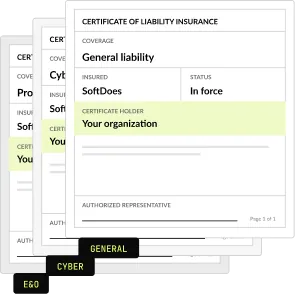
- What paperwork comes first? An NDA and a certificate of insurance before the first call.
Why founders build AI SaaS with SoftDoes
Founders build AI SaaS with SoftDoes because they own the code and IP from day one, and the model is chosen by testing. The team has delivered 40 AI projects since 2020.

- 01
Reviewed by founders and executives
More than half of our Clutch reviewers are founders, executives or department heads.
- 02
Built on leading models
As a Claude Partner Network member and OpenAI Registered Partner, we pick the model that tests best for your product.
- 03
You own the product
The code, repository and IP are yours from day one, on your own accounts.
- 04
40 AI projects since 2020
About 80% of our projects include AI, from document reading to filing through Medicare's API.
- 05
Top AI Company in Kansas City
Clutch named SoftDoes a Top Artificial Intelligence Company and Top Machine Learning Company in Kansas City for 2026.
- 06
Frontier AI lab experience
The team has worked with frontier AI labs and some of the largest data providers.
AI SaaS products by industry
The same product foundations, shaped around each industry's records, systems and rules. Each industry page goes deeper on that market's use cases.
Healthcare
Prior authorization and intake products, with HIPAA controls and payer connections.
Construction
Scoping, bidding and contract tools that homeowners and contractors share.
Real estate
Lead and deal tools that run on data the client owns outright.
Insurance
Claims intake and document review products, with a person approving every payout.
Financial services
Document checks and client reporting, with an audit log for every AI step.
Legal
Intake, review and drafting products that write into case management systems.


Questions about AI SaaS development
What it takes, what it costs and who owns it. Can't find your answer?
What is AI SaaS development?
AI SaaS development is building a subscription software product where AI does the core work, such as drafting, analyzing or answering. Beyond the AI itself, it needs tenant separation, usage-based billing, model cost controls, evaluation and an admin console. SoftDoes builds the whole product and hands you the code.
What is AI SaaS?
AI SaaS is subscription software, used in a browser or an app, where AI does part of the core job. Examples include tools that review contracts, answer support questions or draft reports from a company's own data. Customers pay a monthly plan, and the vendor runs the models, hosting and updates behind it.
Is AI part of SaaS, or a separate kind of product?
AI can be one feature inside a SaaS product, or the reason the product exists. Either way, it runs on the same SaaS foundations: accounts, tenants, billing and security. AI then adds its own parts on top. Each request carries a model cost, and the product needs quality tests and fallbacks for slow or wrong answers.
How is AI used in product development?
AI shows up in two ways. Inside the product, it does work for users: summaries, search, recommendations or agents that act. In the building process, it speeds up research, design and coding. We use both, and we keep a person reviewing every AI change that reaches customers.
What does an AI SaaS build include, and what does it cost?
An AI SaaS product starts at $25,000, including tenants, the AI workflow, billing and an admin console. Testing the market first with a web AI MVP starts at $11,000. Model usage and hosting are billed at cost on your own accounts. Our AI SaaS development cost guide covers tokens, RAG and monitoring in detail.
How do you keep model costs from eating SaaS margins?
We meter AI usage per customer and tie it to your plans, so heavy users pay for what they use. Caching repeated requests, routing simple tasks to smaller models and setting per-tenant limits keep costs predictable. Agent monitoring and cost control costs $3,500 to set up, then from $500 a month.
Should we build an MVP or a full AI SaaS product first?
Build an MVP when you still need proof that customers will use and pay for the AI. Web AI MVPs start at $11,000. Build the full SaaS product, from $25,000, when you have paying users or a signed pilot and need tenants, billing and admin tools. The MVP code can be extended into the full product.
Who owns the product and the code?
You do. The code, the repository and the intellectual property are yours from day one, and the product runs on your own cloud, model and billing accounts. That matters to investors and buyers. If you build an in-house team later, it takes over documented code with runbooks for every service.
Will AI replace SaaS?
Our view: AI agents now handle tasks that once needed a separate tool. Thin products that only wrap a model face pressure. A business still needs software that holds its records, permissions and audit trail. AI changes what SaaS products do. Products that put AI inside a real workflow, on the customer's own data, keep their place.
How long does it take to build an AI SaaS product?
It depends on the user roles, plans, connected systems and the AI job itself. We set the scope, price and schedule for your product in a written plan before the build starts. Many founders begin with Project Discovery for $490, credited to the build. Others first test demand with a web AI MVP, from $11,000.
Can you add AI to our existing SaaS product?
Yes. If we can reach your product's API or backend, we add the AI feature beside it, from $4,000. We build on a branch, test on your real data and release behind a flag to a pilot group. Our AI integration page covers this route in detail.
Which AI model should an AI SaaS product use?
It depends on the task, the accuracy you need and the cost per request. We test two or three models on your real examples before we choose. Many products send simple tasks to a small model and hard ones to a larger model. Model calls sit behind one interface, so a later switch stays small.
How do you keep each customer's data separate?
Every record carries a tenant ID, and every database query and AI search filters on it. Search indexes are filtered per customer, so one company's documents never appear in another company's answers. Tests that try to cross tenants run before every release. Inside each tenant, access follows the roles your product defines.
How should we price our AI SaaS product?
We usually recommend a monthly fee with a usage allowance, such as a set number of AI reviews. Usage above the allowance is billed as overage or credits, so revenue tracks model cost. We set up the plans, meters and limits in Stripe, and we model the margin of each plan before launch.
Updated · Reviewed by Orest Andrusyshyn, Founder and CEO