
U.S.-Based
Data engineering services for AI-ready data
We build the pipelines, warehouse and quality tests that feed your reports and AI tools, with every record traceable to its source.
$3,500
Data readiness review, fixed
$6,000
Pipelines from
5.0
Clutch rating from 40 reviews




















How your data moves after the build
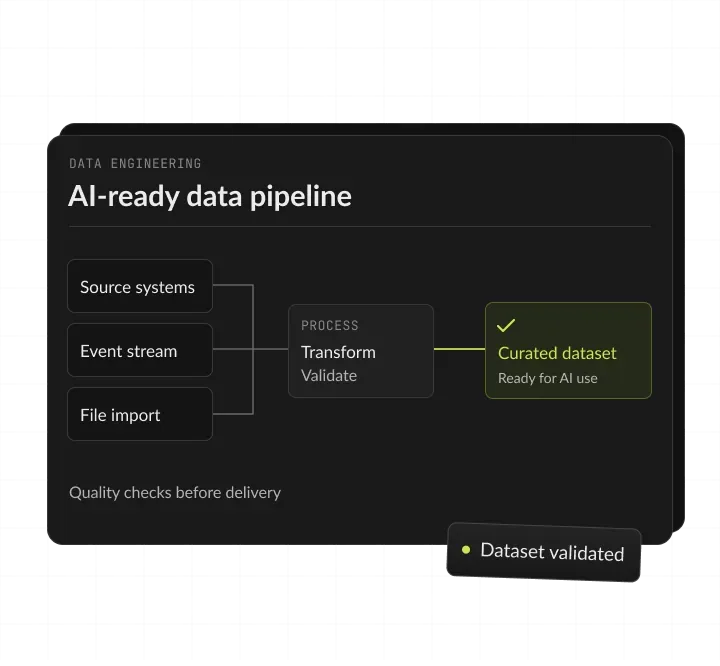
Records from many tools: the pipeline cleans and tests each batch, the data owner reviews failures, and every report reads one trusted source.
Records land in many tools
Orders, invoices and CRM updates arrive in separate systems all day.
The pipeline cleans each batch
It pulls, joins and tests the data, and holds back any record that fails.
The data owner reviews failures
Flagged records wait in a queue with the rule they broke.
One trusted source
Reports, forecasts and AI tools read the same tested tables.
Data engineering services, in short
- Software and AI company in the Kansas City metro
- Data pipelines, cloud warehouses and data quality tests
- For mid-market operations, finance and product teams whose data must be ready for reporting and AI
- A data readiness review costs $3,500, and pipelines start at $6,000

Pull it. Test it. Trust it.
- 01Start here$3,500: a fixed-price data readiness review: your sources, quality gaps and a ranked plan in writing. AI development cost
- 02PipelinesFrom $6,000: pipelines from your source systems into one warehouse, with tests, alerts and run logs. AI readiness assessment
- 03Who it's forTeams whose reports disagree or whose AI pilots stall on data
- 04You ownThe pipelines, data models, tests and documentation
What is data engineering?
Data engineering moves data from the systems that create it to the places that use it, and keeps it correct. Data engineering services build and run those pipelines, warehouses and quality checks. Every company creates data in many tools: an ERP, a CRM, a store, spreadsheets. Data engineering joins it in one place, with one definition for each number, so reports and AI tools agree. “Every successful data initiative starts with understanding the problem, the data, and the decisions behind it.” — Orest Andrusyshyn, Founder and CEO, SoftDoes
What a data engineering engagement includes
An assessment
An assessment of your systems, data flows, reliability, security and cost drivers.
Batch and real-time pipelines
Pipelines from apps, databases, files, APIs and queues.
A warehouse or lakehouse
Modeled around the questions your teams ask.
A data quality program
Source checks, transformation tests and reconciliation to business totals.
Monitoring
Monitoring for failed runs, late data and schema changes.
Documentation
Documented definitions, owners and runbooks for every source.



ETL vs ELT
ETL transforms data before it is loaded into the warehouse. ELT loads raw data first, then transforms it inside the warehouse. Cloud warehouses make ELT practical, while ETL still fits when data must be cleaned or masked before it lands.
Data engineering vs data science
Data engineering makes data reliable and available. Data science builds models on top of it, such as forecasts and risk scores. Our predictive analytics team covers that side.
Types of data engineering work we do
Six common pieces of work, what each covers and when it fits. Prices come from our price list. Warehouse, cloud and tool licenses are billed at cost on your own accounts.

Data readiness review
Sources, quality gaps and a ranked plan, including AI readiness. Fits when you are unsure what to fix first.
Batch pipelines (ETL or ELT)
Scheduled loads with tests, retries and alerts. Fits when reports and models can use hourly or daily data.
Real-time pipelines
Events streamed as they happen. Fits when decisions need data within minutes.
Warehouse or lakehouse modeling
Tables shaped around the questions teams ask. Fits when several systems must answer one question.
Data quality program
Source checks, transformation tests and reconciliation to business totals. Fits when numbers keep disagreeing across reports.
Monitoring and care
Failed-run alerts, fixes and changes as sources evolve. Fits when you want the pipelines watched after launch.
Systems we connect
We pull from the tools you already run and load into the warehouse you choose.
When data engineering pays off
Data engineering pays off when people spend hours every week exporting, cleaning and reconciling data. It also pays off when an AI project stalls because the data is not ready.
These signs usually come before a strong data engineering project:
- Two reports show different numbers for the same month.
- Analysts spend more time cleaning exports than analyzing them.
- Key reports depend on one person's spreadsheet.
- An AI pilot works on sample data but not on the real records.
- A new ERP, CRM or warehouse is coming, and data must move.
When to wait
If one system holds all the data and reports come straight from it, you may not need a warehouse yet. If nobody can say which decisions the data must support, start with a readiness review, not pipelines.
What to prepare before the first call
A list of your systems and who owns each one; the reports, forecasts or AI tools the data must feed; known problems, such as numbers that never match; and read access to one or two sources, or sample exports.
Data pipeline development, warehouses and data quality
What we build so reports, forecasts and AI tools all read the same correct numbers.
Data pipeline development
Batch and real-time pipelines from your apps, databases, files and APIs, with retries and alerts when a source fails. For example, orders from Shopify and invoices from QuickBooks land in one table every hour, with an alert if either source fails.
Cloud data warehouse engineering
A warehouse or lakehouse on Snowflake, Databricks, BigQuery or Redshift, modeled around the questions your teams ask. For example, sales, finance and support data modeled in Snowflake around the ten questions leaders ask each week. See Snowflake development.
Data quality engineering
Tests at the source and after each step, reconciled to business totals, so every number has a named owner. For example, daily revenue in the warehouse is reconciled to the ERP total, and a mismatch pauses the report refresh.
AI data readiness
We check whether your data can feed a model or AI agent: coverage, accuracy, freshness, labels and access rules. For example, before an AI agent reads support history, tickets are checked for gaps, duplicates and personal data. See AI readiness assessment.
Legacy and cloud integration
Old databases, spreadsheets and SaaS tools joined in one model, with sync rules and ownership written down. For example, a 15-year-old inventory database and a new CRM share one customer ID, with sync rules written down.
Data migration
Data moved from old systems to a new warehouse or app, reconciled to the old totals before cutover. For example, ten years of orders move from an on-premise database to Snowflake, with row counts and revenue totals matched.
What you get from a data engineering project
You get pipelines running in your own cloud account and everything needed to run them without us. That means code, tests, definitions, runbooks and alerts.




Data engineering ROI: a worked example
Data engineering pays back when the hours analysts spend on exports and cleanup cost more than the pipelines that replace them. This example uses assumed numbers for 4 analysts, not a client result, so swap in your own. At these numbers, the review and a first pipeline build pay back in under two months, before cloud and warehouse fees. The larger gain is harder to price: every report reads the same tested tables, so teams work from one set of numbers. Enter your analysts' cleanup hours and loaded cost in the AI ROI calculator. If AI is next on your roadmap, the AI readiness quiz shows where your data stands.
Risks in data engineering, and how we handle them
Each risk below gets a control in the pipeline before go-live, and an owner when it fires.

How we keep your data safe in the pipeline
Pipelines run in your own cloud account, access follows your existing roles, and every run leaves a log. Sensitive fields are masked before they reach shared tables.
Health data and private AI
Health data has its own rules, and our guide to HIPAA-compliant AI explains what changes when pipelines carry patient records. For AI that must stay inside your own cloud, see private AI.
Your cloud accounts
Pipelines, warehouses and code live in your own cloud accounts, never in a SoftDoes account.
Narrow credentials
Each connection uses its own credentials with the narrowest access it needs, stored in a secrets manager.
Masked before sharing
Sensitive fields are masked or excluded before data reaches shared tables.
Role-based access
Access to tables follows the roles your teams already have.
Every run logged
Every run is logged, so any number can be traced to its source.
Insured
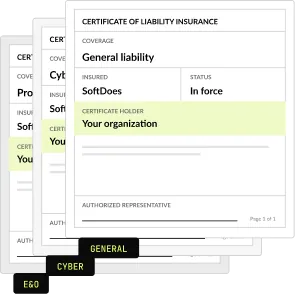
SoftDoes carries general liability, professional liability (errors and omissions) and cyber liability insurance. A certificate of insurance is available on request.
How data engineering consulting turns into working pipelines
Four steps from the first call to pipelines your team trusts and can run.
We map your sources, data flows, quality issues and the reports or AI tools the data must feed. You get a written gap report and a ranked plan.
We design tables, naming rules and tests around the questions your teams ask most. You get a data model your analysts can read.
We build and test each pipeline, with alerts, retries and a log of every run. You get pipelines running in your cloud account.
We document every source and rule, train your team and watch for failed runs. You get runbooks, dashboards and optional care.
Data pipelines in production
Builds from our case studies where data now moves without manual work, and the record behind them.

- Healthcare
Prior Authorization AI
Prior Authorization AI is a healthcare automation startup building AI-powered tools to streamline prior authorization for Medicare and Medicaid medical transportation providers in New Jersey.- 16Weekly hours saved
- 63%Admin time reduced
- 43%Fewer submission errors

- Startup
- Real Estate
Our Haus AI
A finance professional turned founder built Our Haus AI, an AI-powered collaborative workspace where homeowners and contractors scope, bid, contract, and document renovation projects together. SoftDoes took her prototype and made it production-ready.- 10XMVP scope delivered
- 2+years Ongoing partnership
- 1Fully owned Platform

- Real Estate
The building buyer
The Building Buyer is a Florida-based real estate investment firm co-founded by Dylan Troiano and Charles Hanlin. They acquire single-family, multifamily, and commercial properties across South Florida and beyond, with a focus on motivated seller opportunities.- 18Weekly hours saved
- 2+Years Ongoing partnership
- 1Fully owned Platform

- Healthcare
CareInTouch
CareInTouch is a Bay Area home health agency providing skilled nursing and therapy services to patients referred from hospitals and clinics. With over 100 staff, they operate in one of the most complex and compliance-driven healthcare markets in the country.- 40% Reduction In Billing Errors
- 100+Staff Operations Managed
- 0Missed Compliance Deadlines

- Startup
Sparkle The Cleaning Service
Sparkle The Cleaning Service is a Detroit-area residential cleaning company with 10 years in business, connecting homeowners with vetted, insured independent cleaners through a subscription-based marketplace platform.- 75% Platform Transparency
- 2XPlatform Growth
- 40%Higher User Retention

- Healthcare
FMY Orthodontics
FMY Orthodontics, a multi-location practice in West Tennessee, partnered with SoftDoes to replace a spreadsheet-based financial workflow with a custom web platform. The goal was to simplify how staff present treatment financing while allowing patients and families to review and complete decisions remotely.- 60%Workflow Reduction
- 75%Remote Adoption
- 5Locations Aligned

- Real Estate
Brizacorp
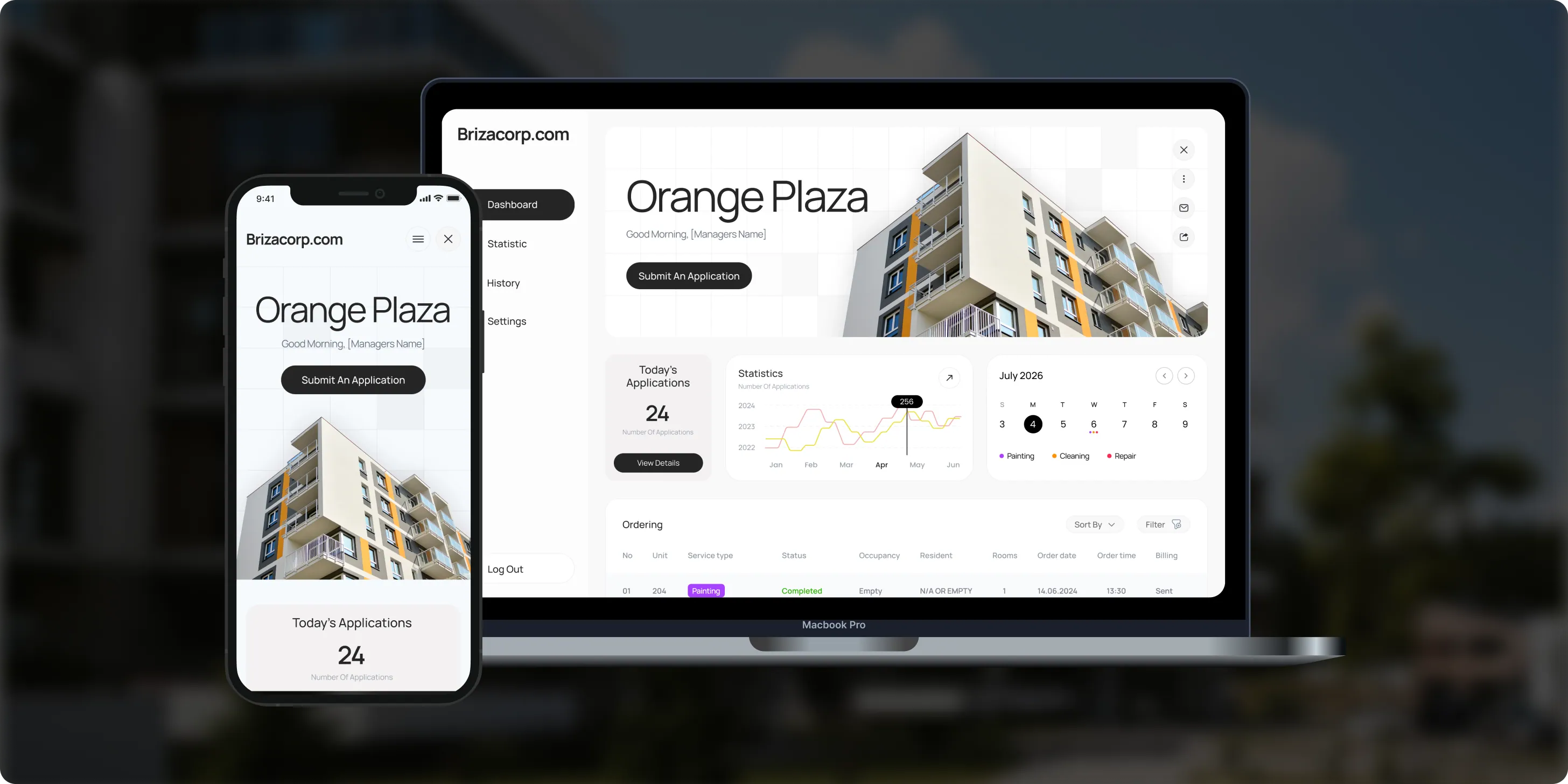
Brizacorp manages residential properties and coordinates the staff who handle painting, cleaning, and repair requests. Its team tracked work across messengers, phone calls, e-mail, and paper planners, with no single place to manage requests or measure performance.- 98%Application Stability
- 95%Utilization Rate
- 30%Faster Task Completion
Why teams choose SoftDoes for data engineering
Teams choose SoftDoes for data engineering because pipelines run in their own cloud, and the data is shaped for the AI they build next. They own all the code, models and documentation.

- 01
Data you own
Pipelines run in your own cloud account, and you own all the code, models and documentation.
- 02
Ready for the AI you build next
As a Claude Partner Network member and OpenAI Registered Partner, we shape data for the models you plan to use.
- 03
Vendor documents first
Our NDA and certificate of insurance reach your procurement team before the first call.
- 04
40 AI projects since 2020
About 80% of our projects include AI, from document intake to filing through Medicare's API.
- 05
Rated 5.0 on Clutch
5.0 from 40 client reviews, and a Clutch 2026 Top Machine Learning Company in Kansas City.
- 06
Kansas City headquarters
Headquartered in Mission, KS, in the Kansas City metro. Call 800-909-2345 to reach the team.
Data engineering by industry
The same pipeline steps, built around each industry's systems, records and rules. Each industry page shows that industry's AI use cases.
Healthcare
Intake, billing and authorization data joined across systems, with HIPAA controls.
Financial services
Statements, transactions and customer records reconciled, with an audit trail.
Real estate
Market, lead and property data refreshed daily, on data the client owns.
Logistics
Shipment, carrier and warehouse data joined for tracking and planning.
Manufacturing
Production, quality and inventory data in one model for planning.
Accounting
Client ledgers and documents organized for review and reporting.


How to choose a data engineering company
Ask these questions before you sign. A strong data engineering partner answers each one in writing.
Questions to ask, and what a good answer includes
- Will everything run in our accounts? Yes: your cloud, your warehouse and your repository.
- How do you test data quality? Source checks, transformation tests and reconciliation to business totals.
- What happens when a source changes? Alerts on schema and freshness changes, and a runbook for the fix.
- Will you extend our current stack? Yes: extend what works, and replace only what blocks the plan.
- Can our team run it without you? Runbooks, documentation and training at handover.
- Can we see pipelines in production? Case studies of live systems, not only diagrams.
- What paperwork comes first? An NDA and a certificate of insurance before the first call.
What AI data readiness and pipelines cost
Fixed prices agreed before work starts. Cloud and warehouse fees go on your own accounts, billed at cost. If you are weighing an outside team against hiring, read should you outsource data engineering. See AI development cost.
Data readiness review
Sources, quality gaps and a ranked plan
$3,500
Data pipelines into your warehouse
Tests, alerts and run logs
From $6,000
Project Discovery
Credited to the build
$490
Maintenance and monitoring
After go-live
From $500 a month
Questions about data engineering services
Cost, readiness, platforms and ownership. Can't find your answer?
What are data engineering services?
Data engineering services build the systems that move data from where it is created to where it is used. That means pipelines from your apps and databases, a warehouse or lakehouse, tests that catch bad records, and monitoring. The result is one trusted source for reports, forecasts and AI tools, instead of exports and spreadsheets.
What does a data engineering consultant do?
A data engineering consultant reviews how data moves through your company, then designs and often builds the fix. The review covers systems, data flows, reliability, security, cost drivers and team skills. It ends with a ranked list of gaps and options. Our readiness review does this for a fixed $3,500.
What is a data pipeline?
A data pipeline is an automated path for data. It pulls data from a source, cleans and joins it, tests it and loads it where it is used. One pipeline might move orders from your store into the warehouse every hour. Good pipelines retry when a source fails, alert an owner and log every run.
How much do data engineering services cost?
A data readiness review costs $3,500 and gives you a written plan. Pipelines start at $6,000, and the price grows with the number of source systems, data volume and how fresh the data must be. Cloud and warehouse fees are billed at cost on your own accounts. Maintenance and monitoring start at $500 a month.
What is AI data readiness?
AI data readiness means your data can feed a model or AI agent without misleading it. We check five things: coverage of the cases the AI will see, accuracy, freshness, labels where a model needs them, and access rules. The review ends with a list of gaps, ranked by the AI projects they block.
Do we need data engineering consulting or a full build?
Start with consulting when you are unsure what to fix first. The readiness review maps your sources and gaps and ranks the work by value. Choose a build when the plan is clear, such as moving three systems into one warehouse. You can also do both: the review first, then pipelines priced from its findings.
Which data platforms do you work with?
We build on the platform that fits your data and budget, including Snowflake, Databricks, Google BigQuery, Amazon Redshift and PostgreSQL. Pipelines run on tools such as Apache Airflow. If you already have a warehouse, we extend it rather than replace it. Everything runs on your own cloud account.
Who owns the pipelines and the data?
You do. Pipelines, data models, tests and documentation run in your own cloud and warehouse accounts, and you own all the code and IP from day one. Your team gets runbooks for every source, so it can operate the stack without us. Maintenance from SoftDoes is optional and starts at $500 a month.
Which data pipeline tool is best?
There is no single best tool. The choice depends on your sources, data volume, how fresh the data must be and who will run it. Orchestrators such as Apache Airflow run scheduled pipelines with many steps. We pick tools your team can maintain, and we extend the stack you already have where it works.
How long does a data engineering project take?
It depends on the number of systems and stakeholders, data volume, security needs and how fast decisions get made. The readiness review turns those variables into a written plan with scope, price and schedule. Pipelines are then priced from its findings, so the schedule rests on what we found, not on guesses.
Warehouse, lake or lakehouse: which do we need?
A warehouse stores cleaned tables for reports and fits most structured business data. A data lake stores raw files of any kind at low cost. A lakehouse combines both, adding warehouse-style tables on top of lake storage. The readiness review recommends one based on your data types, volume and budget.
Can you work with our existing data team?
Yes. We work alongside your analysts and engineers, with clear ownership of data access, definitions, pipelines and upkeep. Some teams want us to build while they learn the stack. Others want extra hands on a backlog they already own. Either way, everything lives in your repository and accounts.
Can you fix our existing pipelines?
Yes. The readiness review starts with your current environment: pipelines, data flows, reliability, security and cost drivers. It produces a ranked list of gaps and options before we suggest migration or new tools. Sometimes the fix is targeted: tests, alerts and clear ownership on the pipelines you already run.
How do you handle sensitive data in pipelines?
Sensitive fields are masked or excluded before data reaches shared tables, and access follows the roles your teams already have. Credentials sit in a secrets manager, and every run is logged. Everything runs in your own cloud account. For patient data, our HIPAA-compliant AI guide explains what changes.
Updated · Reviewed by Orest Andrusyshyn, Founder and CEO