


U.S.-Based
Vertex AI development services for models and agents
We train and deploy custom models and build generative AI apps and agents on Google Cloud. MLOps pipelines keep them accurate in production.
$4,000
Starting price of an AI feature or integration
40
AI projects delivered since 2020
5.0
Clutch rating from 40 reviews
















How a Vertex AI model runs
We approach AI and machine learning as engineering disciplines, not experiments. Our process is designed to move from clear business goals to production-ready models that deliver measurable results.
New sales data lands
Weekly orders arrive in BigQuery from your ERP and store systems.
The model retrains
A Vertex AI pipeline retrains the demand forecast on the new data.
An analyst approves it
They compare accuracy with the current model before release.
The forecast updates
The approved model serves predictions to your planning tool.
Vertex AI development, in short
- Kansas City metro software and AI company that builds on Google Vertex AI
- Custom models, generative AI apps, agents and MLOps pipelines for mid-market companies on Google Cloud
- Builds from $4,000, Google Cloud usage billed at cost to your own account

Models and agents in your project.
- 01Build priceFrom $4,000: models, AI features and integrations
- 02UsageGoogle Cloud usage billed at cost on your account
- 03Gemini for your staffRolling Gemini out to employees is a separate service from building on Vertex AI
- 04You keepModels, pipelines and code in your Google Cloud project
Vertex AI is now Gemini Enterprise Agent Platform
Vertex AI isn't discontinued. Google now calls it Gemini Enterprise Agent Platform and describes it as an evolution of Vertex AI. It covers the full AI lifecycle, from over 200 foundation models to deployed agents. Google's Vertex AI product page and documentation now redirect to the new name.
What Vertex AI development services include
Custom models and pipelines
Custom models for forecasting, recommendations and classification, trained on your data, with training, evaluation and deployment pipelines and approval before each release.
Generative AI apps and agents
Generative AI apps on Gemini, Claude or open models from Model Garden, and agents built with the Agent Development Kit and run on Agent Runtime.
Monitoring
Monitoring that catches drift, plus cost alerts per project.


What stayed, and what was renamed
Custom training, pipelines, the model registry, model monitoring and the feature store are still documented under the new name. Model Garden still offers Gemini, third-party and open models, including Claude as a managed API. Some services carry new names, such as Agent Platform Pipelines and Agent Platform Workbench. Google recommends migrating Vertex AI Extensions to Agent Platform to avoid service disruption.
Not the same as Gemini Enterprise
Gemini Enterprise is Google's AI app for staff: an assistant, company search and agents. Gemini Enterprise Agent Platform is where developers build. For a staff rollout, see our Gemini Enterprise implementation service.
Types of Vertex AI builds
Six builds we deliver on Google Cloud, what each one does and where it fits. Each price is a starting point from our price list; Google Cloud usage is billed at cost on your own account, and maintenance starts at $500 a month.

Generative AI feature on Model Garden
Drafting, summaries or extraction on Gemini, Claude or open models. Fits when users repeat a writing or reading task.
Agent on Agent Runtime
Takes steps across 1 or 2 systems, with approval for risky ones. Fits when a task spans more than one system.
Predictive analytics model
Forecasts demand, churn or risk from your history. Fits when you have historical data with a clear outcome to predict.
NLP model
Classifies documents, emails or tickets. Fits when staff sort text by hand.
Computer vision model
Classifies images or finds defects. Fits when inspection or sorting happens by eye today.
Data pipelines
Moves and cleans data in BigQuery for training and reporting. Fits when data sits in several systems.
What Vertex AI connects to
Our usual Google Cloud stack, plus the systems that feed the models and use their output.
When Vertex AI pays off
Vertex AI pays off when your data already sits in Google Cloud, such as BigQuery or Cloud Storage. It fits models and agents that should run there, under your own project's controls.
Signs we see before a Google Cloud team asks for a build:
- Analysts export BigQuery data to spreadsheets to forecast or score it by hand.
- A model works in a notebook but has no pipeline, registry or monitoring.
- Your product team wants Gemini or Claude features billed to the Google Cloud account you already use.
- People sort documents or images, and the rules are clear enough to teach a model.
- Older ML servers take time to maintain, and nobody owns their upkeep.
When to wait
If staff mainly need an assistant in Gmail and Docs, a Gemini Enterprise rollout is faster than a custom build. If your data is scattered or unlabeled, start with an AI readiness assessment.
What to prepare before the first call
The Google Cloud project and region you plan to use and any data rules, read access to the BigQuery tables or files the model will use or a sample export, the outcome you want to predict or automate with past examples, and one owner on your side who can say what a good result looks like.
What we build on Vertex AI
We build, modernize and support Vertex AI models and apps around your product goals.
Custom model development
Training and deployment pipelines for forecasting, recommendations, and document or image classification, built around your data. For example, a weekly demand forecast for each store, retrained on new sales data in BigQuery.
MLOps and monitoring
Vertex AI Pipelines, a model registry and monitoring that catch drift before it affects users. For example, a pipeline that retrains a churn model on new data and blocks release if accuracy falls below the current model.
Generative AI apps on Model Garden
Apps on Gemini, Claude and open models from Model Garden, with the model chosen per task by accuracy and cost. For example, a support reply drafter that compares Gemini and Claude on the same test set before one is chosen.
Agents with Google's agent tools
Agents built with Google's Agent Development Kit, deployed on Agent Runtime, with Memory Bank for context across sessions. For example, an order status agent that recalls earlier conversations through Memory Bank.
Vertex AI modernization
We move existing ML workloads to Vertex AI, or tune an existing deployment for cost and scale. For example, training scripts moved from a self-managed server to managed pipelines, with each model version logged in the registry.
What you get when the Vertex AI build ships
You get working models or agents in your Google Cloud project and everything needed to run them without us: code, pipelines, tests and documentation.




Vertex AI project ROI: a worked example
A Vertex AI model pays back when the hours it saves cost more than the build and the Google Cloud usage. This example uses assumed numbers for document sorting, not a client result: at these numbers, the model pays for itself in a little over a month, before Google Cloud usage. Google bills usage at cost on your account. Swap in your own document volumes with the AI ROI calculator, and price model calls with the LLM cost calculator; our guide to measuring AI ROI explains the method. After release we track accuracy and cost, so you can compare the real saving with this estimate.
How Vertex AI consulting works
Four steps, and we confirm Vertex AI fits before development starts.
We review your data, Google Cloud setup, model complexity and team experience. You get a recommendation and a fixed price.
We train or configure a first model and measure it against your current baseline. You get accuracy results on your own data.
We build training, evaluation and deployment pipelines, with approval before each release. You get repeatable pipelines in your project.
We deploy to endpoints, monitor drift and cost, and retrain on new data. You get production endpoints and a runbook.
AI work in production
See what our team has already put into production before you scope a Vertex AI build: two systems from our case studies.

- Healthcare
Prior Authorization AI
Prior Authorization AI is a healthcare automation startup building AI-powered tools to streamline prior authorization for Medicare and Medicaid medical transportation providers in New Jersey.- 16Weekly hours saved
- 63%Admin time reduced
- 43%Fewer submission errors

- Startup
- Real Estate
Our Haus AI
A finance professional turned founder built Our Haus AI, an AI-powered collaborative workspace where homeowners and contractors scope, bid, contract, and document renovation projects together. SoftDoes took her prototype and made it production-ready.- 10XMVP scope delivered
- 2+years Ongoing partnership
- 1Fully owned Platform

- Real Estate
The building buyer
The Building Buyer is a Florida-based real estate investment firm co-founded by Dylan Troiano and Charles Hanlin. They acquire single-family, multifamily, and commercial properties across South Florida and beyond, with a focus on motivated seller opportunities.- 18Weekly hours saved
- 2+Years Ongoing partnership
- 1Fully owned Platform

- Healthcare
CareInTouch
CareInTouch is a Bay Area home health agency providing skilled nursing and therapy services to patients referred from hospitals and clinics. With over 100 staff, they operate in one of the most complex and compliance-driven healthcare markets in the country.- 40% Reduction In Billing Errors
- 100+Staff Operations Managed
- 0Missed Compliance Deadlines

- Startup
Sparkle The Cleaning Service
Sparkle The Cleaning Service is a Detroit-area residential cleaning company with 10 years in business, connecting homeowners with vetted, insured independent cleaners through a subscription-based marketplace platform.- 75% Platform Transparency
- 2XPlatform Growth
- 40%Higher User Retention

- Healthcare
FMY Orthodontics
FMY Orthodontics, a multi-location practice in West Tennessee, partnered with SoftDoes to replace a spreadsheet-based financial workflow with a custom web platform. The goal was to simplify how staff present treatment financing while allowing patients and families to review and complete decisions remotely.- 60%Workflow Reduction
- 75%Remote Adoption
- 5Locations Aligned

- Real Estate
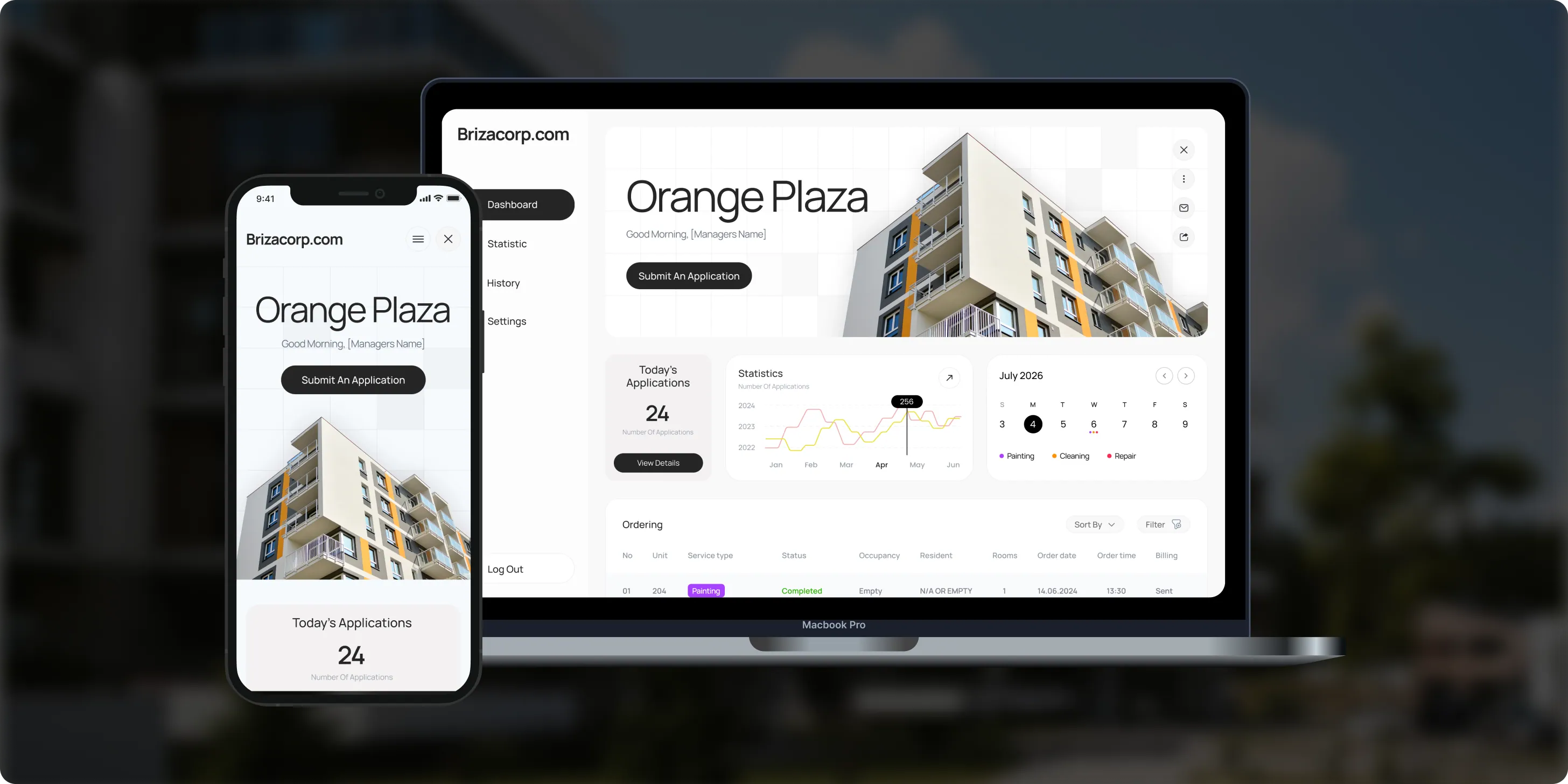
Brizacorp
Brizacorp manages residential properties and coordinates the staff who handle painting, cleaning, and repair requests. Its team tracked work across messengers, phone calls, e-mail, and paper planners, with no single place to manage requests or measure performance.- 98%Application Stability
- 95%Utilization Rate
- 30%Faster Task Completion
Risks in Vertex AI projects, and how we handle them
Each risk gets a control in code or configuration before release, not a promise in a slide.

How Google Cloud protects your data in Vertex AI
Google commitments, plus our rules
Google states it won't use your data to train or fine-tune any AI or ML models without your prior permission or instruction, and says this applies to all managed models on the platform. On our side, each request sends only the fields a task needs, keys stay in your secrets manager, and every model call is logged. For models that run fully inside your own environment, see private AI. For company-wide rules on Vertex AI and other AI tools, see AI governance and compliance. Health data has its own rules. Our guide to HIPAA-compliant AI explains what changes when Vertex AI models handle patient records.
Caching
Google's published Gemini models cache customer data by default to reduce latency, and you can turn caching off for a project.
Abuse logging
Google may log prompts to detect abuse for customers under the Google Cloud Platform Terms of Service.
Grounding with Search
Grounding with Google Search stores derived queries for up to three days, and that storage can't be turned off.
Policy and access
Agent Gateway gives one policy point for agent tool calls and authentication, and access runs through Identity and Access Management.
What Vertex AI costs to run
Pay as you go on your account
Google Cloud bills Vertex AI work pay as you go on your own account. Training and prediction are charged in 30-second increments with no minimum, and a deployed endpoint bills while it waits for requests.
We estimate usage during the fit check and set cost alerts before launch. Our build price is separate and fixed in writing before work starts.
How Google bills it
Partner models such as Claude bill as you use them, or as a fixed fee with provisioned throughput
Model training, endpoints and predictions bill by machine time, measured in node hours
New Google Cloud customers get $300 in free credit to try products and build a proof of concept, and Google doesn't charge until you activate a full paid account

How to choose a Vertex AI consulting partner
Ask any Vertex AI consulting partner these questions before you sign, and expect a written answer to each.
Questions to ask, and what a good answer includes
- Will Vertex AI fit our case at all? A fit check before development, with a plain answer when a custom setup is better.
- How will you measure accuracy? A baseline from your current process and a pass mark agreed before the build.
- Which foundation model will you use, and why? A test of two or three models on your data, with accuracy and cost per task.
- How will models be retrained and released? Pipelines with an approval step before each new version ships.
- What will it cost to run each month? An estimate of training, endpoint and model usage, billed at cost on your account.
- Where will the code and models live? In your Google Cloud project and your repository from day one.
- What paperwork comes first? An NDA and a certificate of insurance before the first call.
What is Vertex AI Agent Builder?
Vertex AI Agent Builder was Google's set of tools for building AI agents on Vertex AI. Its pages now redirect to Gemini Enterprise Agent Platform, where agents are built with the Agent Development Kit and run on Agent Runtime.
Source: Google Cloud, Gemini Enterprise Agent Platform overview, read November 2026.
Start from a template, or build in code
Teams can start from an Agent Garden template or write an agent with the Agent Development Kit. We build in code when the agent must reach your systems, follow approval rules and pass tests before release.
What a Vertex AI build costs
A fixed price per build, agreed before work starts. We never resell usage: Google Cloud bills it at cost on your own account. Linking the build to 1 or 2 more systems adds $3,000, and 3 or more add $9,000. See AI agent development cost.
AI feature or integration
One feature or system
From $4,000
AI agent, 1 or 2 connected systems
With approval steps
From $7,000
AI agent, 3 or more connected systems
Across several systems
From $13,000
Predictive analytics model
Trained on your history
From $8,000
Computer vision model
Images and defects
From $9,000
Maintenance and support
After launch
From $500 a month
Project Discovery
Credited to the build
$490
Why teams build on Vertex AI with SoftDoes
Teams build on Vertex AI with SoftDoes because every model, pipeline and line of code stays in their Google Cloud project. We have delivered 40 AI projects, from forecasting models to agents.

- 01
40 AI projects delivered
About 80% of our projects now include AI, from forecasting models to agents.
- 02
Vendor documents first
Our NDA and certificate of insurance reach your procurement team before the first call.
- 03
You own the code
Models, pipelines and code live in your Google Cloud project and your repositories.
- 04
Claude Partner Network member
Claude runs on Google Cloud as a managed API, and we build on Claude as a Claude Partner Network member.
- 05
Rated 5.0 on Clutch
5.0 from 40 client reviews. Clutch named SoftDoes a Top Artificial Intelligence Company and Top Machine Learning Company in Kansas City for 2026.
- 06
Kansas City headquarters
Headquartered in Mission, KS, in the Kansas City metro. Call 800-909-2345 to reach the team.
Vertex AI by industry
The same models and agents, built around each industry's data and rules. Each industry page covers the model and agent use cases, plus the compliance rules.
Healthcare
Intake classification, records search and prior authorization forms, with HIPAA controls.
Financial services
Risk scoring, document checks and forecasting, with an audit log for every model version.
Manufacturing
Demand forecasts, defect detection and maintenance predictions from plant data.
Logistics
Delivery forecasts, exception sorting and document checks across carrier systems.
Insurance
Claims sorting and document review, with a person approving every payout decision.
Real estate
Property data extraction, lead scoring and market summaries from your own records.


Questions about Vertex AI and Agent Builder
Fit, models, agents and cost. Can't find your answer?
What do Vertex AI development services include?
They cover the full model lifecycle on Google Cloud. We train custom models, build generative AI apps on Model Garden foundation models, and build agents. We also set up pipelines for training, evaluation and deployment, plus monitoring that catches drift. Work runs in your own Google Cloud project, and you own the code and models.
What happened to Vertex AI Agent Builder?
Google's agent docs now describe Gemini Enterprise Agent Platform, which Google calls an evolution of Vertex AI. Its agent tools include the Agent Development Kit, Agent Runtime, Agent Garden of prebuilt agents, and Memory Bank. We build agents with these tools and keep them in your project, next to your models and data.
Do you use foundation models or train custom models?
Both. Model Garden offers Google's Gemini models plus third-party and open-source models, and Claude models are available on Google Cloud as managed APIs. We use them when they fit the task. We train custom models when you need domain-specific accuracy, such as forecasting or classification on your own data.
When should we use Vertex AI instead of our own ML infrastructure?
Vertex AI fits when you want managed training, deployment and monitoring without running your own ML servers. It also suits teams whose data already sits in BigQuery and Cloud Storage. For highly specialized research workloads, a custom setup can still be the better choice, and we will say so in the fit check.
Can Vertex AI work with our existing Google Cloud setup?
Yes. Vertex AI connects natively with BigQuery, Cloud Storage and other Google Cloud services, and it can sit next to your existing data infrastructure. We build pipelines that read from your warehouse, write predictions back where your teams use them and log each model version.
How much does a Vertex AI project cost?
AI features and integrations start at $4,000, AI agents with one or two connected systems at $7,000, and predictive analytics models at $8,000. Google Cloud bills usage separately, at cost, on your own account. Maintenance starts at $500 a month. Any project can start with Project Discovery: $490, credited to the build.
Is Vertex AI discontinued?
No. Google now calls it Gemini Enterprise Agent Platform and describes it as an evolution of Vertex AI. The Vertex AI product page and docs redirect to the new name, and training, pipelines, the model registry and monitoring are still documented there. Some services were renamed, such as Agent Platform Pipelines, so check the names in your runbooks.
Can I use Vertex AI for free?
Partly. New Google Cloud customers get $300 in free credit to try products and build a proof of concept. Google doesn't charge until you activate a full paid account. After that, usage is pay as you go. Training and prediction are charged in 30-second increments, and models bill by use or provisioned throughput.
Can I build my own AI agent on Google Cloud?
Yes. Google's Agent Development Kit is a modular, model-agnostic framework for building agents in code, and Agent Garden offers prebuilt agents and templates. Agents run on Agent Runtime, with Sessions and Memory Bank for context. We build in code when an agent must reach your systems, follow approval rules and pass tests before release.
What is Gemini Enterprise Agent Platform?
It is Google's unified platform to build, deploy, govern and optimize AI agents and model-based solutions. Google describes it as an evolution of Vertex AI. It includes Model Garden with over 200 foundation models and agent tools such as the Agent Development Kit and Agent Runtime. It also keeps the machine learning tools teams used in Vertex AI. Despite the name, it is separate from the Gemini Enterprise app for staff.
Is Gemini Enterprise Agent Platform the same as Gemini Enterprise?
No. Gemini Enterprise is Google's AI app for staff, with an assistant, company search and ready-made agents. Gemini Enterprise Agent Platform is the developer platform for building your own models, apps and agents. Many companies use both. Our Gemini Enterprise implementation service covers the staff rollout.
Does Google use our data to train its models?
Google states it won't use your data to train or fine-tune any AI or ML models without your prior permission or instruction. This covers all managed models on the platform. Gemini models cache data by default to cut latency, and caching can be turned off. We also send each model only the fields a task needs.
Can we use Claude on Vertex AI?
Yes. Google offers Anthropic's Claude models on Google Cloud as fully managed, serverless APIs, billed as you use them or as a fixed fee with provisioned throughput. Usage stays on your Google Cloud bill. We compare Claude, Gemini and open models on your own test set before choosing one for each task.
How long does a Vertex AI project take?
It depends on the model, the data and your release process. We put the scope, price and schedule for the Vertex AI build in a written plan before work starts. Many teams begin with Project Discovery for $490, which is credited to the build. The plan also lists what we need from you, such as project access and sample data.
Updated · Reviewed by Orest Andrusyshyn, Founder and CEO


