Energy costs across the U.S. and Canada are rising fast, and the tools many organizations rely on to manage those costs are not keeping up. If your portfolio spans multiple buildings, complex loads, or distributed energy resources, off the shelf platforms often fall short. This guide walks through when and how to invest in custom energy management software building, from scoping and architecture to AI features and long term maintenance.Key Takeaways
- Custom energy management software monitors and optimizes energy consumption in buildings, and building energy management systems can reduce energy consumption by 10 to 25 percent when properly implemented.
- Custom EMS development makes sense when you need deep integration with building systems like BAS, BMS, SCADA, and ERP, or when you require complex demand side management and portfolio wide energy analytics.
- Expected outcomes include lower energy costs, improved energy efficiency, better use of energy data, and more reliable forecasting of energy demand.
- SoftDoes focuses on custom energy management software development for enterprises and scale ups, combining data analytics, AI and ML, IoT, and cloud engineering.
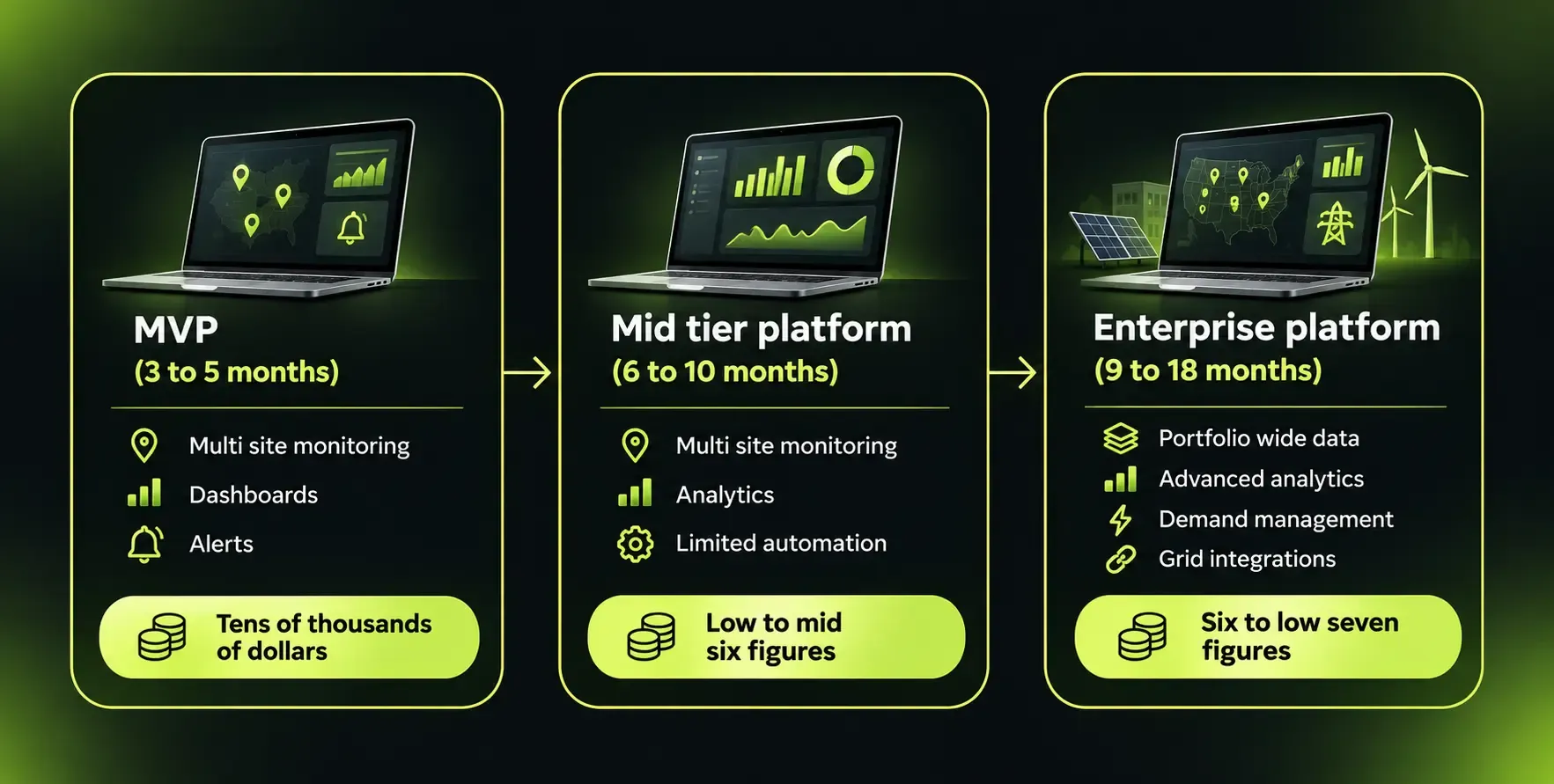
- Realistic timelines range from 3 to 5 months for an MVP to 9 to 18 months for a multi site enterprise EMS, with budgets scaling from tens of thousands to low seven figures.
Why Organizations Are Building Custom Energy Management Software Now
National average retail electricity prices in the U.S. rose nearly 29 percent in nominal terms between 2019 and 2025, with residential rates climbing around 33 percent. Storm recovery costs, grid modernization investments, and clean energy compliance are all pushing bills higher. At the same time, electrification of loads from EVs, heat pumps, and data centers is adding unpredictable demand that traditional energy management systems were never designed to handle.
These pressures hit hardest in organizations where energy spend represents 7 to 10 percent or more of operating costs. A hospital system running at 60 MW peak, a retail chain with dozens of storefronts, or a manufacturer tying energy consumption to production output all face the same problem: generic tools cannot accommodate their complexity, which is why sectors like healthcare often require custom healthcare software development aligned with strict compliance and reliability needs. HVAC systems alone account for approximately 33 percent of a building's energy consumption, and without granular visibility, that energy waste goes unnoticed.
Common pain points with off the shelf energy management tools include rigid data models, limited protocol support, weak demand response automation, and poor fit for complex connected systems. Research shows that 94 percent of small and medium commercial buildings face interoperability and vendor lock in issues with commercial platforms. Custom solutions are tailored to a building's unique infrastructure and operational workflows, and that customization provides flexibility to address specific building needs. However, custom EMS requires significant upfront investment compared to ready made solutions, and custom EMS development can take longer than implementing ready made systems. The key question is whether the savings and operational efficiency gains justify that upfront cost, and for most organizations spending six figures or more annually on energy, the answer is yes.
Core Capabilities of Custom Energy Management Software
A well built EMS platform delivers capabilities that directly reduce energy costs and improve energy performance across your energy and utilities operations. Here are the core functions to plan for:
- Real time and continuous energy monitoring. Track energy flows across HVAC, lighting, process loads, EV chargers, and energy storage systems at 1 to 15 minute intervals. A BEMS provides real-time monitoring of energy consumption, and real-time monitoring helps identify unusual energy consumption patterns before they become expensive problems. Automated alerts notify users of unusual energy consumption patterns through email, SMS, or mobile push notifications.
- Granular sub metering. Sub-metering allows monitoring energy use at each floor of a building, and granular sub metering analyzes energy consumption by specific equipment or zones. This level of detail lets facility managers and energy managers identify opportunities for cost reduction that portfolio level dashboards miss.
- Consumption analytics and visualization. Portfolio dashboards, site level drilldowns, and KPI tracking such as kWh per square foot, kWh per unit produced, and peak demand by month. These data analytics capabilities turn raw operational data into actionable insights.
- Demand side management. Automated demand response systems adjust energy usage during peak pricing hours. This includes automated load shedding, peak shaving based on tariff structures, and curtailment strategies aligned with North American utility programs.
- Forecasting and optimization. Machine learning models for hourly energy demand, solar generation predictions, and dynamic control schedules that optimize consumption across large buildings or campuses. These models can forecast demand with significantly less error than traditional statistical approaches.
- Reporting and compliance. Automated reporting helps managers evaluate energy performance and sustainability goals. This includes emissions estimates, cost breakdowns, and executive summaries for finance and operations teams. Energy management systems streamline compliance and ESG reporting requirements.
Data and Architecture: Building on a Solid Energy Data Foundation
Clean, reliable energy data is the single most important success factor in custom EMS development. Without it, dashboards mislead, forecasts fail, and optimization algorithms produce noise instead of savings.
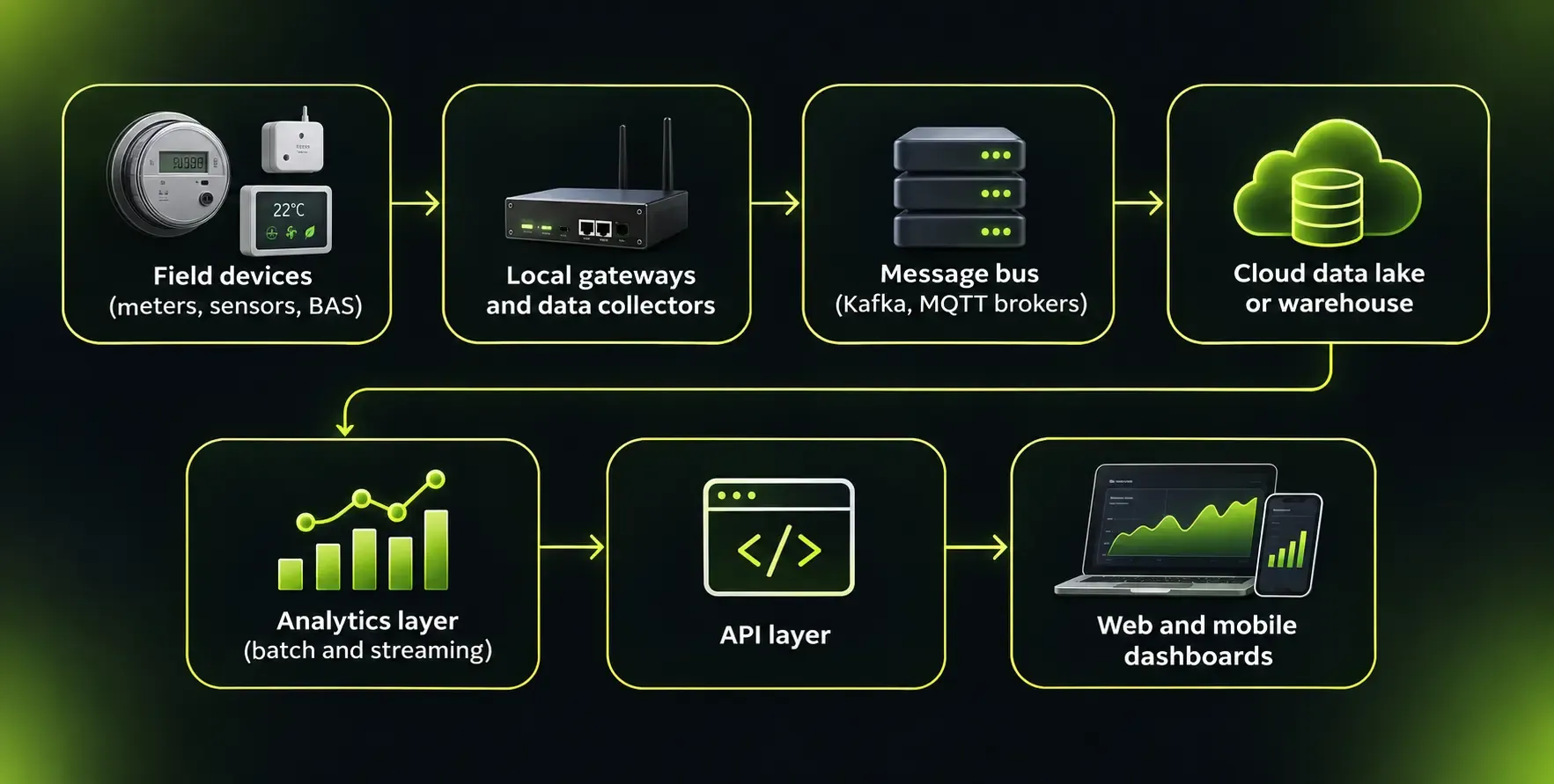
Typical data sources include utility meters, submeters, IoT sensors for temperature and occupancy, BAS and BMS systems, SCADA for industrial plants, production systems, weather feeds, and tariff data. IoT integration enables real-time data collection from smart meters, and energy management software uses IoT devices for continuous monitoring across all these sources. IoT integration allows monitoring of energy usage at granular levels that would be impossible with manual reads.
Target data resolution ranges from 1 minute to 15 minute intervals depending on the use case. Higher resolution improves anomaly detection, sharpens consumption patterns for peak demand events, and enables more accurate energy demand forecasting. Compliance with energy performance standards requires accurate data tracking at consistent intervals.
Energy management software must support standard communication protocols for integration. Common protocols include BACnet, Modbus, OPC UA, MQTT, and REST APIs. For cloud infrastructure, most teams use AWS, Azure, or GCP with event driven ingestion pipelines.
Data quality processes are non negotiable: validation rules, gap detection, duplicate filtering, and reconciliation against utility bills over full billing cycles. Without these, your data model degrades over time and analytics lose credibility.
Step by Step Process for Custom EMS Development
Custom EMS projects follow a predictable sequence. Here is a high level process guide:
- Discovery and requirement analysis. Define energy management objectives, target energy cost reductions, facilities in scope, and user roles including energy managers, facility managers, technicians, and finance teams. Custom EMS aligns with specific operational goals of energy providers and building operators.
- Metering and device inventory. Catalog every meter, sensor, and building system, noting protocol, interval, and current reliability. Many teams discover data gaps at this stage and phase in new submeters or IoT devices.
- System and data architecture design. Decide on cloud provider, data storage patterns, retention rules, and integration patterns with existing building systems. Leverage a modern data architecture approach to handle high volume energy data.
- UI and UX design. Role based dashboards, alarm views, trend charts, and mobile access for field technicians. User interfaces should be intuitive to encourage staff engagement with the system, otherwise adoption stalls. SoftDoes approaches this through dedicated user interface and experience design sprints.
- Implementation. Build back end services, data ingestion pipelines, analytics modules, and front end components in iterative sprints. Custom EMS solutions can evolve with operational growth, so plan for modularity from the start.
- Testing and commissioning. Functional tests, performance tests under high data volume, field validation at pilot sites, and user acceptance testing. Scalability is important for managing multiple buildings within a portfolio, so stress test early.
- Rollout and continuous improvement. Phased deployment by region or site type, feedback loops, and a roadmap for advanced analytics and automation features.
Key Features to Prioritize in a Custom EMS
When building custom internal tools for energy management, prioritize these feature groups:
- Monitoring and visualization. Live energy consumption dashboards, historical trend charts, customizable widgets, and multi site comparison views. A BEMS can reduce energy consumption by up to 40 percent when continuous energy monitoring drives operational changes. Real-time monitoring can reduce energy consumption by 40 percent by catching waste in near real time.
- Alerting and anomaly detection. Threshold alerts for unusual energy usage, pattern based anomaly detection using historical data, and configurable notification channels. AI enhances fault detection and diagnostics in energy systems, catching subtle shifts that human operators miss.
- Demand response and load control. Schedules, curtailment strategies, load shifting, and the ability to send control signals to HVAC, process loads, or EV chargers during peaks. Demand response programs help balance energy loads during peak times.
- Forecasting and planning. Short term demand forecasting for grid events, plus weekly and monthly outlooks for budgeting and procurement. EMS integrates with renewable energy systems for better management of solar and storage assets.
- Reporting and audit trails. Automated PDF and CSV reports, configurable reporting periods, performance indicators, and complete history of changes to control strategies.
- User and permission management. Role based access, least privilege principles, and separation between operations, analytics, and finance users. Predictive maintenance can extend equipment lifespan by detecting anomalies early, but only authorized personnel should adjust thresholds.
AI, IoT, and Data Analytics in Custom Energy Management
AI, IoT, and data analytics are what turn raw energy data into intelligence that actually changes how buildings operate. Without these layers, an EMS is just a dashboard.
IoT devices facilitate automated energy management and optimization by streaming real time data from meters, HVAC equipment, and field assets into centralized platforms. Custom EMS allows seamless integration of diverse IoT devices, whether you are connecting smart meters via MQTT or industrial IoT platforms via OPC UA.
Data analytics use cases include load profiling by building type, energy intensity benchmarking within a portfolio, identifying chronic baseload waste, and spotting system inefficiencies that drive energy wastage. These insights help facility managers reduce operational costs and predict energy usage with enough accuracy to support predictive maintenance and demand side management strategies.
AI analyzes historical data to forecast energy demand accurately, and AI driven systems enable real-time energy analytics and optimization. Neural networks can predict energy demand patterns effectively, with research showing LSTM models reducing forecasting error by 60 to 70 percent compared to baseline statistical methods. AI can reduce energy consumption by up to 40 percent when integrated with automated control systems. ML model development should come after stable data pipelines and clean historical datasets are in place, not as a first milestone.
Integrating EMS with Existing Building and Business Systems
Integration is often the hardest part of building software for energy management, and it is where many projects stall. Legacy hardware integration is critical for effective energy management system implementation, and skipping it creates blind spots in your energy landscape.
Typical systems for integration include BAS and BMS platforms, lighting controls, EV charging systems, CMMS, ERP, and utility billing software. BEMS integrates with existing building management systems for better efficiency, and energy management systems integrate real-time data from various building systems to provide a unified view.
APIs and standard protocols enable two way communication for both data collection and remote control signals. Common integration patterns include event driven alerts feeding work orders into CMMS, EMS data syncing with accounting for energy cost allocation, and occupancy data from other platforms informing HVAC schedules.
Cyber security basics are essential: network segmentation between OT and IT, secure gateways, authentication, and audit logging around control actions. EMS optimizes energy resources and improves operational efficiency, but only when the underlying integration layer is secure and reliable. SoftDoes typically designs integration early in the project rather than treating it as a later phase.
Costs, Timelines, and Scoping for Custom EMS Projects
These ranges are directional for the U.S. and Canadian market, not binding quotes:
Main cost drivers include number of sites and meters, integration complexity with existing infrastructure, data volume and resolution, regulatory and security requirements, and the need for advanced AI and ML features.
Start with a tightly scoped pilot focused on one building type or region before scaling to a full portfolio rollout. This approach validates the data model, surfaces integration challenges early, and builds internal confidence.
Governance, Security, and Long Term Maintenance
Energy management software is operationally critical and must be treated as long lived infrastructure, not a one time project.
- Governance essentials. Named product owner, clear data ownership, change management processes, and defined success metrics reviewed quarterly. A solid data strategy and governance framework prevents drift and ensures data accuracy over time.
- Security practices. Cybersecurity measures are essential for protecting energy management systems. This includes access control, encryption in transit and at rest, vulnerability scanning, and alignment with frameworks like SOC 2 for enterprises operating in regulated industries.
- Maintenance realities. Bug fixes, feature updates, cloud cost optimization, and adjustments for new building systems and tariffs over 5 to 7 years. Utility software must adapt as rate schedules, DR programs, and grid operators evolve.
- Observability. Logging, metrics, and alerting on data pipeline health to avoid silent data drift or gaps that degrade analytics quality and data quality over time.
SoftDoes typically offers ongoing support and evolution plans rather than treating EMS as a completed deliverable.
Benefits of Working with SoftDoes on Custom EMS Development
SoftDoes specializes in custom software development for enterprises and scale ups in the U.S. and Canada, with experience across finance, healthcare, education, e-commerce, and energy, and provides custom software development in Kansas City for organizations needing a local, long-term engineering partner.
- Combined capabilities. Custom EMS development, AI and ML modeling for energy demand, data engineering for high volume energy data, and cloud infrastructure design all under one roof.
- Regulated industry experience. Track record building mission critical, integration heavy systems with strong reliability, security, and compliance across sectors where uptime matters.
- Engagement approach. Discovery workshops, architecture blueprints, incremental delivery, and transparent communication on scope, risks, and costs. No surprises.
- Flexible models. Whether you need a full build, a buy and extend strategy, or help evaluating your current tools, SoftDoes can design a roadmap that fits your constraints. Contact SoftDoes to explore whether custom EMS or a hybrid approach matches your energy optimization goals and helps you work toward a sustainable future.
How to Decide: Build, Buy, or Buy and Extend for Energy Management
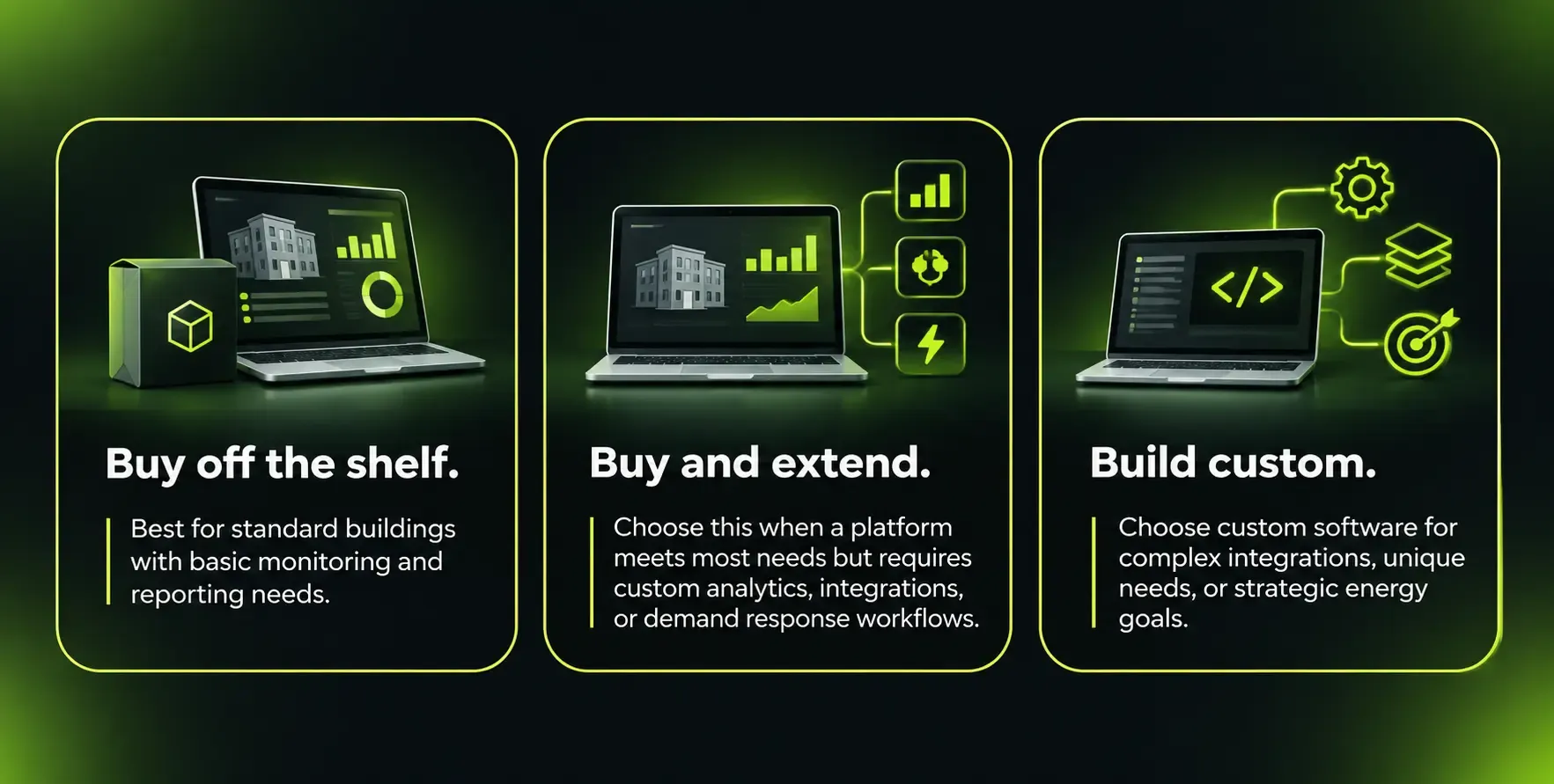
Three paths exist, and each fits a different situation:
To evaluate, assess differentiation requirements, integration complexity, data ownership needs, and 5 year total cost of ownership before choosing. Smart grids, distributed energy resources, and renewable energy assets all add complexity that tips the scale toward custom. SoftDoes can help evaluate your current tools and design a roadmap that combines existing platforms with new custom components where it makes sense, including custom software development in Texas for energy and other regulated-industry clients.









Comments (0)
No comments yet.