
U.S.-Based
Healthcare AI solutions that take the paperwork off your staff
Faxed referrals, prior authorizations and billing deadlines eat hours of staff time each week. We build AI that reads the paperwork, fills your EHR and flags what a person must check.
$7,000
HIPAA-compliant build, from
40
AI projects delivered since 2020
5.0
Clutch rating from 40 reviews
























How a faxed referral moves through the build
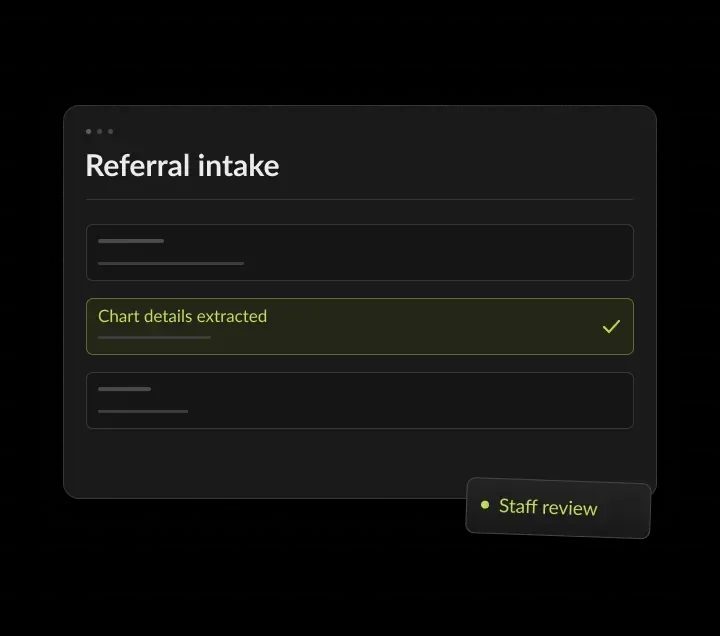
One referral fax: the AI reads and sorts it, intake staff approve and the chart updates.
A referral fax arrives
Records, orders and an insurance card land in the fax inbox.
AI reads and sorts it
It pulls out the patient, payer and order, and checks what is missing.
Intake staff approve
They confirm the patient match and fix any flagged field.
The chart updates
Documents and tasks land in the EHR, with a log of every change.
Healthcare AI development, in short
- Kansas City metro software and AI company
- Healthcare AI solutions for providers and health plans: HIPAA-compliant AI for intake, prior authorization, clinical documentation and billing that writes back to your EHR
- Healthcare builds start at $7,000, run on your own accounts, and you own all the code
- See <a href='/pricing/ai-development-cost'>AI development cost</a>

Paperwork read. Charts filled. People decide.
- 01Build priceFrom $7,000. Prior authorization platforms start at $13,000, with model usage and hosting billed at cost. AI development cost
- 02Who it's forProviders and payers: practice groups, home health teams, health plans and health tech companies with PHI in the workflow. Our HIPAA-compliant AI guide covers the rules
What is the role of AI in healthcare?
In healthcare operations, AI reads the paperwork that slows care down: referrals, authorizations, visit notes and claims. It drafts the record, flags what is missing and routes the work, while staff keep every clinical and coverage decision.
What a healthcare AI build includes
EHR connection
A connection to your EHR through FHIR, HL7 or the vendor's API, tested with synthetic patients first.
Document reading
Document reading for faxes, PDFs and scanned forms, with each field linked to its source page.
Read and write rules
Rules for what the AI may read and write, set by role and limited to the fields a task needs.
A review screen
A review screen where staff approve, fix or reject each draft before it reaches the chart.
An audit log
An audit log of every AI read, draft, approval and change, with the model version.
HIPAA-compliant hosting
HIPAA-compliant hosting in your own cloud account, under a business associate agreement.


Administrative AI, not diagnostic
The healthcare AI on this page is administrative, not diagnostic. It sits between the fax inbox, the EHR, the payer and billing, and it does the reading and re-keying staff do by hand today.
Healthcare AI development vs buying a tool
A ready-made tool gives you one feature on the vendor's platform, with your data in their system. A custom build puts AI inside your own workflow, in your cloud account, in code you own. The trade-off is a build cost up front, and in return the AI follows your rules instead of a vendor's defaults.
Types of healthcare AI solutions we build
Six healthcare builds, what each one does and where it fits. Each price is where that build starts on our price list. Model usage and hosting are billed at cost on your own accounts. Maintenance starts at $500 a month.

HIPAA-compliant chatbot
Answers patient or staff questions from your approved content. Fits when the same questions reach your front desk every day.
Document extraction
Reads referrals, forms and records, then writes checked fields to the EHR. Fits when staff retype faxes and PDFs by hand.
Workflow AI for one team
Reads, drafts and routes work across 1 or 2 systems, with approval steps. Fits when one workflow, such as intake or documentation checks, eats staff hours.
Medical or dental receptionist
Answers calls, verifies callers, books visits and writes intake to the EHR. Fits when calls go to voicemail during busy hours. See the medical or dental receptionist page.
Prior authorization platform
Checks requirements, assembles and submits requests and tracks every decision. Fits when authorizations run across several payers and specialties. See the prior authorization platform page.
AI agent across 3 or more systems
Works across the EHR, payer connections and billing in one flow. Fits when a task spans scheduling, payers and billing.
Medical AI software development, connected to your systems
We connect through FHIR where the EHR offers it, and through HL7, X12 or the vendor's own API where it doesn't.
HIPAA-compliant from the first build
Before any patient data flows
Every healthcare build runs on HIPAA-compliant infrastructure in your own cloud account. These controls are in place before any patient data flows. Our HIPAA-compliant AI guide covers the rules; see also AI governance and compliance and AI red teaming.
A BAA first
We sign a business associate agreement (BAA) before the work touches PHI.
Encryption and access
PHI is encrypted in transit and at rest, behind role-based access and multi-factor sign-in.
Minimum fields, logged
The model sees only the fields a task needs, and every read and write is logged.
A named approver
A named person approves anything that changes a chart, a claim or an authorization.
Tested before launch
We test the AI for data leaks and wrong answers before launch, and again after each change.
What your compliance team reviews before go-live
Before any patient data flows, your compliance team reviews the full data flow. That covers what the AI reads and writes, where PHI is stored and who can see each record. HIPAA compliance is built into the architecture from the start, not added after the fact. The review confirms how each control works on your own systems. Software alone does not make an organization compliant. Full compliance also depends on your policies and operating procedures, which is why the review includes your team.




AI in healthcare, workflow by workflow
Five workflows where AI takes the clerical steps and staff keep the decisions.
Referral and intake processing
AI reads faxed referrals, insurance cards and intake forms, then matches each one to the right patient. Writes to: the chart in your EHR, such as Epic or athenahealth. For example, a 14-page referral fax arrives for a new patient. The AI matches the patient, files the orders and insurance card to the chart, and flags a missing signature.
Prior authorization
AI fills authorization requests from the chart, flags missing documents and tracks every renewal date. Writes to: the payer portal or API, and back to the EHR. For example, an MRI order needs approval. The AI pulls the notes the payer asks for, fills the request and sets a reminder before the authorization expires. See prior authorization software.
Clinical notes and summaries
AI drafts visit summaries and referral letters from the record for a clinician to edit and sign. Writes to: the encounter note in the EHR. For example, after a visit, the AI drafts the referral letter from the encounter note. The clinician edits two lines and signs it in the EHR.
Billing and documentation checks
AI checks each chart for missing documentation before billing deadlines and drafts appeal letters for denials. Writes to: your billing or revenue cycle system. For example, two days before a billing deadline, the AI flags a visit with an unsigned plan of care, and the billing lead fixes it in time.
Patient calls and scheduling
A HIPAA-compliant voice agent answers calls, books visits and logs a summary of every call. Writes to: the scheduling system and the patient record. For example, a patient calls to move a follow-up. The voice agent verifies the caller, books a new time and writes a call summary to the record. See AI receptionist for medical practices.
How a healthcare AI build runs
Four steps from a mapped workflow to a live build. Patient data stays in your accounts at every step.
We walk through the workflow with your staff, map the data flow and agree the measure of success. Your team sees the plan and a fixed price before we write any code. You get a written plan and fixed price.
We build the connectors and AI steps on a branch and test them with synthetic patients in the EHR sandbox. Real records stay untouched. You get a working build and test set.
Your compliance team reviews the data flow, and we test the AI for data leaks and wrong answers. The build must pass the agreed test set. You get test results and production-ready code.
We release to one team or location first. Staff approve every AI draft while we track accuracy and time saved, then widen the release. You get a live workflow and documentation.
Healthcare builds in production
Two HIPAA-compliant healthcare builds from our case studies, and the record behind them.

- Healthcare
Prior Authorization AI
Prior Authorization AI is a healthcare automation startup building AI-powered tools to streamline prior authorization for Medicare and Medicaid medical transportation providers in New Jersey.- 16Weekly hours saved
- 63%Admin time reduced
- 43%Fewer submission errors

- Startup
- Real Estate
Our Haus AI
A finance professional turned founder built Our Haus AI, an AI-powered collaborative workspace where homeowners and contractors scope, bid, contract, and document renovation projects together. SoftDoes took her prototype and made it production-ready.- 10XMVP scope delivered
- 2+years Ongoing partnership
- 1Fully owned Platform

- Real Estate
The building buyer
The Building Buyer is a Florida-based real estate investment firm co-founded by Dylan Troiano and Charles Hanlin. They acquire single-family, multifamily, and commercial properties across South Florida and beyond, with a focus on motivated seller opportunities.- 18Weekly hours saved
- 2+Years Ongoing partnership
- 1Fully owned Platform

- Healthcare
CareInTouch
CareInTouch is a Bay Area home health agency providing skilled nursing and therapy services to patients referred from hospitals and clinics. With over 100 staff, they operate in one of the most complex and compliance-driven healthcare markets in the country.- 40% Reduction In Billing Errors
- 100+Staff Operations Managed
- 0Missed Compliance Deadlines

- Startup
Sparkle The Cleaning Service
Sparkle The Cleaning Service is a Detroit-area residential cleaning company with 10 years in business, connecting homeowners with vetted, insured independent cleaners through a subscription-based marketplace platform.- 75% Platform Transparency
- 2XPlatform Growth
- 40%Higher User Retention

- Healthcare
FMY Orthodontics
FMY Orthodontics, a multi-location practice in West Tennessee, partnered with SoftDoes to replace a spreadsheet-based financial workflow with a custom web platform. The goal was to simplify how staff present treatment financing while allowing patients and families to review and complete decisions remotely.- 60%Workflow Reduction
- 75%Remote Adoption
- 5Locations Aligned

- Real Estate
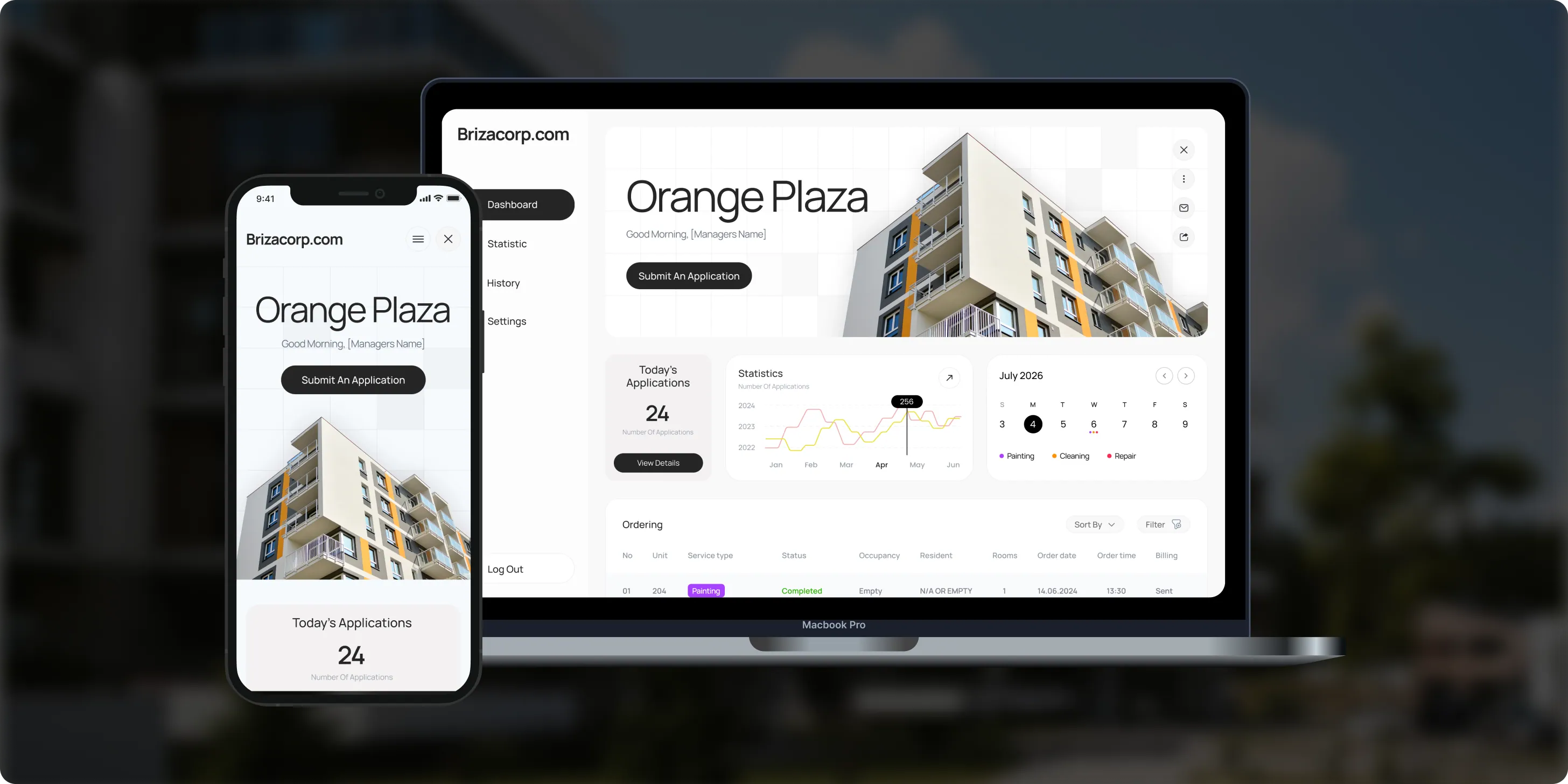
Brizacorp
Brizacorp manages residential properties and coordinates the staff who handle painting, cleaning, and repair requests. Its team tracked work across messengers, phone calls, e-mail, and paper planners, with no single place to manage requests or measure performance.- 98%Application Stability
- 95%Utilization Rate
- 30%Faster Task Completion
Risks in healthcare AI, and how we handle them
The main risks are the wrong patient, PHI exposure, wrong content, missed deadlines, model changes and low adoption. Each gets a control before go-live.

When healthcare AI pays off
Healthcare AI pays off when staff spend hours a week reading, re-keying or chasing documents in a workflow with clear rules. It pays off fastest where a missed step already costs money, such as a lapsed authorization or a late bill.
These are the signs we see most often before a provider or health plan asks for a build:
- Referrals, records and forms still arrive by fax and get typed into the EHR by hand.
- Staff phone payers and doctors' offices to collect documents for each authorization.
- Renewal and billing deadlines live in spreadsheets, and some slip through.
- Clinicians finish notes and referral letters after hours.
- The same patient details are entered in two or three systems.
When to wait
If a workflow runs only a few times a week, the build may cost more than the hours it saves. If patient data sits in systems with no interface or clean export, start with an AI readiness assessment or the AI readiness quiz before any build.
What to prepare before the first call
A step-by-step description of the workflow, as staff do it today; 20 to 50 real examples, such as referrals or authorization packets, with patient details removed for the first review; the person who approves AI output, and the person who owns compliance; the measure that matters: staff hours, days to authorization or missed deadlines; and your EHR vendor and the interfaces your contract includes.
How to choose a healthcare AI development partner
Choose a team that signs a BAA, builds in your cloud account and can show healthcare work in production. Ask these questions before you sign.
Questions to ask, and what a good answer includes
- Will you sign a BAA? Yes, before the work touches PHI.
- Where will PHI live? In your own cloud account, encrypted in transit and at rest.
- How will you connect to our EHR? FHIR where the EHR offers it, HL7 or the vendor's API where it doesn't, tested on synthetic patients first.
- Who approves what the AI writes? A named person on your staff, with every approval logged.
- Can we see healthcare work in production? Case studies of live healthcare builds, not only demos.
- Who owns the code? You do, with the repositories, documentation and deployment files.
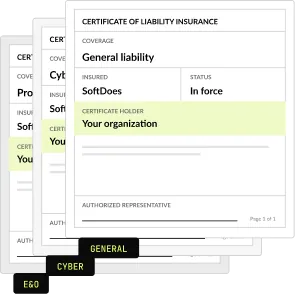
- What paperwork comes first? An NDA before the first call, and a certificate of insurance on request.
These rows cover what to ask any AI development company, plus the BAA, PHI and EHR checks that healthcare adds.
The ROI of healthcare AI solutions: a worked example
Healthcare AI pays back when the staff hours it frees cost more than the build, maintenance and model usage. The example below uses assumed numbers for referral intake, so swap in your own. Example math with assumed numbers, not a client result. At these numbers, the build pays back in about two months, before model usage. Model usage is billed at cost on your account, and it depends on page counts and model choice. Enter your intake team's hours and loaded cost in the AI ROI calculator, and your monthly referral count in the LLM cost calculator. Our guide on how to measure AI ROI explains the baseline to set before launch. After release we track hours saved and error rates on the live workflow, so you see the real saving next to this estimate.
Questions about healthcare AI solutions
Tools, cost, HIPAA and staff. Can't find your answer?
What is the best AI tool for healthcare?
It depends on the workflow. Ready-made tools work for one narrow job, such as dictation. A custom build fits when data has to move between the EHR, payers and billing, or when your rules are unusual. We usually start with the workflow that costs the most staff hours, build it on HIPAA-compliant infrastructure, and connect it to the systems you already run.
Is there a medical AI like ChatGPT?
General chat tools such as ChatGPT and Claude can explain medical topics. On their own, they do not read your EHR or follow your PHI rules. Healthcare teams get more from a model wired into one workflow, with access limits, an audit log and a person who approves each change. Our HIPAA-compliant AI guide covers how to choose one.
What are the top AI applications in healthcare?
The most common applications handle paperwork: referral and intake processing, prior authorization, clinical note drafts, billing documentation checks and patient calls. Imaging and diagnostic AI are larger fields, usually bought from device and imaging vendors. Most providers start with one administrative workflow, prove the hours saved, then add the next workflow on the same data and controls.
How much do healthcare AI solutions cost?
Industry AI builds start at $7,000, and prior authorization platforms start at $13,000. A HIPAA-compliant chatbot starts at $5,000. Maintenance starts at $500 a month. Model usage and hosting are billed at cost on your own accounts. Any project can start with Project Discovery: $490, credited to the build.
Is your healthcare AI HIPAA-compliant?
Yes. Every healthcare build runs on HIPAA-compliant infrastructure in your own cloud account, and we sign a business associate agreement before the work touches PHI. PHI is encrypted in transit and at rest, access follows roles, and every AI read and write is logged. A named person approves any change to a chart, claim or authorization.
Will AI replace healthcare staff?
No. In the builds we ship, AI takes the clerical steps and staff keep the judgment. In our prior authorization build, a founder who spent 16 hours a week on the phone collecting documents now reviews AI-filled forms instead. Clinicians and intake teams approve every change, so the AI moves their time toward patients and away from paperwork.
Can the AI connect to our EHR?
Yes. Where the EHR offers FHIR and SMART on FHIR APIs, we connect through them. Otherwise we use HL7 feeds, the vendor's own API or a secure file exchange. Payer traffic runs through X12 transactions, clearinghouses or payer APIs. Each connection is tested in a sandbox with synthetic patients before it touches live records.
Will AI replace doctors?
No. The AI we build does not diagnose or treat. It drafts notes, letters and forms from the record, and a clinician edits and signs each one. Doctors keep every clinical decision. The aim is to give clinicians back the time they spend on documentation and phone calls, so more of their day goes to patients.
How long does a healthcare AI project take?
It depends on the workflow, the interfaces your EHR offers and your compliance review. The scope, price and schedule for your workflow go into a written plan before the build starts. Any project can begin with Project Discovery for $490, credited to the build. The plan also lists what we need from you, such as sandbox access and sample documents.
Can the AI read faxed referrals and records?
Yes. The AI reads faxed and scanned pages, pulls out the patient, payer, orders and notes, and flags anything missing for staff to resolve. In our prior authorization build, faxed records flow straight into the platform, replacing 16+ hours a week of phone calls to collect documents.
Do you build for health plans as well as providers?
Yes. For health plans we build payer-side intake and utilization review with decision timers, and claims intake that writes to your core systems. Provider builds cover intake, authorizations, documentation and billing. See prior authorization software and AI claims processing for the payer side.
Who owns the code and the data?
You do. The code, prompts, tests and documentation live in your repository, and the data stays in your own cloud and vendor accounts. Nothing depends on a SoftDoes account. If you want us to keep running and improving the build, maintenance and support start at $500 a month.
Can a healthcare chatbot answer patients safely?
Yes, within limits you set. A HIPAA-compliant chatbot answers from content your team approves, such as hours, directions, forms and visit preparation. It never gives medical advice, and it hands clinical or urgent questions to staff. HIPAA-compliant chatbots start at $5,000, and every conversation is logged for review.
Updated · Reviewed by Orest Andrusyshyn, Founder and CEO